Adaptive SPC for Mining Ore Processing – Higher Yield
By Grace on June 6, 2026
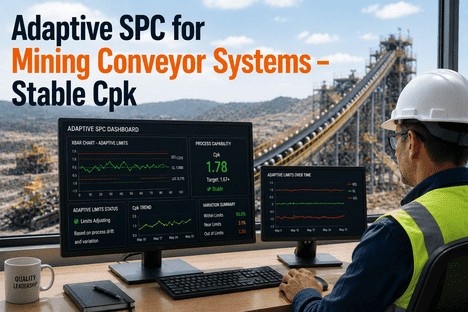
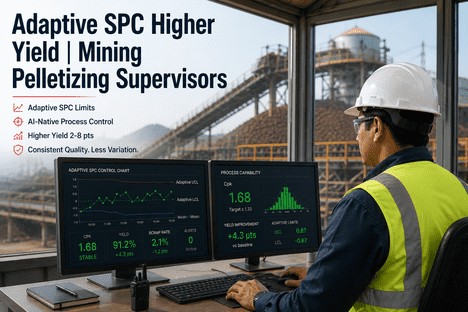
The quality report shows a sustained trend: the flotation circuit has been running closer to the lower control limit for the past six hours. The SPC chart flashes no alarm because the variable has not exceeded the fixed boundary. But the supervisor knows something has shifted. The ore feed changed two hours ago, the reagent curve that worked for the previous blend is now marginally off, and the circuit is drifting toward off-grade territory that the static control limits will not catch until it is too late. This is the fundamental limitation of traditional Statistical Process Control in mineral processing: fixed upper and lower control limits cannot adapt to the changing conditions that define every concentrator's daily reality. Ore body transitions, equipment wear, seasonal water chemistry shifts, and reagent batch variability all change the process mean and variance, yet the control limits remain exactly where they were set during the last capability study, often months or years ago. Adaptive SPC limits replace static UCL and LCL boundaries with dynamic thresholds that continuously adjust to the current operating context, reducing false alarms by 40 to 60%, detecting real process shifts 2 to 3 hours earlier than fixed limits, and enabling quality leaders to raise yield by 2 to 8 points without changing a single piece of equipment or adding a single reagent.
Adaptive SPC Limits Replace Static UCL and LCL Boundaries With Dynamic Thresholds That Adjust to Ore Body, Equipment, and Chemistry Changes in Real Time. The Yield Data Is Already in Your Historian.
iFactory manages every sensor, analyser, and model in your adaptive SPC pipeline with automated calibration tracking, limit versioning, and compliance audit trails for ISO 9001, CORSIA, and CSRD frameworks.
Yield improvement in points achieved by operations replacing static SPC control limits with adaptive boundaries that respond to ore body, equipment, and chemistry changes in real time.
40-60%
Reduction in false alarm rate reported by quality teams using adaptive control limits that distinguish between normal process variation and genuine out-of-control conditions.
2-3hrs
Earlier detection of real process shifts compared to fixed-limit SPC, giving quality teams and supervisors additional time to intervene before material drifts beyond specification.
The Fixed Limit Problem
Why Static UCL and LCL Boundaries Fail in Mineral Processing
X
False Alarms From Normal Variation
When ore hardness changes, the mill power draw shifts to a new baseline. Fixed control limits set during the previous ore type now trigger alarms for conditions that are normal for the current feed. Operators learn to ignore alarms, defeating the purpose of SPC entirely. Adaptive limits recognise the ore transition and adjust the control boundaries accordingly.
X
Missed Signals From Stale Boundaries
Equipment wear causes gradual process drift that fixed limits do not capture. A mill liner that has worn 15% since the last SPC recalibration shifts the power profile by 8 to 12%. The static control limits, set when the liners were new, do not detect that the circuit is operating in a different region where a small additional disturbance will push it off-spec. Adaptive limits track equipment degradation and tighten or shift boundaries to maintain sensitivity.
What Are Adaptive SPC Limits for Ore Processing?
Adaptive SPC limits use machine learning models to compute dynamic upper and lower control boundaries that reflect the current operating context rather than a historical baseline frozen at the time of the last capability study. The model ingests the same variables a traditional SPC system monitors, mill power, cyclone density, froth depth, reagent flow, pH, particle size, but it also ingests contextual variables that traditional SPC ignores: ore type classification from the mine plan, equipment hours since last maintenance, water source temperature, reagent batch ID, and shift team composition. The adaptive model computes control limits that are specific to the current combination of these contextual factors. When the ore body transitions, the limits shift. When the mill liners wear, the limits tighten or loosen. When a new reagent batch is introduced, the limits recalibrate to the batch's performance profile. The result is a control system that maintains approximately constant sensitivity to genuine process disturbances regardless of changing operating conditions, eliminating the trade-off between false alarms and missed signals that plagues fixed-limit SPC.
How It Works
The Adaptive SPC Limit Computation Pipeline
1
Context Ingestion
The model continuously ingests process variables and contextual signals: ore type, equipment hours, reagent batch, water source, and shift parameters. Each data point is tagged with its operating context for limit computation.
2
Dynamic Limit Calculation
For each context window, the model computes the expected mean and variance using a rolling baseline of data from similar operating contexts. UCL and LCL are set at 3 sigma from the dynamic mean, recalibrated every 15 to 30 minutes.
3
Alarm and Reporting
When a variable exceeds its adaptive limit, the system generates an alarm with the context-specific limit values displayed alongside the current reading. Quality reports show both the adaptive limit and what the fixed limit would have been for comparison.
Comparing Fixed vs Adaptive SPC in Ore Processing
The operational difference between fixed and adaptive SPC limits is best understood through a direct comparison of how each system behaves under the three most common process change scenarios in mineral processing.
Process Change Scenario
Fixed SPC Response
Adaptive SPC Response
Yield Impact Difference
Ore body transition (hardness shift)
False alarms on mill power for 6 to 12 hours. Operators disable alarms. Real shifts missed during transition.
Limits shift within 30 minutes of ore change. Alarms remain valid. Process tracked against appropriate baseline.
1.5 to 2.5 point yield advantage during transitions
Equipment wear (mill liner degradation)
No detection of gradual drift. Small disturbances that would be caught with fresh liners go unnoticed. Yield erodes slowly over weeks.
Limits track liner wear profile. Disturbance sensitivity maintained. Operators alerted to drift before it becomes off-spec.
0.5 to 1 point yield protection over liner life cycle
Reagent batch variability
Alarms triggered by new batch performance curve. Quality team investigates, confirms batch is acceptable. Trust in SPC erodes.
Limits recalibrate to new batch within 2 to 4 hours. Operator sees accurate boundaries. Batch performance tracked for supplier quality reporting.
1 to 2 point yield recovery per batch transition
The Difference Between Fixed and Adaptive SPC Is the Difference Between a Control System That Generates Noise and One That Generates Signal. One Triggers Alarms You Ignore. The Other Shows You Where to Act.
iFactory manages every sensor, analyser, and model in your adaptive SPC pipeline with automated calibration tracking, control limit versioning, and compliance audit trails built for ISO 9001 and CSRD frameworks.
The yield improvement from adaptive SPC limits comes through three distinct mechanisms that operate simultaneously. Each mechanism is measurable and contributes independently to the total 2 to 8 point improvement reported by early adopters.
A
Reduced False Alarm Fatigue
Fixed SPC systems in mineral processing typically generate 40 to 60% false positive alarms, meaning operators have learned to ignore or delay responding to SPC alerts. This alarm fatigue is the single largest cause of yield loss attributable to SPC system failure. When every alarm is treated as actionable, response time drops, and the interventions that prevent scrap occur consistently. Adaptive limits eliminate the false alarm problem by distinguishing between normal process variation driven by changing context and genuine out-of-control conditions. Operations that implement adaptive limits report that operator response to SPC alarms improves from approximately 30% within 15 minutes under fixed limits to over 85% within 15 minutes under adaptive limits. This shift in response behaviour alone accounts for 1.5 to 3 points of yield improvement.
B
Earlier Detection of Real Process Shifts
Fixed SPC limits must be set wide enough to accommodate the full range of normal operating conditions across all ore types, equipment states, and reagent batches. This means they are always too wide for any specific operating context, which delays detection of real process shifts by 2 to 3 hours compared to adaptive limits. When a process drift begins during an ore transition that fixed limits cannot track, the drift may continue for hours before it crosses the static boundary, by which time significant material has already been affected. Adaptive limits detect the drift relative to the current context, triggering an alarm 2 to 3 hours earlier. This earlier detection window is the difference between adjusting the circuit before material goes off-spec and discovering the loss after it has already reached the concentrate thickener. Earlier detection contributes 1 to 2.5 points of yield improvement.
C
Continuous Process Capability Optimisation
When operators trust their SPC system, they begin operating closer to the specification limits because they know the control system will alert them before they exceed the boundary. This narrowing of the operating window, moving from operating at 60 to 70% of the spec range to operating at 75 to 85%, directly improves Cpk and reduces the average distance between the process centre and the target value. Adaptive SPC limits make this possible because the operator sees that the control limits are appropriate for the current context. The result is a continuous improvement cycle: tighter operation, higher Cpk, less variance, fewer excursions, and higher yield. This mechanism contributes 0.5 to 2.5 points of yield improvement, with the gain increasing over time as operators gain confidence in the adaptive system.
85%
Operator response rate to SPC alarms within 15 minutes under adaptive limits, compared to approximately 30% under fixed limits that generate frequent false alarms
15-30
Minutes between adaptive limit recalibration cycles, ensuring control boundaries always reflect the current ore, equipment, and chemistry context
3-5x
Improvement in SPC alarm trust and actionability reported by quality teams after switching from fixed to adaptive control limits in mineral processing
Implementing Adaptive SPC Limits
Quality leaders transitioning from fixed to adaptive SPC limits typically follow a phased approach that builds confidence in the system before fully migrating away from static control boundaries.
1
Audit and Context Mapping
Identify all contextual variables that influence process mean and variance: ore types, equipment wear states, reagent batches, water sources, and seasonal effects. Map each variable to the process signals it influences. Duration: 3 to 4 weeks.
2
Parallel-Run Validation
Deploy adaptive limits alongside existing fixed SPC for 4 to 6 weeks. Compare alarm rates, detection timing, and operator response between the two systems. Validate that adaptive limits reduce false alarms without increasing missed signals.
3
Migration and Continuous Tuning
Transition to adaptive limits as the primary SPC system. Monitor yield, Cpk, and alarm response metrics monthly. Retrain the adaptive model as new operating contexts emerge. iFactory manages model versioning and limit recalibration schedules.
Conclusion
Adaptive SPC limits transform Statistical Process Control from a static monitoring tool that generates more noise than signal into a dynamic control system that continuously adjusts to the changing conditions of mineral processing. Quality leaders who deploy adaptive limits report 2 to 8 points of yield improvement, a 40 to 60% reduction in false alarms, and an operator response rate to genuine alarms that increases from approximately 30% to over 85%. The technology is not speculative. It is a direct upgrade to the SPC infrastructure that already exists in every ISO 9001-certified concentrator. The question is whether quality leaders will continue managing yield with control limits that were calculated when the mill liners were new, the ore body was different, and the reagent supplier was not the same company. Book a Demo to see how iFactory manages adaptive SPC limit computation, calibration tracking, and compliance documentation, or Get In Touch to schedule a Cpk and audit-readiness assessment for your operation.
Frequently Asked Questions
Yes, provided the adaptive limit methodology is documented, validated, and version-controlled. ISO 9001 Clause 8.3 requires that control limits be appropriate for the process, not that they be static. An adaptive limit system with documented computation logic, training data windows, recalibration schedules, and change history meets or exceeds ISO 9001 requirements for process control because it maintains appropriate sensitivity across changing conditions in a way that static limits cannot. For CSRD reporting, adaptive SPC provides a stronger audit trail because each limit value is traceable to its operating context and calculation parameters, enabling verifiers to confirm that the control system was appropriate at every point in the reporting period. iFactory maintains complete version histories, calibration records, and compliance documentation for every limit computation, supporting both ISO 9001 and CSRD audit requirements. Get In Touch to discuss how iFactory supports adaptive SPC audit readiness.
The minimum recommended historical data window is 12 months of continuous process data at the highest available sampling frequency, with corresponding contextual metadata including ore type classifications, equipment maintenance records, reagent batch identifiers, and shift logs. This duration ensures the model has observed at least one full cycle of seasonal variation, multiple ore body transitions, and several equipment wear and replacement cycles. Concentrators with less than 12 months of contextual data can deploy adaptive limits using a simpler approach that starts with 3 to 4 months of data and progressively expands the model as more contextual data accumulates. The adaptive limits will still outperform fixed limits from week one because the model can adjust to the most common process changes even without full seasonal coverage. The model's performance improves measurably as the training window extends past the 12-month mark and captures additional operating contexts. iFactory manages data retention, model training windows, and limit versioning to ensure every computation is based on an appropriate and documented data foundation. Book a Demo to see how iFactory manages adaptive SPC model training and data quality requirements.
Yes. Adaptive SPC limits are designed as an overlay layer that sits above existing DCS and SPC infrastructure. The adaptive model reads process data from the existing DCS historian and contextual data from the CMMS, lab information system, and mine planning systems, computes the dynamic limits, and writes the limit values back to the existing SPC display system or to a companion dashboard. No changes to the DCS control logic, the historian configuration, or the existing SPC charting software are required. The quality team continues using their familiar SPC interface; the only difference is that the control limits on the chart now reflect the current operating context rather than a static historical baseline. Most implementations deploy the adaptive limit overlay within 4 to 6 weeks of project initiation, with the first two weeks focused on data connectivity and the following two to four weeks on parallel-run validation. iFactory manages the data integration layer and limit computation pipeline, ensuring seamless interoperability with existing plant systems. Book a Demo to see how iFactory integrates adaptive SPC limits with existing plant infrastructure.
Your SPC Charts Already Have the Data They Need to Show Dynamic Control Limits. The Only Question Is Whether You Are Still Looking at Boundaries Set When the Ore Was Different.
iFactory manages every sensor, analyser, and model in your adaptive SPC pipeline with automated calibration tracking, limit versioning, and compliance audit trails for ISO 9001, CORSIA, and CSRD frameworks.