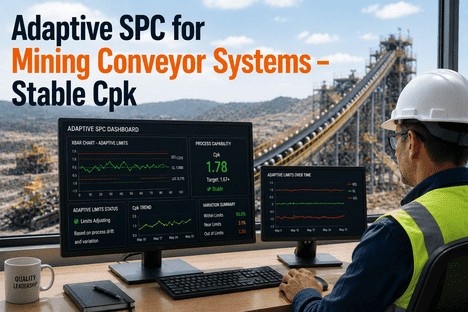
Every flotation circuit runs on control charts. But most of those control charts were set up during commissioning, calibrated against a snapshot of process conditions that no longer exist. The ore has changed. The reagent supplier changed. The water quality shifted with the season. And the UCL and LCL lines on your SPC charts stayed exactly where they were the day a process engineer drew them three years ago. This is not a monitoring problem — it is a control limit problem. And it is the reason quality leaders in mining flotation find themselves investigating grade failures that every single process variable technically "passed."
Adaptive SPC · Dynamic UCL/LCL · AI Root Cause · Audit-Ready Records
Static SPC Limits Are Failing Your Flotation Circuit. Here Is What Adaptive Limits Actually Fix.
iFactory's adaptive SPC engine continuously recalculates UCL and LCL boundaries in response to ore zone transitions, reagent variation, and feed grade shifts — keeping your control limits calibrated to what the process actually is, not what it was when the chart was built.
67%
of flotation SPC alarms are false positives from static limits miscalibrated to current ore conditions
1.67+
Cpk consistently achieved when adaptive limits replace static SPC through ore zone transitions
2–4 hrs
Early warning lead time that adaptive SPC delivers before a grade failure or audit-notable event
100%
Automatic audit trail — every limit change, every alert, every intervention logged with timestamp and root cause
Why Static SPC Limits Fail in Flotation — and Why Nobody Talks About It
Statistical process control was designed for manufacturing environments where the raw material is consistent, the process parameters are stable, and the same recipe runs shift after shift for months. Mining flotation is the opposite of that. The ore body changes as the mine face advances. Hardness, mineralogy, sulphide content, and particle size distribution all vary — sometimes within a single shift. Water quality fluctuates with season and tailings recycle rate. Reagent suppliers change and batches vary. Any one of these shifts invalidates the SPC limits that were built around a different set of conditions.
The consequence is predictable and well-documented in operations across every mining jurisdiction: alarm fatigue. When static limits trigger 30 false-positive alerts per shift because the ore zone changed overnight, operators stop trusting the alarms. And when they stop trusting the alarms, the one genuine assignable-cause event that requires action gets missed. The grade failure that follows is attributed to operator error. The corrective action rewrites a procedure. The static limits stay exactly where they were. The cycle repeats.
Static SPC vs. Adaptive SPC: What Changes at Each Stage of Your Flotation Circuit
| Circuit Stage |
Static SPC Failure Mode |
Adaptive SPC Response |
Audit Benefit |
| Rougher bank |
Air flow and froth depth limits calibrated on soft sulphide ore fire continuously during transitional ore — operators silence alerts |
UCL/LCL recalculate to the ore fingerprint of the current zone; only genuine assignable-cause deviations trigger alerts |
Each limit recalculation is timestamped and documented — fully traceable for ISO 9001 corrective action records |
| Scavenger bank |
Collector dosage limits fixed to average head grade — overdoses during low-grade ore, misses recovery risk during high-grade |
Dosage control limits shift with real-time head grade from the online analyser; alert fires only when the deviation is genuine |
Reagent decisions are tied to documented process state — not to a schedule that cannot be defended at audit |
| Cleaner circuit |
pH limits set to annual average; seasonal water quality shifts produce 15–20 daily false alarms that mask real pH excursions |
Control limits adapt to seasonal water chemistry baseline; signal-to-noise ratio improves, real pH events detected immediately |
Water quality adjustments documented as common-cause; real pH events documented as assignable-cause with root cause attached |
| Concentrate thickener |
Density and recovery targets static regardless of feed variability; off-spec events detected only at final assay |
Recovery forecast integrated with density monitoring; adaptive limits flag developing off-spec conditions 2–4 hours ahead |
Off-spec prevention events logged alongside corrective actions — demonstrates proactive quality control to any assessor |
What Adaptive SPC Limits Actually Are — and How They Work in a Live Circuit
Adaptive SPC limits are not a relaxed version of static SPC. They do not widen the control bands to reduce alarm frequency — that is a common and costly misconception that produces compliant-looking charts with no actual process control. Adaptive limits are dynamically recalculated UCL and LCL boundaries that reflect the actual statistical process distribution under current operating conditions, updated continuously as those conditions change. The standard deviation the limits are built on is real — it just belongs to today's process state, not last year's average.
Layer 1: Ore Zone Recognition
The foundation of adaptive limit accuracy
iFactory's ML engine continuously analyses the multivariate fingerprint of the incoming feed — head grade from the online analyser, particle size from the cyclone, pulp density, and hardness proxies from grinding power draw. When this fingerprint shifts beyond a statistically defined ore zone boundary, the system classifies the transition and loads the control limit baseline that was built from historical data for that ore zone. The shift in UCL and LCL is automatic, documented, and timestamped. Your SPC charts do not widen — they recalibrate to truth.
Supports multi-regime circuits with up to 12 distinct ore zone classifications per mine plan
Layer 2: Western Electric Rule Engine
Pattern detection beyond the limit breach
A process can trend toward a quality failure for hours without a single data point breaching UCL or LCL. Western Electric rules detect these patterns: eight consecutive points on one side of the centreline, six points in a row trending upward, two of three points in the outer third of the control band. iFactory applies all four Western Electric rules simultaneously across every monitored variable — and applies them against the adaptive baseline, not the static one. The result is a root cause alert that fires on a 1-sigma trend in the right direction, not a 3-sigma breach after the damage is done.
All four Western Electric rules applied simultaneously; each pattern detection event documented for audit
Layer 3: Assignable Cause vs. Common Cause Separation
The distinction that makes audit records defensible
ISO 9001 and its derivatives require quality leaders to distinguish between common-cause variation — inherent to the process — and assignable-cause events that require corrective action. Static SPC conflates the two whenever the ore zone changes. Adaptive SPC separates them at the algorithmic level: ore zone transitions are classified and documented as common-cause process shifts that update the baseline; genuine assignable-cause events — collector spikes, air flow failures, reagent supply interruptions — fire the alert and create the corrective action record. Your audit documentation reflects the process, not the noise.
Every common-cause and assignable-cause classification is logged with justification — ready for assessor review
Layer 4: Automated Quality Record Generation
The audit trail that builds itself
Every alert, every limit recalculation, every root cause finding, every quality leader intervention, and every process variable state at the time of detection is logged automatically with a timestamp and a classification. Shift quality summaries, Cpk trend reports, corrective action event logs, and SPC limit change records are generated without any manual input from the quality team. When the ISO 9001 assessor arrives, the documentation that demonstrates continuous monitoring, appropriate corrective action, and calibrated control limits is already assembled, consistent, and searchable — not reconstructed the week before the audit.
ISO 9001 clause 8.5, 8.7, and 10.2 documentation generated automatically as standard operating output
Dynamic UCL/LCL · Western Electric Rules · Self-Documenting Audit Trail
Your SPC Charts Should Reflect the Process as It Is Today — Not as It Was When the Chart Was Built.
iFactory recalculates your flotation circuit's control limits in real time, applies all four Western Electric rules against an adaptive baseline, and generates the audit-ready documentation your ISO 9001 assessor requires — without adding to your team's reporting workload.
The Audit Readiness Gap: What ISO 9001 Assessors Actually Look For in Flotation Operations
ISO 9001:2015 and its 2025 revision do not specify what your SPC control limits must be. They require that you demonstrate your process is under statistical control, that deviations trigger documented corrective action, and that your control methods are appropriate for the process variability you actually face. This is where static SPC creates a compliance risk that most quality leaders in flotation have not fully mapped. When an assessor reviews your quality records and finds that UCL and LCL lines were set three years ago and have not been reviewed since, despite documented ore zone transitions, reagent supplier changes, and seasonal water quality shifts, the finding is not about the limits themselves — it is about the adequacy of your process monitoring method.
8.5
ISO 9001 Clause 8.5 — Production and Service Provision
Clause 8.5 requires that controlled conditions include monitoring and measurement activities at appropriate stages to verify that process and output criteria are met. For flotation, this means your control limits must be calibrated to current process conditions — not to historical averages. Adaptive SPC satisfies this requirement structurally: the limits are always calibrated to the current ore zone, and the calibration itself is documented. Static SPC satisfies it only if conditions have not changed since the limits were set — which in a live flotation circuit is rarely true for more than a few shifts.
iFactory generates the documented evidence of appropriate monitoring at each ore zone transition automatically
8.7
ISO 9001 Clause 8.7 — Control of Nonconforming Outputs
Clause 8.7 requires documented information describing the nonconformity, the actions taken, the concessions obtained, and the identification of the authority deciding the action. When a concentrate grade fails, the quality record must show not just what happened but what the process state was when it happened, what monitoring was in place, and what action was taken. Adaptive SPC creates this record automatically at the moment of alert — the process variable state, the Western Electric rule that fired, the root cause classification, and the quality leader response are all logged in a single event record that satisfies clause 8.7 documentation requirements without manual incident reporting.
Nonconformity records generated at alert time, not reconstructed after the assay confirms the failure
10.2
ISO 9001 Clause 10.2 — Nonconformity and Corrective Action
Clause 10.2 requires evidence that corrective actions were reviewed for effectiveness and that process changes were made to prevent recurrence. For flotation quality leaders, this is the clause most commonly underserved — corrective action records exist, but they cannot demonstrate that the action was appropriate because the root cause is documented as "operator error" rather than the actual process variable excursion that drove it. Adaptive SPC supplies the root cause at alert time, ranked by causal weight, with the process variable states and Western Electric rule classifications attached. Corrective action records built on this foundation demonstrate exactly the evidence chain Clause 10.2 requires: what happened, why it happened, what was done, and whether it worked.
Root-cause-linked corrective actions replace "operator error" findings — demonstrating the systematic quality control assessors want to see
"
Before we deployed adaptive SPC, our ISO 9001 pre-audit would take the quality team three weeks to prepare. We were manually reconstructing corrective action records from DCS logs and shift notes, then trying to explain why the SPC limits in the cleaner circuit hadn't been reviewed since 2021 despite two ore zone transitions and a reagent supplier change. The assessor's findings were always the same: the root cause documentation was insufficient. Now, every event produces its own documented record at the moment it fires. Our last pre-audit preparation took four days. Our Cpk for the quarter was 1.83 and the assessor had no findings on our quality records for the first time in six years.
— QA Manager, Copper-Molybdenum Concentrator — Rougher-Scavenger-Cleaner Circuit, 18,500 tpd
The Cpk Picture: What Adaptive SPC Does to Grade Consistency Across a Full Quarter
Cpk is the number that concentrates customer attention and defines the quality leader's performance record. In a flotation operation, Cpk is also the number that exposes whether the quality management system is genuinely in control or merely producing a retrospective account of what happened. Static SPC produces a Cpk that fluctuates sharply at ore zone transitions and recovers slowly across the following shifts as operators manually readjust to the new conditions. Adaptive SPC keeps Cpk stable through those transitions because the control limits, the alert thresholds, and the intervention recommendations all update when the ore changes — not two shifts after the damage has been done.
Quality Metric
Static SPC
Adaptive SPC with AI Root Cause
Cpk at ore zone transitions
Drops 0.3–0.5 points; 1–2 shifts to recover as operators manually readjust to new conditions
Maintained above 1.67 — limits and recommendations update with the ore transition, not after it
False-positive alarm rate
25–40 false alarms per shift during ore transitions; operators develop alarm fatigue, real events missed
2–4 actionable alerts per shift — all against adaptive baseline; signal-to-noise ratio 8–10x higher
Off-spec concentrate events per quarter
6–12 — detected at assay, after concentrate has entered the stockpile
0–2 — prevented by 2–4 hour advance alert; corrective action taken before grade failure materialises
ISO 9001 audit preparation time
2–4 weeks manually assembling corrective action evidence from DCS logs and shift notes
3–5 days — all records auto-generated at alert time; searchable, consistent, and assessor-ready
Root cause documentation quality
"Operator error" or "feed variability" — non-specific findings that cannot demonstrate systematic corrective action
Ranked root cause with causal weight, variable states, Western Electric rule triggered, and recommended intervention
How Quality Leaders Use Adaptive SPC Differently — Three Shifts That Change the Outcome
Adaptive SPC does not replace the quality leader's judgment — it removes the noise that makes good judgment impossible. When the alarm count drops from 30 false positives per shift to 3 genuine alerts, and each alert arrives with a ranked root cause and a recommended intervention, the quality leader's job changes from filtering noise to making decisions. These three operational shifts are where the Cpk and audit readiness gains actually come from.
1
Shift Handover Becomes a Forward Briefing, Not a Post-Mortem
The incoming quality leader reviews the adaptive SPC forecast for the next 4 hours — which variables are trending toward their UCL, which ore zone transition is indicated by the feed fingerprint, and which corrective action from the previous shift is showing effectiveness. The conversation changes from "we had 14 alarms last shift, most of them false" to "bank 3 froth stability is trending on a Western Electric rule 2 pattern — the ore transition started at 04:30 and the frother needs adjusting before the 06:00 assay." Decisions are made before the grade is at risk, not after it has failed.
Every handover conversation is supported by a documented process state that becomes part of the shift quality record.
2
Corrective Actions Are Filed at the Moment of Intervention, Not Assembled Weeks Later
When the quality leader responds to an adaptive SPC alert — authorising a collector dosage reduction, adjusting air flow to bank 4, or initiating a frother top-up — that action is logged automatically against the alert record, the root cause classification, and the process variable states at the time. The corrective action is created in the moment the intervention is taken. Four weeks later, when the ISO 9001 assessor asks for corrective action evidence from that shift, the record is already complete — the root cause, the action, the outcome, and the effectiveness evidence from the Cpk data that followed. There is nothing to reconstruct and nothing that can be challenged for completeness.
ISO 9001 clause 10.2 evidence is built during normal operations, not during audit preparation.
3
The Monthly Quality Review Uses Cpk Trend Data, Not Incident Narratives
Monthly quality reviews built on static SPC typically present a list of incidents — what went wrong, why it went wrong according to the operator notes, and what was done about it. Reviews built on adaptive SPC present Cpk trend data across ore zones, Western Electric rule event frequency, alert-to-intervention response times, and corrective action effectiveness rates. The review shows whether the quality management system is improving, which ore zone presents the highest process risk, and which corrective actions are working. These are the metrics that demonstrate a genuine quality management system to any assessor — and they are also the metrics that actually drive the sustained Cpk improvement that protects concentrate quality and customer relationships.
Monthly quality reports generated automatically from adaptive SPC event data — no manual compilation required.
Conclusion
Static SPC limits in flotation are not a minor calibration issue — they are a structural gap in quality management that compounds across every ore zone transition, every seasonal water quality shift, and every reagent supplier change your operation experiences. Each of those events invalidates the UCL and LCL values your alarms are built on, generating false positives that erode operator trust and masking the genuine assignable-cause events that require corrective action. The ISO 9001 assessor who reviews your quality records and finds control limits that have not been reviewed since commissioning will find more than a documentation gap — they will find evidence that your quality management system is not calibrated to the process it is supposed to control.
Adaptive SPC closes that gap structurally. Control limits that recalculate to the current ore zone, Western Electric rule detection applied against a live baseline, assignable-cause separation that makes corrective action records defensible, and automatic quality documentation that is built during operations rather than assembled under audit pressure — these are not incremental improvements to traditional SPC. They are a fundamentally different approach to process control that produces both a higher and more stable Cpk and an audit trail that demonstrates, record by record, that the quality management system is doing exactly what ISO 9001 requires it to do.
Quality leaders who manage mining flotation operations in 2026 face auditors who understand the difference between a quality system that generates evidence and one that reconstructs it. iFactory's adaptive SPC platform is built for the former. Book a Demo to see adaptive limit configuration for a flotation circuit matched to your ore types, or talk to an expert about a free Cpk and audit-readiness assessment for your operation.
Your Flotation Circuit Has a Static SPC Problem. Get a Free Cpk and Audit-Readiness Assessment.
iFactory reviews your existing SPC configuration against your historical process data to identify where static limits are producing false alarms, missing genuine events, or creating documentation gaps that an ISO 9001 assessor will find. The assessment is free, site-specific, and built from your own DCS historian records.
Frequently Asked Questions