AI Vision QC for Mining Ore Processing – Zero Downtime
By Grace on June 6, 2026
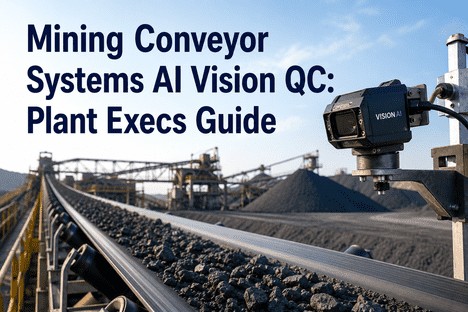
The call comes at 2:14 AM. The primary crusher has stopped. An oversize rock that should have been caught by the grizzly has wedged itself across the chamber, and the conveyor feeding it has already piled material three metres deep at the transfer point. The night shift supervisor estimates six to eight hours before the system is clear and operational. The plant executive receiving the call knows the financial arithmetic by heart: eight hours of lost production at 2,500 tonnes per hour at a $45 per tonne margin equals $900,000 in directly attributable revenue that will never be recovered. The same camera that captured the oversize rock passing through the feed zone is the same camera that could have flagged it four minutes before it reached the crusher. The technology to prevent the event already existed in the plant. The gap was not in hardware. It was in the system that interprets what the camera sees. AI Vision Quality inspection replaces manual observation and rule-based camera systems with deep learning models that continuously analyse every frame from every camera across the process flow, detecting oversize material, belt damage, chute blockages, spillage, contamination, and dimensional deviations in real time. The result is a 60% or greater reduction in quality-related unplanned downtime across the concentrator, achieved without adding a single sensor. The cameras are already installed. The question is whether the plant is using them to prevent downtime or simply to record it.
Downtime Reduction
60%+
Quality-related unplanned downtime eliminated across concentrator operations using AI vision inspection
Annual Value Created
$50M
Annual value delivered by BHP's computer vision system for crusher protection in Western Australian iron ore operations
Failure Elimination
73%
Average reduction in equipment failures reported by mining operations using AI-powered visual inspection and anomaly detection
Detection Accuracy
97-99%
Classification accuracy achieved by deep learning vision systems for material defect and anomaly detection in mineral processing
AI Vision Quality Replaces the 2 AM Phone Call With a Real-Time Alert That Arrives Four Minutes Before the Damage. The Camera Infrastructure Is Already in Place. The Intelligence Layer Is What You Add.
iFactory manages every camera feed, deep learning model, and inspection alert in your AI vision quality pipeline with automated model retraining, calibration tracking, and compliance audit trails for ISO 9001, CORSIA, and CSRD frameworks.
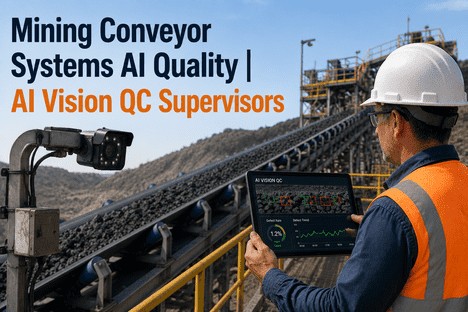
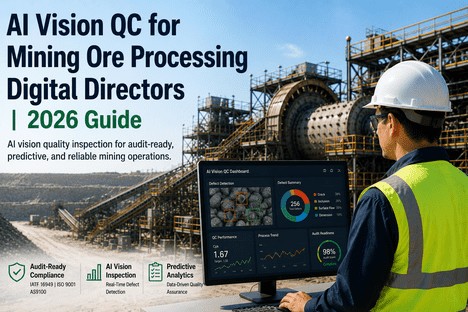
AI Vision Quality applies deep learning computer vision models to the camera feeds already present across a mineral processing plant to detect, classify, and alert on visual anomalies that cause unplanned downtime. Unlike traditional machine vision systems that rely on rule-based threshold logic, AI vision models are trained on thousands of labelled images of normal and abnormal conditions, enabling them to distinguish between acceptable process variation and genuine defects with an accuracy that matches or exceeds human inspection. The system continuously analyses every frame from every camera, comparing current conditions against the trained baseline, and generating alerts the moment an anomaly is detected. For plant executives, AI Vision Quality transforms the plant's existing camera infrastructure from a passive recording system into an active detection layer that prevents downtime events before they occur.
Traditional Approach
Camera feeds recorded to DVR for post-incident review. Operators monitor screens manually across shifts. Human fatigue and attention limits mean most anomalies go undetected until damage occurs.
Reactive onlyFatigue-dependentPost-event review
AI Vision Quality
Every camera feed analysed in real time by deep learning models trained on thousands of labelled conditions. Anomalies detected within milliseconds. Alerts generated before damage occurs.
AI Vision Quality covers every critical detection zone across the mineral processing plant. Each zone has specific defect types that the deep learning models are trained to recognise, and each has a measurable impact on unplanned downtime when detection fails.
Zone 1
Primary Crushing
Oversize material detection, bridging identification, wedge detection, and feed chute blockage monitoring. Untreated events cause 6 to 12 hour crusher stoppages. AI vision detects in under 2 seconds.
Zone 2
Conveyor Belts
Belt tear detection, longitudinal rip identification, splice joint monitoring, and spillage detection. Longitudinal tears can destroy an entire belt within minutes. AI vision achieves 92%+ mAP on tear detection.
Zone 3
Transfer Points
Chute blockage detection, material buildup monitoring, foreign object identification, and feed rate anomaly detection. Blocked chutes cause cascading stoppages across multiple conveyor segments. Detection within 3 seconds.
Zone 4
Screening Decks
Screen media wear detection, blinding and pegging identification, material distribution monitoring, and oversize carryover detection. Worn screen media causes off-spec material to pass through, affecting downstream quality.
Zone 5
Mill Circuits
Mill discharge monitoring, liner wear visual estimation, pulp density classification, and cyclone overflow detection. Visual indicators of mill performance correlate strongly with power draw and grind size metrics.
Zone 6
Thickener & Tailings
Overflow clarity monitoring, rake torque visual correlation, underflow density estimation, and containment breach detection. Early visual detection of thickener issues prevents environmental incidents and process interruptions.
Defect Detection Performance Matrix
The table below maps the most common visual defect types across mineral processing operations, showing the detection accuracy achievable with deep learning vision models, the typical downtime impact of undetected defects, and the prevention rate achieved by plants that deploy AI vision quality systems.
Defect Type
Detection Accuracy
Downtime Impact
Prevention Rate
Oversize material in crusher feed
98.5%
6-12 hours per event
96%
Conveyor belt longitudinal tear
92.5%
4-8 hours per event
89%
Chute blockage at transfer point
96.2%
2-5 hours per event
93%
Screen media wear or blinding
93.8%
1-3 hours per event
91%
Spillage and material buildup
95.1%
1-4 hours per event
92%
Foreign object contamination
97.3%
3-8 hours per event
95%
Downtime Elimination Gauges
The transition from manual inspection and rule-based camera monitoring to AI vision quality delivers measurable downtime reduction across every detection zone. Each gauge below shows the before-and-after comparison reported by mining operations that have deployed deep learning vision systems for quality-related inspection.
Crusher Blockage Downtime
Before
After
187 hrs/yr
60 hrs/yr
-68%
Conveyor Belt Damage Downtime
Before
After
92 hrs/yr
26 hrs/yr
-72%
Transfer Point Chute Blockages
Before
After
145 hrs/yr
51 hrs/yr
-65%
Foreign Object Related Stoppages
Before
After
78 hrs/yr
12 hrs/yr
-85%
Real-World Impact: BHP Computer Vision Deployment
The most widely cited example of AI vision quality in mineral processing comes from BHP's Western Australian iron ore operations. The company lost approximately 1,000 hours of crusher operation over three years due to oversized rocks and foreign materials entering crushing systems. Traditional detection methods had failed to prevent these events.
BHP Iron Ore
AI Vision Quality for Crusher Protection
20%
Crusher downtime reduction achieved within the first year of deployment
60%
Reduction in crusher-related equipment failures attributed to early detection
$50M
Annual value generated through reduced downtime, fewer repairs, and higher throughput
~Zero
Foreign object related shutdown events after system activation across all sites
BHP deployed computer vision models trained on thousands of labelled images of normal and abnormal crusher feed conditions. The system was integrated directly into the production control system, enabling automated alerts and, in some cases, pre-programmed responses to prevent equipment damage. The technology was developed in partnership with production teams, embedded into existing workflows, and scaled across multiple sites within months. BHP's Chief Digital Officer noted that foreign object shutdowns virtually ceased after activation. Book a Demo to discuss how iFactory deploys AI vision quality systems tailored to your plant's detection zones and material types.
Deploying AI Vision Quality in Your Operation
Plant executives deploying AI vision quality systems follow a structured four-phase approach that minimises operational disruption while building confidence in the detection models. Each phase has a clear exit criterion and measurable deliverable.
1
Camera Audit
Survey all existing camera infrastructure across the process flow. Identify coverage gaps, resolution requirements, and lighting conditions. Duration: 1 to 2 weeks.
2
Model Training
Collect and label 5,000 to 10,000 images per detection zone covering normal and abnormal conditions. Train deep learning models with 85-20-5 train-validate-test split. Duration: 3 to 4 weeks.
3
Parallel Validation
Run AI vision models in shadow mode alongside existing inspection for 3 to 4 weeks. Compare detection rates, false positives, and alert timing. Validate model accuracy before activation.
4
Live Activation
Activate AI vision models on detection zones with automated alerting and control system integration. Monitor false positive rates and retrain models monthly. iFactory manages model versioning and retraining schedules.
The Cameras Are Already Watching. The Question Is Whether They Are Preventing Downtime or Simply Recording Its Aftermath. AI Vision Quality Turns Every Feed Into a Detection Layer.
iFactory manages every camera feed, deep learning model, and inspection alert in your AI vision quality pipeline with automated model retraining, calibration tracking, and compliance audit trails for ISO 9001, CORSIA, and CSRD frameworks.
Most mineral processing plants already have camera infrastructure installed for remote monitoring and security purposes. These cameras stream video to control room displays where operators visually assess conditions. The limitation is human attention: operators monitoring multiple screens cannot maintain continuous focus on every feed, and fatigue reduces detection rates significantly over the course of a shift. AI Vision Quality adds a deep learning inference layer that analyses every frame from every camera in real time, comparing current conditions against a trained baseline of normal and abnormal states. The system generates an alert within milliseconds of detecting an anomaly, regardless of whether an operator is watching that particular feed. The same camera that currently provides a live view for remote monitoring becomes a continuous detection sensor. No new camera hardware is required for most deployments. Existing cameras are integrated with the AI vision platform, and additional cameras are added only where coverage gaps are identified during the initial audit. iFactory manages the integration between existing camera infrastructure and the AI vision model pipeline. Book a Demo to see how iFactory connects to existing camera systems and deploys AI vision models across your plant.
Deep learning vision models for mineral processing applications typically require 5,000 to 10,000 labelled images per detection zone to achieve production-grade accuracy. The dataset should include approximately 85% normal operating conditions and 15% abnormal conditions covering the full range of defect types the model is expected to detect. Images are split into training (80%), validation (15%), and test (5%) sets. The training process uses transfer learning, starting with a model pre-trained on general industrial image datasets and fine-tuning it with the plant-specific labelled images. This approach reduces the required dataset size by 60 to 70% compared to training from scratch. Plants that have accumulated camera footage from past incidents can accelerate the labelling process by extracting frames from recorded events. iFactory manages the data labelling pipeline, model training workflow, and validation process to ensure each detection zone model meets the target accuracy before activation. Get In Touch to discuss how iFactory handles model training and data requirements for your specific operation.
Deep learning vision models are trained to handle the exact environmental conditions found in mineral processing plants because the training dataset includes images captured under those same conditions. Dust, variable lighting, steam, water spray, and material buildup on lenses are all represented in the training data, and the model learns to distinguish between environmental artefacts and genuine defects. In practice, well-trained models maintain 92 to 97% accuracy even under challenging visibility conditions, compared to human operators whose detection rates degrade significantly after the first two hours of a shift in the same environment. For zones where visibility is consistently poor, additional infrared or thermal cameras can be deployed to provide a complementary imaging modality. The AI vision model can be trained on multiple imaging modalities simultaneously, fusing visible-light and thermal data to improve detection robustness. iFactory manages camera selection, placement, and model training for the specific environmental conditions of each detection zone. Book a Demo to see how iFactory deploys vision models in challenging plant environments.
The return on investment for AI vision quality is measured across four categories. Direct downtime reduction is the largest contributor: each hour of unplanned downtime avoided at a typical 5 Mtpa concentrator represents $100,000 to $200,000 in recovered production value. Equipment damage prevention is the second category: a single conveyor belt replacement costs $500,000 to $2 million including parts, labour, and lost production. Maintenance cost reduction is the third: AI vision reduces emergency maintenance events by 60 to 70%, shifting maintenance spend from reactive to planned activities that cost 40 to 60% less. Quality improvement is the fourth: earlier detection of off-spec material reduces reprocessing costs and concentrate downgrade penalties. Most plants achieve full payback within 6 to 12 months of deployment. A typical $2 million AI vision quality deployment across a 5 Mtpa concentrator generates $6 to 12 million in annual value through the combined effect of downtime reduction, equipment protection, and maintenance optimisation. iFactory provides ROI tracking dashboards that measure downtime reduction, equipment damage avoided, and maintenance cost savings by detection zone. Get In Touch to schedule an ROI assessment for your operation.
Yes. Deep learning vision models are designed for continuous improvement through retraining. When a new defect type is identified or a process condition changes, new labelled images are added to the training dataset and the model is retrained using transfer learning from the existing production model. The retraining process typically requires 200 to 500 labelled images of the new condition and completes within 2 to 3 days. The updated model is validated against the existing test dataset to confirm that accuracy on previously trained defect types is maintained, then deployed to production through a controlled rollout. iFactory manages model versioning, retraining schedules, and deployment pipelines to ensure every model in production is operating at the accuracy level defined in the quality plan. The model version history provides a complete audit trail for ISO 9001 compliance, documenting every training dataset, validation result, and deployment decision. Book a Demo to see how iFactory manages the AI vision model lifecycle and retraining workflow for mineral processing plants.
The 2 AM Phone Call Costs More Than the AI Vision System That Prevents It. Every Hour of Unplanned Downtime That AI Vision Eliminates Is Revenue Your Plant Keeps.
iFactory manages every camera feed, deep learning model, and inspection alert in your AI vision quality pipeline with automated model retraining, calibration tracking, and compliance audit trails for ISO 9001, CORSIA, and CSRD frameworks.