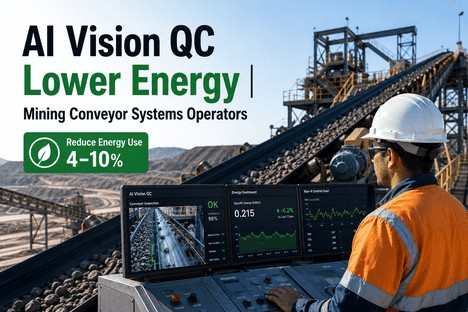
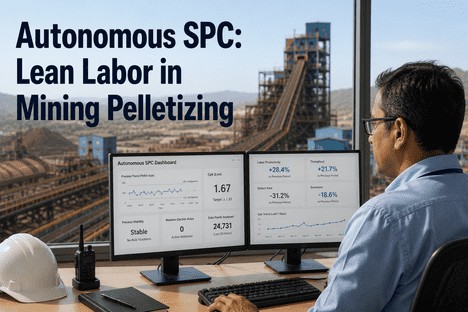
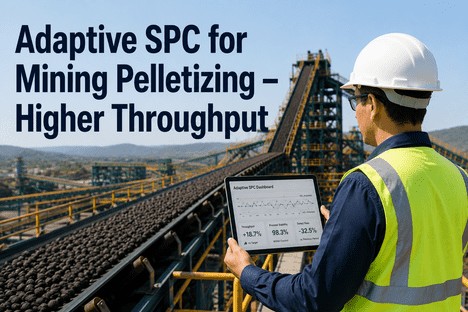
Energy is the largest controllable cost in a pelletizing plant — and most plant executives are still managing it with quality tools designed for a different era. Static SPC charts, shift-end Cpk reports, and manual limit reviews cannot keep pace with the real-time variability that drives energy waste in pelletizing: ore blend fluctuations that shift the optimal moisture window, induration zone temperatures drifting beyond their efficient band, and binder dosage running high to compensate for green strength uncertainty. Autonomous SPC changes the energy equation. This is the plant executive's guide to how.
Self-Tuning Control Limits · Multivariate ML · Induration Optimization · Real-Time Energy KPIs
The Plant Executives Cutting Specific Energy Consumption 4–10% in Pelletizing Are Running Autonomous SPC — Not Static Charts.
iFactory's autonomous SPC platform gives plant executives self-tuning control limits, multivariate ML pattern detection, and continuous Cpk/Cp/Pp/Ppk — calibrated in real time to every ore blend, recipe, and process regime shift in your pelletizing operation.
4–10%
Reduction in specific energy consumption documented in pelletizing operations deploying autonomous SPC with real-time induration zone optimisation
92%
Defect prediction accuracy achieved when AI-SPC analyses hundreds of process variables simultaneously — forecasting yield issues up to 24 hours ahead
50–70%
False alarm reduction when self-tuning ML limits replace static control charts — restoring operator alert credibility and driving response rates to near 100%
15%
Overall yield improvement documented when autonomous SPC predicts yield issues 24 hours ahead, enabling corrective action before product is lost
Why Energy Waste in Pelletizing Is a Quality Control Problem First
Most plant executives categorise energy optimisation and quality management as separate work streams — one owned by process engineering, the other by the quality function. In pelletizing, this separation is the source of the inefficiency. Energy waste in the induration furnace is almost never caused by equipment failure or a control system limitation. It is caused by the quality management system failing to detect drift early enough to keep the process in its energy-efficient zone. When moisture deviates above the optimal balling window, the furnace drying load increases. When green ball strength is inconsistent, firing temperature is held high to compensate for uncertainty. When binder dosage runs above minimum effective levels because the quality system cannot confirm that minimum dosage is producing sufficient strength, every additional kilogram of bentonite represents unnecessary chemistry and unnecessary drying energy.
Autonomous SPC addresses energy efficiency by tightening quality control at the points that drive energy consumption — not by adjusting energy systems directly, but by keeping the process in the narrow band where it produces specification product with minimum input. That is the fundamental insight: energy optimisation in pelletizing is a consequence of quality process control that is accurate, continuous, and fast enough to matter.
Where Energy Is Lost in Pelletizing — and What Autonomous SPC Does About It
Stage 01 — Balling Circuit
Moisture Drift Above the Optimal Window
The balling disc operates within a narrow moisture window — typically ±0.3% around the target — where green ball strength and size distribution are simultaneously on-spec. Static SPC limits detect drift only after it has persisted across multiple measurement intervals. Autonomous SPC detects the pattern of variables that precedes a moisture drift event — feed particle size distribution, binder absorption behaviour, ambient humidity proxies — and generates an alert while the process is still correctable without energy penalty.
Energy impact: Every 1% excess moisture above optimal increases furnace drying energy load by approximately 3–5% on a per-tonne basis.
Stage 02 — Induration Furnace
Temperature Zone Drift Beyond Efficient Band
The induration furnace is the single largest energy consumer in the pelletizing plant, accounting for 70–80% of total process energy on straight-grate configurations. Zone temperatures running above the minimum needed to achieve crush strength targets represent direct fuel waste. Autonomous SPC monitors the correlation between green ball quality characteristics and the firing temperature required to achieve the crush strength specification — and identifies when temperatures can be reduced without quality risk, as well as when drift toward understrength product requires a corrective adjustment rather than a compensatory temperature increase.
Energy impact: Induration temperature running 20°C above the minimum required represents approximately 1.5–2.5% excess fuel consumption on the furnace annual run.
Stage 03 — Binder Dosage
Over-Dosing as a Risk Hedge Against Quality Uncertainty
When the quality system cannot reliably confirm that binder dosage at minimum specification levels is producing adequate green strength — because static SPC limits do not account for binder batch efficacy variation or ore blend changes — plant operators run dosage above minimum as a hedge. This is rational given the cost of green strength failures downstream, but it creates unnecessary chemistry cost, increases the drying energy load per tonne, and in bentonite-intensive operations adds material cost that compounds across millions of tonnes per year. Autonomous SPC provides the green strength confidence that makes minimum effective dosage the safe operating mode rather than the risky one.
Energy impact: Excess bentonite at 0.5% above minimum effective dosage adds approximately 0.3–0.5 GJ/t to the drying energy requirement in wet feed configurations.
How Autonomous SPC Works in Practice: Self-Tuning Control Limits and Multivariate ML
The term "autonomous" in autonomous SPC refers specifically to the system's ability to maintain calibrated, defensible control limits without requiring quality engineers to manually recalculate and update them every time the process changes regime. In pelletizing, this is not a convenience feature — it is the core functional requirement. A plant producing multiple pellet grades from multiple ore blends with varying binder batches operates in a nearly continuous state of process regime transition. Every transition event invalidates the existing control limits for the duration of the transition, and in a static SPC system, that transition period is a quality and energy risk window with no coverage.
Self-Tuning Control Limits
Limits That Recalibrate to Every Process Change — Automatically
Self-tuning control limits use a rolling statistical model of the current process baseline — updated continuously from the live data stream — to calculate UCL and LCL that reflect what normal actually looks like right now, for the current ore blend, the current binder batch, and the current production recipe. When an ore blend change is registered, the limits begin transitioning to the new baseline within a configurable window. When a recipe changes for a different pellet grade, the full limit set switches to the new grade's specification profile automatically. The result is a control chart where every alert reflects a genuine deviation from current operating conditions — not from the operating conditions of three months ago when the capability study was last performed.
Ore blend transition coverage
Recipe change auto-switch
Binder batch recalibration
Continuous Cpk/Cp/Pp/Ppk
Multivariate ML Detection
Pattern Detection Across Variables That No Single Chart Can See
A pelletizing plant generates hundreds of simultaneously-tracked process variables. The combination of these variables — rather than any individual variable — is what predicts quality failures and energy excursions. Multivariate ML monitors the cross-variable pattern continuously and identifies when the combination of moisture, disc speed, feed rate, particle size proxy, and binder dosage is trending toward a historically problematic configuration — even when no single variable has crossed its individual control limit. This is the capability that 24-hour-ahead defect forecasting is built on: the pattern that precedes a crush strength failure or an oversize rate spike is visible in the multivariate signal well before it is visible in any univariate chart.
Cross-variable pattern alerts
24-hour defect forecasting
Energy excursion prediction
Western Electric rules engine
Autonomous SPC · Multivariate ML · Self-Tuning Limits · Real-Time Energy KPIs
Energy Waste in Pelletizing Is a Quality Detection Problem. Autonomous SPC Closes the Gap at the Source.
iFactory gives plant executives the self-tuning SPC platform that keeps moisture, temperature, and binder dosage in the energy-efficient quality window — continuously, without manual recalibration, for every ore blend and every pellet grade.
The Plant Executive's View: What Autonomous SPC Looks Like at the Operations Level
Autonomous SPC is not a tool that quality engineers use and executives receive reports from. It is a plant operations intelligence platform — and the plant executive's view is designed around the questions that drive capital allocation, shift performance reviews, and customer quality commitments. Here is what the executive dashboard shows and why it matters at the operations level.
View 01
Specific Energy per Tonne — Live
Real-time specific energy consumption displayed per tonne of pellet produced, broken down by process zone — balling, drying, induration, and cooling. The autonomous SPC platform correlates live energy KPIs with the quality variable state for each zone, making it immediately visible when energy consumption is elevated because a quality parameter has drifted from its efficient operating band. The plant executive sees not just the energy figure but the quality cause driving it — giving operations the information to act rather than the symptom to investigate.
View 02
Cpk / Cp / Pp / Ppk — Continuous
Process capability indices calculated continuously and displayed as live trend lines — not shift-end snapshots. Plant executives see whether capability is stable, improving, or declining in real time, with a projected Cpk at current trajectory overlaid on the chart. When capability trends below the 1.67 target, the platform surfaces the specific variable or variable combination driving the decline, enabling targeted corrective action before the capability threshold is breached and before energy-inefficient compensatory measures are needed to protect quality.
View 03
Predictive Quality Alert Feed
The alert feed surfaces multivariate ML predictions ranked by severity and lead time — how many hours until the predicted quality event is expected to be confirmed by test results if no corrective action is taken. For crush strength predictions, this lead time is typically 4 to 8 hours, providing an intervention window that allows batch isolation, firing profile adjustment, or a hold authorisation before additional out-of-spec product is committed. The alert feed includes the top contributing variables for each prediction, giving quality engineers the specific investigation starting point rather than a general quality warning.
View 04
COPQ Dashboard — Cost of Poor Quality Live
The cost of poor quality dashboard translates quality events — oversize recycle tonnage, crush strength rejects, binder over-dosage hours, energy excursion events — into their operational cost equivalents, updated in real time. Plant executives see the COPQ as a running cost figure, not as an end-of-month accounting entry. When quality-driven energy waste is expressed in dollars per shift rather than GJ per tonne, the business case for tighter autonomous control becomes continuously visible at the executive level — and the savings from autonomous SPC are directly measurable against the baseline without requiring a separate financial analysis.
"
We had been running the induration furnace 18°C above the minimum crush-strength-adequate temperature for almost two years — not because the process required it, but because our quality system could not give us the confidence to reduce it. Every time we tried to step the temperature down, we had a crush strength failure within two weeks and we stepped it back up. After deploying autonomous SPC and running the predictive model in parallel for six weeks, we had enough confidence in the green strength correlation to reduce the firing setpoint. We have run at the lower setpoint for 14 months. Fuel consumption on the grate-kiln system is down 6.4% year-on-year. The quality system gave us the energy saving — the energy system didn't.
— Plant General Manager, Iron Ore Pelletizing Operation — Grate-Kiln System, 4.5 Mtpa
The ROI Case: What 4–10% Specific Energy Reduction Means at Scale
Energy is typically the second-largest operating cost in a pelletizing plant after concentrate — and in fuel-intensive grate-kiln configurations, induration energy alone can represent 15–25% of total production cost per tonne. For a 5 Mtpa pelletizing plant running an induration energy intensity of 0.25 GJ per tonne of pellet, a 7% reduction in specific energy consumption represents approximately 87,500 GJ of annual savings. At natural gas prices of USD 8/GJ, that is a USD 700,000 annual fuel saving from one parameter — one that requires no capital expenditure, no process modification, and no new equipment. It requires only the quality confidence to operate at minimum adequate temperature rather than at a conservative over-temperature cushion.
COPQ Reduction Pathways — How Autonomous SPC Converts Quality Improvement Into Financial Return
Pathway 01
Induration Temperature Reduction
When autonomous SPC provides the green strength confidence to reduce firing temperature to the minimum adequate setpoint, direct fuel savings of 3–6% are achievable in grate-kiln and straight-grate operations. The savings scale directly with plant capacity and prevailing fuel price — and are permanent, not a one-time optimisation event.
Pathway 02
Binder Dosage at Minimum Effective Level
Eliminating precautionary over-dosing of bentonite reduces drying energy load per tonne, decreases material cost, and improves pellet iron grade by reducing the dilution effect of flux additions. For operations running 0.5% above minimum effective dosage, the combined energy and material saving is typically USD 0.80–1.20 per tonne of pellet produced.
Pathway 03
Oversize Recycle Reduction
Oversize pellets returned to the balling circuit consume capacity, extend balling cycle times, and represent previously-inducted energy that must be re-expended. Autonomous SPC detection of size distribution drift before oversize production peaks typically reduces recycle rate by 30–50% — recovering balling capacity and eliminating the energy already invested in the rejected material.
Implementation: What Deployment Looks Like for a Plant Executive
Plant executives evaluating autonomous SPC typically ask three questions before committing: how long does implementation take, what internal resources are required, and how is the predictive model validated before it is trusted for operational decisions. These are the right questions, and the answers should be specific.
Implementation for a pelletizing plant with an existing process historian typically takes 6 to 10 weeks from first data connection to live autonomous SPC operation. The historian connection and initial model build consume the first three to four weeks. Shadow mode deployment — where the autonomous SPC system runs in parallel with the existing quality programme, generating alerts and predictions without driving decisions — runs for two to four weeks. Shadow mode is not a delay; it is the validation step that gives the quality team confidence in the predictive accuracy before relying on the system for operational holds and corrective actions. The accuracy data from shadow mode is also the documented evidence the plant executive needs to justify the investment to a capital committee or an operations review.
Internal resource requirements during deployment are primarily from the quality and process engineering functions — typically 3 to 5 days of engineering time for data mapping and process variable tagging, plus participation in the shadow mode review. The plant's operational team does not need to change workflows during deployment. The autonomous SPC system adapts to the existing data infrastructure; the existing infrastructure does not need to adapt to it.
Deployment Timeline — From First Connection to Live Autonomous Operation
Weeks 1–2
Historian Connection & Data Mapping
Process variables tagged, LIMS data stream connected, initial baseline dataset compiled from historical records.
Weeks 3–4
Initial Model Build & Limit Configuration
Autonomous SPC model trained on historical data. Control limits configured per grade, blend, and zone. Western Electric rules engine activated.
Weeks 5–7
Shadow Mode Validation
Predictions generated in parallel with existing quality programme. Accuracy validated against actual test results. Executive sign-off on predictive performance.
Week 8+
Live Autonomous Operation
Autonomous SPC drives quality alerts, COPQ dashboard live, predictive defect feed active. Self-tuning limits recalibrate continuously from this point forward.
Conclusion
The 4–10% specific energy reduction that autonomous SPC delivers in pelletizing is not a projection or a vendor claim. It is the documented consequence of operating the induration furnace, the balling circuit, and the binder dosage system at minimum adequate input levels rather than at the conservative over-input levels that static quality systems force. Every degree of excess firing temperature, every fraction-percent of excess moisture, every additional kilogram of precautionary binder is a symptom of quality uncertainty — and autonomous SPC eliminates that uncertainty at its source.
For plant executives, the strategic case is clear. A quality system that cannot distinguish between legitimate process regime changes and genuine quality deviations forces conservative over-inputs as a hedge against uncertainty. A quality system that self-tunes its limits to every ore blend, recipe, and binder batch transition removes that hedge requirement — and the energy saving is what remains. The capital requirements are minimal. The deployment timeline is measured in weeks. The financial return is permanent and measurable at the shift level.
iFactory's autonomous SPC platform is purpose-built for plant executives in mining pelletizing operations who need to close the gap between their quality programme and their energy performance targets. Book a Demo to see the platform configured for your pellet grade portfolio and ore blend profile, or talk to an expert about a COPQ reduction assessment for your operation.
Frequently Asked Questions
Calculate Your COPQ Reduction ROI — Get a Free Plant-Specific Assessment Based on Your Own Energy and Quality Data.
iFactory's autonomous SPC platform for plant executives in mining pelletizing — self-tuning control limits, multivariate ML defect forecasting, continuous Cpk/Cp/Pp/Ppk, and a live COPQ dashboard that makes quality-driven energy waste visible at the operations level from day one.