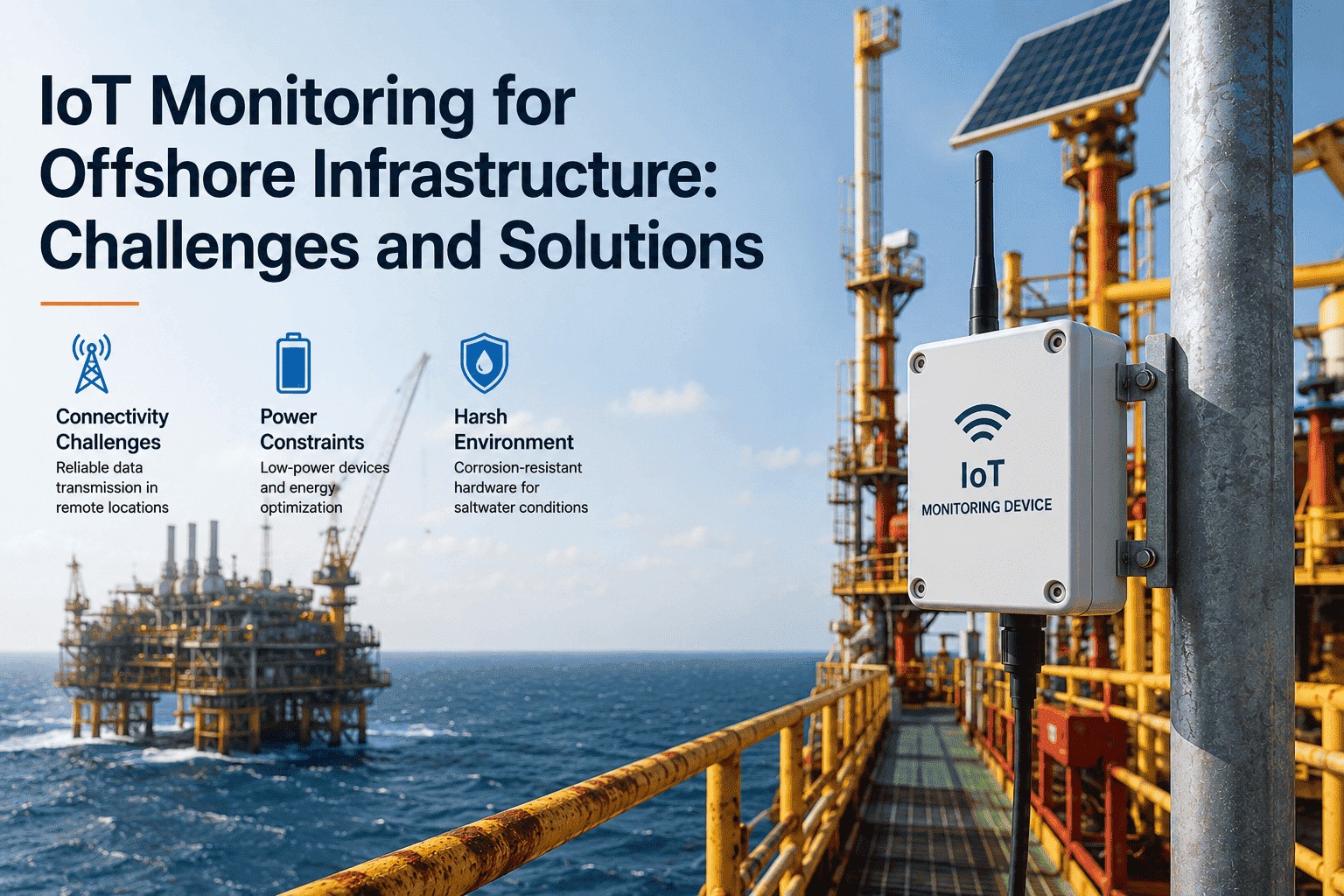
Out at sea, the rules of infrastructure monitoring change. A wind turbine 80 kilometers offshore doesn't get a maintenance van pulling up — it gets a helicopter, a weather window, and a four-figure mobilization bill before a single bolt is touched. An underwater pipeline doesn't get a visual inspection — it gets an ROV deployment that costs more in a single day than land-based monitoring runs in a year. And every sensor placed in this environment must survive a corrosion challenge that strips coatings, eats fasteners, and shortens electronic lifespans by an order of magnitude compared to onshore deployments. Yet offshore is exactly where IoT monitoring delivers its most compelling ROI — because physical access is so expensive, the cost of every avoided maintenance trip is multiplied, and the consequences of an undetected failure stretch from production loss into safety and environmental territory. The challenge isn't whether to monitor offshore infrastructure. It's how to deploy IoT that actually survives, transmits, and stays powered in an environment designed to kill electronics. iFactory's offshore IoT monitoring platform is engineered specifically for these conditions — combining marine-grade sensors, hybrid connectivity, and energy-resilient gateway architecture so operators get continuous asset visibility even from the most remote installations.
Offshore IoT · Marine Monitoring · Satellite Connectivity · Corrosion Detection
The Most Expensive Maintenance Trip Is the One You Could Have Avoided
iFactory delivers offshore-hardened IoT monitoring that survives saltwater, transmits without terrestrial networks, and runs without grid power — so operators see asset condition continuously, not just on inspection day.
Why Offshore IoT Is Different — In One Page
Up to 90% of offshore wind O&M cost comes from accessibility — getting people and parts to the asset, not the repair itself.
Saltwater corrosion rates run 5–10× faster than industrial onshore atmospheres on uncoated mild steel.
Steel structures disrupt wireless signals — typical onshore IoT protocols fail without offshore-specific design.
No grid power at most monitoring points — sensors must self-sustain or extract energy from the environment.
The Three Pillars of Offshore IoT Challenge — and Why None Can Be Solved in Isolation
Every offshore IoT deployment fails at one of three points: the sensor stops surviving the environment, the data stops reaching shore, or the device runs out of power. A platform that solves only two of these still produces blind spots — and blind spots in offshore infrastructure are where the expensive failures hide.
The Material Challenge
Saltwater Corrosion, Biofouling, and Environmental Stress
Marine environments combine high chloride concentration, UV exposure, mechanical wave loading, freezing-thawing cycles, and biofouling — a combination that destroys electronics, degrades sensor accuracy, and breaks mechanical mounts faster than any onshore equivalent. A standard industrial IoT sensor specified for ten years onshore can fail in 12 to 18 months in a splash zone.
Primary Failure Mode
Enclosure ingress · sensor drift · mount fatigue
Engineering Response
IP68/IP69K · 316L stainless · titanium fasteners
The Connectivity Challenge
Long-Distance Transmission Without Terrestrial Networks
Standard cellular networks reach 20–40 km from shore on a good day. Most offshore assets sit well beyond that, in environments where steel structures interfere with wireless propagation and weather affects satellite link quality. Maritime IoT is more complex than land-based applications because devices must withstand long voyages far from terrestrial networks, making connectivity require a combination of satellite networks at sea and LTE-M and 5G at ports. Single-protocol designs fail. Hybrid designs work.
Primary Failure Mode
Coverage gaps · packet loss · steel interference
Engineering Response
Satellite + cellular + LoRaWAN hybrid · edge buffering
The Power Challenge
Continuous Operation Without Grid Power
Most offshore monitoring points have no grid power. Battery-only designs fail within months. The solution is energy harvesting tuned to the deployment environment — solar where exposure is reliable, wave energy harvesters for surface platforms, and ultra-low-power sensor designs that operate on microwatts. The goal isn't long battery life. The goal is no battery replacement ever.
Primary Failure Mode
Battery depletion · scheduling boat trips for swaps
Engineering Response
Solar + wave harvesting · MPPT · sleep scheduling
The Challenge-to-Solution Matrix: How Offshore-Hardened IoT Architecture Works
Each layer of an offshore IoT deployment has a specific failure mode and a specific engineering response. The matrix below shows the mapping from challenge to solution — and is the framework iFactory uses when configuring deployments for marine and offshore asset operators.
| Layer |
Offshore Challenge |
Engineering Solution |
| Sensor Hardware |
Saltwater ingress destroying electronics within months |
IP68/IP69K-rated, 316L stainless steel enclosures, conformal-coated PCBs |
| Mounting & Mechanical |
Galvanic corrosion between mount and asset surface |
Titanium fasteners, isolation gaskets, sacrificial anode integration |
| Short-Range Comms |
Steel structures blocking RF propagation between sensors and gateway |
LoRaWAN sub-GHz with mesh topology, repeaters at structural choke points |
| Long-Range Backhaul |
No terrestrial cellular coverage beyond ~40 km from shore |
Satellite (Iridium/Starlink) primary, cellular failover at coast, local edge buffer |
| Power Supply |
No grid access; battery swaps cost more than the sensor |
Solar + wave energy harvesting with MPPT, lithium buffer, low-power MCU |
| Data Resilience |
Connectivity drops during storms; data must not be lost |
Local flash storage (90+ days), store-and-forward sync, prioritized packets |
Wind Farms · Oil & Gas · Subsea Cables · Sea-Crossing Bridges · Aquaculture
Match the IoT Stack to Your Specific Offshore Asset
iFactory configures sensor selection, comms protocol, power source, and alert logic per asset class — wind turbine sensors are not pipeline sensors are not bridge sensors. The deployment fit matters more than the platform.
Connectivity Strategy: The Three-Tier Network Architecture That Actually Reaches Shore
A single connectivity protocol cannot serve an offshore monitoring deployment. The reliable architecture is layered — short-range between sensors, medium-range to the local gateway, long-range to shore — with each tier optimized for its specific role.
Tier One · Sensor to Gateway
Short-Range Wireless Inside the Asset Structure
Protocols: Bluetooth Low Energy for in-structure links under 100m. LoRaWAN sub-GHz for longer-range mesh between sensors and gateways across a wind farm or platform — proven up to 15km in open marine conditions where line-of-sight exists between nodes.
Tier Two · Gateway to Shore (Near Coast)
Cellular Backhaul for Coastal Installations
Protocols: LTE-M and NB-IoT for low-bandwidth, high-reliability sensor data within cellular range. 5G at ports and coastal terminals for high-throughput operations. Cost-effective and well-supported by carrier networks where coverage is available — the right choice for installations within commuting distance of the coastline.
Tier Three · Gateway to Shore (Deep Sea)
Satellite Backhaul Where Cellular Cannot Reach
Protocols: Iridium SBD for low-bandwidth, latency-tolerant status data — covers every ocean. Starlink and similar LEO services for high-bandwidth applications such as video inspection feeds. Hybrid satellite-plus-cellular gateways automatically failover between networks based on availability, so connectivity loss never means data loss.
Power Strategy: Why Battery Life Is the Wrong Metric for Offshore IoT
Onshore, "five-year battery life" is a feature. Offshore, it's a service trip scheduled five years from now — and a service trip 80 km offshore can cost more than the sensor itself. The right design target is perpetual operation through environmental energy harvesting, with batteries serving only as buffer storage for low-generation periods.
Source One
Solar Photovoltaic
Surface installations get 4–8 peak sun hours daily even in northern latitudes. With MPPT charge controllers and properly sized panels, marine solar can support continuous sensor operation indefinitely.
Best For
Buoys · platform decks · turbine nacelles
Source Two
Wave Energy Harvesting
Pendulum-based and triboelectric wave energy harvesters generate stable power from constant motion of the sea — supplying sensors without dependence on weather or sunlight cycles.
Best For
Floating platforms · sea-crossing bridges · buoys
Source Three
Low-Power Design + Sleep Scheduling
A sensor that wakes for 100ms every 15 minutes draws orders of magnitude less power than a continuously-on equivalent. Combined with harvesting, this enables truly battery-optional designs.
Best For
Subsea sensors · structural monitors · all classes
“
The hard part isn't getting the first month of data — anything works for a month offshore. The hard part is year three, when the cheap competitors' deployments have all failed and you're still getting clean readings. Survivability isn't a feature, it's the entire product. Specify ten-year material life, hybrid connectivity from day one, and energy harvesting that doesn't depend on battery swaps. Everything else is just monitoring you'll pay to replace.
— Offshore Asset Integrity Lead, North Sea Operations — 22 Years — Chartered Engineer (IMechE), ISO 55001 Practitioner
Five Offshore Asset Classes Where IoT Monitoring Delivers the Highest ROI
The offshore environment isn't one use case — it's five distinct asset categories with different sensor requirements, different failure modes, and different economic models for monitoring ROI. Each demands a tailored stack rather than a generic IoT deployment.
Asset Class 01
Offshore Wind Turbines
Vibration monitoring on gearboxes and bearings, blade strain sensors, and corrosion monitoring on foundation structures. Up to 90% of offshore wind O&M cost is due to accessibility — the logistical challenges of transporting engineers and technicians to offshore sites — meaning every avoided visit is worth far more than the sensor cost.
Core Sensors
Vibration
Strain
Corrosion
Asset Class 02
Oil & Gas Platforms and Pipelines
Wall-thickness sensors on risers and pipelines, pressure and flow monitoring at critical points, vibration analysis on rotating equipment. Detecting corrosion before it causes a leak avoids both production loss and environmental liability — the most expensive combination in the offshore industry.
Core Sensors
Wall thickness
Pressure
Acoustic
Asset Class 03
Sea-Crossing Bridges and Coastal Structures
Chloride-ingress sensors embedded in concrete, strain gauges on critical structural elements, water-level and wave-loading monitoring. Marine bridges face corrosion rates many multiples higher than inland structures — making continuous monitoring far more cost-effective than periodic inspection.
Core Sensors
Chloride
Strain
Wave load
Asset Class 04
Subsea Pipelines and Cables
Acoustic leak detection, cathodic protection potential monitoring, and seabed displacement sensors. Subsea inspection by ROV runs into five and six figures per day — sensor-based monitoring lets operators target inspection visits to actual anomaly events rather than calendar intervals.
Core Sensors
Acoustic
CP potential
Displacement
Asset Class 05
Aquaculture and Maritime Facilities
Water quality sensors, net-pen displacement monitoring, mooring tension sensors, environmental telemetry. Production losses from undetected water quality events or net failures rival the loss profiles of industrial assets — and the monitoring infrastructure scales with the same offshore IoT stack.
Core Sensors
Water quality
Tension
Displacement
From Deployment to Decision — What an Offshore IoT Program Looks Like in Operation
A well-architected offshore monitoring program isn't a one-time install. It's a continuous operational layer that produces value across four functional dimensions — each one stacking on the previous to convert raw sensor signals into measurable outcomes.
Outcome One
Avoided Maintenance Trips
Sensor data confirms asset condition without sending a helicopter or boat. The cost of one avoided offshore mobilization typically exceeds the annual cost of monitoring the entire installation — making the ROI argument straightforward to make to finance.
Outcome Two
Pre-Failure Intervention
Trend analysis on sensor data identifies degradation patterns weeks or months before failure. Intervention shifts from emergency response to planned maintenance — reducing both repair cost and asset downtime in the same operational change.
Outcome Three
Safety Incident Reduction
Continuous monitoring catches conditions that periodic inspection misses — corrosion under insulation, fatigue cracks in vibration-prone members, anomalous pressure events. Each early detection avoids escalation into a safety incident or environmental release.
Outcome Four
Regulatory and Insurance Documentation
Continuous sensor logs build an auditable record of asset condition that satisfies regulators, supports insurance renewals at favorable premiums, and provides evidence of operator diligence in the event of any incident investigation.
Conclusion
Offshore IoT monitoring is fundamentally an exercise in engineering for survival before instrumentation. The sensor must outlast the corrosion. The connection must reach across the open ocean. The power supply must operate for years without intervention. Solve any two of these and the third becomes the bottleneck. Solve all three and offshore monitoring transforms from an experimental pilot into the most cost-justified asset management investment an operator can make — because the underlying economics of physical access have always made offshore the highest-ROI environment for predictive maintenance.
iFactory's platform is engineered for these conditions from the hardware layer up — marine-grade sensors with proven service life, hybrid satellite-cellular-LoRaWAN connectivity, and energy harvesting designed so deployments don't require service trips. Book a Demo to see the architecture configured for your specific offshore asset class.
Frequently Asked Questions
Offshore monitoring isn't optional — but the wrong platform makes it worse than no monitoring at all.
iFactory delivers offshore IoT engineered to survive saltwater, transmit across open ocean, and run without service trips — so operators get the continuous asset visibility that makes predictive maintenance work where it matters most.