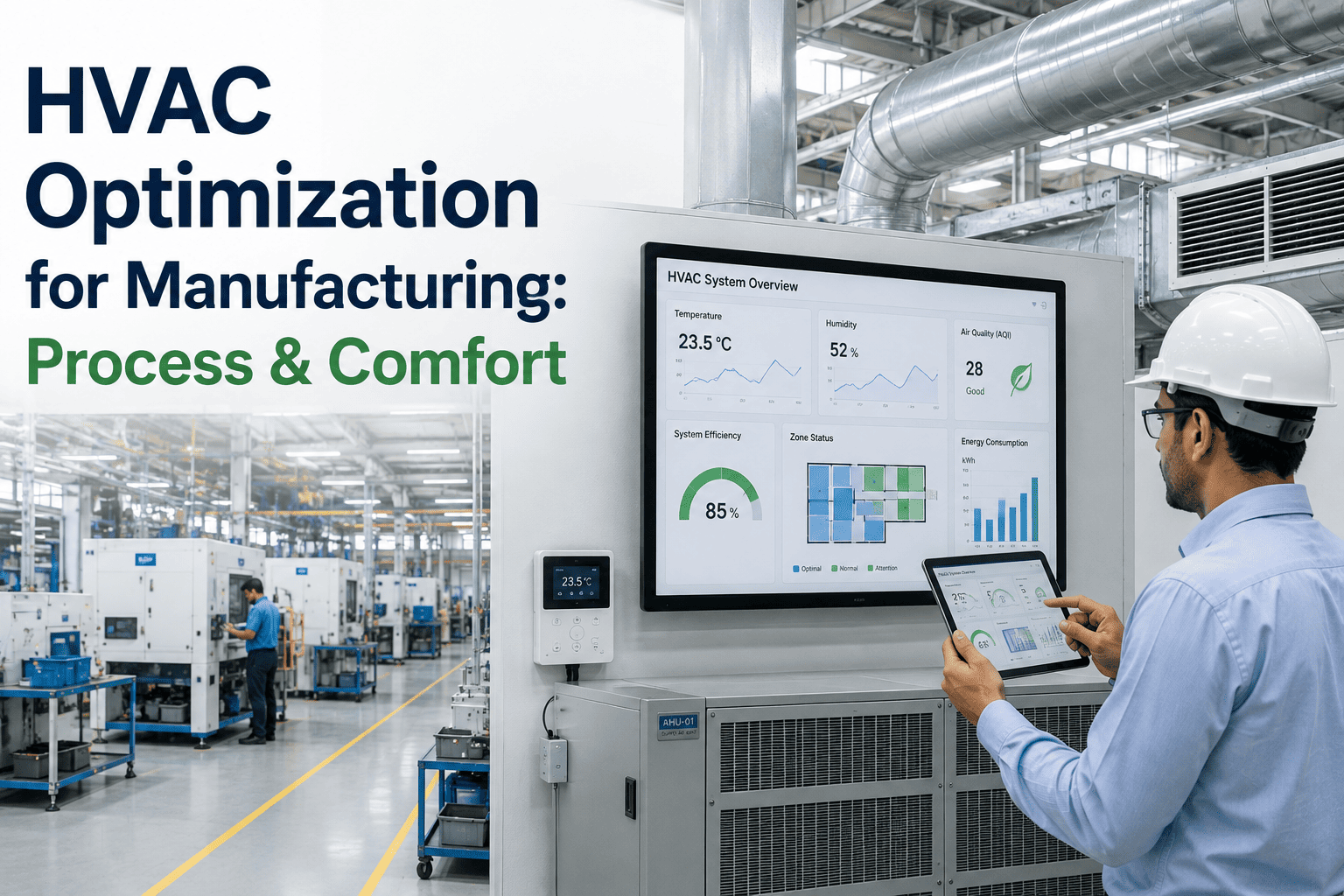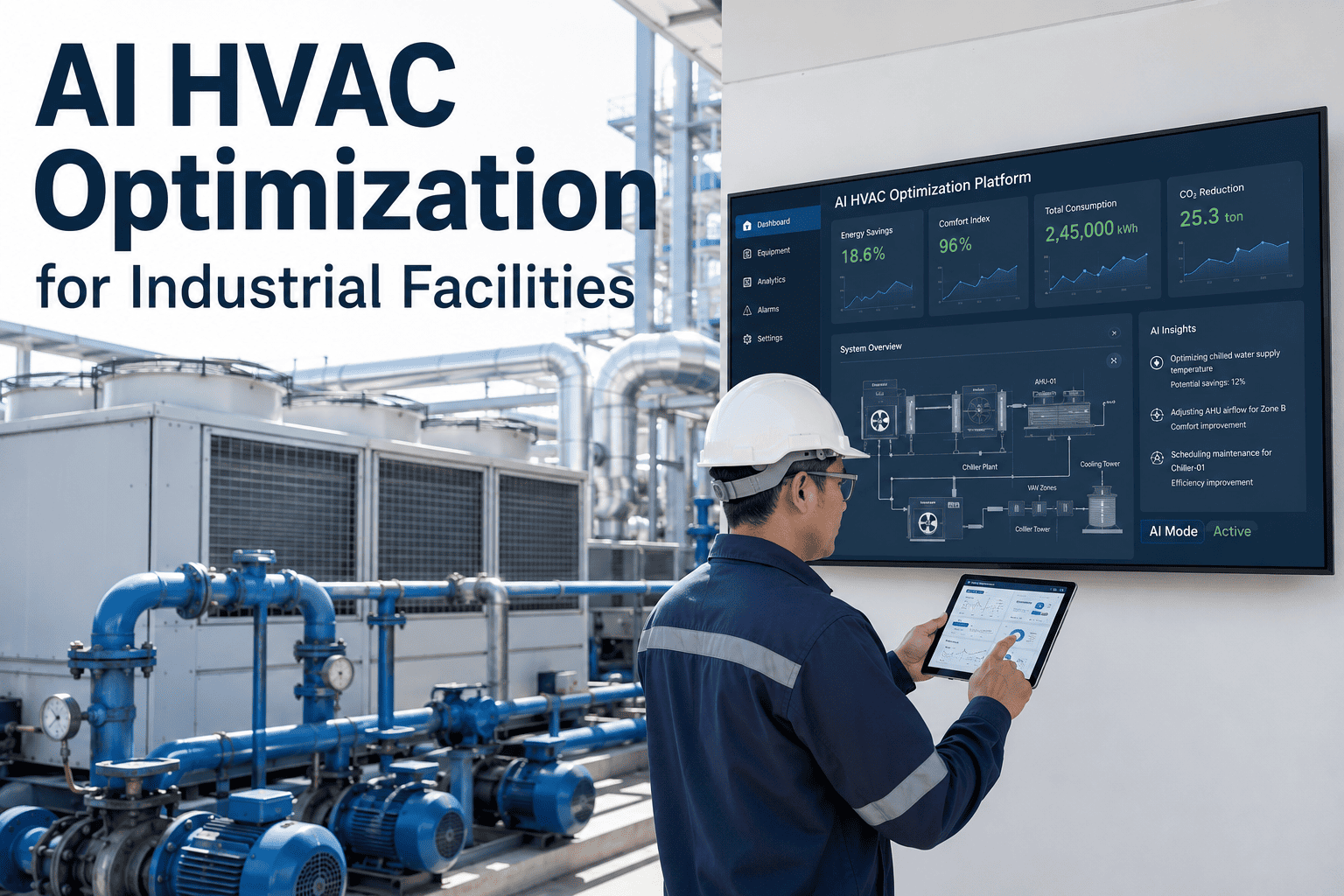
A process engineer walking the plant floor on a Sunday afternoon will usually find the air handlers running the exact same schedule they ran on a Tuesday during peak production, because HVAC is one of the only major utility systems in most facilities that nobody actively manages day to day. It gets commissioned once, set to a schedule that seemed reasonable at the time, and then left alone for years while production patterns, occupancy, and seasonal loads shift underneath it. That static schedule is not neutral, it is actively wasting energy on every shift where actual conditions do not match the assumptions baked in years ago. iFactory watches production schedules, occupancy, and zone-level conditions together and adjusts setpoints, dampers, and run schedules to match what the plant is actually doing right now, and you can book a demo to see it modeled against your own facility's HVAC load profile.
Plant HVAC Is Set-and-Forget by Default — And That Default Is Quietly Expensive
iFactory continuously optimizes setpoints, schedules, and damper positions against actual production activity, zone occupancy, and outdoor conditions, closing the gap between a fixed commissioning-day schedule and what your facility actually needs hour to hour.
Industrial Facilities Have Load Patterns Office Building Controls Were Never Designed For
Most industrial HVAC systems are controlled using logic borrowed from commercial building automation, which assumes a fairly predictable daytime occupancy pattern. A manufacturing plant does not behave that way, and the mismatch between the control logic and the actual operating pattern is where most of the waste hides.
Shift-Based Occupancy
A three-shift plant has occupancy and process heat load swings that a standard 7-to-6 office schedule never accounts for, leaving zones over-conditioned during low-activity shifts.
Process Heat Loads
Equipment, furnaces, and compressed air systems add heat loads that vary by production mix, which a fixed HVAC schedule has no way to sense or respond to.
Zone-Specific Requirements
A clean room, a warehouse, and a production floor within the same facility often need very different conditioning strategies that a single building-wide schedule flattens into one compromise.
Seasonal Drift
Setpoints tuned for commissioning-day conditions slowly become mismatched as seasons change, and without active tuning nobody revisits them until a comfort complaint forces the issue.
iFactory Continuously Closes the Loop Between What HVAC Is Doing and What the Plant Actually Needs
Rather than optimizing HVAC as an isolated system, iFactory ties the optimization loop directly to the signals that actually drive load: production schedule, occupancy sensing, process heat generation, and outdoor conditions.
Sense
Production schedule, zone occupancy, process heat load, and outdoor weather are continuously ingested alongside current HVAC state.
Predict
The model forecasts near-term load for each zone based on the production schedule and historical patterns for that specific zone.
Adjust
Setpoints, damper positions, and run schedules are adjusted ahead of the predicted load change rather than reacting after conditions drift.
Verify
Actual zone conditions and energy draw are compared against the prediction, and the model refines itself for that zone's specific behavior.
A Fixed Schedule Cannot Tell the Difference Between a Full Production Shift and an Empty Floor
iFactory adjusts HVAC in real time based on what is actually happening in each zone, not what the original commissioning schedule assumed.
Four Levers Account for Most of the Recoverable Energy in a Typical Plant HVAC System
Relative savings potential across the four main optimization levers, based on typical industrial facility profiles where zone occupancy and production schedule vary significantly by shift.
What Actually Changes When HVAC Control Becomes Adaptive
| Control Aspect | Fixed Schedule Approach | AI-Optimized Approach |
|---|---|---|
| Setpoint tuning | Set once at commissioning, rarely revisited | Continuously tuned against actual zone conditions and load |
| Occupancy response | Fixed schedule regardless of actual shift activity | Setback and recovery timed to actual occupancy and production schedule |
| Zone-level control | Single building-wide schedule compromise | Independent optimization per zone based on its specific load pattern |
| Equipment sequencing | Static staging order for chillers and air handlers | Dynamic sequencing based on predicted near-term load |
Most Plants Only Adjust HVAC When Someone Complains, Which Is Backwards
In the absence of active optimization, the only feedback loop most facilities have for HVAC performance is a comfort complaint, and complaints only happen when conditions have drifted far enough to be noticeable and uncomfortable. This means the system spends most of its operating life somewhere between wasteful and marginal, correcting only when it becomes bad enough for someone to call facilities. A zone that is slightly over-cooled during a low-occupancy shift never generates a complaint, it just quietly burns energy, and that is exactly the kind of waste that a comfort-complaint-driven process will never catch because nobody is uncomfortable enough to say anything.
Continuous optimization replaces that reactive loop with one that responds to actual load and occupancy data before conditions drift far enough to matter, which means the plant captures savings during the vast majority of hours where nothing is wrong enough to complain about but plenty is wrong enough to waste energy.
What Process Engineers Report After Adding AI-Based HVAC Optimization
HVAC Sits in a Budget Gap Between Facilities and Production, Which Is Exactly Why It Gets Ignored
In most industrial organizations, the production team owns the process equipment budget and the facilities team owns the building systems budget, and HVAC in a manufacturing plant sits awkwardly between the two. Production teams rarely think about air handling as their responsibility since it feels like a building system, while facilities teams often have limited visibility into the actual production schedule that drives real occupancy and heat load in each zone. This gap means HVAC frequently gets treated as background infrastructure that runs on autopilot, reviewed only during a capital planning cycle or after an equipment failure, rather than as an operating cost that responds directly to how the plant is actually run day to day.
Closing that ownership gap does not require reorganizing reporting lines, it requires giving both teams shared visibility into how HVAC energy use tracks against actual production activity, so a spike in consumption during a slow production week becomes visible and addressable rather than buried in a monthly utility bill that arrives weeks after the fact.
Most Facilities Begin With Their Highest Energy-Intensity Zones Rather Than a Full Building Rollout
A typical rollout starts by identifying the two or three zones with the highest combined HVAC energy draw and the most variable occupancy pattern, since these zones tend to carry the largest recoverable savings and provide the clearest early proof of value. Connecting to the existing building automation system for those zones usually requires no new field hardware, since the necessary setpoint, damper, and equipment status points are already present in most modern BAS platforms. Once the model has established an accurate baseline and demonstrated measurable savings in those initial zones, coverage typically expands to the remaining building areas over the following weeks, following the same validation approach used in the first phase.
Questions Process Engineers Ask About AI-Based HVAC Optimization
Stop Running HVAC on a Schedule That Was Accurate the Day It Was Commissioned
iFactory continuously matches setpoints, schedules, and dampers to what your plant is actually doing, zone by zone.