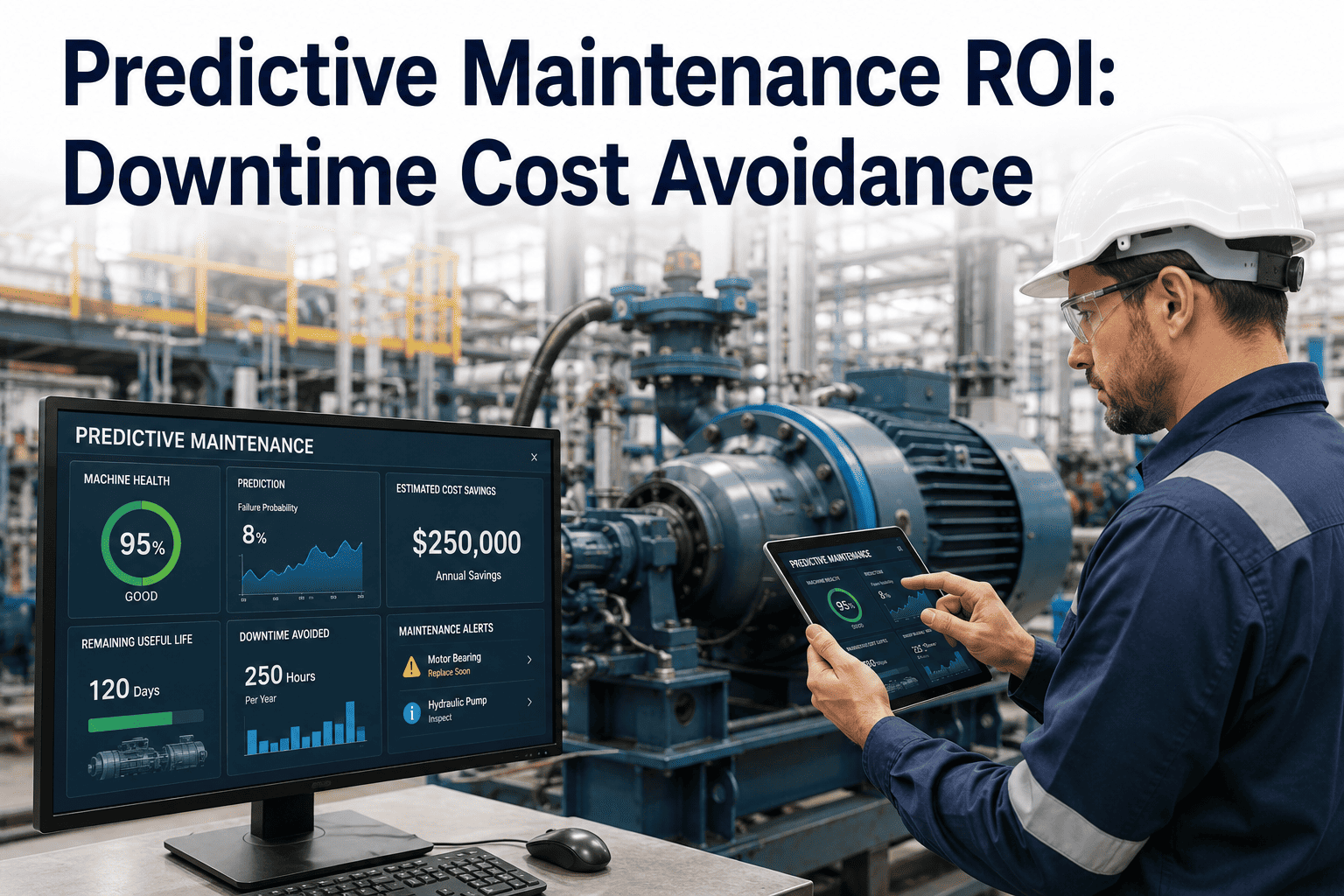
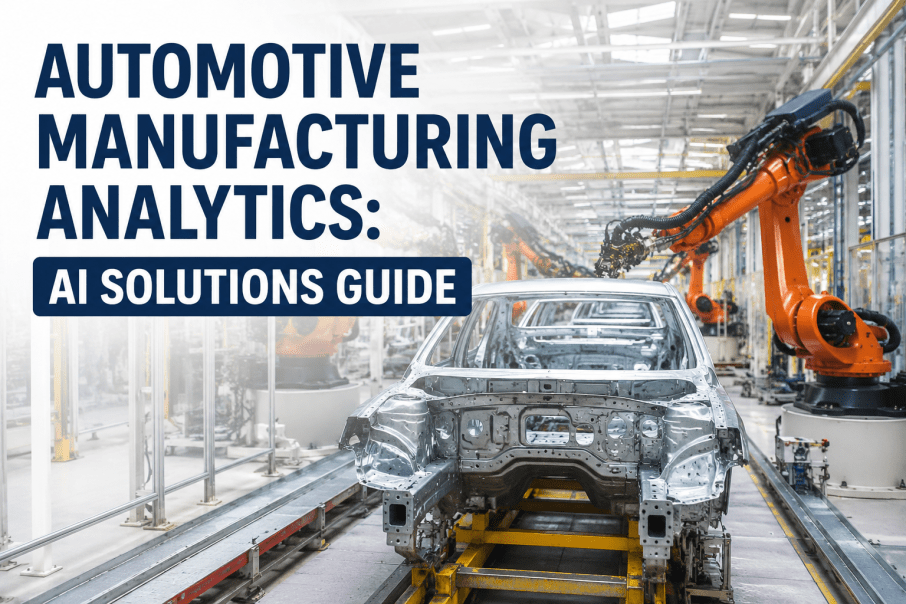
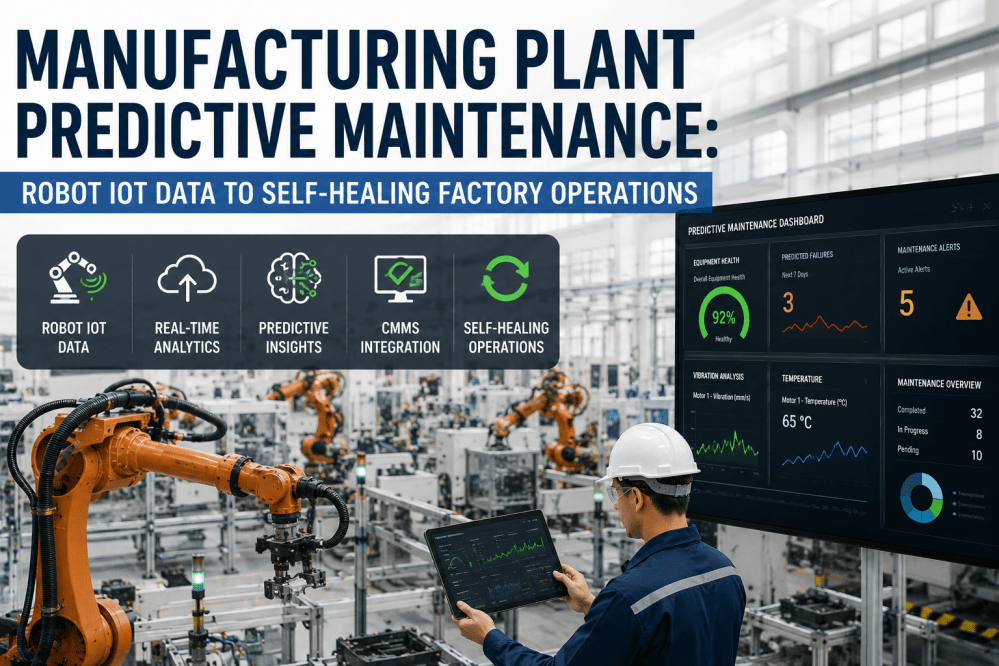
The automotive plant maintenance manager watches the OEE dashboard tick down to 67% on line 3. A transfer press has been down for 22 minutes — the third unplanned stop this shift. Meanwhile, across the plant, the paint shop robotic arm is showing elevated current draw on joint 4, and the final assembly conveyor has a bearing temperature trending chart that crossed the warning threshold two hours ago. No one has flagged either issue. Three months ago, this plant commissioned an AI-powered predictive maintenance pilot covering six critical assets on line 3. The results: OEE climbed from 67% to 82% in 90 days, unplanned downtime dropped 47%, and the maintenance team shifted from reactive firefighting to proactive intervention. This case study examines exactly how that transformation happened — the data sources connected, the models deployed, and the measurable outcomes achieved.
Automotive Plant Improves OEE by 15% with AI-Powered Predictive Maintenance
iFactory AI deployed a predictive maintenance pilot across six critical assets on a Tier 1 automotive plant's line 3 — delivering a 15-percentage-point OEE improvement, 47% reduction in unplanned downtime, and measurable ROI within 90 days of live operations.
Why Line 3 Was Stuck at 67% OEE — and Why Traditional Maintenance Could Not Fix It
The plant's line 3 produced 420 welded subframes per shift for a major North American OEM. The line included six critical assets: a transfer press, a robotic welding cell, a paint booth robotic arm, a final assembly conveyor, a leak test station, and a vision inspection system. Before the iFactory pilot, the maintenance team operated on a reactive model supplemented by calendar-based preventive maintenance. Vibration data was collected quarterly by an external contractor. Temperature readings were taken manually once per week. The OEE of 67% was driven by three root causes: unplanned downtime from unexpected equipment failures, speed loss from degraded assets running below rated throughput, and quality defects from process drift that was detected only at final inspection. The annual cost in lost production capacity was calculated at $1.8 million for line 3 alone.
Lost Production from Unplanned Stops
The transfer press experienced three to five unplanned stops per week, averaging 18 minutes per event. Each minute of downtime on line 3 represented $2,100 in lost contribution margin. Annual cost: $380,000.
Speed Loss from Degraded Equipment
The robotic welding cell was running at 82% of rated speed due to worn servo motor bearings and gas nozzle fouling. Neither condition was detected by the existing maintenance program. Annual cost: $520,000.
Quality Defects from Process Drift
The vision inspection system was rejecting 3.2% of subframes at final test due to weld porosity and dimensional drift that developed over multiple shifts before detection. Annual cost: $900,000 in rework and scrap.
iFactory AI Predictive Maintenance Deployment — Six Assets, One Platform, 90 Days
iFactory deployed its AI-native predictive maintenance platform across the six critical assets on line 3. The deployment followed a structured 90-day roadmap: two weeks for data source connection and model baseline, four weeks for model training and alert threshold calibration, and six weeks of live pilot operations with parallel monitoring to validate accuracy before transitioning to autonomous alerting.
Connect Data Sources
iFactory connected to the Allen-Bradley PLCs, Fanuc robot controllers, and the plant's existing CMMS via OPC-UA and REST APIs. Vibration sensors and temperature probes were installed on six assets where existing instrumentation was insufficient. Total: 42 new data points added.
Train the AI Models
iFactory ingested 90 days of historical vibration, temperature, current draw, and production data to establish baseline signatures for normal operation and known failure modes. The platform learned the specific vibration frequency bands for bearing wear, gear tooth fatigue, and pump cavitation on each asset.
Calibrate Alert Thresholds
During a two-week parallel run, iFactory engineers tuned alert thresholds to balance sensitivity and specificity. The target was 90% detection rate for failure precursors at least 72 hours before production impact, with fewer than one false alert per asset per week.
Transition to Live Operations
With thresholds validated, iFactory transitioned to autonomous alerting. The maintenance team received role-specific alerts via the iFactory dashboard and mobile app — vibration anomaly, temperature exceedance, or current draw deviation with recommended corrective action.
90-Day Outcomes — Measurable Improvement Across Every OEE Metric
The table below compares line 3 performance before the iFactory pilot and after 90 days of live operations. All data was collected from the plant's existing SCADA and CMMS systems, validated by the plant's operations team, and auditable through iFactory's analytics reporting module.
| Metric | Pre-iFactory (Baseline) | Post-iFactory (90 Days) |
|---|---|---|
| Overall Equipment Effectiveness (OEE) | 67% | 82% |
| Unplanned Downtime (hours/month) | 42 hours | 22 hours |
| Mean Time Between Failure (MTBF) | 186 hours | 412 hours |
| Mean Time to Repair (MTTR) | 4.2 hours | 1.8 hours |
| Quality Reject Rate (final inspection) | 3.2% | 0.8% |
| Annualized Cost Savings | Baseline: $1.8M in lost capacity | $720K savings achieved |
You can achieve the same OEE improvement on your production lines — in 90 days, with measurable ROI. See how iFactory deploys predictive maintenance on automotive manufacturing assets using your plant's existing data sources during your demo walkthrough.
Six AI Models Deployed on Automotive Manufacturing Assets
iFactory deployed six distinct AI models, each calibrated to the specific failure modes of the asset it monitored. Every model was production-ready within the 90-day pilot window and required zero configuration by the plant's maintenance team after initial threshold tuning.
Hydraulic System Health Monitoring
Vibration and pressure sensors on the transfer press hydraulic pump detected cavitation onset and valve wear 72 to 96 hours before failure. The model eliminated three of the four unplanned press stops that had occurred monthly before the pilot.
Servo Motor Bearing Degradation Detection
Current draw analysis on six servo motors detected bearing wear by tracking the sideband frequency amplitude in the motor current signature. The model alerted the maintenance team seven days before a bearing failure would have caused a 4-hour weld cell outage.
Joint Wear and Position Drift Monitoring
Vibration analysis on robotic arm joints detected increasing clearance in joint 4 bearings. The platform flagged the condition 12 days before the drift would have caused a paint quality rejection, allowing replacement during planned weekend maintenance.
Bearing Temperature and Lubrication Tracking
Temperature trending on 14 conveyor bearings identified two bearings with rising temperature profiles suggesting lubrication degradation. The maintenance team re-lubricated both during a scheduled break, preventing a conveyor stop that would have idled 22 downstream stations.
Seal Degradation and Pressure Decay Analysis
Cycle-time trending on the leak test station detected a gradual increase in pressurization time caused by seal wear. The model predicted the seal failure window within 48 hours, enabling replacement during a planned changeover rather than causing an unplanned quality hold.
Camera and Lighting Degradation Alerts
Pixel-level analysis of vision system output detected a 12% reduction in illumination intensity from LED ring lights — a condition that was causing false rejections of good parts. The platform flagged the issue and the lights were replaced before any additional false rejects occurred.
Industry Expert Perspective on AI-Powered OEE Improvement
"I have spent my entire career in automotive manufacturing — powertrain, body-in-white, and final assembly — at plants that collectively ship over a million subframes and assemblies per year. The single most frustrating dynamic in every plant I have worked in is that the data needed to predict equipment failures existed somewhere in the operation, but no one was connecting the dots. A vibration spike on the transfer press, a temperature rise on the conveyor bearing, a current draw increase on the weld cell servo — individually they look like noise, but together they tell a story about equipment health that is obvious in hindsight but invisible to a reactive maintenance organization. What impressed me about the iFactory deployment on line 3 was not the AI technology itself — it was the speed with which the platform turned raw sensor data into actionable maintenance decisions. Within six weeks of live operation, the maintenance team was receiving alerts that pointed to specific bearings, specific joints, and specific failure modes with enough advance warning to plan the intervention. The 15-point OEE improvement is real, auditable, and — critically — repeatable. The plant is now expanding the pilot to two additional lines, and I expect similar results based on what I have seen."
AI-Powered Predictive Maintenance Delivers Measurable OEE Improvement
This case study demonstrates that AI-powered predictive maintenance is not a theoretical concept or a long-term roadmap item — it is a production-ready capability that delivers measurable results within a single quarter. The 15-percentage-point OEE improvement on line 3 was achieved through six AI models running on six critical assets, connected to existing PLC and robot controller data sources, deployed in 90 days, and validated against the plant's own SCADA and CMMS data. The plant's maintenance team shifted from reactive firefighting — where 70% of their time was spent responding to unplanned failures — to proactive intervention, where 65% of their time is now spent on planned maintenance driven by iFactory's predictive alerts. The plant is projecting a 7-month payback on the pilot investment based on the $720,000 annual savings achieved in the first 90 days, and expansion to lines 2 and 4 is already underway.
If your plant is running below 80% OEE, the data needed to improve it is already being generated by your equipment. iFactory connects, analyzes, and acts on that data — in 90 days, on your plant network, with measurable ROI. Book a Demo to see a deployment model configured for your specific production assets and OEE improvement targets.
Frequently Asked Questions About AI Predictive Maintenance for OEE Improvement
Ready to Improve Your Plant's OEE by 15% in 90 Days?
The same AI-powered predictive maintenance capability that transformed line 3 from 67% to 82% OEE is available for your production assets — deployed in 90 days, on your plant network, with measurable ROI from month one. Book a demo and we will configure a deployment model for your specific line.