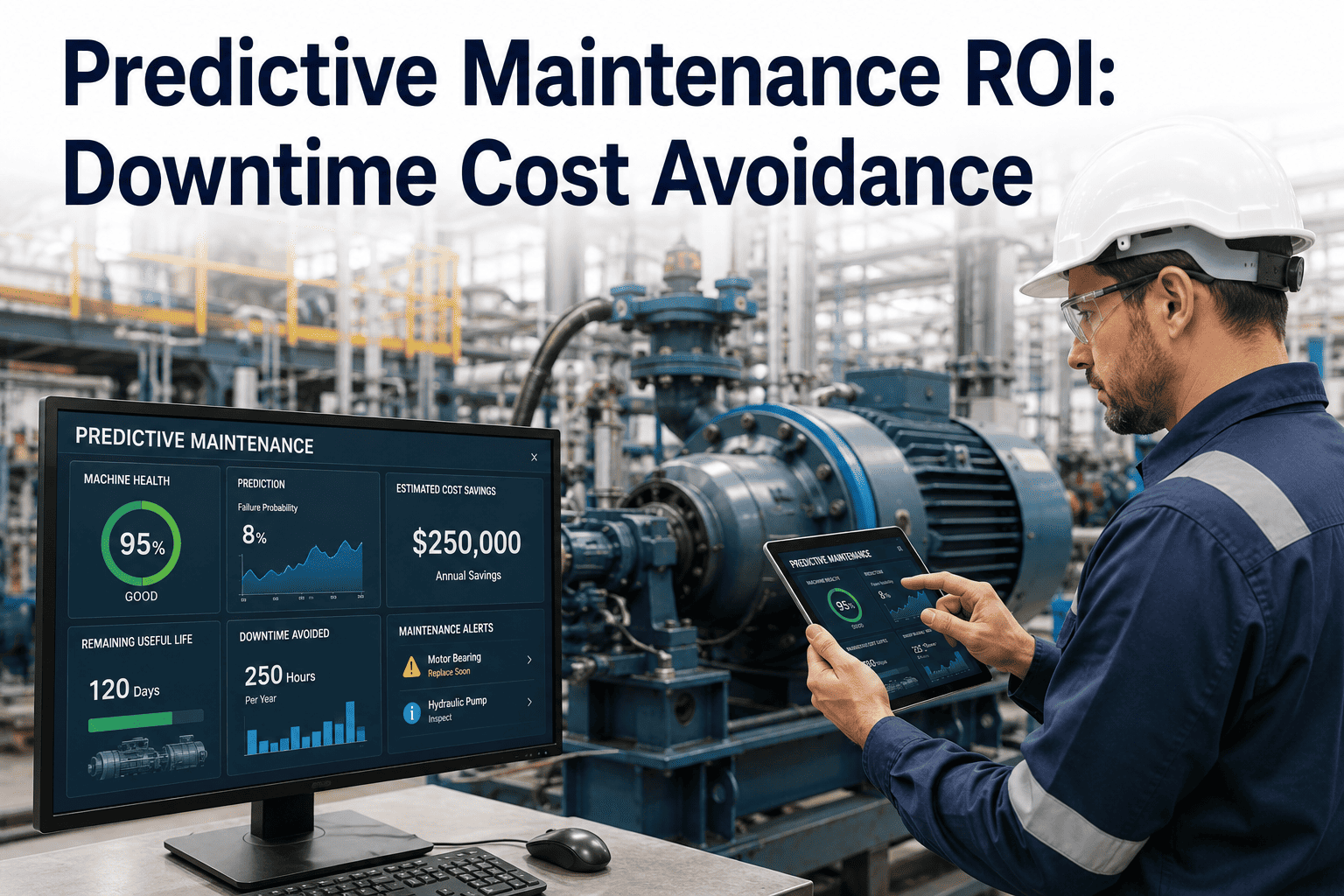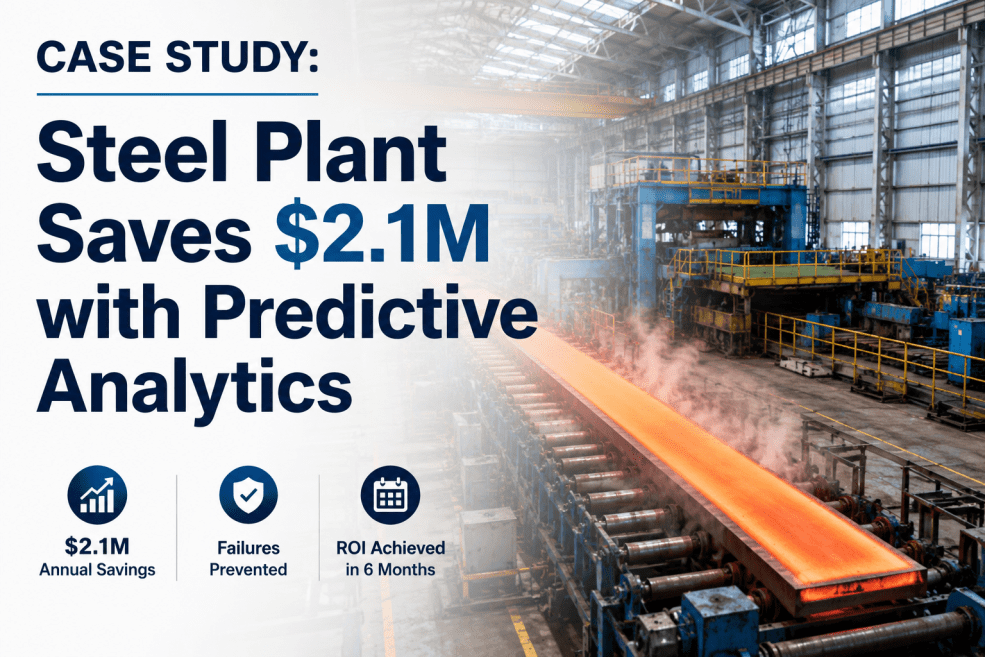
Steel manufacturing runs on relentless thermal cycles, massive rotating equipment, and continuous casting operations where a single bearing failure or refractory breach can idle an entire melt shop for days. For one Midwest U.S. integrated steel producer, unplanned downtime was costing $3.4M per incident, and reactive maintenance consumed 62% of the maintenance budget. This case study examines how the plant deployed iFactory AI's predictive analytics platform across 1,200 critical assets and achieved $2.1M in annual savings with full ROI realized within six months.
Steel Plant Saves $2.1M with Predictive Analytics
AI-powered predictive maintenance, IoT condition monitoring, and rapid ROI at an integrated U.S. steel mill
The $12M Downtime Problem Facing the Plant
The facility, producing 2.8 million tons of finished steel annually, operated five core production areas: coke plant, blast furnace, basic oxygen furnace (BOF), continuous caster, and rolling mill. Prior to the iFactory AI deployment, the plant relied on calendar-based preventive maintenance with limited condition monitoring. Key pain points included unplanned caster tundish failures, blast furnace stove degradation going undetected until leakage occurred, and rolling mill bearing failures that cascaded into extended spall repairs. The average mean time between failures (MTBF) across rotating assets was 47 days, well below the 120-day industry benchmark for integrated mills.
AI-Powered Predictive Maintenance: The Implementation
The deployment followed a structured four-phase approach spanning 14 weeks from kickoff to full production. The iFactory AI team integrated IoT sensors, PLC data streams, and existing CMMS history into a unified predictive analytics engine trained on 18 months of historical failure data.
Want to see how your plant's asset data compares? Book a Demo for a free readiness assessment.
$2.1M Annual Savings: The ROI Breakdown
Within six months of full deployment, the plant documented $1.08M in hard cost avoidance and $1.02M in operational efficiency gains. The table below breaks down savings by category across the first year of operation.
| Savings Category | Annual Impact | Primary Driver |
|---|---|---|
| Averted Caster Tundish Failures | $680,000 | Thermal imaging AI detected refractory erosion 11 days before breach, allowing scheduled replacement during planned outage |
| Reduced Rolling Mill Bearing Spalls | $420,000 | Vibration envelope analysis identified inner-race defects 3 weeks before failure, eliminating 2 catastrophic spall events |
| Blast Furnace Stove Optimization | $310,000 | AI model flagged dome temperature drift 72 hours early; adjusted combustion ratios, avoided refractory crack propagation |
| Eliminated Emergency Overtime Premiums | $250,000 | Shift from reactive to planned maintenance reduced weekend call-ins by 74% |
| Extended Asset Life Through Precision Lubrication | $180,000 | AI-driven oil analysis scheduling reduced gearbox replacements from 7 to 2 annually |
| Improved Production Throughput | $260,000 | OEE availability gain of 9 percentage points from 71% to 80% |
| Total First-Year Savings | $2,100,000 | ROI achieved in month 6 |
How iFactory AI Enabled the Transformation
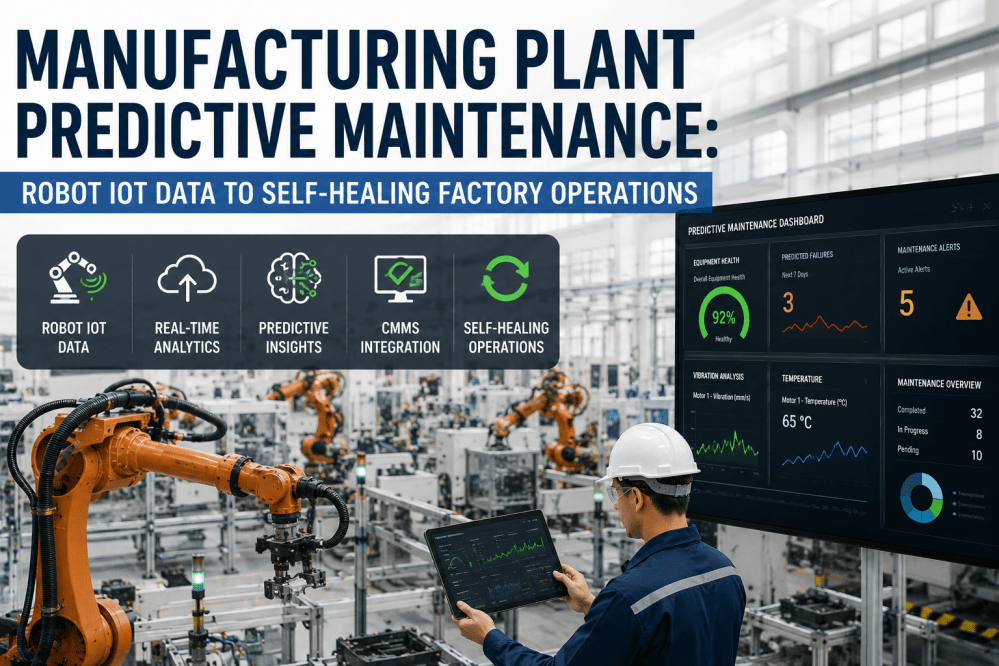
Three core modules of the iFactory AI platform drove the steel plant's predictive analytics program: AI Vision for thermal and visual inspection, Digital Twin for scenario simulation, and the Predictive Maintenance engine for anomaly detection across all asset classes.
Predictive Maintenance Engine
Machine learning models trained on 18 months of failure history detect bearing wear, shaft misalignment, and lubrication degradation up to 21 days before failure. Supports vibration, temperature, current, and acoustic emission inputs.
AI Vision Inspection
Thermal camera feeds at the continuous caster and BOF tap hole are analyzed in real time by computer vision models to detect refractory wear, slag carryover, and hot spots before they become safety incidents.
Digital Twin Simulation
Full-process digital twin models production flow from ironmaking to finishing. Engineers simulate the impact of maintenance decisions on throughput, energy consumption, and emissions before executing work orders.
IoT Sensor Integration
Pre-configured connectors for 40+ industrial protocols including OPC-UA, MODBUS, Profinet, and IO-Link. Wireless mesh network supports up to 2,000 sensor nodes per plant without additional infrastructure.
Expert Review
"The steel industry has been running reactive maintenance for so long that many plant managers have normalized $3M failure events as 'the cost of doing business.' What this case study proves is that the data to predict these failures already exists in the PLCs and historian systems — it just needs the right AI layer to make it actionable. The 47-day to 132-day MTBF improvement documented here aligns with what I have seen across three mills using iFactory AI's platform. The key enabler is the model training on plant-specific failure data rather than generic benchmarks. That specificity is what delivers the 6-month payback instead of the 18-month payback you see with blanket CBM programs."
Conclusion
The $2.1M annual savings achieved by this integrated steel plant demonstrates that AI-powered predictive analytics is not a theoretical exercise for heavy industry — it is a measurable, repeatable operational improvement strategy. By shifting from calendar-based to condition-based maintenance across 1,200 critical assets, the plant reduced unplanned downtime by 86 percent, extended mean time between failures from 47 to 132 days, and recovered full platform investment within six months. For plant managers and reliability engineers evaluating predictive maintenance platforms, the deciding factor is no longer whether the technology works — it is how quickly it can be trained on your specific asset population and failure history.
Ready to build your business case for predictive analytics in your steel operation? Book a Demo with iFactory AI's industrial team.
Frequently Asked Questions
Start Your Predictive Analytics Journey
iFactory AI helps steel producers and heavy industrial plants reduce unplanned downtime, extend asset life, and achieve measurable ROI within months — not years.