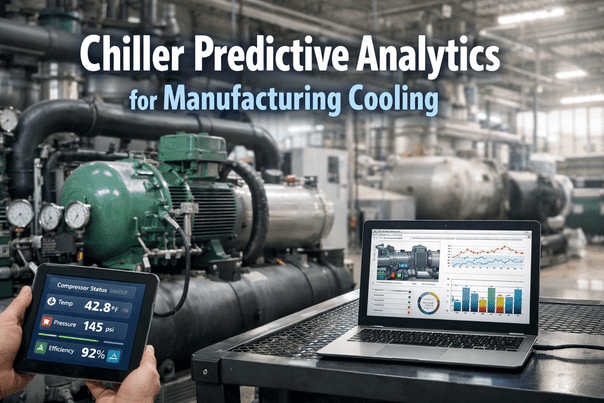
Industrial chillers are the backbone of process cooling in manufacturing plants — and the single most expensive system to lose without warning. Refrigerant leaks account for 25 to 30% of all chiller service calls, tube fouling is the number one cause of water-cooled chiller problems, and 75% of chiller failures are fully preventable with structured monitoring. Yet most manufacturing plants still manage chillers reactively: responding to alarms, scheduling fixed-interval services, and discovering compressor degradation only after efficiency has already collapsed. A compressor replacement runs $15,000 to $150,000. A 500-ton chiller replacement costs $250,000 to $500,000 with lead times stretching 16 to 24 weeks. iFactory's AI-powered chiller predictive analytics platform monitors compressor health, refrigerant charge, condenser fouling, and approach temperatures continuously — detecting degradation patterns weeks before they cascade into unplanned production stops. Book a demo to see iFactory chiller monitoring live.
Chiller Failure Modes iFactory Detects Before They Cause Production Stops
Manufacturing chillers degrade through interconnected mechanical, refrigerant, and heat transfer mechanisms. A single undetected issue — low refrigerant charge, developing condenser fouling, or compressor bearing wear — cascades into capacity loss and eventual shutdown. iFactory monitors all four failure pathways simultaneously.
iFactory Chiller Monitoring Parameters: What We Track Continuously
Manufacturing chiller performance is determined by a suite of interdependent parameters. iFactory monitors every critical signal and connects trending data to predictive models that identify failure patterns before any individual parameter breaches its alarm limit.
How iFactory Chiller Predictive Analytics Works: The Platform Workflow
From sensor connection to maintenance action in four stages. iFactory eliminates the gap between chiller data and maintenance response that reactive operations accept as normal — converting raw process data into specific, costed recommendations before any threshold is breached.
- Connect iFactory to existing BMS, SCADA, or standalone chiller controllers via OPC-UA, BACnet, MQTT, or REST API
- Register each chiller in iFactory with make, model, capacity, refrigerant type, and design operating parameters
- Establish baseline performance profiles for each chiller across its full load range
- Set parameter-specific alert thresholds calibrated to your chiller's manufacturer specifications
- AI models build chiller-specific performance fingerprints from continuous sensor data across all operating conditions
- Approach temperature trending begins identifying fouling development independent of any single-point alarm
- Refrigerant charge tracking calculates performance deviation from expected charge curve at current conditions
- Compressor health index calculated from motor current, vibration, and discharge temperature combined
- AI generates failure probability scores per chiller with time-to-threshold estimates for each monitored parameter
- Cost-of-inaction calculations show the financial impact of deferring each flagged intervention
- Maintenance work orders auto-generate with sensor trend data, failure mode identification, and recommended action pre-populated
- Mobile alerts notify technicians with specific readings, deviations, and priority classification
- Maintenance teams receive completed pre-diagnostic context — no manual data gathering before every service event
- Each completed work order feeds back into the AI model, improving prediction accuracy over time
- Energy optimisation recommendations — load sequencing, condenser water temperature reset, part-load staging
- CapEx forecasting updates automatically as chiller condition scores accumulate maintenance and performance history
Technology Stack: What Powers iFactory Chiller Analytics
Four integrated technology layers convert raw chiller sensor data into production-protecting maintenance intelligence — from AI pattern recognition that detects fouling weeks ahead, to digital twins that forecast compressor replacement schedules with 18 to 36 month visibility.
Results: What Manufacturing Plants Achieve with iFactory Chiller Analytics
These benchmarks reflect outcomes from manufacturing facilities that transitioned from periodic chiller inspection to iFactory continuous monitoring. Results measured within 12 months of deployment.
Platform Comparison: iFactory vs Competitors for Chiller Predictive Analytics
Chiller monitoring capability varies dramatically across manufacturing analytics platforms. This comparison evaluates leading solutions on the capabilities that determine whether predictive analytics actually prevents cooling failures in production environments.
| Platform | Chiller AI Analytics | Refrigerant Monitoring | Fouling Detection | BMS Integration | Energy Optimisation | Work Order Auto-Gen | Deploy Time |
|---|---|---|---|---|---|---|---|
| iFactory Best Fit | Full AI + digital twin | Continuous charge tracking | Approach temp trending | BACnet, OPC-UA, MQTT | kW/ton + staging | Auto with context | Days |
| Siemens Insights Hub | Good — Siemens assets | Partial | Via rule config | Native Siemens | Partial | Requires config | 6 to 12 weeks |
| TRACTIAN | Vibration-focused | Not available | Not available | Limited | Not available | Good | 2 to 4 weeks |
| Augury | Rotating equipment focus | Not native | Not available | Limited | Not available | Partial | 3 to 6 weeks |
| C3 AI Manufacturing | Broad — custom build | Custom development | Custom rules | Multi-protocol | Custom | Custom | 3 to 12 months |
| Fiix (Rockwell) | Not available | Not available | Not available | Limited | Not available | Good | 2 to 4 weeks |
| MaintainX | Not available | Not available | Not available | Not available | Not available | Good | 1 to 2 weeks |
| Limble CMMS | Not available | Not available | Not available | Basic | Not available | Good | 1 to 2 weeks |
| Fracttal | Basic IoT analytics | Not available | Not available | Partial | Not available | Partial | 2 to 4 weeks |
| Plex Manufacturing Cloud | ERP-linked analytics | Not native | Not available | Partial | Basic | Partial | 8 to 16 weeks |
| SafetyCulture (iAuditor) | Not available | Not available | Not available | Not available | Not available | Checklist-based | 1 week |
| Mingo Smart Factory | OEE-focused | Not available | Not available | Limited | Basic energy | Partial | 2 to 3 weeks |
Full: native out-of-box capability. Partial: requires configuration or custom build. Not available: not in current product.
Regional Compliance: How iFactory Supports Chiller Regulations Across Your Markets
Industrial chiller operations face specific regulatory obligations in each major manufacturing market — covering refrigerant management, energy performance, and safety documentation. iFactory generates the records these obligations require directly from daily monitoring operations.
| Region | Key Regulations | Chiller-Specific Requirements | iFactory Coverage |
|---|---|---|---|
| USA | EPA 608, ASHRAE 15 and 34, Section 608 refrigerant management, OSHA 29 CFR 1910.119 (PSM), DOE energy efficiency standards, EPA F-Gas reporting | Certified technician requirements for refrigerant handling, mandatory leak detection systems for systems over 50 lbs charge, EPA 608 refrigerant log maintenance, ASHRAE 15 safety relief valve documentation | EPA 608 refrigerant log auto-populated from monitoring data, leak detection alert records, ASHRAE 15 safety inspection scheduling, DOE efficiency compliance trending, OSHA PSM documentation |
| UAE | UAE Cooling Act, ESMA regulations, Civil Defence cooling system requirements, Dubai Municipality energy standards, Abu Dhabi Estidama Pearl rating, OSHAD-SF | District cooling integration compliance, ESMA-approved refrigerant requirements, Civil Defence documentation for cooling systems in commercial buildings, energy performance certificates under Dubai Green Building Regulations | UAE Cooling Act compliance documentation, ESMA refrigerant tracking, Civil Defence inspection records, Estidama energy performance data exports, OSHAD-SF maintenance records |
| United Kingdom | F-Gas Regulation (UK), HSE ACoP L8 (Legionella), RIDDOR for refrigerant incidents, Energy Savings Opportunity Scheme (ESOS), Building Safety Act 2022 | F-Gas quarterly leak checks for systems over 300 kg CO2-equivalent charge, certified engineer documentation, L8 cooling tower risk assessments, ESOS energy audit data requirements | UK F-Gas leak check scheduling and records, L8 compliance inspection scheduling, ESOS energy audit data exports, HSE-compliant maintenance records, Building Safety documentation |
| Canada | Environment Canada National Inventory Report, ODS and HFCs Regulations, provincial OHS codes, CSA B52 Mechanical Refrigeration Code, BOMA Canada energy standards | CSA B52 compliance for refrigeration system design and maintenance, provincial OHS lockout/tagout documentation for chiller servicing, refrigerant tracking under ODS regulations | CSA B52 maintenance records, provincial OHS documentation, ODS refrigerant tracking, BOMA energy performance data, multi-province portfolio compliance dashboard |
| Europe (EU/Germany) | EU F-Gas Regulation 2024/573, EN 378 Refrigerating Systems, BetrSichV, ISO 14001 environmental management, EPBD energy performance, CSRD sustainability reporting | EU F-Gas mandatory leak detection for systems over 500 tonnes CO2-equivalent, certified technician records, EN 378 safety documentation, annual F-Gas reporting to national registries | EU F-Gas reporting automation, EN 378 safety inspection scheduling, BetrSichV maintenance records, CSRD-aligned energy and refrigerant data exports, GDPR-compliant data handling |