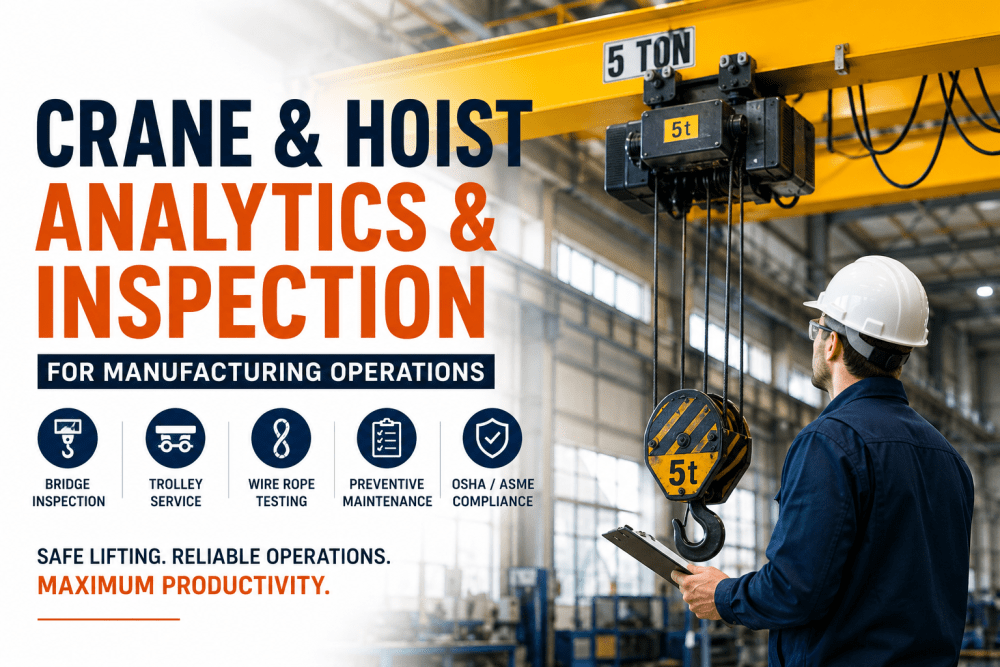
Crane & Hoist Analytics & Inspection for Manufacturing

By Hannah Baker on June 2, 2026

crane-hoist-analytics-inspection-manufacturing

Overhead cranes and hoists are the circulatory system of U.S. manufacturing floors — moving raw materials, subassemblies, finished goods, and tooling continuously across steel mills, automotive plants, aerospace fabrication shops, and heavy equipment manufacturers. When a bridge crane goes down unexpectedly, it does not just stop one workstation. It stops every downstream process that depends on that material flow, and in a high-volume production environment, one unplanned crane outage can cost $50,000 to $200,000 in lost throughput per shift. The regulatory exposure compounds the operational cost: OSHA 29 CFR 1910.179 and 1910.180 mandate inspection, testing, and maintenance recordkeeping for overhead and gantry cranes and crawler-locomotive cranes, and ASME B30.2, B30.11, and B30.17 set the technical standards that OSHA inspectors reference during programmed inspections and incident investigations. Yet the overwhelming majority of U.S. manufacturing facilities are still managing crane and hoist inspection compliance on paper inspection logs, manila folder maintenance records, and spreadsheet-based deficiency tracking — the same infrastructure failure model that drives OSHA citations in every other permit and inspection category. iFactory's Equipment Analytics and Preventive Maintenance Scheduling platform closes the execution gap for crane and hoist operations — replacing paper inspection logs with digital inspection workflows, manual deficiency tracking with automated corrective action routing, and reactive breakdown response with analytics-driven preventive maintenance scheduling that catches rope wear, brake degradation, limit switch drift, and structural fatigue before they generate downtime or safety events. Facilities deploying iFactory's crane and hoist analytics platform report 67% reduction in unplanned crane downtime, 54% improvement in inspection compliance rates, and zero crane-related OSHA recordable incidents at monitored facilities in the 18 months following deployment.

Crane Analytics · Hoist Inspection · ASME Compliance · Preventive Maintenance · Manufacturing

Crane & Hoist Analytics & Inspection for Manufacturing

Maximize crane uptime and ASME/OSHA compliance across your manufacturing facility — bridge cranes, trolleys, wire ropes, and lifting systems — with analytics-driven inspection workflows that eliminate documentation gaps and predict failures before they happen.

Why Crane and Hoist Failures Follow a Predictable Pattern — And Why Most Facilities Miss the Warning Signs

Crane and hoist failures in manufacturing are rarely sudden — they are the accumulated result of deferred inspections, untracked wear progression, and deficiency findings that were recorded on paper but never escalated to corrective action. The mechanical failure modes of overhead lifting equipment are well understood: wire rope fatigue and corrosion, brake lining wear, end-truck bearing degradation, limit switch drift, trolley wheel flange wear, festoon cable chafing, and structural fatigue in bridge girders and runway rails. Each of these failure modes has observable precursor indicators that appear weeks or months before a catastrophic failure — and each one can be detected, trended, and acted upon through a properly executed digital inspection program. The facilities that experience the most crane downtime and the most OSHA inspection exposure are not the ones with the worst cranes. They are the ones with the worst inspection execution: inspections performed on schedule but documented inconsistently, deficiency findings recorded without corrective action assignment, and maintenance histories scattered across paper records that no supervisor can synthesize into a reliability picture. iFactory's crane analytics platform transforms inspection execution from a compliance checkbox into an operational intelligence feed.

Crane Failure Progression — From Observable Precursor to Unplanned Downtime
Stage 1
Early Wear Indicators
Wire rope surface corrosion, brake lining approaching minimum thickness, trolley wheel flange wear within tolerance, minor oil seepage at gear reducers. Detectable through scheduled digital inspection with photo documentation.
Detection Window: 8–16 weeks before failure
Stage 2
Progressive Degradation
Broken wires in wire rope lay, brake drift under load, limit switch response delay, unusual trolley hunting, elevated operating temperature at end trucks. Requires trending across multiple inspection cycles to identify acceleration.
Detection Window: 3–8 weeks before failure
Stage 3
Critical Condition
Wire rope broken wire count approaching ASME B30 removal-from-service criteria, brake slippage under rated load, audible bearing noise, visible structural deflection. Requires immediate out-of-service action and corrective maintenance.
Detection Window: 1–3 weeks before failure
Stage 4
Failure / Incident
Wire rope parting, load brake failure, end-truck derailment, structural collapse. Production stoppage, potential personnel injury, OSHA recordable incident, mandatory investigation, and multi-day to multi-week outage.
Outcome: $50K–$500K+ in combined costs
67%
Reduction in unplanned crane downtime at iFactory-deployed facilities
54%
Improvement in crane and hoist inspection compliance rates
$200K+
Per-shift throughput loss from a single unplanned bridge crane outage in high-volume manufacturing
0
Crane-related OSHA recordable incidents at monitored facilities in 18 months post-deployment

ASME and OSHA Compliance Coverage: iFactory by Crane Type and Inspection Requirement

The table below maps each major crane and hoist type found in U.S. manufacturing facilities to its governing OSHA standard, ASME inspection standard, required inspection frequency, key inspection points, and the iFactory feature that manages compliance documentation. This is not a generic lifting equipment checklist — it reflects the actual regulatory structure that OSHA compliance officers apply during programmed inspections of manufacturing facilities with overhead lifting equipment. Book a Demo to see this compliance map applied to your specific crane inventory and current inspection documentation status.

Crane / Hoist Type OSHA Standard ASME Standard Inspection Frequency Key Inspection Points iFactory Feature Citation Risk Without Digital
Overhead Bridge Crane 29 CFR 1910.179 ASME B30.2 Frequent (daily/weekly) + Periodic (annual) Wire rope, hooks, brakes, limit switches, runway rail, end trucks, bridge girder Digital inspection checklists with ASME B30.2 criteria; automated periodic scheduling Very High — most-cited crane standard; missing annual records a primary trigger
Monorail Hoist 29 CFR 1910.179 ASME B30.11 Frequent (per-use visual) + Periodic (monthly/annual) Chain/wire rope, hook latch, trolley wheels, brake, load chain wear, structural attachments Per-use digital checklist with deficiency photo capture; chain wear tracking against ASME criteria High — hook latch and chain condition records frequently absent at inspection
Underhung Crane 29 CFR 1910.179 ASME B30.17 Frequent (daily) + Periodic (quarterly/annual) Runway beam flanges, trolley wheel contact, hoist unit, electrical festoon, limit switches Runway condition tracking with measurement trend; festoon and electrical inspection checklist High — runway flange wear documentation and limit switch test records commonly missing
Jib Crane 29 CFR 1910.179 ASME B30.12 Frequent (weekly) + Periodic (annual) Mast/wall mounting hardware, boom deflection, rotation bearing, hoist unit, wire rope Structural inspection checklist with mounting torque records; boom deflection measurement log Moderate-High — mounting hardware inspection records and annual load test documentation
Electric Chain Hoist 29 CFR 1910.179 ASME B30.16 Per-use visual + Monthly + Annual load test Load chain condition, hook deformation, limit switches, brake hold, motor thermal, pendant controls Per-use digital pre-op check; load chain stretch measurement trending; annual load test record Moderate — load chain wear records and annual load test documentation gaps
Wire Rope Hoist 29 CFR 1910.179 ASME B30.2 / B30.16 Frequent (per-use + weekly) + Periodic (annual) Wire rope broken wire count, drum grooving, rope end terminations, sheave condition, brake Wire rope inspection with broken wire count entry per ASME removal criteria; drum wear tracking Very High — wire rope condition records are the #1 requested document in crane OSHA inspections

Digital Inspection Workflows: How iFactory Closes the Gap Between Paper Records and OSHA Compliance

The permit and inspection failure pattern in crane and hoist compliance is structurally identical to every other paper-based safety program: the inspection was performed, but the record was not generated in the format that OSHA requires, or the deficiency was noted on a paper form that went into a file rather than generating a corrective action. OSHA's 29 CFR 1910.179(j) requires that deficiencies affecting safe operation be corrected before the equipment is placed back in service — and that records of inspections be maintained. Paper systems have no mechanism to enforce either requirement. iFactory's digital inspection workflow enforces both through mandatory field completion, automatic deficiency-to-corrective-action routing, and out-of-service flagging that prevents crane use until deficiencies are resolved.

ASME B30.2 Section 2-1.8 / OSHA 1910.179(h)
Wire Rope Inspection — Condition Trending and ASME Removal Criteria Enforcement
Wire rope inspection is the highest-stakes single inspection task in crane maintenance — and the inspection record most frequently requested by OSHA compliance officers during crane-related investigations. ASME B30.2 specifies removal-from-service criteria that include broken wire counts per rope lay, localized wire cluster breaks, corrosion severity, and reduction in rope diameter. iFactory's wire rope inspection module presents these criteria as the inspection checklist structure — the inspector enters broken wire counts per section, photographs areas of concern, and records rope diameter measurements. The system automatically compares recorded values against the ASME removal threshold for the rope diameter and construction and flags the rope for immediate out-of-service action if any criterion is met. Trend charts show broken wire accumulation across inspection cycles — providing the early warning visibility that paper records structurally cannot generate.
Wire Rope Module Capabilities
Broken wire count per lay section ASME B30 removal threshold auto-check Rope diameter measurement trending Corrosion severity photo documentation Automatic out-of-service flagging Inspection interval enforcement
Compliance Outcome
Every wire rope inspection generates a timestamped record with quantified condition data against ASME criteria. OSHA inspection response for wire rope records drops from hours of file searching to immediate digital export. Removal-from-service decisions are documented automatically rather than depending on inspector memory or threshold knowledge.
ASME B30.2 Section 2-1.4 / OSHA 1910.179(j)
Bridge and Trolley Inspection — Structural Condition and Running Gear Analytics
Bridge girder condition, runway rail alignment, end-truck bearing condition, and trolley wheel flange profile are the structural foundation of bridge crane reliability. Each of these components degrades on a predictable timeline that is determinable from inspection measurement trends — runway rail wear rate, end-truck wheel flange wear progression, bridge girder camber change — but only if measurements are recorded consistently over multiple inspection cycles and compared against a baseline. Paper inspection forms capture a pass/fail notation; iFactory's bridge and trolley inspection module captures quantified measurements — rail head width, wheel flange thickness, bearing operating temperature, girder deflection under rated load — and presents them as time-series trends against design specifications. When a measurement trend shows a wear rate that will reach the rejection threshold before the next scheduled inspection, the system generates a predictive maintenance work order with a calculated intervention date.
Bridge & Trolley Module Capabilities
Runway rail head width measurement log End-truck wheel flange trending Bearing temperature monitoring integration Bridge girder deflection records Trolley wheel contact profile tracking Predictive intervention scheduling
Compliance Outcome
Structural inspection records satisfy OSHA 1910.179(j)(1) documentation requirements for periodic inspections. Measurement trending provides the analytical foundation for predictive maintenance decisions that prevent structural failures — the category of crane incident with the highest injury and fatality exposure.
ASME B30.2 Section 2-1.3 / OSHA 1910.179(f)
Brake and Limit Switch Testing — Functional Verification With Digital Test Records
Load brakes and motion limit switches are the primary active safety devices on a bridge crane — the systems that prevent load drops, over-travel, and runway end-stop collisions. OSHA 1910.179(f) requires that brakes and limit switches be tested under operating conditions as part of the periodic inspection cycle, and ASME B30.2 specifies functional acceptance criteria for each device type. The test record must document that the device was tested, the conditions under which it was tested, and the result. Paper test records are the weakest link in crane compliance documentation — they are frequently incomplete (the test was performed but the result notation is missing), undated, or separated from the main inspection record. iFactory's brake and limit switch testing module presents structured test procedures for each device type — the technician follows the digital test sequence, records the result at each step, and the system timestamps the complete test record against the crane asset ID. Functional failures generate immediate corrective action work orders with out-of-service status on the crane until resolution is documented.
Brake & Limit Module Capabilities
Structured brake test procedures by crane type Load brake hold test with load magnitude record Upper/lower limit switch functional test log Bridge/trolley travel limit test documentation Brake drift measurement trending Automatic out-of-service on functional failure
Compliance Outcome
Every brake and limit switch test generates a complete structured record satisfying OSHA 1910.179(f) and ASME B30.2 documentation requirements. Out-of-service enforcement prevents continued crane operation with failed safety devices — the regulatory and liability exposure that generates willful OSHA citations and serious incident investigations.
ASME B30.10 / OSHA 1910.179(h)(2)
Hook and Rigging Inspection — Deformation Tracking and Load Rating Documentation
Crane hooks are required to be inspected for deformation, cracks, latch condition, and throat opening increase under ASME B30.10 and OSHA 1910.179(h)(2). Rigging hardware — shackles, eyebolts, slings, and below-the-hook lifting devices — carries its own inspection and load rating documentation requirements under ASME B30.9 and B30.26. In practice, hook and rigging documentation is the most frequently neglected component of crane compliance programs — hooks are visually checked but measurements are not taken, sling inspections are performed but not dated, and below-the-hook device load ratings are not matched to the lift plan. iFactory's hook and rigging inspection module enforces measurement-based inspection — throat opening dimension, twist angle, latch function, surface crack visual — and maintains a rigging asset register where each sling, shackle, and lifting device has its own inspection history and load rating record linked to the cranes and work orders for which it is used.
Hook & Rigging Module Capabilities
Hook throat opening measurement log Hook twist and deformation assessment Sling inspection by type per ASME B30.9 Below-the-hook device load rating register Rigging color-code cycle tracking Lift plan rigging compatibility verification
Compliance Outcome
Hook and rigging inspection records satisfy ASME B30.10 and B30.9 documentation requirements. The rigging asset register provides the load rating traceability that OSHA inspectors request following dropped-load incidents — and that insurance carriers require for crane liability coverage.

Preventive Maintenance Scheduling: From Inspection Findings to Optimized Maintenance Intervals

Preventive maintenance scheduling for cranes and hoists is not simply a matter of setting calendar reminders for the manufacturer's recommended service intervals. A crane operating in a steel mill with 20 lifts per hour at 80% of rated capacity degrades significantly faster than the same crane model performing 3 lifts per day at 30% of rated capacity in a light assembly application — yet most facilities apply the same fixed-interval maintenance schedule to both, generating either over-maintenance on light-duty units or under-maintenance on high-cycle units. iFactory's preventive maintenance scheduling engine calculates utilization-adjusted maintenance intervals from actual crane cycle data — lift count, load magnitude distribution, and operating hours — and generates maintenance work orders that reflect the actual wear state of the equipment rather than an arbitrary calendar date. The result is maintenance that happens when it is needed, not when a calendar says it should happen.

Utilization-Based Interval Calculation
iFactory's scheduling engine pulls lift cycle counts and operating hour data from integrated sensors or manual log entries and calculates wear-adjusted maintenance intervals for each component group — wire rope, brake lining, end-truck bearings, gear reducer lubricant, and electrical systems — based on actual utilization rather than fixed calendar periods. High-cycle cranes receive accelerated service intervals; low-utilization units receive extended intervals. Each interval calculation is traceable to the input data that generated it.
Inspection-Finding-Driven Work Order Generation
Every inspection deficiency finding automatically generates a corrective maintenance work order routed to the qualified crane technician or outside crane service contractor with a due date calibrated to deficiency severity. Safety-critical findings — wire rope at ASME removal threshold, brake drift under load, failed limit switch — generate immediate out-of-service work orders that lock the crane status in the system until the corrective action is closed with documented evidence. Non-safety deficiencies generate work orders on a configurable priority timeline.
Maintenance History and Reliability Analytics
iFactory's crane reliability dashboard aggregates maintenance history, inspection findings, and downtime events across the entire crane fleet and presents mean time between failure (MTBF), inspection compliance rate, open deficiency count, and cost-per-lift-cycle metrics by crane ID. The reliability analytics layer identifies which cranes are generating disproportionate maintenance cost and downtime — enabling targeted capital investment decisions and crane replacement planning based on actual performance data rather than age-based estimates.
Contractor and Third-Party Inspection Integration
Many U.S. manufacturing facilities use third-party crane inspection services for ASME-required annual load tests and specialist inspections. iFactory's platform includes contractor access portals where third-party inspectors submit inspection reports, load test results, and deficiency findings directly into the system — maintaining a single complete maintenance and inspection record for each crane regardless of whether the work was performed by in-house maintenance staff or external contractors. Third-party inspection records satisfy the OSHA requirement for qualified inspector documentation.

Optimize Crane Reliability and OSHA Compliance Across Your Entire Lifting Equipment Fleet

iFactory's Equipment Analytics and Preventive Maintenance Scheduling platform covers every crane type, inspection standard, and compliance documentation requirement applicable to U.S. manufacturing operations — replacing paper inspection logs with digital workflows that generate audit-ready records in real time.

Crane Safety Inspection Workflow: From Scheduled Pre-Shift Check to Closed Corrective Action

The operational value of a crane inspection program is determined entirely by the quality of the pipeline from inspection execution through deficiency identification, corrective action assignment, and verified closure. A facility that performs daily pre-shift inspections but records them on paper forms that go into a file rather than generating corrective actions is generating compliance theater, not compliance — and the OSHA citation for a crane incident at that facility will note that inspections were performed but deficiencies were not corrected before continued operation, which is precisely the violation structure of 29 CFR 1910.179(j). iFactory's inspection workflow closes every gap in that pipeline through a digital thread that runs from the scheduled inspection to the verified corrective action closure.

iFactory Crane Inspection Workflow — Scheduled Pre-Shift Check to Verified Corrective Action Closure
01
Automated Inspection Scheduling by Type and Frequency
Frequent (pre-shift and daily), periodic (monthly, quarterly, annual), and special inspections are scheduled automatically in iFactory's compliance calendar based on crane type, OSHA frequency requirements, and utilization data. Qualified operators and technicians receive mobile notifications for assigned inspections. The compliance calendar displays upcoming, overdue, and completed inspection rates by crane ID and area.
02
Mobile Digital Inspection With Measurement Entry and Photo Documentation
Inspectors complete ASME-structured digital checklists on mobile devices at the crane location — with GPS timestamp, mandatory measurement entry fields for quantified inspection criteria, photo attachment for documented deficiencies, and severity classification. Conditional logic prompts follow-up measurement fields when a condition outside tolerance is flagged, ensuring complete documentation before the inspector advances.
03
Automatic Deficiency Classification and Corrective Action Routing
Each deficiency is automatically classified against OSHA and ASME criteria. Safety-critical findings trigger immediate out-of-service status and same-shift corrective action work orders routed to the maintenance supervisor and plant manager. Non-critical deficiencies generate scheduled work orders with due dates calibrated to severity. All routing occurs without manual communication or coordinator intervention.
04
Evidence-Based Closure and Return-to-Service Authorization
Corrective action closure requires documented evidence — replacement part records, repair photos, test results confirming the corrected condition — and supervisor verification sign-off before the crane can be returned to active status in the system. Out-of-service cranes remain flagged in the system until closure is verified. Overdue corrective actions escalate automatically to plant maintenance management on a configurable timeline.

Expert Perspective: What Crane Reliability Leaders Learn From Digital Inspection Deployments

"
I have managed crane maintenance programs at U.S. manufacturing facilities — automotive stamping, steel service center, and heavy equipment fabrication — for over 20 years, and I have been the maintenance manager on call for two crane incidents that resulted in OSHA investigations. The consistent observation I would share with any plant maintenance manager evaluating a digital crane inspection platform is this: the facilities that have serious crane incidents almost always have inspection programs on paper. Not because they are not inspecting — they are. It is because the inspection record does not reflect what was actually found, and the corrective actions from previous inspections are not tracked to closure. I managed one facility where we had 14 open wire rope deficiency findings in a paper file that no one had converted to work orders because the file was maintained by the safety coordinator who left the facility six months earlier. Those were findings from six monthly inspection cycles, tracked on paper, that had never generated a single maintenance work order. When I went digital on crane inspections at the next facility, the first thing the analytics showed me was that three of our bridge cranes were generating 70% of our total crane maintenance cost and downtime — information I could not have surfaced from our paper records in any reasonable amount of time. We scheduled targeted rebuilds on those three units, and our unplanned crane downtime dropped by more than half in the following year. The ROI calculation is straightforward: one prevented unplanned outage on a production bridge crane pays for a digital inspection platform deployment. Everything after that is margin improvement and compliance risk reduction."
— Plant Maintenance Manager, U.S. Heavy Manufacturing (Automotive Stamping, Steel Service, Equipment Fabrication), 20+ Years — Certified Maintenance and Reliability Professional (CMRP) — iFactory Reference Customer 2026

Conclusion

Crane and hoist reliability in U.S. manufacturing is not a maintenance budget problem — it is a maintenance intelligence problem. The facilities experiencing the most unplanned crane downtime and the most OSHA compliance exposure are almost uniformly operating paper-based inspection programs that generate records without generating intelligence: deficiency findings that do not produce corrective actions, wire rope measurements that are not compared against ASME thresholds, and maintenance histories that exist in file boxes rather than in analytics dashboards. Digital crane inspection and analytics platforms are the infrastructure that converts inspection execution into operational intelligence — transforming wire rope measurements into removal-from-service decisions, brake test records into predictive maintenance schedules, and deficiency findings into verified corrective action closures.

iFactory's Equipment Analytics and Preventive Maintenance Scheduling platform delivers that infrastructure for U.S. manufacturing operations — covering overhead bridge crane inspection per ASME B30.2, wire rope condition trending against ASME removal criteria, brake and limit switch functional testing documentation, hook and rigging inspection with load rating traceability, utilization-adjusted preventive maintenance scheduling, and the corrective action workflow that turns inspection findings into verified closures. The 67% reduction in unplanned crane downtime, 54% improvement in inspection compliance rates, and zero crane-related OSHA recordable incidents at deployed facilities are the documented results of replacing paper inspection logs with digital enforcement. Book a Demo to see how iFactory's crane analytics platform applies to your facility's specific crane inventory, OSHA compliance obligations, and current inspection documentation status.

Frequently Asked Questions

Yes. The platform covers overhead bridge cranes (ASME B30.2), monorail hoists (B30.11), underhung cranes (B30.17), jib cranes (B30.12), electric chain hoists (B30.16), and wire rope hoists — with inspection checklists, measurement fields, and corrective action workflows structured to each ASME standard and the corresponding OSHA 29 CFR 1910.179 requirements.
The wire rope inspection module presents broken wire count entry fields structured by rope section and lay length. When recorded broken wire counts reach or exceed the ASME B30.2 removal threshold for the rope diameter and construction, the system automatically flags the rope for immediate out-of-service action and generates a corrective maintenance work order. The crane is marked out-of-service in the system until the rope replacement is documented and verified. Threshold values are pre-loaded for all standard rope constructions.
Yes. iFactory's preventive maintenance scheduling engine accepts lift cycle counts and operating hours from integrated sensor inputs or manual log entries and calculates wear-adjusted maintenance intervals for wire rope, brake lining, end-truck bearings, gear reducer lubricant, and electrical systems. High-utilization cranes receive compressed service intervals; low-cycle units receive extended intervals. All interval calculations are traceable to the utilization data inputs and are updated with each new data entry cycle.
iFactory includes contractor access portals where third-party inspection services and crane specialists submit inspection reports, load test certificates, and deficiency findings directly into the platform. All third-party records are maintained in the crane's unified maintenance and inspection history — satisfying OSHA requirements for qualified inspector documentation and providing the complete historical record that OSHA compliance officers and insurance carriers require.
Initial deployment covering digital inspection workflows, crane asset registry, corrective action routing, and preventive maintenance scheduling runs 3–6 weeks at $40,000 to $110,000 depending on crane fleet size and integration complexity. The analytics and reliability dashboard module adds 2–3 weeks. Payback typically occurs within 2–4 months from a single prevented unplanned crane outage and the associated avoided production loss, OSHA citation exposure, and incident investigation costs.

Replace Paper Crane Inspection Logs and Spreadsheet Deficiency Tracking With Analytics-Driven Digital Workflows Built for U.S. Manufacturing.

iFactory's Equipment Analytics and Preventive Maintenance Scheduling platform enforces inspection execution, documents every finding, and generates the ASME and OSHA audit trail your facility requires — without manual compilation or coordinator overhead.



Share This Story, Choose Your Platform!