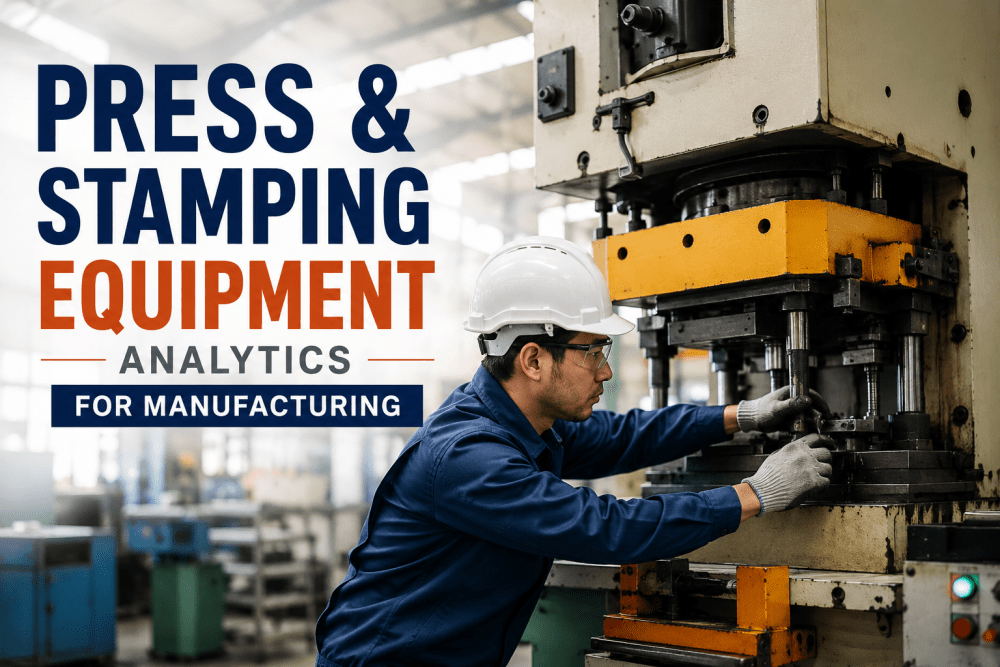
The afternoon shift supervisor at a mid-volume automotive stamping plant watches the tonnage monitor on a 1,200-ton transfer press drift from 785 tons to 802 over three consecutive hits. He knows the die is breathing wrong — but the legacy PLC dashboard only logs a green light. By the time maintenance opens the press at shift change, the die face has micro-cracked across 14 stations. The line loses 11 hours. The replacement die costs $47,000. The customer's truck plant idles for a day. That single drift — invisible, unrecorded, unremarked — was the signal. This page is about making that signal visible before the steel cracks.
Stop losing dies to invisible tonnage drift. Predict press failures before they cost a shift.
iFactory connects to your existing press PLCs, hydraulic sensors, and die monitors — then builds a real-time model of every stroke. When tonnage, velocity, or temperature deviates, you get a preventive alert hours or days before the die cracks. No cloud. No new sensors. Six weeks to first alert.
Without iFactory, you catch press problems when the die is already cracked. With iFactory, you catch them when the signal first drifts.
The difference is not incremental. It's the difference between a $47,000 die replacement and a 30-minute adjustment during planned downtime. Between a line that runs 94% OEE and one that scrapes by at 72%. Here is exactly what changes.
Without iFactory
- Tonnage limits set wide enough to miss drift until die contact surfaces crack
- Hydraulic pressure logged to a local HMI — no trend analysis, no automatic alert
- Die changes triggered by part quality failure (scrap) rather than preventive signal
- Maintenance runs blind between scheduled inspections — 6–8 weeks of undetected wear
- Root cause of press stall takes 4+ hours of manual data sifting across PLC, CMMS, and operator logs
With iFactory
- Every stroke's peak tonnage plotted against a dynamic model — 0.5% deviation triggers alert
- Hydraulic ram velocity and pressure monitored in sub-second windows, with anomaly detection
- Die change recommended 48 hours before process capability (Cpk) drops below 1.33
- Continuous health score per die, updated every cycle — maintenance acts on trend, not calendar
- Press root cause identified in under 10 minutes via correlated sensor timeline
Every press line leaks money through signals no one sees. Here is where the dollars go.
In a typical 1,000-ton transfer press running three shifts, five days per week, the gaps between scheduled maintenance and actual wear events cost between $280,000 and $420,000 per year per press. These are the four largest leaks.
Unscheduled die replacement
When a die cracks mid-run, the replacement averages $47,000 for a progressive die set, plus 8–14 hours of line downtime at $1,200 per minute of lost production to the OEM customer.
Scrap from out-of-spec tonnage
Drifting tonnage produces parts at the edge of print tolerance. In a 1,200-strokes-per-hour line, 30 minutes of undetected drift generates 600 scrap parts at $14 per blank.
Hydraulic component wear
Erratic ram velocity from degrading servo valves accelerates pump wear. Replacing a main hydraulic pump on a 1,500-ton press costs $22,000 in parts alone, plus 16 hours of crane time and line downtime.
Emergency overtime & expedited logistics
Mid-shift press failures trigger call-in overtime at 2.5X base rate, emergency die shipping ($3,500–$6,000 for next-day freight), and often a premium for rush die repair.
Add it up. A single press line with four unscheduled events per year loses $300,000–$400,000 in direct costs. That is before the OEM penalty clauses for missed shipments. iFactory's preventive analytics cuts those events by 80–90%.
From raw sensor data to prescriptive action in four steps. No new hardware. No data science team.
iFactory connects to your existing press PLCs (Siemens, Rockwell, Mitsubishi, Fanuc), hydraulic pressure transducers, and die temperature probes. The appliance sits on your plant network — zero data leaves the building. Within six weeks, your team receives the first preventive alert.
Connect & Ingest
iFactory reads existing sensor data from press PLCs, servo drives, hydraulic manifolds, and die-mounted thermocouples — no new sensors required.
Build a Stroke Model
The platform learns the normal signature of each die: peak tonnage, ram velocity curve, hydraulic pressure profile, and thermal settling behavior across all operating speeds.
Detect Anomalies in Real Time
Every stroke is compared against the model. Tonnage drift of 0.3%, hydraulic pressure oscillation, or die temperature asymmetry triggers a graded alert — advisory, warning, or critical.
Prescribe the Next Action
iFactory tells maintenance what to do: adjust counterbalance pressure by 50 psi, clean die lubrication channels, or schedule a die change within 48 hours. No guesswork.
Four capabilities that turn press data into a preventive maintenance playbook.
These are not generic IIoT features. They are built specifically for the physics of metal stamping — tonnage, velocity, temperature and the unique signatures of progressive and transfer dies.
Tonnage Signature Monitoring
iFactory captures peak, valley, and dwell tonnage for every station in a progressive die. The model accounts for material gauge variation (e.g., 1.2mm vs. 1.5mm HSS), lubrication changes, and press speed ramps. A 0.5% deviation from the expected profile generates a preventive alert — not after the die cracks, but when the signal first changes.
Hydraulic System Health Index
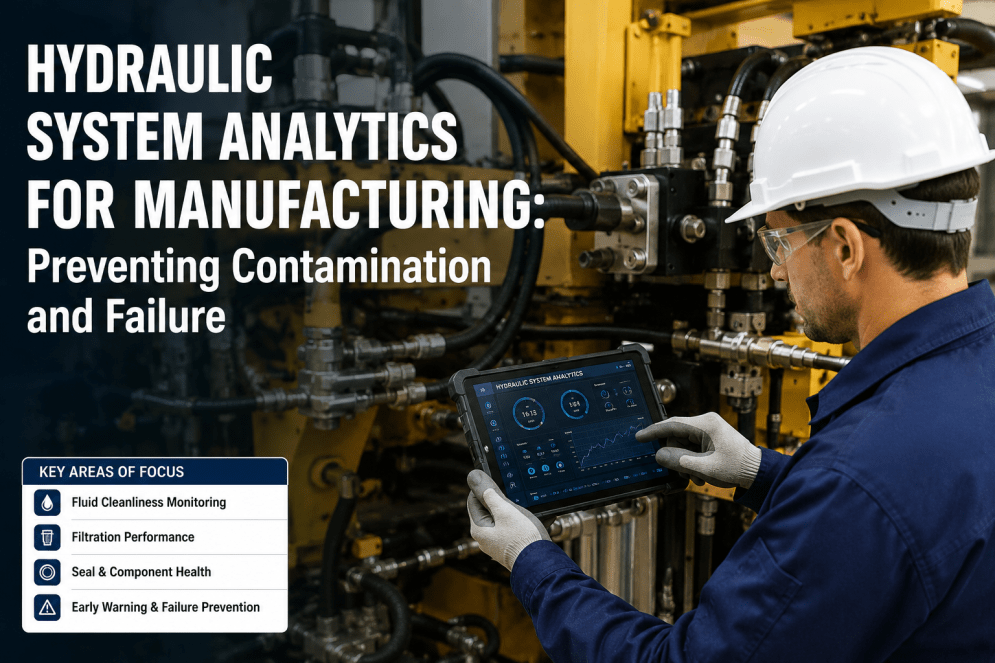
Every press's hydraulic circuit — pump pressure, ram velocity, accumulator pre-charge, servo valve response — is modeled as a system. iFactory detects when a servo valve begins to stick (response time increases by 8ms) or when pump efficiency drops below 92%. Maintenance gets a component-level diagnosis, not a generic "hydraulic fault" code.
Die Condition Trending
Die wear is not a binary event. iFactory tracks the gradual degradation of die condition across thousands of strokes — changes in forming force, part ejection force, and die temperature profile. When the trend line crosses a user-defined threshold (e.g., 15% increase in forming force vs. baseline), the system recommends a die change with 48 hours of lead time.
Press Reliability Optimization
Beyond individual dies, iFactory models the entire press system — clutch/brake engagement time, slide parallelism, counterbalance pressure stability, and bolster plate temperature. When a 0.2mm increase in slide parallelism is detected over 10,000 strokes, the system schedules a gib adjustment during the next planned downtime. No emergency stops. No lost production.
Your press line is already generating the data you need. iFactory turns it into a preventive alert in six weeks. Book a 30-min walkthrough and we'll connect to your live PLC feed to show you what you're missing.
Every iFactory deployment includes these five outcomes — guaranteed in writing.
We do not sell software licenses. We sell a preventive analytics service that runs on a turnkey appliance on your plant floor. Here is exactly what is included.
End-to-end deployment in 6–12 weeks
iFactory's team handles all PLC connectivity, sensor mapping, model building, and alert configuration. Your team provides read-only access to press controllers and a network connection. No IT project plan required.
On-premise appliance — zero cloud dependency
The iFactory appliance sits on your plant network. All sensor data stays inside your four walls. No data egress, no third-party servers, no cybersecurity audit friction. NVIDIA-powered hardware handles all inference locally.
Preventive alerts in the first quarter
Within 90 days of deployment, your team receives actionable preventive alerts on tonnage drift, die condition, and hydraulic health. The first alert typically arrives within six weeks of the initial data connection.
24x7 managed service
iFactory's operations team monitors model accuracy, alert thresholds, and system health around the clock. If a model needs retraining due to a new die or material change, we handle it — no burden on your plant engineering team.
Pilot-to-ROI in one quarter
The pilot covers one press line. By the end of the first quarter, you have hard metrics on downtime reduction, die life extension, and scrap reduction. Only then do you decide whether to scale to additional lines.
No data science hiring required
The iFactory platform is pre-trained on thousands of press-stamping datasets from automotive, appliance, and aerospace plants. Your team does not need to write a single model or tune a single parameter. The analytics are delivered, not built.
Real questions from plant engineers and operations leaders about press analytics.
Your press line is already telling you when the next die failure will happen. iFactory translates that signal into a preventive action.
Schedule a 30-minute technical walkthrough. We'll connect to your live press data and show you the first alert within that call — no commitment, no upfront cost.