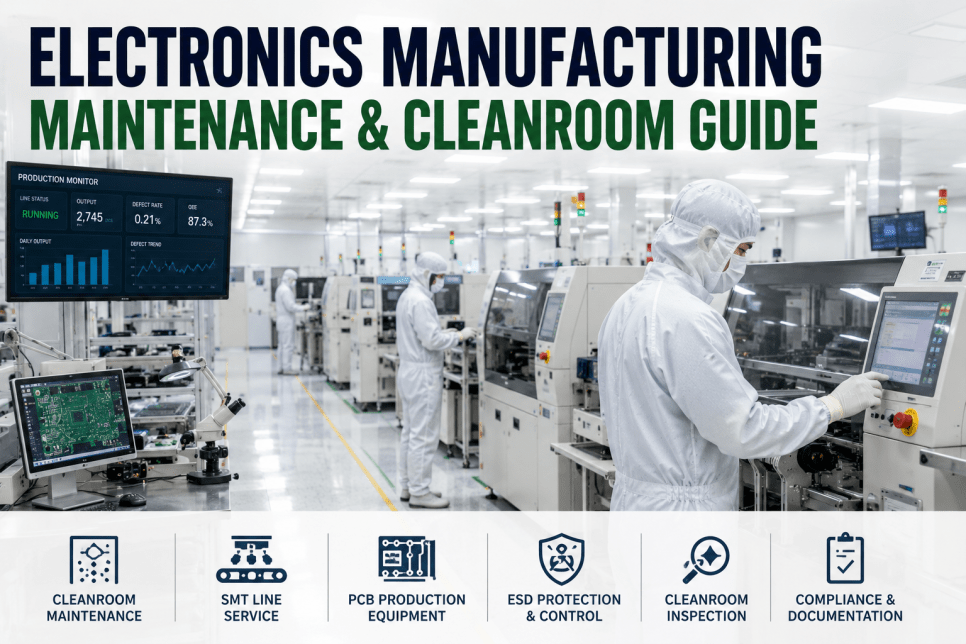
Electronics manufacturing facilities operate at the intersection of extreme precision, environmental sensitivity, and relentless production pressure. A single particle contamination event in a cleanroom can scrap an entire wafer batch. An ESD failure on an SMT line can go undetected through assembly and into field returns that cost ten times the original component value. The maintenance programs that keep semiconductor fabs, PCB assembly lines, and surface mount technology operations running at rated yield — and keep them compliant with ISO 14644 cleanroom standards and IPC-A-610 quality requirements — are categorically different from general industrial maintenance. iFactory AI is purpose-built for this environment: connecting your CMMS, predictive analytics, ESD monitoring, and cleanroom compliance documentation into a single operational platform designed for electronics and semiconductor manufacturing. Facilities that deploy structured, data-driven electronics manufacturing maintenance programs report 30–45% reductions in unplanned downtime on SMT lines, 25–35% reductions in cleanroom compliance findings, and yield improvements averaging 8–15% within the first year of systematic equipment care.
Why Electronics Manufacturing Maintenance Is Categorically Different
General industrial maintenance programs are designed around equipment uptime, safety, and cost efficiency. Those objectives apply to electronics manufacturing — but they operate on top of a layer of environmental, electrostatic, and contamination controls that have no equivalent in most other industries. A semiconductor fab or PCB assembly operation is not just maintaining machines; it is maintaining a controlled environment in which those machines operate. The two are inseparable, and a maintenance program that addresses one without the other will systematically underperform.
The consequence profile is also different. Equipment degradation in electronics manufacturing rarely produces a visible or immediate failure. It produces yield drift: gradual increases in defect rates, subtle shifts in solder paste deposition, incremental degradation in pick-and-place accuracy, or slow deterioration in reflow oven temperature uniformity. By the time these issues appear as scrap rates or customer returns, the root cause is weeks old and the financial exposure is already realized. The only defense is a structured, data-driven maintenance program with enough sensor coverage and historical depth to detect drift before it becomes defect.
Cleanroom Maintenance: Compliance, Contamination Control, and Environmental Monitoring
Cleanroom maintenance in electronics and semiconductor manufacturing is governed by ISO 14644-1 (classification), ISO 14644-2 (monitoring), and facility-specific contamination control plans that define particle count limits, air change rates, differential pressure baselines, and personnel protocol requirements. Maintaining ISO Class 5, 6, or 7 certification is not an annual audit event — it is a continuous operational discipline that depends on the systematic execution of HEPA filter integrity testing, HVAC performance verification, surface contamination sampling, and gowning protocol compliance tracking.
Continuous Particle Count and Environmental Parameter Monitoring
Real-time particle counters, temperature sensors, relative humidity monitors, and differential pressure transmitters are the foundation of ISO 14644-2 compliant cleanroom monitoring. iFactory AI integrates data from all environmental monitoring points into a single dashboard with configurable alert thresholds, automatic out-of-specification event logging, and trend analysis that identifies environmental drift before it reaches the ISO class limit.
HEPA and ULPA Filter Integrity Testing and Replacement Scheduling
HEPA and ULPA filter performance is the single most critical maintenance parameter in any ISO-classified cleanroom. Filter integrity testing — DOP/PAO aerosol challenge per IEST-RP-CC034 — must be performed on a defined schedule and after any maintenance activity that disturbs the filter housing. iFactory manages filter test scheduling, technician assignment, result recording, and replacement work order generation based on scan results and filter age.
Surface Contamination Sampling and Cleaning Protocol Management
Surface particle and microbial contamination sampling — swab and contact plate programs per ISO 14644-9 — provides the verification layer that environmental monitoring cannot: confirmation that surfaces in direct or near-contact with product are within acceptable limits. iFactory manages sampling point maps, technician assignments, result trending, and out-of-limit investigation workflows.
HVAC Maintenance and Air Change Rate Verification
The HVAC system that supplies and recirculates air in an ISO-classified cleanroom is the facility's primary contamination control infrastructure. Air change rate verification, supply and return grille balance confirmation, makeup air damper calibration, and chilled water coil condition inspection are all maintenance activities that directly determine whether the room holds its ISO classification between filter integrity test cycles. iFactory schedules, dispatches, and documents all HVAC maintenance activities with class-level impact tracking.
SMT Line Maintenance: Reflow Oven, Stencil Printer, and Pick-and-Place Servicing
Surface mount technology production equipment — stencil printers, SPI systems, pick-and-place machines, reflow ovens, and AOI systems — represents the highest-density concentration of yield-critical maintenance tasks in any electronics manufacturing facility. Each machine in the SMT line has its own failure modes, service intervals, and performance parameters, and degradation in any one of them propagates downstream: a stencil printer with worn squeegee blades produces inconsistent paste deposition that a reflow oven cannot correct. iFactory AI manages the full SMT maintenance chain with equipment-specific PM templates, calibration tracking, and predictive analytics built on production data integration. Operators who want to see how iFactory maps to their specific SMT line configuration can Book a Demo with our electronics manufacturing team.
| SMT Equipment | Critical Maintenance Task | Failure Mode if Neglected | Recommended Interval | iFactory Feature |
|---|---|---|---|---|
| Stencil Printer | Squeegee blade inspection and replacement, stencil tension verification, print head calibration | Inconsistent paste volume, bridging, insufficient solder — downstream reflow defects untraceable to source | Squeegee: 500K cycles; tension: weekly; calibration: monthly | Cycle-count-triggered PM, calibration certificate archive |
| Solder Paste Inspection (SPI) | Camera calibration, lighting intensity verification, reference board correlation check | False accept or false reject rate drift — either masks real defects or creates phantom rework demand | Calibration: weekly; lighting: monthly; correlation: quarterly | Calibration scheduling, SPC integration, alert on drift |
| Pick-and-Place Machine | Nozzle inspection and cleaning, feeder calibration, vision system verification, lubrication of linear guides | Placement offset, missing components, tombstoning — yield loss directly traceable to head wear | Nozzles: daily inspect, 200K cycles replace; guides: per OEM | Nozzle cycle tracking, feeder calibration records, lubrication PM |
| Reflow Oven | Zone temperature calibration, conveyor speed verification, flux residue cleaning, nitrogen system check | Cold or hot joints, delamination, voiding — thermal profile deviation from golden sample undetectable without regular calibration | Thermal profile: weekly; flux cleaning: shift; N₂ check: daily | Calibration work orders, shift-based cleaning tasks, N₂ consumption trending |
| Automated Optical Inspection (AOI) | Optic cleaning, reference board programming update, false call rate trending, conveyor alignment | Escapes or excessive false calls — either outcome degrades line efficiency and customer quality confidence | Optics: weekly; reference update: per ECO; trending: continuous | False call rate dashboard, optic cleaning schedule, ECO-triggered reprogramming task |
| Wave Solder / Selective Solder | Solder dross removal, flux density monitoring, nozzle wetting verification, conveyor finger inspection | Bridging, insufficient solder, voiding on THT components — dross contamination accelerates all failure modes | Dross: daily; flux: per shift; nozzle: weekly | Shift-frequency task scheduling, solder composition tracking, consumable inventory alerts |
ESD Protection Maintenance: The Hidden Yield Killer in Electronics Manufacturing
Electrostatic discharge damage is the single most underreported failure mode in electronics manufacturing. Unlike mechanical or contamination failures, ESD damage is frequently latent — the component passes initial electrical test but fails in the field under thermal or voltage stress. ANSI/ESD S20.20 compliance requires systematic maintenance of ESD protection infrastructure: wrist strap testers, ESD flooring, grounding points, ionizer performance, ESD-safe workstation verification, and packaging material qualification. Most facilities perform these checks — but few manage them in a system that provides trending, scheduling, and compliance documentation at the level required for ANSI/ESD S20.20 audit defense.
PCB Manufacturing Equipment Maintenance: Wet Process, Lamination, and Drilling Operations
Bare PCB fabrication equipment — innerlayer imaging systems, wet process chemistry lines, lamination presses, CNC drilling machines, and electroplating systems — operates under maintenance requirements that combine chemical process control, precision mechanical calibration, and environmental compliance. Chemistry bath concentration control in particular is a maintenance discipline that directly determines plating quality, etch uniformity, and via hole reliability — parameters that are extremely difficult to recover once they drift outside specification. Manufacturers who want to understand how iFactory AI manages PCB fab equipment maintenance can Book a Demo with our electronics manufacturing specialists.
- Daily bath analysis for etch rate, copper concentration, and pH — iFactory schedules titration tasks and records results with SPC control limit alerts
- Replenishment work orders auto-generated when bath analysis results approach control limits — eliminates manual tracking and operator-dependent replenishment timing
- Filter and carbon treatment replacement on timed and condition-based intervals — iFactory tracks bath throughput volume to trigger replacement at correct intervals
- Waste treatment system verification — effluent pH, heavy metal concentration, and flow rate monitored and documented for EPA permit compliance
- Drill bit replacement on hit-count-based intervals — iFactory tracks drill usage by bit diameter and material type, triggers replacement before hole quality degradation occurs
- Spindle runout measurement on scheduled calibration cycle — spindle eccentricity above 2μm limit triggers work order before drill breakage or hole position error
- Vacuum holddown system verification — platen seal condition and vacuum level checked on weekly schedule; seal degradation tracked in iFactory asset history
- Axis calibration and lead screw inspection on quarterly schedule — positional accuracy verified against coordinate measurement standard and logged in iFactory calibration record
- Platen flatness verification and caul plate inspection on quarterly schedule — platen deviation above 0.002" limit causes dielectric thickness variation that impacts impedance control
- Hydraulic system oil analysis and filter replacement on OEM-specified intervals — iFactory manages oil sample scheduling and tracks results against viscosity and contamination limits
- Temperature uniformity mapping on semi-annual schedule — thermocouple survey of all press platens identifies hot spots that cause resin flow nonuniformity and void defects
- Press program archive and version control — iFactory document management tracks approved lamination cycle revisions and prevents unauthorized parameter changes
- Anode inspection and replacement on ampere-hour-based intervals — iFactory tracks plating current consumption and triggers anode replacement before copper depletion affects throwing power
- Hull cell testing on weekly schedule — assesses plating bath additives and identifies brightener/suppressor imbalance before it appears as surface roughness or skip plating
- Rectifier calibration and DC current ripple measurement on quarterly schedule — current ripple above specification degrades copper grain structure and reduces via barrel fatigue life
- Plating thickness measurement program — iFactory schedules cross-section inspection and X-ray fluorescence measurement, trends results against IPC-6012 minimum copper requirements
Expert Review: What a Structured Maintenance Program Actually Delivers in Electronics Manufacturing
I have managed maintenance operations in electronics manufacturing for over 18 years — SMT assembly, bare PCB fabrication, and semiconductor back-end operations across facilities in the U.S., Malaysia, and Mexico. The single most consistent finding across all of those environments is that yield problems and equipment reliability problems are the same problem. Facilities that treat them separately — a quality department managing yield and a maintenance department managing uptime — consistently underperform facilities that connect equipment condition data to process output data. The maintenance platform matters enormously for this. When I first reviewed iFactory AI for our SMT operations, what distinguished it from the generic CMMS tools we had used previously was the direct integration between equipment maintenance records and production output trending. We could see, for the first time, the correlation between reflow oven calibration interval and first-pass yield rate. That correlation was the business case for shortening our calibration cycle and investing in predictive thermal profiling. The ROI was realized within two quarters. The cleanroom compliance documentation capability was an equally significant improvement — our previous process involved three people spending two weeks before every ISO recertification audit compiling records manually. iFactory generates the same documentation package in hours. For any electronics manufacturer operating above a few hundred employees, a purpose-built maintenance platform is not a discretionary investment. It is the infrastructure that makes everything else work.
Conclusion: Electronics Manufacturing Maintenance Is a Yield Strategy, Not Just an Uptime Strategy
The electronics and semiconductor manufacturing industry operates at margins and quality requirements where the line between world-class and average performance is drawn by maintenance discipline. Cleanroom environmental integrity, SMT equipment calibration, ESD protection verification, and PCB process chemistry control are not background administrative tasks — they are direct yield determinants, and they need to be managed with the same analytical rigor applied to production metrics. The facilities consistently operating at the top of the yield and reliability curve are the ones that have connected their maintenance data to their production data and built the feedback loops that turn equipment condition trends into proactive interventions.
iFactory AI is the platform built to support that integration for electronics manufacturing operations of all sizes — from single-site SMT assembly to multi-facility semiconductor manufacturing networks. The combination of purpose-built PM templates for electronics equipment, ISO 14644-compliant cleanroom monitoring, ANSI/ESD S20.20 program management, and class society-grade compliance documentation provides the infrastructure that makes electronics manufacturing maintenance a genuine competitive advantage rather than a cost center. Book a Demo to begin the facility configuration assessment for your electronics manufacturing operation.
Frequently Asked Questions
ISO 14644-2 requires particle count monitoring at minimum every 6 months for ISO Class 5 and below, every 12 months for Classes 6–8, with HEPA filter integrity testing at the same frequencies. Differential pressure, temperature, and humidity monitoring should be continuous or at intervals defined in the facility's contamination control plan. iFactory automates all required scheduling and generates compliant monitoring records automatically.
Standard preventive maintenance replaces components or performs service at fixed calendar or cycle-count intervals regardless of actual condition. Predictive maintenance uses sensor data — motor current, vibration, thermal imaging, and production quality metrics — to detect degradation trends and service equipment when condition data indicates it is necessary, not when a calendar date arrives. On SMT equipment, predictive maintenance reduces both over-maintenance (replacing good components) and under-maintenance (missing failure onset between fixed intervals), with typical downtime reductions of 30–45% compared to pure calendar-based PM programs.
ANSI/ESD S20.20 certification requires documented evidence of a compliant ESD control program including: wrist strap and footwear verification records (typically daily), worksurface and flooring resistance measurement records (monthly), ionizer performance verification records (weekly), grounding system continuity records (quarterly), and a training record for all EPA personnel. Third-party certification auditors review the completeness and consistency of these records — gaps or manual records without statistical trending are common audit findings that iFactory's structured program management eliminates.
Reflow oven thermal profile maintenance should include weekly profiler verification runs using a calibrated thermocouple board to confirm that set-point temperatures are being achieved within ±5°C of the golden profile, conveyor speed verification at the same frequency, and flux residue cleaning every shift or per the oven manufacturer's recommendation based on flux load. Zone temperature calibration against a NIST-traceable standard should be performed quarterly or after any heating element replacement. Profile data should be trended over time — drift in zone temperature is an early indicator of heating element degradation and can be caught weeks before a hard failure or a customer return.
A standard iFactory AI deployment for an electronics manufacturing facility — including equipment asset build, PM template configuration for SMT line and cleanroom systems, ESD program setup, sensor integration with existing PLC or DCS systems, and user training — typically reaches full operational readiness in 8–12 weeks from project kick-off. Facilities with existing asset lists and PM schedules in a legacy CMMS can typically reduce this timeline through iFactory's data migration support service.