Plastics manufacturing is a high-stakes, equipment-intensive industry where unplanned downtime doesn't just cost production hours — it costs you material waste, energy overruns, mold damage, and the downstream ripple effects that never make it onto a single line item. Whether your facility runs extrusion lines, injection molding presses, blow molders, or thermoforming stations, every one of those machines operates under relentless thermal stress, hydraulic pressure, and mechanical fatigue that compounds quietly until something fails at the worst possible moment. The U.S. plastics industry processes more than 35 million tons of resin annually, and the facilities maintaining that output share a consistent operational truth: preventive maintenance on plastics processing equipment is the single highest-ROI investment a plant manager can make — and iFactory AI's CMMS and predictive maintenance platform is built specifically to execute it at scale.
Is Your Plastics Plant Running on Reactive Maintenance — or Preventive Intelligence?
iFactory AI delivers CMMS, preventive maintenance scheduling, predictive analytics, and real-time equipment monitoring purpose-built for extruders, injection molding machines, blow molders, and thermoforming lines — so your plastics facility runs at peak OEE, not at the mercy of unplanned failures.
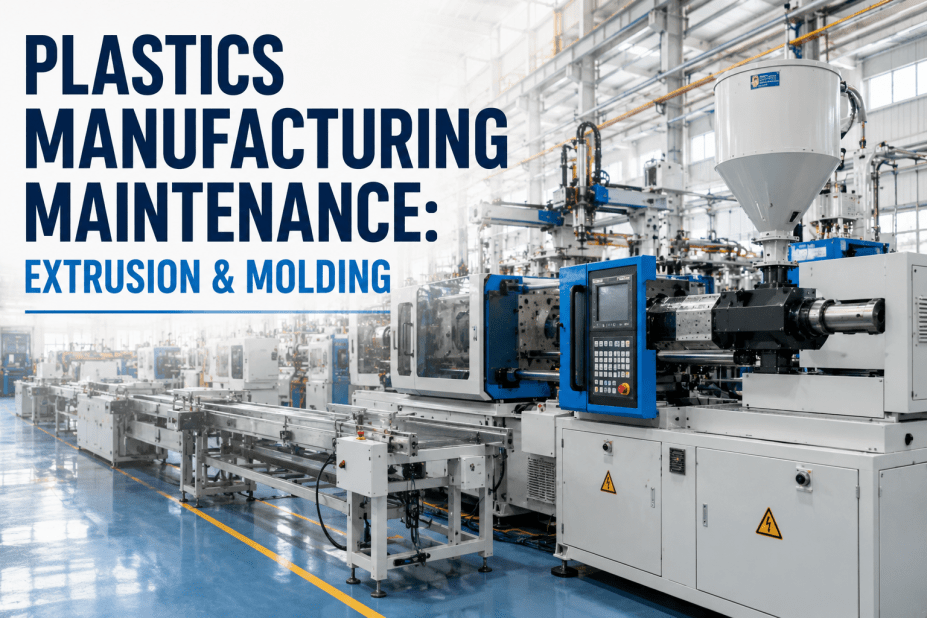
The Four Core Plastics Processing Machines — and Why Each Demands Its Own Maintenance Strategy
Extrusion, injection molding, blow molding, and thermoforming are not interchangeable processes. Each machine architecture creates distinct failure modes, wear patterns, and maintenance intervals that a generic PM program will miss. Understanding the mechanical and thermal reality of each platform is the starting point for building a maintenance strategy that actually protects uptime.
Extrusion Machine Maintenance
Extruders operate under continuous heat and mechanical stress as polymer melt is forced through a die at high pressure. The primary wear mechanism is progressive screw-and-barrel clearance growth — as the gap between screw flights and barrel wall widens, material flows backward instead of forward, reducing output and forcing operators to increase screw speed, which accelerates wear further in a self-reinforcing cycle.
Industry best practice, validated by CPM Extrusion Group and machine OEMs including Graham Engineering and Kuhne, calls for measuring screw flight diameter and barrel bore every 500–1,000 operating hours and trending clearance growth over time. Gearbox lubrication checks, barrel heater band inspections, and die pressure gauge calibration complete the core extruder PM program.
- Measure screw-barrel clearance every 500–1,000 operating hours
- Vibration testing on gearboxes every 6–12 months
- Thermal imaging of barrel and die heating zones quarterly
- Check and replace barrel heater bands on manufacturer intervals
- Inspect and clean die screens and breaker plates each production run
- Verify gearbox oil quality and synthetic lubricant change intervals
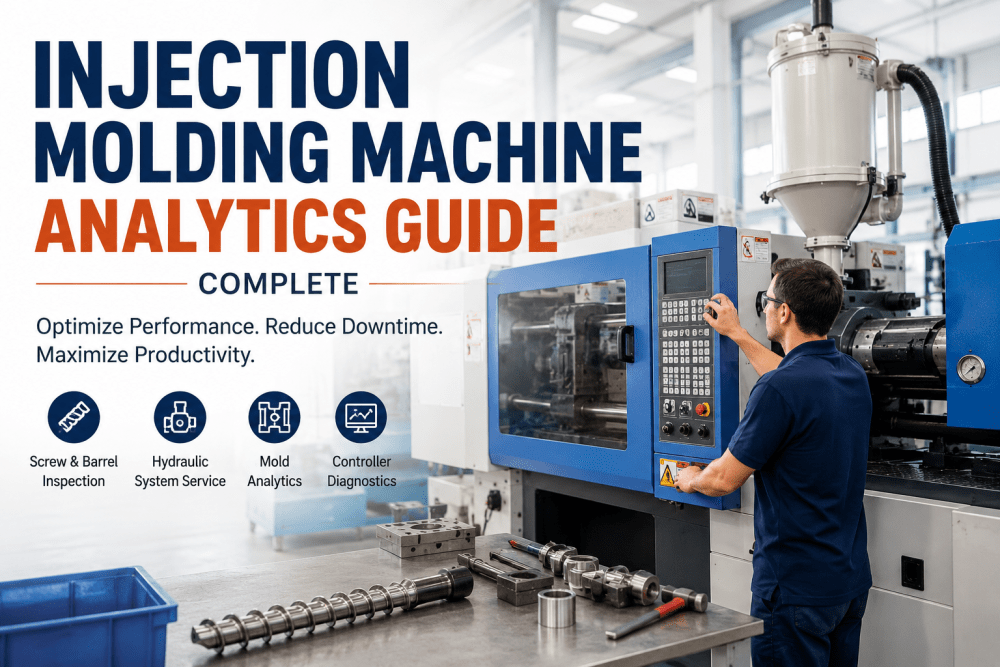
Injection Molding Machine Maintenance
Injection molding machines operate in high-cycle, high-pressure environments where mold condition directly determines part quality. Coolant line fouling, hot runner heater band degradation, and hydraulic system contamination are the dominant failure modes — all of which are preventable with structured PM intervals.
PCS Company's Mike Stemm, with over 40 years of injection molding industry experience, emphasizes that preventive and predictive maintenance over reactive approaches protects costly tooling investments and extends machine life. Cooling system management — ensuring no more than a 5°F temperature differential between coolant inlet and outlet — is among the most impactful and most overlooked maintenance tasks in injection molding operations.
- Clean coolant lines quarterly; maintain inlet-outlet delta below 5°F
- Replace hot runner heater bands every 6–12 months
- Inspect thermocouples and temperature controllers regularly
- Check hydraulic fluid condition and contamination quarterly
- Inspect tie bars, platens, and clamp systems per OEM schedule
- Log all maintenance activities and mold cycle counts in CMMS
Blow Molding Machine Maintenance
Blow molding equipment — covering extrusion blow molding, injection blow molding, and injection stretch blow molding — combines the wear mechanisms of extrusion with the mold and clamping demands of injection molding, creating a maintenance profile that spans both disciplines. Parison die wear, mold cooling channel fouling, air system integrity, and neck finish tooling condition are the priority inspection areas.
Facilities producing high-volume blow-molded containers — bottles, industrial drums, automotive tanks — face additional maintenance demands from the high-speed mold open-close cycles that stress clamping mechanisms and platen guide rails. Lubrication schedules for clamping components and inspection of water cooling channels within mold halves are central to sustaining cycle-time consistency and part quality.
- Inspect parison die and head tooling for wear and resin buildup
- Clean and descale mold cooling channels on scheduled intervals
- Verify air knife and blowing pin condition each production run
- Lubricate clamping guide rails and platens per OEM schedule
- Check mold alignment and inspect neck finish inserts regularly
- Inspect compressed air system filters and regulators monthly
Thermoforming Machine Maintenance
Thermoforming equipment heats plastic sheet stock to a pliable state and forms it against a mold using vacuum, pressure, or matched tooling. The maintenance priorities center on oven heating element consistency, sheet transport chain tension and lubrication, mold surface condition, and vacuum/pressure system integrity — failures in any of these areas produce directly visible defects in the formed part.
Sheet extrusion lines feeding thermoforming operations add an upstream maintenance dependency: extruder performance variability — from gauge variation to surface finish inconsistency — degrades thermoforming quality even when the forming machine itself is in perfect condition. Integrated maintenance planning across the extrusion-thermoforming production chain is essential for consistent part quality.
- Inspect and balance oven heating elements for zone uniformity
- Lubricate sheet transport chains and inspect tension on schedule
- Clean mold surfaces and inspect for wear or surface damage
- Test vacuum pump performance and inspect seals monthly
- Check pressure assist system regulators and fittings
- Calibrate sheet temperature sensors and pyrometers quarterly
The True Cost of Unplanned Downtime in Plastics Manufacturing — and Where Most Plants Are Today
Most plastics facility managers estimate downtime costs by counting the obvious loss — idle machine hours times hourly production rate. The actual cost stack is five layers deep, and most plants only see the top one. Understanding the full cost picture is what makes the business case for structured preventive maintenance irrefutable.
The hours the machine is down times the hourly production rate. This is the only number most plants track. It understates real cost by 3–5x in equipment-intensive polymer operations.
Emergency screw replacements, hydraulic pump repairs, and hot runner rebuilds procured outside normal purchasing channels carry 40–80% premium over planned-maintenance equivalent costs. A new screw and gearbox repair can cost tens of thousands of dollars versus pennies on the dollar in preventive lubrication.
Worn screws and barrels produce inconsistent melt temperatures that generate off-spec parts before and after the equipment failure event. Scrap rates in extrusion operations spike 3–8x during the hours surrounding unplanned downtime events — a cost that rarely appears in maintenance budget accounting.
As screw-barrel clearance grows, polymer leakage past the screw increases, forcing higher drive current to maintain output. Energy consumption per unit of output rises progressively — a cost that accumulates across thousands of operating hours before the machine fails and is never attributed to deferred maintenance.
Extruder failures that propagate into die head damage, mold damage from injection unit pressure excursions, and clamping system damage from undetected platen misalignment create secondary repair costs that dwarf the original failure cost. These cascading events are almost entirely preventable with structured PM programs.
iFactory AI's CMMS tracks all five cost layers — not just production loss — giving plastics plant managers the complete financial picture needed to justify preventive maintenance investment to leadership and demonstrate documented ROI within the first operating year. Book a Demo to see how iFactory AI structures downtime cost reporting for plastics equipment fleets.
Reactive vs. Preventive vs. Predictive Maintenance: Which Model Fits Your Plastics Operation?
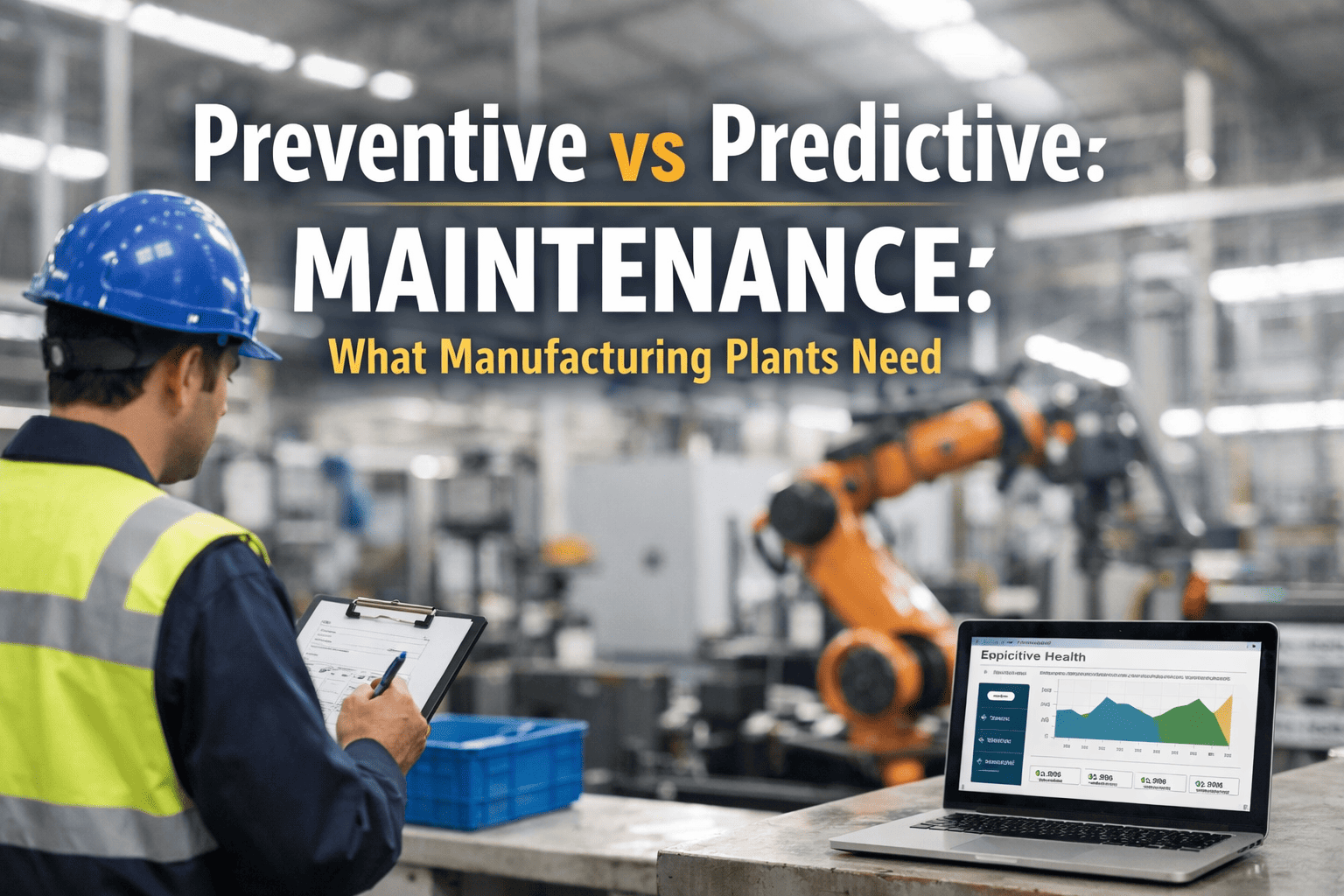
Plastics manufacturing facilities typically operate across one of three maintenance maturity levels. Understanding where your operation sits today — and what the economic difference is between each level — is the foundation for building the right maintenance program with iFactory AI.
| Dimension | Reactive Maintenance | Preventive Maintenance | Predictive Maintenance |
|---|---|---|---|
| Trigger | Equipment fails | Time or cycle-count intervals | Sensor data, condition monitoring |
| Downtime Profile | Unplanned, extended, high-cost | Planned, short, predictable | Minimal — interventions before failure |
| Repair Cost | Emergency premium — 40–80% higher | Standard rates, planned procurement | Lowest — intervene before damage propagates |
| Scrap & Waste Impact | High — failure produces off-spec output | Low — consistent process parameters | Lowest — real-time quality correlation |
| Tooling & Mold Life | Shortened — failures cascade to tooling | Extended — structured care intervals | Maximized — condition-based replacement |
| Energy Efficiency | Degrading — wear increases energy per unit | Stable — wear controlled within intervals | Optimized — wear detected and corrected early |
| Maintenance Labor | High — emergency response, overtime | Moderate — scheduled work orders | Efficient — targeted, data-driven interventions |
| iFactory AI Support | Work order management, failure logging | PM scheduling, checklists, interval triggers | IoT sensor integration, OEE analytics, alerts |
Most U.S. plastics facilities today operate at the reactive-to-preventive transition — reacting to failure on major equipment while running paper-based PM checklists on others. iFactory AI is designed to close that gap, moving facilities from stage 1–2 reactive operations to stage 3–4 preventive and predictive programs without requiring large IT infrastructure investments or extended implementation timelines.
How iFactory AI's CMMS and Predictive Maintenance Platform Manages Plastics Equipment
iFactory AI's platform is purpose-built for the asset-intensive, process-critical reality of plastics manufacturing — where one extruder seizure can erase a month of margin and where every machine type has its own maintenance language. The platform delivers unified visibility across your entire plastics equipment fleet: extruders, injection presses, blow molders, thermoformers, auxiliaries, and utilities.
Equipment Asset Hierarchy
Organize extruders, injection presses, blow molders, and thermoformers in a parent-child asset structure — down to the screw, gearbox, mold, and sensor level. Every component carries its own maintenance history, spare parts list, and failure log across moves and refits.
PM Scheduling & Checklists
Pre-built and customizable PM templates for extruder barrel checks, hydraulic oil sampling, mold cleaning, heater band continuity, vacuum pump integrity, and all equipment-specific intervals — automatically triggered by operating hours, cycle counts, or calendar date.
OEE Analytics & Production Monitoring
Real-time OEE tracking across your plastics lines connects equipment availability, performance rate, and quality yield into a single production health dashboard — identifying the hidden downtime and micro-stop patterns that erode efficiency without triggering a formal downtime event.
IoT Sensor Integration
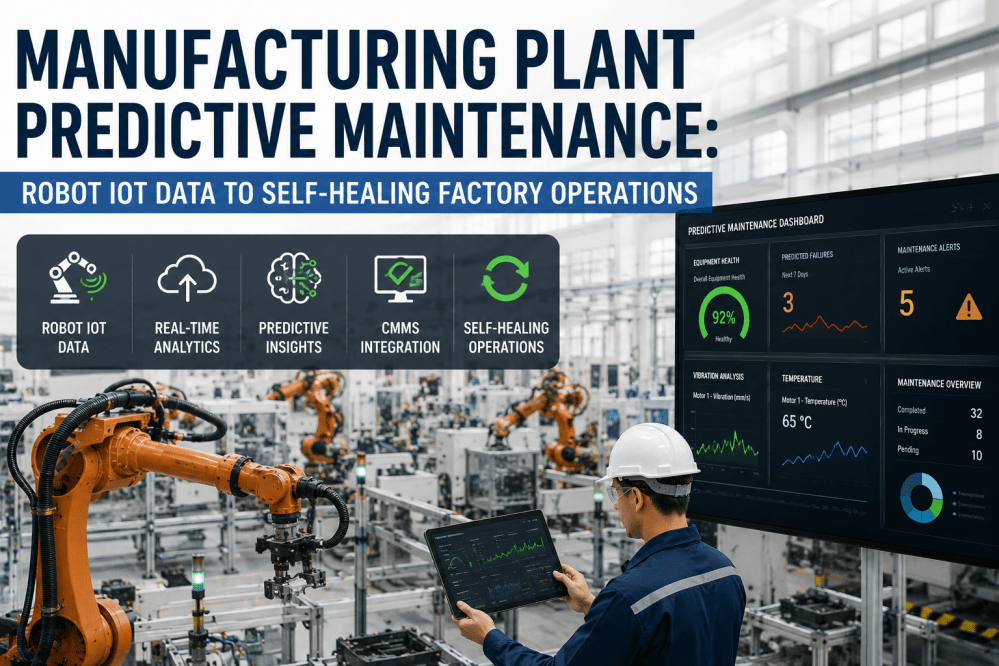
iFactory AI connects to PLC systems, vibration sensors, temperature transmitters, and energy meters on your plastics equipment — ingesting real-time process data to trigger condition-based maintenance alerts before wear patterns escalate into failure events.
Work Order Management
Generate, assign, track, and close work orders for plastics equipment maintenance from any device — with parts consumption logging, technician time tracking, and failure code classification that builds the maintenance history needed for predictive analytics.
Parts & Inventory Management
Maintain optimal stocking levels for critical plastics spare parts — screw segments, heater bands, hydraulic seals, mold components, and wear parts — with automatic reorder triggers linked to PM work order consumption, preventing the stockout scenarios that extend emergency repair downtime.
5-Step Plastics Maintenance Program Implementation with iFactory AI
Building a structured preventive maintenance program for a plastics facility doesn't require a multi-year ERP implementation or a dedicated IT department. iFactory AI's implementation approach is designed for plastics plant operations — fast to deploy, configured to your specific equipment mix, and delivering measurable results within the first 60–90 days of operation. Book a Demo to walk through this roadmap applied to your facility.
Equipment Asset Registry and Failure Mode Mapping
All extrusion lines, injection presses, blow molders, thermoformers, and auxiliary equipment are catalogued in iFactory AI's asset hierarchy — with OEM maintenance specifications, current maintenance history, and criticality scores assigned. Known failure modes for each equipment type are documented with failure codes that will drive work order analysis and trend reporting.
PM Template Configuration and Interval Setting
Machine-specific PM checklists are configured for each equipment type — extruder barrel and screw checks, injection mold cooling and hydraulic PM, blow molder air system and clamping inspection, thermoformer oven and vacuum system tasks. Intervals are set by operating hours, cycle counts, or calendar schedule based on OEM guidance and current production cadence.
IoT and PLC Integration for Condition Monitoring
iFactory AI's IoT gateway connects to available PLC systems and sensor networks on your plastics equipment — pulling real-time vibration, temperature, pressure, and energy data into the platform. Condition-based alert thresholds are configured for critical parameters: barrel temperature deviation, gearbox vibration baseline exceedance, hydraulic pressure drop, and vacuum system performance degradation.
Maintenance Team Onboarding and Work Order Workflow
Maintenance technicians are onboarded to iFactory AI's mobile-first work order interface — assigning, executing, and closing PM and corrective work orders directly from the plant floor. Parts consumption, labor hours, and equipment condition notes are captured in real time, building the maintenance history data that enables future predictive analytics.
OEE Benchmarking, Trend Analysis, and Continuous Improvement
After 60–90 days of full program operation, iFactory AI generates a validated performance report comparing pre- and post-implementation OEE, unplanned downtime frequency, maintenance cost per operating hour, and scrap rate correlation to equipment condition. This data drives the continuous improvement cycle — refining PM intervals, adjusting alert thresholds, and identifying the next set of equipment for predictive analytics expansion.
Deploy iFactory AI Maintenance Intelligence Across Your Plastics Equipment Fleet
iFactory AI delivers CMMS, PM scheduling, IoT sensor integration, OEE analytics, work order management, and predictive maintenance — purpose-built for extruders, injection molding machines, blow molders, and thermoforming lines. Live in 8 weeks.
Expert Review: What Industry Research Documents About Plastics Equipment Maintenance Programs
The plastics industry has accumulated substantial field research and OEM guidance on equipment maintenance best practices — from CPM Extrusion Group's training programs to PCS Company's injection mold tooling expertise to Plastics Technology magazine's decades of application coverage. The consensus that emerges from this body of knowledge is consistent: structured preventive maintenance is not a cost center — it is a production optimization strategy that pays for itself many times over in reduced emergency repair costs, extended tooling life, and improved part quality consistency.
Plastics Technology's field reporting on screw and barrel maintenance, drawing on contributions from multiple processing experts, documents the self-reinforcing nature of extrusion wear: as clearance grows, operators increase screw speed to maintain output, which accelerates wear further. The implication is that measurement and trending — done consistently every 500–1,000 operating hours — provides early detection at a point where intervention cost is a fraction of late-stage replacement cost.
- Early wear detection reduces replacement cost by 60–70% versus late-stage failure
- Commercial Purging Compounds (CPC) integrated into PM routines extend screw and barrel life measurably
- Documented PM logs correlate directly with extended component life and reduced scrap rates
PCS Company's Mike Stemm, with over 40 years supporting injection mold tooling across automotive and industrial molding operations, documents the structured approach that leading molders use during planned maintenance windows — a practice that the automotive sector has institutionalized around annual shutdown periods. The core message is that molds and machines are costly investments that deserve care proportional to their replacement value. Documented maintenance intervals, cooling system management below 5°F differential, and hot runner heater band replacement on schedule are the baseline standard.
- Coolant line cleaning quarterly is the single highest-impact injection mold PM task
- Heater band replacement on 6–12 month intervals prevents the most common hot runner failures
- Detailed maintenance logs are essential for warranty claims and informed tooling decisions
The Plastics Industry Association's 2024 data and industry surveys consistently show that U.S. plastics facilities lag behind automotive and aerospace manufacturing in CMMS adoption rates — with a significant proportion of small-to-mid-size molding and extrusion operations still using paper-based or spreadsheet maintenance tracking. The operational consequence is that failure pattern data that would enable predictive maintenance is either not collected or not actionable in its current format. Digital CMMS deployment at plastics facilities is the foundational step that converts existing maintenance activity into analyzable data.
- Paper-based PM tracking prevents pattern analysis and predictive alerting
- Digital work order logs create the failure history foundation for predictive maintenance models
- CMMS adoption in plastics correlates strongly with OEE improvement in available case studies
Plastics Manufacturing Maintenance — Frequently Asked Questions
Industry consensus from machine OEMs including Kuhne Group, Graham Engineering, and CPM Extrusion Group, supported by Plastics Technology field reporting, establishes every 500–1,000 operating hours as the standard measurement interval for screw flight diameter and barrel bore diameter. The key practice is not just measuring but trending — recording clearance values over time reveals the wear rate specific to your resin type and operating conditions, allowing you to predict replacement need before output drops or energy costs spike. For abrasive resins like glass-filled grades or PVC compounds, more frequent measurement intervals may be warranted. iFactory AI's CMMS automatically schedules these measurement tasks by operating-hour trigger, ensures technician completion, and records all measurements in a trended equipment health record. Book a Demo to see how iFactory AI manages extruder wear tracking at your facility.
The highest-impact injection molding PM tasks, ranked by their effect on preventing costly failures, are: cooling system management (cleaning coolant lines quarterly and maintaining inlet-to-outlet temperature differential below 5°F), hot runner heater band and thermocouple replacement on 6–12 month schedules, hydraulic fluid condition monitoring and change intervals, and tie bar and platen alignment inspection. These four task categories address the dominant failure modes in injection molding — mold damage from thermal non-uniformity, hot runner system failures, hydraulic contamination leading to injection unit and clamp cylinder damage, and structural failures from platen misalignment. Documenting all maintenance activities in a CMMS like iFactory AI creates the maintenance history that enables intelligent scheduling and prevents the knowledge loss that occurs when experienced technicians leave the organization.
iFactory AI's CMMS and predictive maintenance platform supports plastics manufacturing maintenance in five core ways: first, it maintains a complete asset hierarchy for your entire equipment fleet — extruders, injection presses, blow molders, thermoformers, and auxiliaries — with component-level maintenance history and spare parts management. Second, it automates PM scheduling by operating-hour triggers, cycle counts, or calendar intervals — ensuring maintenance tasks are executed on time regardless of production pressure. Third, it connects to PLC systems and IoT sensors on your plastics equipment for real-time condition monitoring and alert generation. Fourth, it provides OEE analytics that correlate equipment condition with production performance metrics. Fifth, it delivers documented maintenance history and cost reporting that builds the case for maintenance investment and supports ISO 55001 and other compliance requirements. Implementation typically deploys in 6–8 weeks without disruption to existing production operations.
Blow molding equipment maintenance combines the screw-barrel wear considerations of extrusion with the mold cooling, clamping, and tooling demands of injection molding — creating a broader maintenance profile than either process alone. The unique challenges in blow molding include: parison die and head tooling wear from continuous polymer flow; mold cooling channel fouling from mineral-laden water scaling (which creates hot spots and wall-thickness variation in the blown part); high-cycle clamping mechanism wear on the guide rails and platen surfaces that are stressed on every mold open-close cycle; and compressed air system maintenance — filters, regulators, and blowing pin condition — that directly affects part dimensional consistency. For extrusion blow molding of industrial containers and automotive tanks, where wall thickness tolerance is critical, parison die condition and head tooling inspection on regular intervals are particularly high-impact maintenance tasks that iFactory AI's PM scheduling system can automate and track.
A full iFactory AI preventive maintenance program deployment for a plastics manufacturing facility — including asset registry, PM template configuration, IoT sensor integration where available, maintenance team onboarding, and work order workflow activation — typically completes in 6–8 weeks. The implementation is structured in phases that allow each component to go live progressively without disrupting ongoing production: asset registry and PM scheduling are live within the first two weeks, IoT integration and OEE analytics activate in weeks five and six, and full performance benchmarking is available at the 60–90 day mark. Facilities without existing CMMS infrastructure can be fully operational faster than those migrating from legacy systems, as there is no data migration complexity. The first measurable ROI indicators — reduced emergency work order frequency and improved PM completion rates — are typically visible within the first 30–45 days of full operation.
Plastics Manufacturing Maintenance: The Operational Advantage Starts with a Structured Program
The economics of plastics manufacturing maintenance are straightforward: structured preventive maintenance on extrusion, injection molding, blow molding, and thermoforming equipment costs a fraction of the emergency repair, material waste, energy inefficiency, and tooling damage that unmanaged wear produces. The challenge in most plastics facilities is not understanding this — it is having the system infrastructure to execute PM programs consistently under the production pressure that always seems more urgent than scheduled maintenance.
iFactory AI solves the execution problem by making structured preventive maintenance the path of least resistance for your maintenance team. Automated PM scheduling by operating hours and cycle counts, mobile work order execution, IoT-driven condition alerts, and OEE analytics that connect equipment health to production performance — all in a single platform configured for your specific plastics equipment mix, deployed in 8 weeks, and delivering measurable OEE improvement within the first 90 days. Book a Demo to see iFactory AI configured for your plastics plant and take the first step toward a production floor where planned maintenance is the standard — not emergency repair.
Deploy iFactory AI Maintenance Intelligence at Your Plastics Facility — Live in 8 Weeks
Join plastics manufacturers using iFactory AI to manage preventive maintenance for extruders, injection molding machines, blow molders, and thermoforming lines — with CMMS, PM scheduling, IoT condition monitoring, OEE analytics, and work order management in one unified platform.