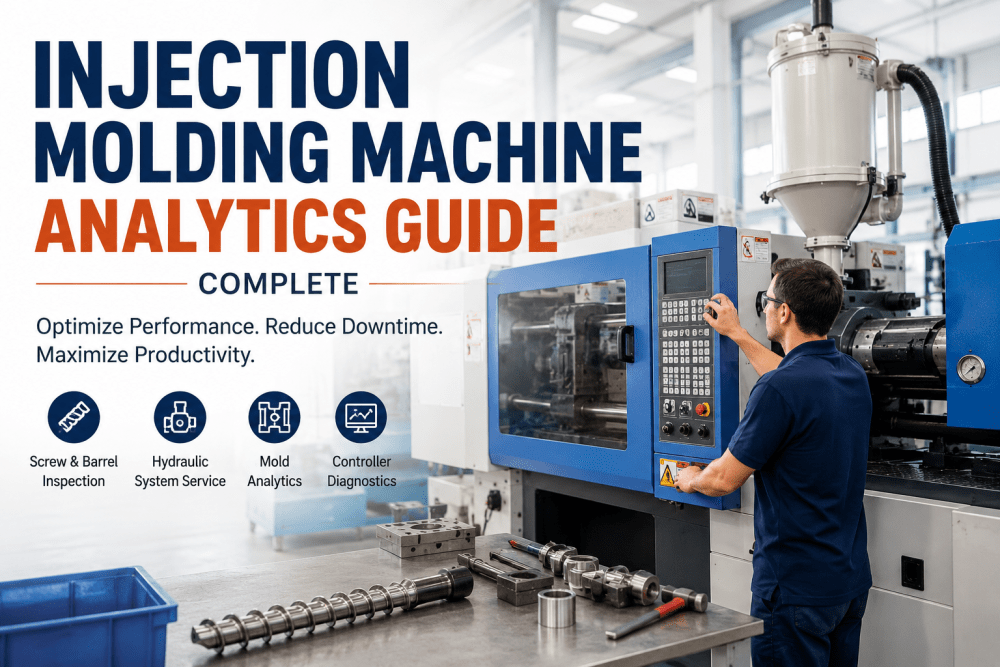
Injection molding plants run on margins that are decided a fraction of a second at a time. Cycle time, shot weight consistency, and clamping pressure determine whether a press is profitable or bleeding scrap, and yet most plants still set these parameters from a setup sheet that was written when the mold was new and the resin lot was different. The result is first-pass yields that drift shift to shift and scrap rates that get accepted as normal because the real cause is hidden inside process variability nobody is tracking continuously. iFactory's injection molding module was built to make that variability visible and actionable in real time.
Stop running presses on setup sheets that expired weeks ago
iFactory monitors every shot against an optimal process fingerprint and recommends parameter corrections before drift becomes scrap, so your team catches problems at cycle 15 instead of cycle 1,500.
Five variables that decide if your press makes money
Injection molding profitability comes down to how consistently you control a handful of process parameters that interact with each other in ways a static setup sheet cannot capture. When one variable drifts, the others compensate invisibly until the part falls out of spec.
Cycle time
A 0.3-second reduction on a 15-second cycle adds over 700 additional parts per day per press. Across a 10-press shop running three shifts, that is thousands of extra salable parts weekly with no additional machine time or labor cost.
Shot weight
Shot weight variation of just 0.1 gram can shift part dimensions enough to trigger dimensional rejects on tight-tolerance parts. Most plants do not track shot weight at the granularity needed to catch this drift before it produces scrap.
Hold pressure
A single hold pressure value ignores that the part needs different packing force as the gate freezes and the cavity fills. AI optimizes the entire pressure profile across multiple zones, reducing sink marks and warpage.
Melt temperature
Barrel zone temperatures drift during long runs, and a 2-4 degree shift changes viscosity enough to alter fill patterns. Plants running overnight often see first-article quality degrade by morning without a clear root cause.
Clamping force
Most presses run clamping force 5-15% higher than necessary, consuming more energy and accelerating mold wear. AI calculates minimum clamping force based on actual cavity pressure rather than a conservative fixed number.
Why fixed parameters stop working after the first week
A setup sheet is a snapshot of ideal conditions at one point in time. The moment resin changes, the mold warms up, or the shift changes, that snapshot is already outdated. Here is what actually causes parameters to drift in the weeks after a mold is qualified.
Resin lot viscosity drifts between shipments
The same grade from the same supplier can have measurable MFI variation lot to lot. A setup sheet calibrated to one lot will overpack or underpack when the next lot arrives, and most plants discover this only after producing scrap parts.
Mold temperature shifts during extended runs
Mold surface temperature climbs steadily over the first few hours and can take 50-100 shots to stabilize. Early parts often differ from steady-state parts in shrinkage and warpage, a gap the setup sheet cannot account for.
Ambient conditions change between shifts
Summer overnight cooling versus winter heating changes the temperature of water flowing through mold circuits. A setup sheet that works on first shift may produce different results on third shift without any parameter change at all.
Screw and barrel wear change shear characteristics
As screw flights wear, the shear heating delivered to the resin changes, meaning melt temperature is no longer what the barrel setpoints suggest. This degradation happens gradually enough that operators never notice the cumulative shift.
Water circuit fouling reduces cooling efficiency
Mineral buildup in cooling channels reduces heat transfer over weeks and months, so the mold runs hotter than when the setup sheet was written. Parts cool slower, cycle times creep up, and crystallinity changes in semi-crystalline materials.
Operator setup variation is never documented
Two operators setting the same mold can arrive at slightly different injection speeds, transfer positions, and hold times based on experience. These small differences compound into measurable yield variation that gets blamed on material or the mold itself.
How AI reads what a setup sheet can't capture
iFactory's injection molding module sits alongside your existing press controllers and MES, adding a real-time prediction layer that turns raw process signals into actionable corrections before the next shot is molded.
Ingest live process signals from the press
Injection pressure curves, screw position, cavity temperature, and cycle time are pulled from the press controller at sub-second resolution, building a real-time picture of what each shot actually did from fill through pack to hold.
Detect drift against the optimal process fingerprint
The model compares every shot's process signature to the known-good fingerprint established during setup validation, flagging deviations in injection speed, peak pressure, or cushion position before they produce an out-of-spec part.
Recommend specific parameter corrections
When drift is detected, the system suggests targeted adjustments to injection speed, hold pressure profile, or barrel temperature to bring the next shot back into the optimal window, rather than relying on operator intuition.
Close the loop with quality feedback
When dimensional or visual inspection data is fed back, the model refines its understanding of which process adjustments actually improved quality, making future recommendations more precise for that specific mold and resin combination.
See what your shot-to-shot variation actually looks like
iFactory maps every cycle on your press against the optimal fingerprint and shows you exactly where setup sheets are falling short on your own production data.
Before and after AI on the same press
These numbers come from actual pilot results across plastics plants running commodity and engineering grades. Every metric is measured against the same press's own baseline from the 90 days before iFactory was installed.
What a 60-day pilot delivers on your floor
The pilot is designed to produce a defensible cost reduction number that your leadership team can evaluate against real baselines, not projections. Here is what is included from day one through final validation.
Connects to your existing press controllers
Works with Engel, Arburg, Husky, KraussMaffei, and other major brands through standard OPC-UA or proprietary interfaces already on your floor.
Calibrates to your current resin grades
Model learns the behavior of the resins, colorants, and additives you run, including regrind blends, without requiring any material or supplier changes.
Runs in shadow mode first
Recommendations are generated and logged but not pushed to the press during the first two to three weeks, so your team validates accuracy before acting on them.
Measures against your actual baseline
Pilot success criteria are defined against your real scrap rate, cycle time, and yield from the 90 days before start, not against industry averages or estimates.
On-premise deployment with no cloud dependency
Runs on an NVIDIA appliance inside your plant network, keeping process data and production cost information on site and behind your existing firewall.
Grade-by-grade expansion path after pilot
Start with your highest-volume or most troublesome grade and add coverage as the model proves out, with zero disruption to grades not yet in scope.
Questions plant managers ask before starting
Stop guessing at parameter changes and start proving what works
iFactory shows your team exactly where each press is drifting, why it is drifting, and what to change before the next shot. Book a demo and we will walk through it on your own production data.