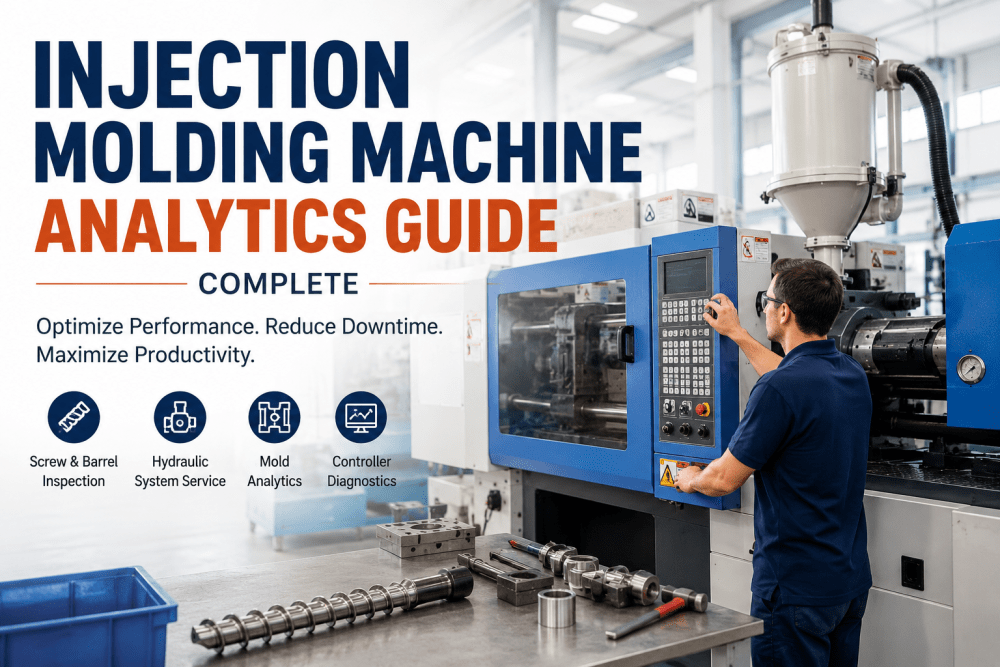
Six months ago, a $2.8 million injection molding line at a Midwest automotive supplier was losing $12,000 per shift to unplanned downtime. The plant manager couldn't see the creeping screw wear, the hydraulic drift, or the mold cooling degradation until a catastrophic failure stopped the line cold. Today, that same line runs at 94% OEE, maintenance is scheduled around actual component degradation rather than calendar dates, and the team catches developing issues — a 0.02mm screw flight loss, a 3°F mold temperature excursion, a 2% hydraulic pressure decay — three to five shifts before they become defects or stoppages. This is what injection molding machine analytics delivers when it moves from spreadsheets and intuition to real-time, condition-based intelligence.
Stop Guessing. Start Predicting. The Complete Guide to Injection Molding Machine Analytics
A unified analytics platform that monitors every critical subsystem — screw, barrel, mold, hydraulics, controller, and cycle — and converts machine data into scheduled preventive actions, eliminating surprise failures and optimizing process efficiency across your entire molding floor.
What Injection Molding Machine Analytics Looks Like in Practice
These results come from a 17-machine molding facility producing automotive interior components. The iFactory platform was deployed in 8 weeks, relying entirely on on-premise data capture with no cloud dependency. Every metric is measured from the same baseline: the 90-day period before deployment.
Complete Visibility Across Every Critical Subsystem
iFactory ingests data from every source on your molding floor — machine controllers, mold thermocouples, hydraulic pressure transducers, screw position encoders, and your existing CMMS — and presents a unified, actionable view of machine health.
Screw & Barrel Wear Monitoring
Continuous tracking of screw recovery time, backpressure stability, and barrel zone temperature variance. The platform detects 0.01mm flight wear trends and alerts maintenance 40–60 hours before degradation affects part quality. Eliminates the guesswork around screw replacement intervals.
Mold Performance & Cooling Analytics
Real-time monitoring of mold temperature differential, cooling circuit flow rates, and cycle-to-cycle thermal recovery. Identifies blocked cooling channels, thermocouple drift, and mold alignment shifts. Reduces mold-related downtime by 65% through predictive intervention.
Hydraulic System Health
Monitors pump pressure ripple, valve response latency, and oil temperature trends. Detects pump wear, seal degradation, and contamination buildup 3–5 days before failure. Enables targeted hydraulic maintenance rather than blanket fluid changes every 2,000 hours.
Controller & Cycle-Time Diagnostics
Ingests injection profile data, clamp force readings, and cycle-time parameters from the machine controller. Identifies deviations in injection speed, holding pressure, and cooling time that correlate with part defects. Provides operators with real-time process capability indices (Cpk) per shot.
Predictive Maintenance Scheduling
Automatically generates work orders based on component degradation curves rather than calendar intervals. Schedules screw pull inspections, mold maintenance, and hydraulic service at the optimal point in the wear cycle, extending component life by 30–50% while eliminating surprise failures.
Downtime Root-Cause Analysis
Correlates stoppage events with preceding sensor trends across all subsystems. Answers the critical question: did the hydraulic failure cause the screw wear, or did the screw wear cause the hydraulic overload? Reduces troubleshooting time from hours to minutes.
The Cost of Flying Blind on Your Molding Floor
Every injection molding operation runs on a delicate balance of temperature, pressure, timing, and material behavior. When you lack real-time analytics, small degradations compound into expensive failures. Here is what that costs in practice.
Undetected Screw Wear Wastes $140,000 Per Machine Per Year
A 0.05mm reduction in screw flight height increases specific energy consumption by 8–12% and produces inconsistent melt quality. Without analytics, most plants replace screws on a fixed schedule — either too early (wasting $8,000–$15,000 per screw) or too late (producing scrap for weeks). iFactory detects wear trends at 0.01mm resolution and schedules replacement at the exact economic optimum.
Mold Cooling Degradation Causes 23% of All Molding Downtime
Blocked cooling channels, fouled thermolators, and degraded mold temperature control account for nearly a quarter of all unplanned stops. Each event costs $4,200–$7,800 in lost production and tooling stress. iFactory monitors mold cooling circuit flow rate and temperature differential per zone, flagging developing blockages 48–72 hours before they cause a stop.
Hydraulic Failures Are the Most Expensive Surprise on the Floor
A single hydraulic pump failure on a 650-ton press costs $18,000–$35,000 in replacement parts and 8–14 hours of lost production. Contaminated oil, seal wear, and valve drift develop over weeks but only announce themselves at failure. iFactory's hydraulic health analytics detect pump efficiency decline and valve response shift 3–5 days before failure, enabling scheduled intervention during planned downtime.
Your molding floor already generates the data you need. The only question is whether you're using it to predict failures or just record them after they happen. Book a 30-min walkthrough and we'll show you how one plant went from reactive to predictive in 8 weeks.
From Data-Source Handoff to Predictive Operations in 8–12 Weeks
iFactory is an end-to-end, turnkey platform. You provide read-only access to your machine controllers, mold sensors, and CMMS. We do the rest — no cloud migration, no data egress, no integration projects.
Connect Your Data Sources
We install an on-premise NVIDIA appliance on your plant network and connect it to your injection molding machine controllers, mold thermocouple arrays, hydraulic pressure transducers, and existing CMMS. No cloud dependency, no data leaving your facility.
Automated Baseline Generation
The platform ingests 14–21 days of historical machine data to establish normal operating ranges for every monitored parameter — screw recovery time, barrel zone temperature variance, mold cooling delta-T, hydraulic pressure ripple, and cycle-time distribution.
Predictive Model Deployment
iFactory's analytics engine builds degradation models for each subsystem, calibrated to your specific machines, molds, and production schedules. Alert thresholds are set automatically based on statistical process control limits, not arbitrary numbers.
Condition-Based Maintenance Execution
The platform generates work orders in your CMMS when degradation reaches the intervention threshold. Your technicians receive a specific diagnosis — "screw recovery time increased 18%, inspect flight height on station 7" — and the optimal window for the work.
Every Promise Delivered in a Single Turnkey Platform
End-to-End Deployment
You hand over data-source access. We deliver a working pilot in 6–12 weeks. No integration projects, no middleware, no consultants. The platform connects, configures, and calibrates itself.
100% On-Premise, Zero Cloud Dependency
Your machine data never leaves your plant network. The NVIDIA appliance runs all analytics locally. No data egress, no latency, no cybersecurity exposure. Works on air-gapped networks.
Pilot-to-ROI in One Quarter
Measurable outcomes within 90 days of deployment. The platform targets a 4x ROI within the first year, driven by downtime reduction, scrap savings, and maintenance optimization.
24x7 Managed Service
iFactory monitors your platform health, updates models as machines age, and provides direct operations support. You get the analytics capability without needing a data science team.
Common Questions About Injection Molding Machine Analytics
Your Molding Floor Is Already Telling You What's About to Break
Every screw revolution, every mold cycle, every hydraulic pressure pulse contains the data you need to predict and prevent failures. iFactory turns that noise into scheduled, actionable maintenance. See it in action on your data — book a 30-minute walkthrough.