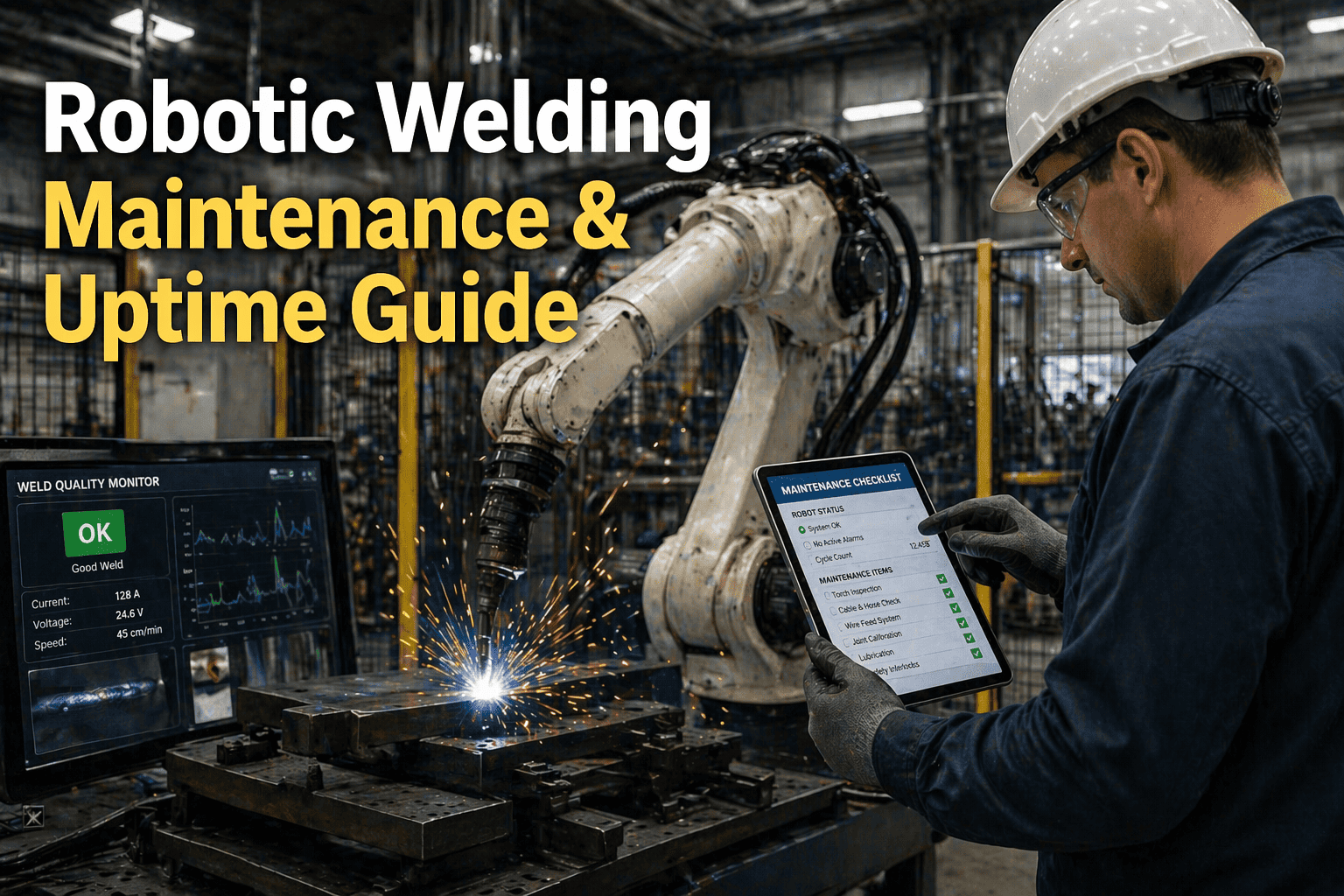
Welding equipment is the silent backbone of modern manufacturing — from automotive body shops fabricating thousands of vehicle frames per shift, to heavy machinery plants laying down structural welds that must survive decades of mechanical stress. Yet welding equipment is also one of the most maintenance-sensitive asset classes in any production environment. A worn contact tip, a contaminated shielding gas line, a misaligned robotic torch, or a degraded ground clamp can each produce defective welds that escape detection until the part reaches a customer — at which point the cost of failure is measured in recalls, warranty claims, and reputational damage. The reality across U.S. manufacturing is that most welding equipment failures are not random; they are the predictable consequence of reactive maintenance practices that miss early degradation signals in MIG guns, TIG torches, wire feeders, power sources, and robotic welding cells. iFactory AI's robotics and welding maintenance analytics platform brings structured, predictive maintenance discipline to every welding asset — capturing consumable wear cycles, arc-on-time metrics, gas flow integrity, and robotic cell performance in a single intelligence layer. If your weld quality is inconsistent or your downtime tickets keep pointing back to the welding station, Book a Demo to see how iFactory transforms welding maintenance from firefighting into a measurable, defensible operational system.
Why Welding Equipment Demands a Different Maintenance Philosophy
Welding equipment occupies a unique position in the manufacturing asset hierarchy. Unlike CNC machines or conveyors, where wear is gradual and largely mechanical, welding systems combine high-current electrical components, precision gas delivery, consumable parts that degrade by the hour, and — in robotic cells — complex motion systems whose accuracy directly determines weld quality. A single welding station typically contains five interdependent subsystems: the power source, the wire feeder or filler delivery mechanism, the torch or gun assembly with its consumables, the shielding gas system, and (in automated cells) the robot, fixturing, and safety interlocks. A failure in any subsystem produces the same visible symptom — a bad weld — but the root cause and required intervention vary dramatically.
This complexity is precisely why generic maintenance programs fail in welding environments. A monthly inspection that checks "the welder" is not maintenance — it is a checklist exercise that misses the daily consumable wear, the per-shift gas flow verification, and the per-cycle robotic torch alignment that determine whether the next weld will pass inspection. Plants that treat welding maintenance as a structured, asset-specific discipline routinely cut weld defect rates by 40–60% and extend equipment life well beyond manufacturer estimates. To see how this discipline maps to your specific welding fleet — MIG, TIG, robotic, or mixed — Book a Demo with iFactory's welding analytics team.
Consumable Wear Invisibility
MIG contact tips, TIG tungsten electrodes, gas nozzles, diffusers, and liners degrade on a per-arc-hour basis — yet most plants replace them on a "when it fails" basis. The result is hours of marginal weld quality before the operator notices the symptom, producing rework, scrap, and inspection failures that trace back to a consumable that should have been swapped a shift earlier.
Root CauseShielding Gas System Drift
Argon, CO2, and tri-mix gas systems develop slow leaks, regulator drift, and flow restrictions that operators rarely catch until porosity defects appear in finished welds. By the time the gas issue is diagnosed, weeks of borderline-quality parts may have shipped — a quiet but expensive failure mode that structured flow monitoring would have caught at onset.
Quality RiskRobotic Cell Drift & TCP Loss
Robotic welding cells lose Tool Center Point (TCP) accuracy gradually through collisions, thermal expansion, and mechanical wear. Without scheduled TCP verification, the robot continues welding to programmed coordinates that no longer correspond to the actual torch position — producing systematic placement errors across an entire production run before the deviation is detected.
Automation RiskPower Source Degradation
Welding power sources develop capacitor aging, cooling fan degradation, and internal contamination that reduce arc stability long before catastrophic failure. Reactive maintenance catches these issues only when the unit fails mid-shift — converting what should be a scheduled component swap into an emergency repair that idles an entire production cell for hours.
Reliability GapProcess-Specific Maintenance Protocols for Every Welding Method
A maintenance protocol that works for a MIG station will fail when applied to a TIG cell, and a TIG protocol will miss critical inspection points on a robotic welding system. Each welding process has its own wear pattern, consumable lifecycle, and failure mode signature. The most effective welding maintenance programs build process-specific inspection routines into a unified analytics platform — so that operators, technicians, and reliability engineers all work from the same playbook, calibrated to the welding method in front of them.
MIG Welding Equipment Maintenance Priorities
MIG systems live and die by consumable hygiene. Contact tips should be inspected every two arc-hours for keyholing and replaced before erosion alters wire-to-work distance. Gas diffusers and nozzles require spatter cleaning every shift to maintain shielding gas coverage. Wire feed rollers must be inspected for groove wear and tension drift weekly — a worn roller produces erratic wire feed, which manifests as inconsistent arc length and porosity. Liner replacement intervals are wire-type-dependent: hard wires wear liners faster than soft wires, and the analytics platform should track liner-hours against wire type to predict replacement before feed problems begin.
TIG Welding Equipment Maintenance Priorities
TIG maintenance centers on torch integrity and gas purity. Tungsten electrodes require correct grinding geometry — improper tip angle changes arc characteristics and bead profile. Gas lenses, collets, and back caps must seal completely to prevent atmospheric contamination of the weld puddle. High-frequency start systems on AC TIG units need regular inspection of HF points and capacitors. Water-cooled torches add an additional inspection layer: coolant flow, hose integrity, and coolant chemistry all affect torch life and operator safety. iFactory's analytics platform tracks consumable replacement events against weld defect data, surfacing correlations that point to maintenance gaps before they affect production quality.
Robotic Welding Cell Maintenance Priorities
Robotic welding cells require everything a manual welding station requires — plus the disciplines unique to industrial automation. Daily TCP verification ensures the torch is where the program thinks it is. Cable management inspection prevents the dress pack from binding or wearing. Anti-collision device testing verifies that the cell will stop safely on a fixturing error. Fixture wear measurement catches the dimensional drift that produces systematic placement errors. Wire-cut and nozzle-clean station maintenance ensures that automated consumable management actually works. iFactory's robotics tracking layer captures every robot fault, cycle count, and consumable event against weld quality data — converting robotic welding from a black box into a transparent reliability system. Book a Demo to see how this integrates with your robot brand.
Reactive vs. Predictive Welding Maintenance: A Side-by-Side Analysis
The economic case for predictive welding maintenance is rarely about a single avoided breakdown — it is about the cumulative impact across consumable cost, weld quality, equipment life, and production availability. The table below captures the operational delta between traditional reactive welding maintenance and an analytics-driven predictive program built around the iFactory platform.
| Maintenance Metric | Reactive Welding Maintenance | Predictive Welding Analytics | Performance Gain |
|---|---|---|---|
| Consumable Replacement Trigger | After visible defects | Arc-hour based prediction | Defect prevention |
| Unplanned Welding Downtime | Frequent mid-shift failures | Scheduled component swaps | –55% downtime hours |
| Weld Defect Rate | Variable, drift-prone | Consistent, monitored | –40–60% defect reduction |
| Robotic TCP Accuracy | Drift undetected | Daily verified | Continuous accuracy |
| Gas Consumption | Leak losses undetected | Flow-monitored | –15–25% gas waste |
| Power Source Service Life | Below manufacturer rating | Extended via condition-based care | +30–40% asset life |
| Audit & Traceability Readiness | Paper logs, gaps | Digital, timestamped records | Audit-ready continuously |
Six iFactory Capabilities That Transform Welding Equipment Reliability
iFactory AI's robotics and cobot maintenance tracking platform is engineered around the capabilities that directly determine welding equipment performance. Each capability is built to deploy quickly, integrate with existing welding power sources and robot controllers, and produce measurable improvements in weld quality and equipment uptime. To see a capability demonstration mapped to your specific welding fleet, Book a Demo with our welding solutions team.
Consumable Lifecycle Tracking
Track every contact tip, nozzle, diffuser, liner, tungsten, and gas lens against arc-hours, weld cycles, and wire consumption — with predictive replacement alerts that prevent the consumable degradation cycle from producing weld defects before maintenance intervenes.
Robotic Welding Cell Health Monitoring
Continuous monitoring of robot joint torque, cycle counts, fault histories, dress pack wear indicators, and TCP verification results — surfacing degradation patterns in the robotic cell before they translate into placement errors, collisions, or systematic weld defects across production runs.
Gas System Integrity Analytics
Flow rate monitoring, cylinder consumption tracking, and regulator performance analysis identify leaks, restrictions, and drift in shielding gas delivery — preventing the porosity and contamination defects that result from undetected gas system degradation across MIG and TIG operations.
Power Source Condition Monitoring
Capture arc-on-time, duty cycle utilization, internal temperature trends, cooling fan operation, and fault code histories from welding power sources — enabling condition-based maintenance scheduling that extends asset life and eliminates mid-shift power source failures.
Digital Welding Inspection Checklists
Structured digital checklists for daily, weekly, and monthly welding equipment inspections — enforcing complete, timestamped maintenance records across MIG guns, TIG torches, wire feeders, robotic cells, and gas systems with full audit trail integrity for ISO 3834 and AWS D1.1 compliance environments.
Weld Quality & Maintenance Correlation
Link weld defect data, inspection results, and rework events directly to maintenance histories, consumable changes, and equipment condition metrics — surfacing the cause-and-effect relationships that traditional siloed quality and maintenance systems consistently miss across welding operations.
The Financial Case: How Predictive Welding Maintenance Pays for Itself
The Compounding ROI of Structured Welding Maintenance Analytics
The return on investment from a predictive welding maintenance program compounds across three distinct layers — direct cost avoidance, productivity recovery, and long-term asset value extension. Manufacturing reliability engineers who deploy iFactory's welding analytics platform consistently report that the first quarter of operation recovers the platform cost through avoided downtime alone, after which every defect prevented, every consumable optimized, and every robotic cell hour preserved becomes pure compounding return. To model the welding maintenance ROI specific to your fleet, Book a Demo for a facility-specific projection.
Immediate: Downtime & Defect Avoidance
A single welding cell that produces a body panel, frame member, or pressure vessel weld at 50 cycles per hour can lose $5,000–$15,000 per hour of unplanned downtime when production is bottlenecked behind the welding station. Predictive consumable replacement, gas system monitoring, and robotic cell health tracking convert most of these emergency events into scheduled, off-shift component swaps — recovering the cost of the analytics platform within the first quarter of operation in most facilities.
Short-term value driverIntermediate: Consumable & Gas Optimization
Structured consumable tracking typically reveals that some stations replace tips and nozzles prematurely while others run them well past optimal life — both of which waste money and quality. Standardizing replacement against actual arc-hours, combined with gas leak detection and flow optimization, routinely reduces welding consumable and gas spend by 15–25% while improving weld consistency across the fleet.
Medium-term efficiency driverLong-Term: Welding Asset Life Extension
Welding power sources, robotic manipulators, wire feeders, and water coolers all respond positively to condition-based maintenance — typically delivering 30–40% longer service life than reactively maintained equivalents. For a plant with twenty welding stations, this asset life extension defers capital expenditure significantly and frees budget for capacity expansion or automation upgrades elsewhere in the operation.
Long-term strategic advantageAverage reduction in weld defect rates when predictive consumable management and gas system monitoring replace reactive maintenance practices across MIG and TIG operations.
Typical decrease in unplanned welding cell downtime after deployment of iFactory's predictive maintenance analytics and consumable lifecycle tracking platform.
Combined reduction in welding consumable and shielding gas spend when usage is tracked against arc-hours and gas system leaks are eliminated through flow monitoring.
Average service life extension achieved for welding power sources, robotic manipulators, and wire feeders under structured condition-based maintenance programs.
Expert Review: What Reliability Engineers Say About Welding Maintenance Analytics
In conversations with maintenance directors, welding engineers, and reliability leaders across automotive, heavy equipment, and structural fabrication sectors, three themes consistently emerge as the practical differentiators between welding programs that work and those that struggle. These themes — captured below — represent the operational wisdom that separates plants achieving 95%+ welding cell availability from those still firefighting weekly equipment failures.
"Track Arc-Hours, Not Calendar Days"
Experienced welding reliability engineers consistently emphasize that consumable replacement schedules built around calendar intervals — "change tips every Friday" — produce both premature replacement and missed degradation depending on station utilization. The discipline that works is arc-hour tracking: every consumable, liner, and torch component has a known life range expressed in arc-hours, and the maintenance system should trigger replacement against actual usage rather than a fixed time interval.
Best Practice: Usage-Based Maintenance"Treat Weld Defects as Maintenance Data"
Welding engineers stress that defect patterns are the most reliable early warning system for equipment problems. Porosity points to gas system or torch sealing issues. Inconsistent bead geometry points to wire feed problems. Spatter increases point to contact tip wear. When weld defect data flows into the same analytics platform as the maintenance system — as it does in iFactory's unified architecture — the maintenance team gains a powerful diagnostic feedback loop that traditional siloed quality systems cannot provide.
Best Practice: Defect–Maintenance Correlation"Verify TCP Daily, Not When Something Breaks"
Robotic welding cell operators with the highest availability metrics share a common discipline: Tool Center Point verification is a daily routine, not a corrective action. A two-minute TCP check at shift start catches the drift that would otherwise produce hundreds of mispositioned welds across a production run. Embedding TCP verification into a structured digital checklist — with the result captured in the maintenance system — converts robotic welding from a high-variability process into a predictable, repeatable one.
Best Practice: Daily TCP VerificationDeploying Welding Maintenance Analytics: A Three-Phase Rollout Roadmap
Moving from reactive welding maintenance to a structured, analytics-driven program follows a phased pathway that preserves production continuity while progressively eliminating the failure modes that drive welding downtime, defect rates, and consumable waste. Most U.S. manufacturing facilities reach full operational maturity within twelve weeks of project kickoff.
Welding Asset Inventory & Baseline Capture
Every welding power source, wire feeder, torch assembly, robotic cell, and gas delivery system is inventoried in the iFactory platform within the first 2–3 weeks. Baseline consumable usage, current maintenance practices, weld defect histories, and downtime patterns are captured to establish the measurement reference against which all future improvements are quantified.
Timeline: 2–3 Weeks · FoundationDigital Checklist & Consumable Tracking Deployment
Structured digital inspection checklists for MIG, TIG, and robotic welding cells are deployed across operator, technician, and engineering roles between weeks 3–8. Consumable lifecycle tracking goes live, capturing arc-hour usage against contact tips, nozzles, liners, and tungsten electrodes — generating the first predictive replacement alerts that prevent reactive consumable failures.
Timeline: 3–8 Weeks · ActivationPredictive Analytics & Continuous Improvement
With consumable, equipment, and weld quality data accumulating, the platform begins surfacing trend analytics — recurring failure modes, high-frequency consumable categories, robotic cell drift patterns — that enable proactive program refinement. This converts welding maintenance from a reactive cost center into a continuous improvement engine that delivers compounding gains over time.
Timeline: 8–12 Weeks & Beyond · MaturityConclusion: Welding Maintenance as a Strategic Capability
Welding equipment maintenance is no longer an operational afterthought to be handled by the maintenance crew on the next available shift. In modern U.S. manufacturing environments — where weld quality determines product safety, where robotic cells run at high duty cycles, and where customer audits demand documented traceability — welding maintenance is a strategic capability that directly influences product quality, production availability, and capital efficiency. The plants that treat it that way achieve measurably better outcomes than the plants that do not.
The transition from reactive welding maintenance to a structured, analytics-driven program is neither expensive nor disruptive. It is a matter of bringing the right discipline — usage-based consumable tracking, condition-based equipment care, daily robotic cell verification, and unified weld-quality correlation — into a platform that operators, technicians, and reliability engineers can all work from. iFactory AI delivers exactly that platform, purpose-built for the welding processes and equipment that U.S. manufacturers actually run. If you are ready to move your welding operation from firefighting to predictive control, Book a Demo with our welding solutions team.
Welding Equipment Maintenance — Manufacturing Engineer FAQs
Does iFactory's welding analytics platform integrate with major welding power source brands?
Yes. The platform is designed to integrate with welding power sources from major manufacturers — including Miller, Lincoln Electric, Fronius, ESAB, and Panasonic — using either native data interfaces where available or PLC-based data collection where direct integration is not exposed. The same approach extends to robotic welding cells from FANUC, ABB, Yaskawa, KUKA, and other leading automation brands, capturing cycle counts, fault histories, and TCP verification data in a unified maintenance record.
How does the platform handle consumable tracking for high-volume MIG welding operations?
Consumable tracking is built around arc-hour accumulation and weld-cycle counting rather than calendar intervals. Each consumable — contact tip, nozzle, diffuser, liner — is assigned an expected service life expressed in arc-hours, and the platform monitors usage against that threshold to trigger predictive replacement alerts before the consumable begins producing weld defects. For high-volume MIG operations, this typically results in 15–25% reductions in consumable waste while simultaneously improving weld consistency.
Can the platform support TIG-specific maintenance requirements such as tungsten grinding and water cooling?
Yes. The digital inspection checklist system is fully configurable to TIG-specific requirements — tungsten electrode grinding geometry verification, collet and gas lens condition inspection, water cooler flow and temperature monitoring, HF start system checks for AC TIG units, and coolant chemistry verification on water-cooled torches. The same audit trail discipline applies whether the workflow covers MIG, TIG, plasma arc welding, or robotic systems.
How does the platform help with weld quality root cause analysis when defects appear?
Because weld defect data, inspection results, and maintenance histories all reside in the same unified analytics platform, the system can correlate defect events with recent consumable changes, equipment condition metrics, gas system performance, and robotic cell events. This converts what is traditionally a multi-day investigation across siloed quality and maintenance systems into a guided root cause analysis that typically identifies the contributing maintenance factor within hours.
How quickly can a typical U.S. manufacturing plant deploy welding maintenance analytics with iFactory?
Most facilities complete welding asset inventory and baseline capture within 2–3 weeks of project kickoff, deploy digital inspection checklists and consumable tracking across all welding stations by week 8, and reach predictive analytics maturity by week 12. The deployment is designed to be non-disruptive to ongoing production, with digital workflows running in parallel to existing practices during the transition period before fully replacing paper-based systems.





.png)