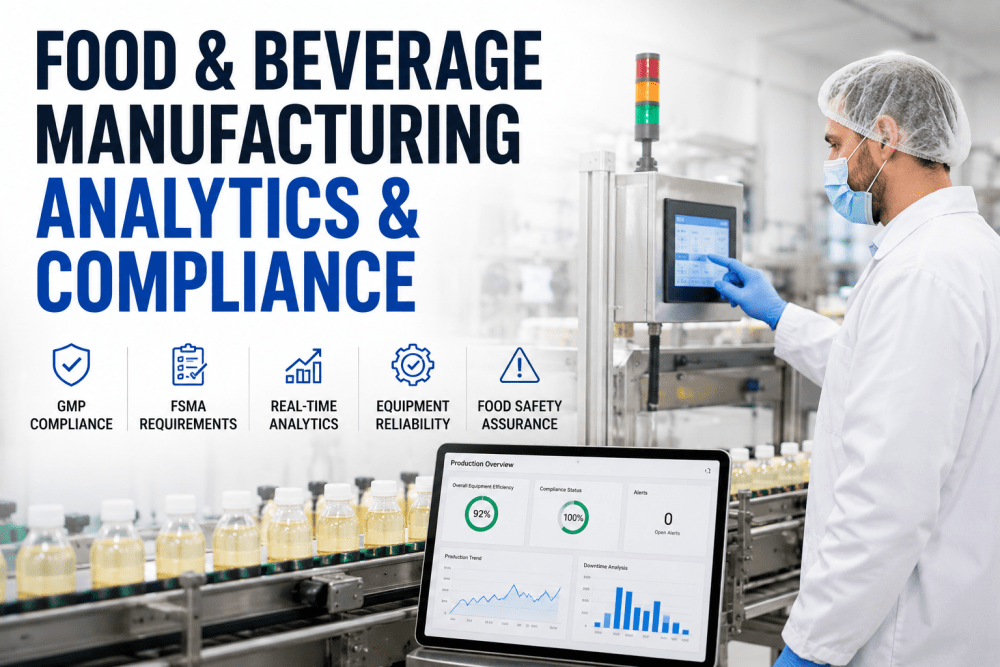
Food and beverage manufacturers operate under more regulatory scrutiny than nearly any other industrial sector — GMP requirements, FSMA preventive controls, allergen management protocols, and sanitary equipment standards all intersect on the same production floor where throughput and uptime pressures are relentless. The operations teams managing these plants cannot afford to treat compliance and efficiency as competing priorities. The good news: AI-powered food manufacturing analytics addresses both simultaneously. iFactory's industrial analytics platform brings real-time equipment monitoring, predictive maintenance, compliance documentation, and allergen traceability into a single operational view — built specifically for U.S. food and beverage processing environments.
The U.S. food and beverage manufacturing sector generates over $1.1 trillion in annual output, but it operates under regulatory pressure that intensifies every year. FDA's FSMA enforcement has moved from education to active inspection, with recalls costing manufacturers an average of $10 million per event when brand damage is factored in alongside direct remediation costs. Meanwhile, rising ingredient costs and tight margins make equipment downtime — which averages 23 unplanned hours per month in a typical food processing plant — a direct threat to profitability.
Food processing analytics platforms like iFactory close the gap between compliance documentation and operational performance. Rather than treating GMP recordkeeping as a separate administrative burden and equipment monitoring as a maintenance function, these platforms connect both data streams into a unified operational model. The result: compliance records are generated automatically from real operational data, and the same sensor network that supports FSMA documentation also drives predictive maintenance alerts that prevent the downtime events that create food safety risk in the first place.
The most persistent compliance risk in food manufacturing is not a process failure — it is a documentation failure. FDA investigators consistently find that plants have adequate process controls in place but cannot produce the records that demonstrate those controls were monitored, verified, and corrected when deviations occurred. FSMA's preventive controls rule requires written records for every monitoring activity at every CCP, every corrective action, and every verification procedure. For a mid-size processing facility running three shifts across four production lines, that is thousands of compliance records per month — the majority of which are still entered manually in most U.S. food plants.
iFactory's GMP compliance analytics module connects directly to the PLC and sensor network already installed on most food processing equipment, automatically generating FSMA-compliant monitoring records from actual operational data. Temperature deviations, CIP cycle parameters, pasteurization hold times, and sanitation verification steps are all captured in real time and stored in an audit-ready format that meets 21 CFR Part 117 recordkeeping requirements. When an FDA inspector arrives, the compliance record package is already complete.
| Compliance Requirement | Manual Approach (Current State) | iFactory Analytics Approach | Risk Reduction |
|---|---|---|---|
| FSMA Preventive Control Records | Manual logbooks, 2–4 hour lag, paper scanning required for audit | Auto-generated from sensor data, real-time, digital audit trail | High — eliminates documentation gaps |
| CCP Monitoring Logs | Hourly manual readings, transcription errors, incomplete during shift changes | Continuous automated monitoring, deviation alerts within 90 seconds | High — continuous vs. interval coverage |
| Corrective Action Documentation | Retrospective entry after resolution, often incomplete | Triggered automatically on deviation, timestamped, linked to root cause | Medium-High — improves traceability |
| Sanitation Verification Records | Sign-off sheets, photo documentation, manual filing | Digital verification workflows with sensor confirmation of completion | Medium — structured vs. ad-hoc records |
| Allergen Changeover Verification | Checklist-based, operator-dependent, no system enforcement | Workflow-enforced, cannot proceed without verification steps completed | High — process locked until verified |
| Supplier Verification Records | Spreadsheet tracking, manual certificate of analysis filing | Integrated COA management with automated expiration alerts | Medium — reduces administrative overhead |
Food processing equipment presents a maintenance challenge that is fundamentally different from other industrial sectors: every unplanned failure carries both an operational cost and a food safety risk. A bearing failure on a conveyor in an automotive plant costs downtime. The same failure on a ready-to-eat food production line can contaminate finished product, trigger a recall, and generate an FDA enforcement action — all from the same 45-minute failure event. Maintenance programs in food manufacturing must therefore deliver not just equipment reliability, but food safety reliability.
The sanitary design requirements that make food processing equipment safer to clean also make it harder to instrument. Stainless steel surfaces, high-pressure washdown environments, and enclosed equipment housings limit the placement options for traditional vibration and temperature sensors. iFactory's food plant maintenance module is designed for these constraints — using non-contact acoustic sensors, washdown-rated vibration probes, and process variable analytics to build failure prediction models on the equipment types most critical to food production reliability.
Allergen-related recalls are among the most costly and reputationally damaging events a food manufacturer can face. The FDA reported over 40% of all food recalls in 2024 were allergen-related — the majority caused not by formulation errors but by cross-contact during production, inadequate changeover cleaning, or mislabeling. These are process control failures, and they are analytics-solvable problems if the right data is connected to the right workflows.
iFactory's allergen management module goes beyond checklist digitization. It integrates allergen scheduling logic with production planning, so allergen-containing runs are sequenced to minimize high-risk transitions. It enforces changeover cleaning verification through sensor-confirmed rinse cycles before allowing production to restart on allergen-free items. And it maintains a real-time allergen status map of every active production line — visible to QA, operations, and scheduling teams simultaneously — so allergen cross-contact risks are identified and resolved before product is committed to packaging.
HACCP plans define the critical control points where food safety hazards must be controlled — but the monitoring of those CCPs in most U.S. food plants is still largely manual, interval-based, and dependent on individual operator attention. A pasteurizer operating 0.5°F below its lethal temperature set point for 12 minutes between hourly manual checks is a food safety event that may never appear in the compliance record. Continuous CCP monitoring through process analytics changes that — every second of every shift is monitored, deviations are flagged in real time, and the record of what happened is complete and verifiable.
iFactory's food safety analytics module connects to the temperature, pressure, flow, and pH sensors already present on most pasteurizers, retorts, heat exchangers, and CIP systems. Statistical process control algorithms run continuously on these data streams, identifying drift patterns that precede CCPs deviations before the threshold is crossed. When a deviation does occur, the system automatically generates the FSMA corrective action record, alerts the QA team, and logs the hold status of product produced during the deviation window — all without operator intervention.
| Capability Area | What iFactory Delivers | Compliance Standard Supported | Operational Impact |
|---|---|---|---|
| FSMA Preventive Controls | Automated monitoring records, corrective action logs, verification documentation | 21 CFR Part 117 | Audit preparation time reduced from days to hours |
| GMP Analytics | Real-time sanitation compliance, hygiene zone monitoring, personnel access tracking | FDA GMP / 21 CFR Part 110 | GMP deviation detection before product impact |
| Predictive Maintenance | AI failure prediction on sanitary equipment, CIP pump health, refrigeration systems | Supports FSMA equipment maintenance requirement | 67–94% reduction in unplanned sanitary equipment downtime |
| Allergen Management | Digital changeover workflows, sensor-confirmed cleaning, allergen status dashboard | FSMA Allergen Preventive Control | Cross-contact risk eliminated through workflow enforcement |
| CCP Monitoring | Continuous sensor-based CCP monitoring, SPC analytics, deviation alerting | HACCP / FSMA CCP Documentation | 100% CCP coverage vs. interval-based manual monitoring |
| Lot Traceability | End-to-end lot tracking from raw material to finished product shipment | FSMA Traceability Rule (21 CFR Part 1, Subpart S) | Full trace assembly in under 15 minutes vs. 4–8 hours |
| OEE & Production Analytics | Real-time OEE, fill-weight accuracy, CIP cycle efficiency, throughput analytics | Operational — supports GMP production controls | Average 12–18% OEE improvement in first 12 months |
The dichotomy between compliance investment and operational efficiency investment that has historically defined budget conversations in food and beverage manufacturing is a false one. The same sensor network, data infrastructure, and analytics platform that generates FSMA-compliant monitoring records also drives the predictive maintenance alerts that prevent downtime. The same allergen workflow system that eliminates cross-contact risk also accelerates changeover times. The same CCP monitoring analytics that satisfies FDA inspection requirements also identifies the process drift patterns that erode yield and product consistency.
iFactory's food manufacturing analytics platform is built around this convergence. Rather than deploying a compliance documentation tool and a separate maintenance analytics platform and a separate food safety monitoring system, iFactory delivers a unified operational intelligence layer that addresses all three — from a single data integration, with a single sensor network, maintained by a single operations team. For U.S. food and beverage manufacturers facing increasing regulatory scrutiny, rising ingredient costs, and persistent equipment reliability challenges, that convergence is not just operationally efficient — it is a competitive advantage.