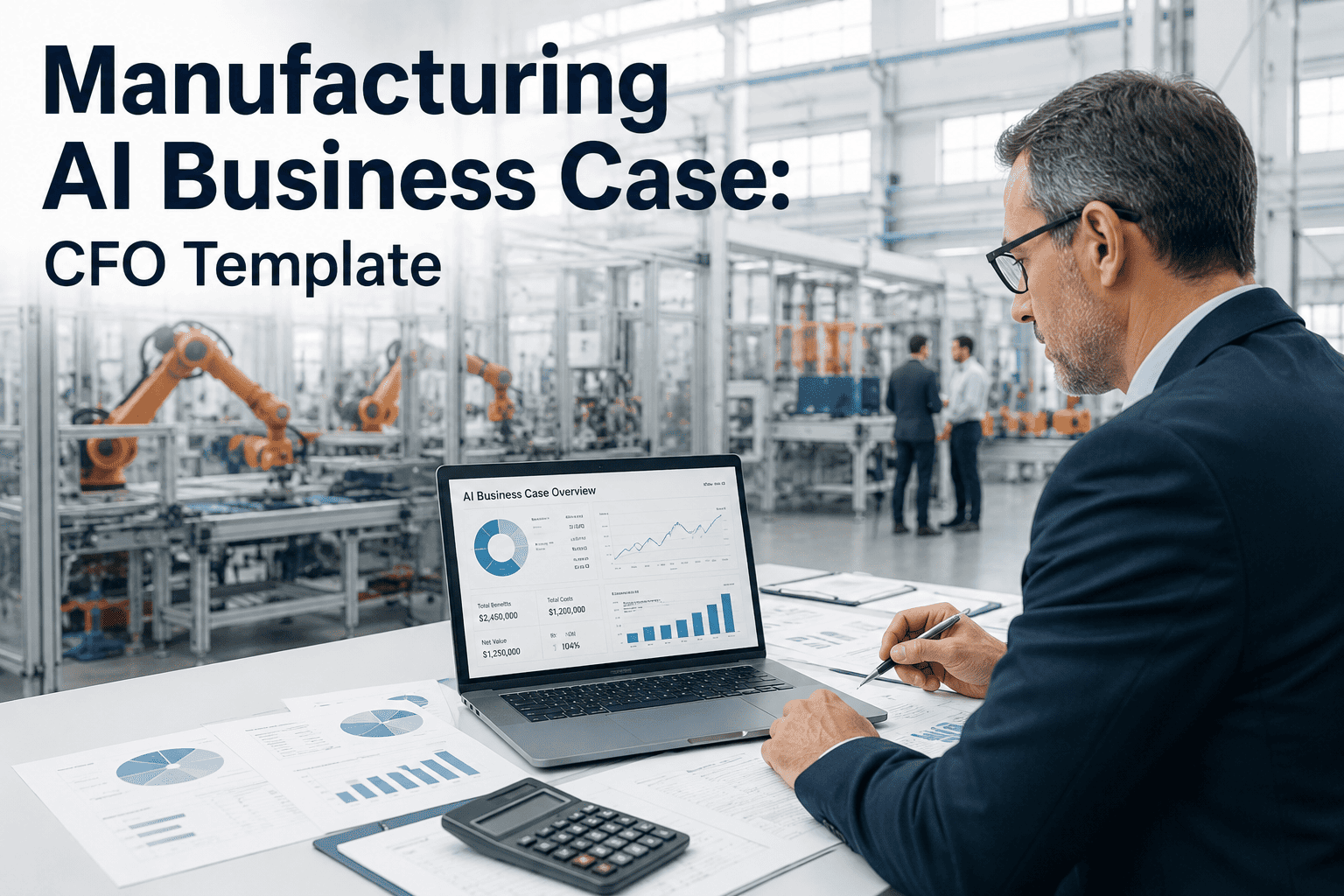
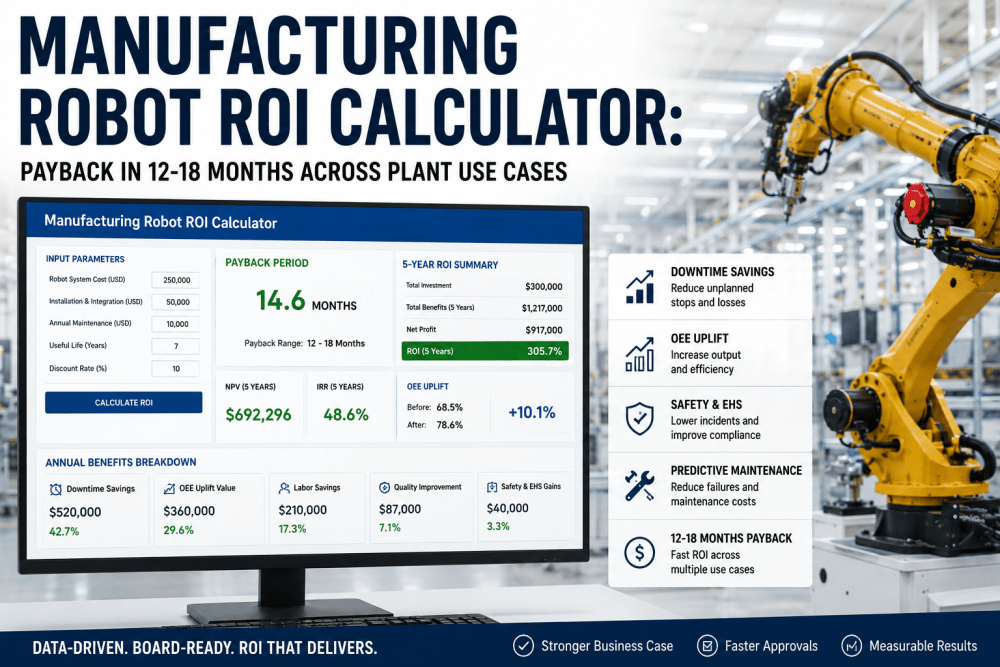
A predictive maintenance pilot that cuts downtime by 25% sounds like an easy approval. It rarely is, because a plant manager's story and a CFO's business case are built from different materials — one is a narrative, the other is a set of defensible numbers with assumptions a finance committee can pressure-test. Manufacturing AI proposals get rejected or delayed far more often over an undocumented baseline, an excluded integration cost, or a missing downside scenario than over the technology itself. A standard business case template — value drivers, cost categories, assumptions, and a sensitivity range — turns that pitch into a number the finance committee can actually approve. iFactory's platform is built to generate exactly that structure from your plant's own operating data. Book a demo to see the business case template populated with your production numbers.
AI-Driven · Finance-Ready · Manufacturing AI Business Case
The Manufacturing AI Business Case Template CFOs Actually Approve
Value drivers, cost categories, documented assumptions, and a sensitivity range — the same structure your finance committee already uses to evaluate capital projects, applied to AI investment.
8 mo
Median payback period across manufacturing AI use cases with a documented baseline
10:1
Average ROI for predictive maintenance within two years of implementation
210%
Median three-year ROI across enterprise AI deployments with defined KPIs
1 in 4
Organizations underestimate AI project costs by 50% or more before approval
Why Business Cases Get Rejected
Four Reasons CFOs Send Manufacturing AI Proposals Back
A finance committee does not reject AI on principle. It rejects a business case it cannot defend to the board — and these four gaps are the ones that show up most often.
No Baseline
The "Before" Number Was Never Measured
A claimed 25% downtime reduction is meaningless without a documented pre-AI baseline. Without it, the CFO has no way to verify the benefit after go-live, so the number gets discounted before it reaches the board.
Single Driver
Only Labor Savings Made It Into the Model
Throughput gains, scrap reduction, and avoided downtime are usually larger value drivers than labor savings alone, but proposals built only around headcount routinely understate the true return by half or more.
Hidden Costs
Integration and Data Cleanup Were Left Out
Software licensing is typically a small share of first-year AI spend. When integration, data preparation, and change management are excluded from the model, actual cost overruns surface only after approval.
No Range
There Was Only One Scenario, Not a Range
A single-point ROI projection looks fragile next to every other capital proposal in the room, which arrives with a best case, worst case, and base case already built in.
The Value Driver Stack
Four Value Drivers Every Manufacturing AI Business Case Should Quantify
Most proposals stop at the first driver. The strongest business cases quantify all four, because each one compounds on the plant's existing cost structure differently.
Downtime Avoidance
10–20% availability improvement
Predictive maintenance value is the easiest to model because unplanned downtime already carries a known cost per hour on most production lines — the AI's job is to reduce the frequency of that known cost.
Scrap and Quality Recovery
200–300% ROI on defect reduction
AI-driven inspection and quality analytics catch drift before it becomes scrap, converting a variable cost that erodes margin every shift into a tracked, shrinking line item.
Throughput and Capacity Recovery
15–25 point OEE improvement
Recovering OEE points on existing equipment is functionally equivalent to adding capacity without a capital purchase — the value driver a CFO recognizes fastest on a spreadsheet.
Risk and Insurance Reduction
Adds 15–25% to direct ROI
Fewer safety incidents, lower warranty claims, and reduced insurance premiums are secondary value drivers that rarely appear in a first draft but consistently improve the final ROI figure.
iFactory Builds the Business Case Directly From Your Plant's Operating Data.
Baseline capture, value-driver quantification, cost modeling, and a board-ready sensitivity range — generated from your production line's actual numbers instead of an assumed benchmark.
Assumptions and Sensitivity Analysis
Three Scenarios Every Sensitivity Table Should Include
A CFO trusts a range far more than a single number. Model each value driver at three adoption and performance levels so the committee sees where the risk actually concentrates.
Conservative
Downtime reduction8%
Payback period18 mo
3-year ROI120%
Base Case
Downtime reduction15%
Payback period10 mo
3-year ROI210%
Aggressive
Downtime reduction24%
Payback period6 mo
3-year ROI340%
Narrative vs. Numbers
The Pitch That Gets Delayed vs. the Business Case That Gets Approved
Component
Narrative Pitch
Finance-Ready Business Case
Baseline
Estimated from industry benchmarks or vendor claims
Measured from 30+ days of the plant's own production data
Value Drivers
One driver, usually labor savings
Four drivers quantified: downtime, quality, throughput, risk
Cost Model
Software license price only
Licensing, integration, data preparation, and training included
Outcome Range
Single ROI figure with no downside case
Conservative, base, and aggressive scenarios modeled side by side
Committee Result
Sent back for more data, delaying approval by a quarter or more
Approved or declined on the numbers, in a single review cycle
From the Field
What Changed When the Proposal Became a Spreadsheet, Not a Story
Our first predictive maintenance pitch to the finance committee had one number in it — a projected 20% downtime reduction — and no source for where that number came from. It got tabled. The second version had thirty days of measured downtime data as the baseline, four value drivers instead of one, a cost model that included integration and training, and three scenarios instead of one. Same technology, same plant, same team. The committee approved it in the same meeting, because for the first time they could see exactly which assumption they were betting on if the aggressive case didn't materialize, and the conservative case still cleared our hurdle rate.
— CFO, Mid-Market Discrete Manufacturer, Three U.S. Production Facilities
1 meetingTime to approval on the second version of the business case
4 driversValue drivers quantified instead of one
3 scenariosConservative, base, and aggressive cases presented together
Conclusion
The Technology Was Never the Hard Part. The Spreadsheet Was.
Most manufacturing AI proposals that stall in front of a CFO are not being rejected on technical merit. They are being rejected because the business case behind them is missing a documented baseline, understates the value drivers, hides real implementation cost, or offers no range of outcomes to evaluate risk against. Every one of those gaps is fixable before the proposal ever reaches the committee.
iFactory's platform captures the production baseline, quantifies each value driver against your plant's own data, and builds the cost model and sensitivity range your finance team expects to see. Book a Demo to generate a business case template built around your production line's numbers.
Frequently Asked Questions
Manufacturing AI Business Cases — What CFOs Ask Before Approving
What should a manufacturing AI business case include at minimum?
A defensible business case needs five components: a measured pre-AI baseline for the target metric, quantified value drivers across downtime, quality, throughput, and risk rather than a single driver, a full cost model covering licensing, integration, data preparation, and training, a three-year cash flow view, and a sensitivity table showing conservative, base, and aggressive outcomes. Proposals missing any one of these five typically face additional review cycles before a funding decision is reached.
Book a demo to see this structure populated with your own plant's numbers.
How is a manufacturing AI investment typically classified between capex and opex?
Hardware such as sensors, edge gateways, and network upgrades is usually capitalized, while software subscriptions, cloud compute, and ongoing services are typically treated as operating expense. The mix matters for the business case because a capex-heavy proposal is evaluated against a hurdle rate and depreciation schedule, while an opex-heavy proposal is judged more like a recurring cost against expected recurring benefit. Most manufacturing AI deployments blend both, so the model should present each cost line by its correct classification rather than a single lump sum.
What payback period is realistic for manufacturing AI, and does it vary by use case?
Payback periods vary significantly by use case: predictive maintenance on well-instrumented equipment typically pays back in three to fourteen months, while more complex use cases such as digital twins or enterprise-wide scheduling optimization can take twelve to eighteen months or longer. The median across manufacturing AI use cases sits around eight months when a proper baseline exists. A business case that presents a single payback figure without naming the underlying use case and its baseline conditions should be treated with caution by a finance reviewer.
Why do manufacturing AI cost estimates so often run over budget?
Cost overruns usually come from categories left out of the original estimate rather than the software license itself, which typically represents a small share of total first-year spend. Data cleanup, system integration, security review, change management, and ongoing monitoring commonly add twenty to thirty percent beyond the baseline budget when they are not modeled upfront. A quarter of organizations underestimate total AI project cost by fifty percent or more, almost always because these operational cost categories were treated as an afterthought rather than a line item in the original business case.
How often should the business case be revisited after the AI system goes live?
The business case should be reviewed against actual results at ninety days, at the one-year mark, and then annually, comparing the realized value drivers against the conservative, base, and aggressive scenarios presented at approval. This turns the original sensitivity table into a live scorecard rather than a one-time pitch document, and it is the single strongest piece of evidence for approving the next AI investment on the same production line.
Contact support for help structuring a post-implementation value review.
Give Your Next AI Proposal a Business Case Your CFO Can Actually Defend
Baseline capture, four-driver value quantification, full cost modeling, and a board-ready sensitivity range — built directly from your plant's own production data, not an industry benchmark.