Boston Dynamics' Spot quadruped robot has rapidly evolved from a research curiosity into a production-grade industrial inspection asset deployed across BMW, Michelin, POSCO, Ford, and Nestle manufacturing plants. With 1,500+ Spot units now operational in industrial environments globally, manufacturers are documenting predictive maintenance ROI of 15-30% reduction in unplanned downtime and inspection cost savings exceeding $400,000 annually per plant. Book a Demo to see how iFactory integrates Spot fleet data into a unified predictive maintenance and digital twin platform.
iFactory's Spot integration captures thermal, acoustic, and visual inspection data and pipes it into a unified PdM workflow — replacing manual rounds with 24/7 autonomous monitoring.
Manufacturing plants have historically relied on manual operator rounds for asset inspection — a methodology constrained by labor cost, schedule gaps, inconsistent data capture, and inaccessible inspection points. Hot zones near furnaces, confined spaces beneath conveyor lines, elevated structures, and chemical exposure areas all create inspection blind spots that contribute directly to unplanned equipment failure and safety incidents. The economic impact is substantial: a single hour of unplanned downtime in automotive assembly costs an average of $1.3 million, while steel mill outages can exceed $5 million per event.
Boston Dynamics' Spot quadruped — equipped with payloads from FLIR thermal cameras, Fluke vibration sensors, and the SoundSee/ii900 acoustic imaging system — has emerged as the industry-standard mobile inspection platform for closing these gaps. Spot navigates stairs, gratings, oil-stained floors, and uneven terrain that wheeled robots cannot traverse, executing autonomous missions through the Orbit fleet management platform with sub-3cm pose repeatability for thermal and acoustic readings. For U.S. manufacturers chasing Industry 4.0 deployment, Spot delivers what fixed sensors cannot: contextual, multi-modal inspection data tied to a precise spatial location on the plant floor.
The credibility of Spot quadruped manufacturing plant inspection is no longer theoretical. Tier-1 global manufacturers have published detailed deployment data on inspection coverage, downtime avoidance, and ROI payback. Each case study below reflects publicly documented results from production deployments — not pilot programs. Book a Demo to discuss how a similar deployment can be modeled for your facility.
BMW's Plant Spartanburg deployed Spot units for autonomous body shop inspection rounds covering 360+ asset points per shift. Spot replaced manual operator walks through high-risk weld zones, capturing thermal data on robotic weld guns and acoustic signatures from conveyor drive motors — flagging anomalies before failure.
Michelin integrated Spot into its tire production facility for inspection of curing presses, mixers, and extruders. Multi-spectrum payloads detect rubber buildup, bearing temperature anomalies, and process airflow deviations — feeding directly into Michelin's predictive maintenance system.
POSCO became one of the first heavy-industry adopters, deploying Spot in its blast furnace and continuous casting areas where ambient temperatures exceed 70°C. Spot's thermal payload monitors refractory wall hot-spots, identifying potential burn-through events 6-8 weeks before catastrophic failure.
Ford uses Spot for 3D scanning during plant reconfiguration projects — capturing point cloud data of existing layouts in days rather than weeks, accelerating new product line introductions and reducing engineering survey costs by an estimated 50%.
Nestle deployed Spot for sanitation-sensitive inspection in confectionery and beverage facilities. Spot's washdown-compatible variants conduct visual inspection of CIP loops, valve assemblies, and product handling zones — generating FDA-aligned audit records.
Hyundai's HMGICS deploys a Spot fleet alongside autonomous mobile robots and AI vision systems in one of the most automated EV manufacturing facilities globally — establishing a reference architecture for next-generation OEM smart factories.
Spot's effectiveness as a predictive maintenance platform depends entirely on the payload configuration. Boston Dynamics provides standard payload mounts (DB-25 and GXP interfaces) and a Payload SDK, enabling integrators to deploy mission-specific sensor stacks. The most production-deployed payload combinations for Spot AIVI industrial inspection in manufacturing are summarized below — each tied to a specific class of asset failure that the payload is designed to detect early.
The CAM+ payload delivers 30x optical zoom for reading analog gauges, inspecting weld seams, and verifying valve positions from a safe standoff distance. Image data is timestamped, geo-located within the plant, and synced to the Orbit platform for trend analysis.
Radiometric thermal cameras (FLIR Boson, A700-series) detect bearing overheating, electrical hot-spots, refractory degradation, and steam trap failures. Temperature deltas above SOP thresholds automatically generate work orders in iFactory's CMMS platform.
Acoustic camera payloads visualize compressed air, gas leaks, partial discharge in electrical assets, and bearing fault signatures inaudible to operators. Spot acoustic ii900 monitoring captures leak data that traditional ultrasonic surveys miss entirely.
Velodyne and Leica BLK ARC LiDAR payloads transform Spot into a mobile reality-capture platform. Continuous 3D scans feed digital twin models, enabling layout verification, clash detection, and as-built documentation for capital projects. Book a Demo to see digital twin integration in action.
SafetySense and OGI (Optical Gas Imaging) payloads detect methane, VOC emissions, and combustible gas concentrations — replacing manual operator gas surveys in hazardous classified zones with autonomous, repeatable measurement.
Plant managers and operations leaders evaluating Spot quadruped manufacturing plant inspection consistently require a clear, defensible ROI model. The table below synthesizes performance benchmarks from publicly documented Spot deployments across automotive, steel, tire, and food manufacturing — comparing Spot against manual operator rounds and traditional fixed-sensor approaches across the dimensions that matter most.
| Inspection Dimension | Manual Operator Rounds | Fixed Sensor Network | Spot Quadruped (with iFactory) |
|---|---|---|---|
| Inspection Coverage | 60-75% (gaps inevitable) | Fixed points only | 95%+ programmable routes |
| Data Consistency | Operator dependent | Consistent | Sub-3cm pose repeatability |
| Hot Zone / Hazard Access | Limited, PPE required | Installation challenging | Fully autonomous |
| Mission Frequency | 1-2 per shift | Continuous (fixed points) | Every 1-4 hours mobile |
| Multi-Sensor Capability | Handheld instruments only | Single-purpose sensors | Thermal + acoustic + visual |
| Capital Cost | Low capex, high opex | $200K-$800K install | $150K-$250K per unit |
| ROI Payback | N/A (ongoing labor) | 3-5 years | 12-18 months typical |
The strategic value of Spot in manufacturing is not the robot itself — it is the closed-loop predictive maintenance workflow that Spot enables when its inspection data integrates with a CMMS, digital twin, and analytics platform. iFactory's integration architecture ingests Spot mission data through the Orbit API, correlates it with PLC/SCADA telemetry, and triggers conditional maintenance work orders when defined thresholds are crossed.
Inspection routes are configured in Boston Dynamics Orbit (formerly Scout) with named action points — each tied to a specific asset, payload sensor, and acceptance threshold. Routes execute on schedule or on-demand, with no operator intervention required.
Spot autonomously navigates the plant floor, captures multi-spectrum inspection data at each action point, and uploads results to the Orbit cloud — completing missions of 90+ minutes on a single charge with auto-docking for recharge.
iFactory's connector ingests Orbit mission data — thermal images, acoustic spectrograms, vibration readings, and gauge values — and correlates each measurement with the corresponding asset record, PLC tag, and historical baseline in the CMMS.
AI models analyze deviation from established asset signatures — bearing temperature trends, acoustic frequency shifts, gauge drift — and calculate Remaining Useful Life (RUL) estimates that feed the predictive maintenance dashboard.
When anomaly confidence exceeds maintenance team thresholds, iFactory auto-generates a work order with associated inspection imagery, asset history, parts list, and recommended task — closing the loop from Spot mission to maintenance action.
All Spot inspection data populates the plant digital twin, enabling layered asset visualization, MTBF trending, OEE correlation, and audit-ready reporting for regulators, insurers, and OEM warranty claims.
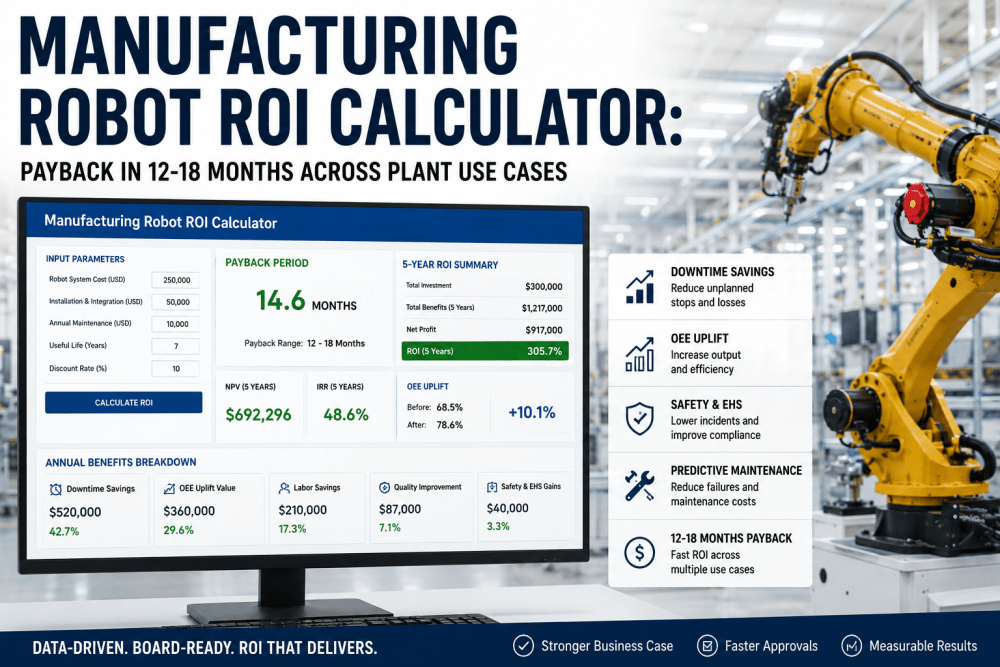
For a mid-size manufacturing facility (250-500 employees, two production lines, $80-150M annual revenue), the financial case for Spot deployment is anchored in three categories: avoided unplanned downtime, reduced inspection labor, and shifted maintenance from corrective to predictive. The table below models the typical economics observed across iFactory's Spot OEM manufacturing integrations.
| Cost Category | Pre-Spot Baseline | With Spot + iFactory | Annual Saving |
|---|---|---|---|
| Unplanned Downtime | 120 hours/year | 75-85 hours/year | $280,000+ |
| Manual Inspection Labor | 2,400 hrs/yr ($168K) | 600 hrs/yr ($42K) | $126,000 |
| Reactive vs Planned Maintenance Cost | 68% reactive | 28% reactive | $95,000 |
| Insurance & Safety Incidents | 3-5 incidents/yr | 0-1 incidents/yr | $48,000 |
| Annualized Spot + iFactory Cost | — | ($110,000) | Net: $439K+ |
Typical full payback is achieved in 12-18 months, with cumulative 3-year savings of $1.3M+ per deployed Spot unit when integrated with iFactory's CMMS, AI vision, and digital twin layer.
A Spot deployment that operates in isolation captures interesting data but rarely justifies its capital cost. The deployments delivering documented ROI all share one architectural pattern: tight integration between the Spot fleet (via Orbit), the plant MES/SCADA layer, a CMMS for work order execution, and a digital twin for spatial context. iFactory provides the integration substrate that unifies these systems.
Spot anomaly alerts trigger work orders in iFactory's CMMS with full inspection imagery, asset metadata, parts recommendations, and SLA tracking — eliminating the manual translation step between inspection finding and maintenance action.
Every Spot reading is geo-located against the 3D digital twin model — enabling supervisors to navigate from a thermal anomaly to the asset's 3D representation, BOM, maintenance history, and CAD drawings in a single click.
Inspection findings correlate with MES production data and OEE metrics — surfacing the causal relationship between asset condition and product quality, line speed, and yield loss for operations leadership review.
After reviewing 40+ documented Spot manufacturing deployments and consulting with operations leaders at four iFactory customer sites running Spot fleets in production, the consensus is clear: Spot delivers the most measurable ROI when treated as a data-acquisition platform feeding a larger predictive maintenance and digital twin ecosystem — not as a standalone inspection tool.
The leaders we interviewed consistently emphasized three pre-deployment readiness factors that separate successful Spot programs from disappointing pilots. First, the plant must have a baseline CMMS or asset registry — Spot data has limited value when there is no asset master to correlate against. Second, the maintenance team must define inspection thresholds, alert routing, and work order workflows before the first Spot mission runs, or the system generates noise rather than action. Third, leadership must commit to a phased rollout: starting with 1-2 high-value inspection routes, proving ROI over 90 days, and expanding from there.
Where Spot underperforms expectations, the root cause is almost always integration debt — not Spot capability. A Spot platform sitting on a maintenance team's desk without ingesting data into the CMMS, without digital twin overlay, and without anomaly detection models is delivering perhaps 20% of its potential value. The Spot Orbit manufacturing platform is excellent at fleet management, but it is not designed to replace your enterprise asset management or analytics stack. That is precisely the integration gap iFactory was built to close. Book a Demo to walk through the integration reference architecture in detail.
Yes. Spot has built-in obstacle avoidance, can be configured with safety-rated speed limits, and supports geo-fenced operating zones. For deployment in active production areas, most manufacturers conduct a site-specific risk assessment aligned with ANSI/RIA R15.08 and OSHA general industry standards. Spot's autonomous operation has logged millions of hours across industrial sites without recorded human injury events.
Spot's payloads typically match or exceed handheld instrument performance for repeatability, with the major advantage being consistency. Because Spot returns to the same pose (within 3cm) for every reading, the data is directly comparable across missions — eliminating the operator variance that limits trend analysis with handheld tools. Boston Dynamics certifies key partner payloads including FLIR thermal cameras and Fluke acoustic imagers.
Yes. The Boston Dynamics Orbit platform exposes a documented REST API for mission data export. iFactory provides pre-built connectors for SAP PM, IBM Maximo, Infor EAM, Rockwell FactoryTalk, Siemens MindSphere, and PTC ThingWorx — enabling Spot inspection data to flow directly into your existing enterprise asset management and operations stack without custom integration projects.
Phase 1 (weeks 1-4): Site assessment, route mapping, payload selection, and Spot commissioning. Phase 2 (weeks 5-10): Mission programming, threshold tuning, and CMMS/digital twin integration. Phase 3 (weeks 11-16): First production missions, baseline data collection, and operator handover. Most customers report measurable PdM value (avoided downtime events) by month 4-5, with documented ROI by month 12-18.
Orbit is excellent at fleet management — scheduling missions, managing Spot units, viewing raw inspection data. iFactory adds the enterprise layer that Orbit is not designed to provide: CMMS work order automation, asset master correlation, predictive maintenance modeling, digital twin spatial context, MES/OEE integration, audit reporting, and unified analytics across Spot, fixed sensors, and AI vision systems. The two platforms are complementary, not competitive.
The evidence from BMW, Michelin, POSCO, Ford, Nestle, and Hyundai is no longer debatable: Spot quadruped robots have moved beyond pilot status into core manufacturing inspection infrastructure. For U.S. manufacturing leaders evaluating their Industry 4.0 roadmap, the question has shifted from "should we deploy quadruped robots" to "how do we deploy them with the integration backbone required to capture full value."
The deployments delivering 12-18 month ROI share three characteristics. They start with a clearly defined inspection problem — typically a high-cost downtime asset or an inaccessible hazard zone. They integrate Spot mission data into the broader CMMS, MES, and digital twin layers from day one. And they treat Spot as a sensor platform serving a predictive maintenance program — not as a standalone novelty. Manufacturers following this playbook are documenting 15-30% reductions in unplanned downtime, 50%+ reductions in inspection labor cost, and meaningful improvements in worker safety in high-risk zones.
iFactory's Spot integration is purpose-built to deliver this outcome — connecting Boston Dynamics Orbit to your CMMS, AI vision platform, and digital twin in a unified Industry 4.0 architecture. For manufacturers ready to move beyond evaluation into deployment, the path forward starts with mapping your highest-value inspection routes and modeling the predictive maintenance ROI specific to your asset base.
iFactory's Spot integration architecture is deployed across global manufacturing plants. See a live walkthrough of the Orbit-to-CMMS-to-digital-twin data flow configured for your asset base.



.png)