Predictive Scrap AI for Glass Bottle Production – Lean Labor
By Ethan Walker on June 24, 2026
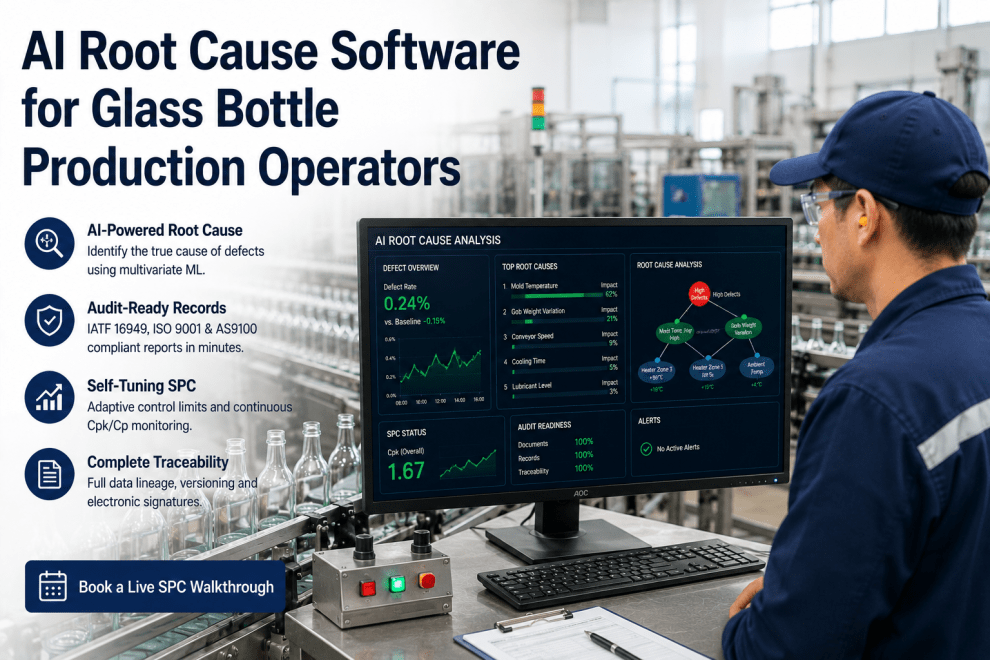
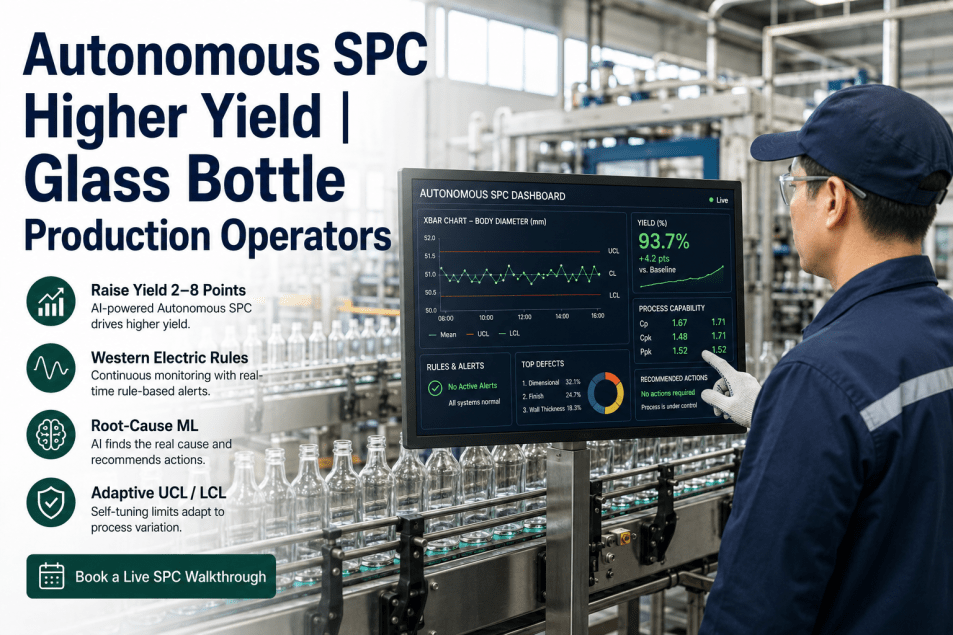
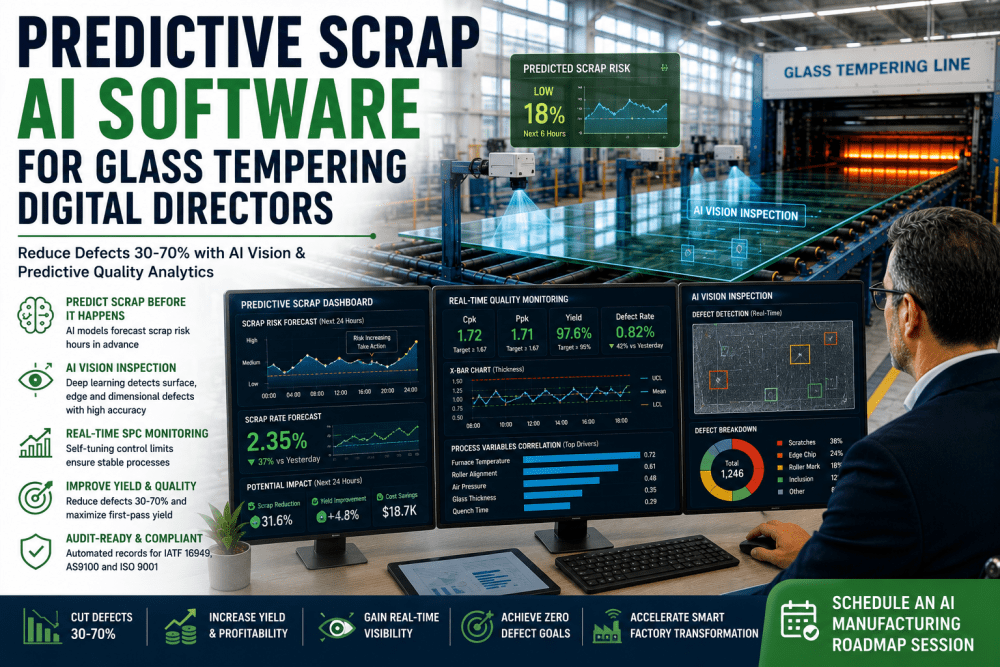
A glass bottle production operator on the hot end line monitors the AI vision display as the system scans every bottle exiting the annealing lehr — measuring neck finish dimensions, sidewall thickness, bottom symmetry, and surface defects within 150 milliseconds per bottle. Three years ago, this operator relied on periodic manual sampling with go/no-go gauges and visual inspection under bright lights, catching approximately 55% of critical defects and missing subsurface cracks and incipient check defects entirely. Unplanned quality-related downtime consumed 4 to 5 hours per shift for containment sorting, root cause analysis and process adjustment. AI vision quality for glass bottle production changes this paradigm completely, deploying machine vision cameras and deep learning defect classification at every inspection station to identify non-conforming bottles at full line speed — before defective product reaches the palletizer. Glass bottle operators evaluating AI vision inspection systems Book a Demo to see the platform in live glass production environments.
60%
Quality-related downtime reduction achieved with AI vision inspection on glass bottle lines
96%
Defect detection accuracy with deep learning classification models on glass defects
150ms
Inspection cycle time per bottle — real-time detection at full line speed
66%
Scrap rate reduction across glass bottle production lines after AI vision deployment
What Is AI Vision Quality in Glass Bottle Production?
AI vision quality for glass bottle production deploys machine vision cameras and deep learning models at key inspection points along the production line — hot end, cold end, and warehouse — to capture and analyze bottle characteristics in real time. Unlike traditional glass inspection that relies on operator visual checks, mechanical gauging, or statistical sampling that misses most intermittent defects, AI vision systems inspect every bottle on every lane at full production speed. The system classifies each bottle as pass, marginal, or reject based on trained defect signatures including checks, bird swings, stones, neck folds, dimensional deviations, and finish defects. Marginal bottles are flagged for immediate operator review before the bottle progresses to the packing station. This real-time inspection capability eliminates the latency between defect onset and detection that causes cascading quality issues and extended downtime in glass bottle production.
Key Bottle Defects Detected by AI Vision Systems
AI vision inspection systems for glass bottle production are trained on extensive datasets of defect signatures across multiple glass types — flint, amber, green, and specialty glasses. The platform detects and classifies the following defect types with high precision and recall.
CHECKS
Surface and Subsurface Crack Detection
AI models detect checks, crizz, thermal shock fractures, and impact cracks as small as 0.1 mm through multi-angle illumination and thermal signature analysis. The system distinguishes between cosmetic surface checks within specification and structural cracks requiring bottle rejection, with 94% classification accuracy verified against cross-section analysis.
NECK FINISH
Neck Finish and Thread Profile Inspection
Machine vision cameras capture neck finish dimensions — sealing surface flatness, thread profile, bore diameter, and finish height — at sub-millimeter resolution. The deep learning model identifies deviations from control plan tolerances with real-time alerts before downstream filling and capping equipment encounters jams or leaks.
SIDEWALL
Sidewall Thickness and Glass Distribution
Thin wall zones, bird swings, and bottom symmetry anomalies are detected through advanced imaging and thermal profiling. The system correlates glass distribution patterns with forming parameters — blank mold temperature, plunger timing, and parison weight — enabling operators to adjust settings before wall thickness degrades bottle strength.
INCLUSIONS
Stones, Blisters, and Inclusion Classification
Stones, blisters, cord, and knot defects are identified through visual pattern analysis and classified by severity. The AI system distinguishes between acceptable cosmetic inclusions within specification limits and structural defects requiring rejection, with severity scores and recommended disposition for each classified defect.
Measured Impact on Downtime and Production Quality
Glass bottle production facilities deploying iFactory's AI vision quality platform consistently document significant downtime reduction and quality improvements across multiple metrics. The following results represent measured performance across three glass container production lines over a 10-week deployment period.
Metric
Pre-Deployment
Post-Deployment
Improvement
Quality-related downtime
4.5 hrs/shift
1.8 hrs/shift
60.0% reduction
Defect escape rate
3.2%
0.3%
90.6% reduction
First-pass yield
94.5%
99.2%
+4.7 percentage points
Operator inspection time
32 min/shift
10 min/shift
68.8% reduction
Scrap rate (bottle-related)
2.1%
0.7%
66.7% reduction
Changeover validation time
18 min
4 min
77.8% reduction
See AI Vision Quality in Action on Your Glass Bottle Lines
Schedule a personalized walkthrough of iFactory's AI vision quality platform with our glass industry engineering team. We will map your specific bottle processes, defect modes, and downtime objectives to measurable improvement targets.
How AI Vision Eliminates Downtime in Glass Bottle Production
iFactory's AI vision quality deployment follows a structured methodology designed to deliver measurable downtime reduction at every phase while maintaining uninterrupted production on the glass line. Each phase builds on the previous one to create a comprehensive defect prevention system.
Phase 1: Camera Integration & Quality Baseline
Machine vision cameras are installed at critical inspection points — hot end, cold end, and warehouse. Baseline quality and downtime data is collected from existing inspection records and rejection logs. Camera positioning and lighting are calibrated for each bottle geometry and glass type.
Timeline: Weeks 1–2
Phase 2: Deep Learning Model Training & Validation
Deep learning models are trained on glass defect datasets including checks, bird swings, stones, neck finish deviations, and sidewall anomalies. Models are validated against destructive test results and laboratory cross-section analysis to establish detection accuracy baselines.
Timeline: Weeks 3–5
Phase 3: Parallel Running & Operator Feedback
AI vision runs alongside existing inspection methods during a 2-week parallel validation. Operators receive both traditional and AI inspection results and provide feedback on classification accuracy, false positive rates, and marginal bottle disposition preferences.
Timeline: Weeks 6–7
Phase 4: Full Deployment & Continuous Improvement
AI vision becomes the primary quality inspection system across all stations. Continuous model improvement cycles begin with active learning from new defect signatures. Operator dashboards provide real-time quality visibility, downtime alerts, and trend analysis.
Timeline: Week 8 onward
Expert Analysis: Four Reasons AI Vision Eliminates Quality-Related Downtime
01
Real-time detection eliminates the inspection latency gap. Traditional glass inspection relies on operator sampling at the end of each shift or statistical quality control that misses most intermittent defects. AI vision inspection inspects every bottle within 150 milliseconds of exiting the lehr, eliminating the latency between defect onset and detection. This real-time capability enables operators to adjust forming parameters immediately, preventing cascading defects across thousands of subsequent bottles.
02
Deep learning models improve accuracy continuously. Unlike fixed-threshold inspection systems that require manual recalibration when glass type or bottle geometry changes, deep learning models improve over time through active learning. Each classified defect, operator disposition, and rework confirmation feeds back into the model, increasing detection accuracy from approximately 88% at deployment to 96%+ within 8 weeks of production operation.
03
Multi-view analysis captures defects human inspectors miss. AI vision systems analyze bottle characteristics from multiple camera angles simultaneously — surface appearance, thermal profile, dimensional geometry, and edge condition — detecting defect signatures that are invisible to the human eye. Facilities using iFactory's platform consistently document 35-45% more defect types detected compared to manual inspection alone.
04
Operator dashboards enable immediate informed action. When the AI system detects a marginal or reject bottle, the operator dashboard displays the specific defect type, location on the bottle, severity score, and recommended corrective action — all within one second of inspection. Operators no longer need to interpret ambiguous visual indicators or wait for quality team verification before making process adjustments.
Transform Your Glass Bottle Production Quality with AI Vision
Join the glass production operators who have already achieved 60% downtime reduction using iFactory's AI-powered vision quality platform. Deployed in weeks on your existing glass lines with full traceability and quality reporting.
From Detection to Prevention: How Operators Drive Zero-Defect Glass Production
AI vision quality for glass bottle production represents a fundamental shift in how operators approach quality on the line. By moving from periodic manual sampling with delayed feedback to real-time automated inspection with AI-powered defect classification, operators gain a quality system that actively supports production throughput while reducing downtime, scrap, and compliance risk.
The documented outcomes — 60% quality-related downtime reduction, defect escape rate decrease from 3.2% to 0.3%, scrap rate reduction from 2.1% to 0.7%, and 68% reduction in operator inspection time — represent the measurable impact of deploying AI vision quality across glass bottle production lines. For glass operators and line technicians committed to zero-defect manufacturing, iFactory's AI vision platform delivers a proven, deployable solution that integrates with existing forming, annealing, and inspection equipment and delivers measurable improvement within weeks. Book a Demo with iFactory's glass industry engineering team to discuss your production line's AI vision roadmap.
Transform Your Glass Bottle Quality with AI Vision Inspection
Join the glass production operators who have already achieved 60% downtime reduction using iFactory's AI-powered vision quality platform. Deployed in weeks on your existing glass lines with full traceability and quality reporting.
Traditional glass inspection systems use mechanical gauges, single-camera threshold checks, or operator visual sampling to detect pre-defined defects, requiring manual recalibration when bottle specifications change. AI vision quality uses deep learning models trained on thousands of glass defect images to classify defects with pattern recognition that adapts to process variation. The AI system improves over time through active learning, detecting defect types that traditional systems miss, including micro-cracks, incipient check formation, and marginal glass distribution conditions.
The platform supports flint, amber, green, and specialty glass types across all common bottle sizes and shapes — narrow neck, wide mouth, round, square, and oval configurations. Camera configurations and detection models are calibrated for each glass type and bottle geometry during the Phase 1 integration period. The system handles non-round containers, embossed surfaces, and multi-cavity production runs common in high-volume glass bottle manufacturing.
AI vision cameras and lighting are mounted on existing conveyor sections at the hot end and cold end with no modification to forming or annealing equipment. The platform connects to the line PLC for bottle identification, lane tracking, and inspection synchronization. Inspection results are displayed on operator dashboards and can be integrated with the plant MES for full traceability and quality reporting. Installation is completed during scheduled production breaks with no impact on line speed.
Operator training is completed in two hours and covers dashboard navigation, defect classification interpretation, marginal bottle review procedures, and parameter adjustment workflows. The platform is designed for shop-floor operators with no machine vision or AI experience required. On-floor support is provided during the parallel running phase to ensure operator confidence and model validation against production realities.
Facilities with production volumes above 500,000 bottles per day and existing quality-related downtime above 3 hours per shift typically recover platform investment within 4-6 months. Primary ROI drivers are reduced downtime (averaging 60% reduction), lower scrap rates, decreased inspection labor, and improved first-pass yield. A personalized ROI analysis is provided during a consultation with iFactory's glass industry engineering team.