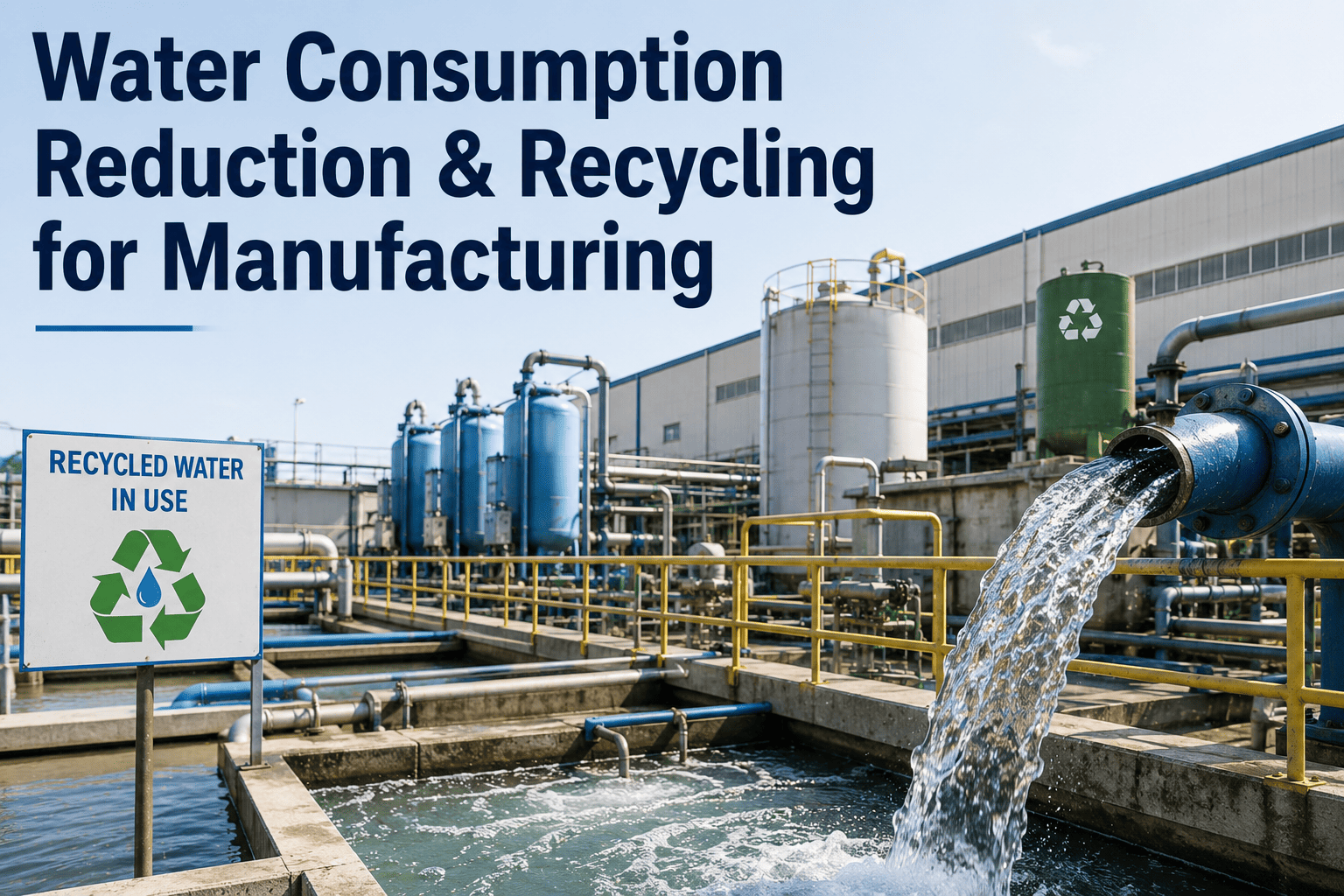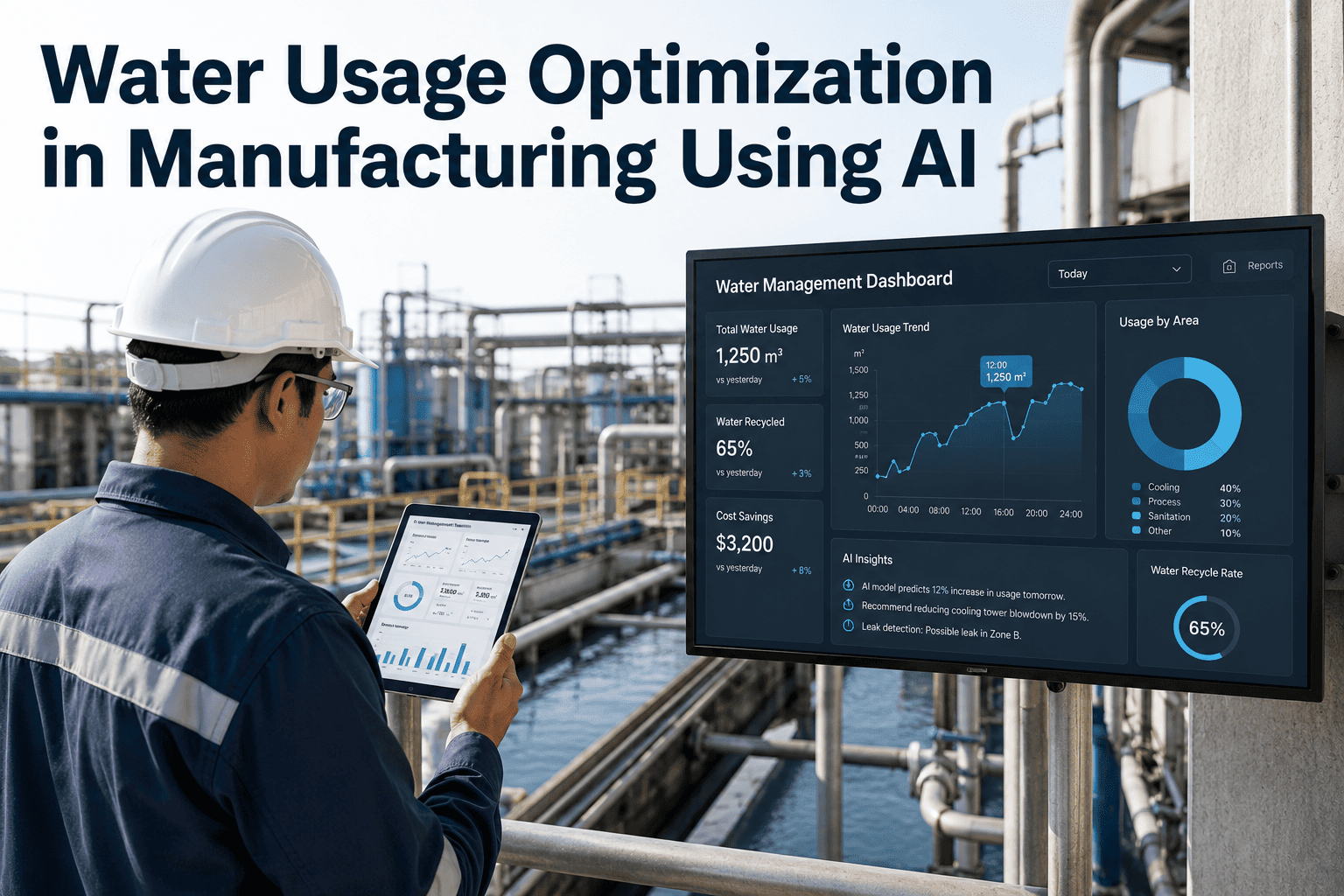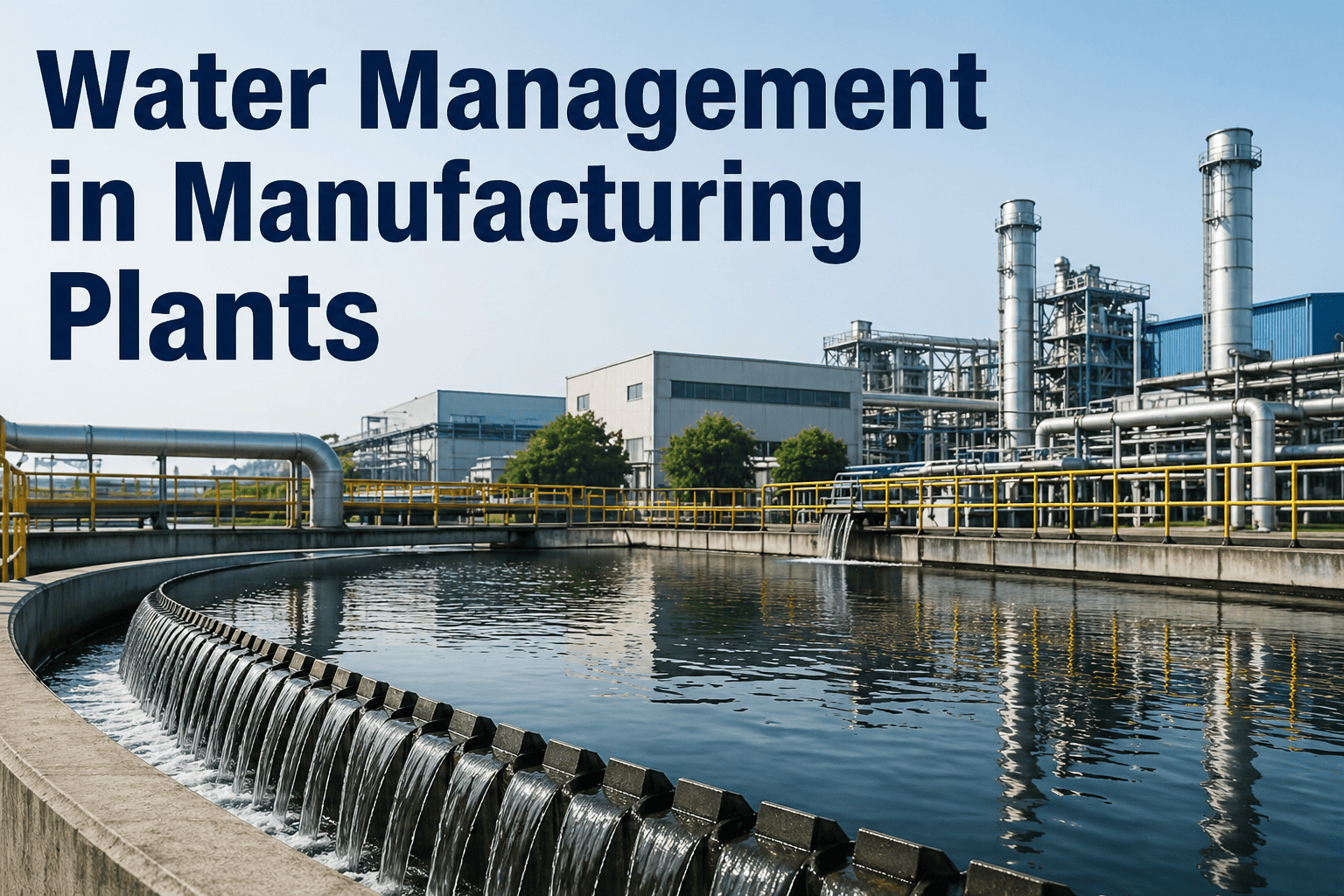
A mid-sized automotive manufacturing plant in the US Midwest discovered its cooling tower system was circulating 18 million gallons of water per day through a process that had not been optimized in 17 years. The water was treated, cooled, and discharged at a cost of $4.20 per 1,000 gallons. Nobody had calculated that recirculating 40% of the cooling water through a secondary treatment loop instead of discharging it and treating fresh water could reduce daily water consumption to 10.8 million gallons a 40% reduction costing $158,400 less per year. The cooling tower optimization project cost $82,000 and paid back in 6 months. Manufacturing plants across industries face identical optimization opportunities across cooling systems, process water recycling, and wastewater reuse that remain hidden because water management operates in isolated silos: the facilities team manages cooling towers, the production team manages process water, and the environmental compliance team manages wastewater discharge. iFactory manufacturing operations software unifies water management across every system cooling towers, process water, wastewater treatment, and recycled water loops into one intelligent platform that identifies optimization opportunities, tracks water costs per production unit, and alerts operators when conservation targets are not being met. Schedule a demo to model water savings and sustainability metrics for your manufacturing facility.
Why Manufacturing Plants Waste Water at Scale
Manufacturing facilities consume water at volumes most operations fail to track or optimize. A mid-sized automotive plant uses 20 to 30 million gallons per day. A semiconductor fab uses 100+ million gallons daily. A beverage plant uses 2 to 3 gallons of water for every gallon of beverage produced. Yet most plants manage water as an operational cost that gets passed to production budgets without rigorous cost accounting, efficiency tracking, or system-wide optimization. Water discharge is regulated by the EPA and state environmental agencies, but water consumption — the volume of fresh water extracted and the cost per unit of production — is rarely optimized below baseline utility rates or seasonal variability.
This creates three operational failures that persist across manufacturing plants:
Cooling towers are often the largest water consumer at any manufacturing plant — 30 to 70% of total water consumption at many facilities. Most cooling towers operate at fixed bleed-off rates and treatment protocols established 10 to 20 years ago. Cycles of concentration (how many times water is recirculated before discharge) are rarely optimized for current equipment or water quality. A 5-cycle cooling tower system that could operate safely at 7 cycles wastes 30% of makeup water and treatment chemicals. Older systems operating at 3 cycles waste 60% versus optimized operation.
Process water discharged from plating lines, cleaning operations, and washing stages is treated to discharge standards but never reused. At many facilities, this water quality exceeds what cooling tower makeup water or secondary process loops require. A plating facility could capture and filter discharge water from rinsing stations (currently 2 million gallons per day) and reuse it as cooling tower makeup water or equipment wash water instead of discharging it and purchasing 2 million gallons of fresh water daily. The economics are compelling: capture and treatment cost $0.35 per 1,000 gallons versus $4.20 per 1,000 gallons for fresh water purchase.
Plants track total water consumption and total cost, but few track water cost per unit of production, per production line, or per shift. This blind spot prevents identifying which process areas are water-inefficient. A production line consuming 8,000 gallons per unit when similar equipment elsewhere consumes 4,000 gallons per unit goes unnoticed without unit-level cost tracking. Without visibility into cost-per-unit, facility managers cannot prioritize water conservation investments or benchmark against peer facilities.
Water Management Systems: Where Water Goes in Manufacturing
Understanding where water flows through a manufacturing facility is the first step toward optimization. Water enters as fresh supply, moves through cooling systems, process applications, and cleaning operations, and exits through discharge, reuse loops, or evaporative loss. Each pathway has distinct quality requirements, treatment costs, and optimization opportunities.
Cooling towers are the largest water consumer and the largest opportunity for optimization at most manufacturing plants.
Daily makeup water enters the cooling tower basin to replace water lost to evaporation and bleed-off. Most facilities use municipal water or groundwater. Quality varies — municipal water may contain 200 to 500 ppm total dissolved solids (TDS), groundwater may contain 600 to 1,200 ppm.
Water enters the basin with treatment chemicals — scale inhibitor, corrosion inhibitor, and biocide — dosed to prevent scaling, corrosion, and biological fouling. Treatment cost ranges from $0.08 to $0.25 per 1,000 gallons depending on chemical program and dosing frequency.
Water circulates through the basin and fills all process cooling loops at a rate of 500 to 5,000 gpm per loop, depending on equipment. As water circulates, it cools but also accumulates dissolved minerals and biological organisms. Cycles of concentration — how many times makeup water is recirculated before bleed-off — determines water consumption and chemical treatment cost.
The primary water loss mechanism in cooling towers. Approximately 1% of circulating flow rate is lost to evaporation under normal operating conditions. A 3,000 gpm cooling tower loses 30 gpm to evaporation continuously — about 43,200 gallons per day. This water is not recoverable; it is replaced with fresh makeup water.
When accumulated minerals reach a maximum concentration (determined by cycles of concentration), water is discharged to treatment or sewer. At 3 cycles of concentration, bleed-off is 33% of makeup water (1 unit makeup, 1 unit evaporation, 1 unit bleed = 3 cycles). At 7 cycles, bleed-off is 14% of makeup (1 makeup, 1 evaporation, 0.14 bleed = 7 cycles). Optimization increases cycles of concentration to reduce bleed-off discharge.
Water discharged from process operations often has quality suitable for non-potable reuse applications.
Plating and metal finishing operations produce rinse water containing suspended solids and metal ions. Volume: 5,000 to 50,000 gpd depending on production. Current fate: discharged to wastewater treatment or sewer. Recycling opportunity: capture, settle, and filter for cooling tower makeup water or secondary washing. Cost to recycle: $0.35 per 1,000 gallons. Fresh water cost avoided: $4.20 per 1,000 gallons. Annual savings on 10,000 gpd: $14,105.
HVAC and compressed air systems produce condensate — clean water with minimal treatment. Volume: 1,000 to 10,000 gpd. Current fate: often discharged to sewer. Recycling opportunity: capture and use for landscape irrigation, cooling tower makeup, or equipment washing. Cost to capture: $0.05 per 1,000 gallons. Fresh water cost avoided: $4.20 per 1,000 gallons. Annual savings on 5,000 gpd: $7,665.
Parts washing, line cleaning, and equipment rinsing produce high-volume wash water with floating oils, particulates, and soaps. Volume: 5,000 to 30,000 gpd. Current fate: sludge removal, wastewater discharge. Recycling opportunity: gravity separation, media filtration, and reuse in secondary washing stages. Cost to treat: $0.40 per 1,000 gallons. Fresh water cost avoided: $4.20 per 1,000 gallons. Annual savings on 20,000 gpd: $29,200.
Stormwater from roof and parking areas is typically discharged to stormwater systems. Volume: highly variable, averages 0.5 to 5 million gallons per storm event. Recycling opportunity: capture in retention ponds and use for irrigation, dust control, or process operations after minimal treatment. Cost to capture and treat: $0.15 per 1,000 gallons. Fresh water cost avoided: $4.20 per 1,000 gallons. Annual savings on 1 million gallons captured: $4,050.
Optimize Water Systems Across Your Manufacturing Facility
Water management operations software identifies water conservation opportunities across cooling systems, process water, wastewater treatment, and recycled water loops — calculating cost impact per optimization and prioritizing by payback period.
Water Conservation Checklist for Manufacturing Plants
The following checklist identifies the most common water optimization opportunities at manufacturing facilities. High-impact items are marked with priority levels.
Model Water Savings for Your Manufacturing Facility
Water optimization ROI varies significantly by facility water profile, current treatment practices, and production volume. Manufacturing operations software calculates specific water conservation opportunities and quantifies cost impact for your facility.
Frequently Asked Questions: Water Management in Manufacturing
Summary: Why Manufacturing Plants Implement Water Management Systems
Water conservation in manufacturing delivers three quantifiable benefits: reduced operational cost (water and treatment chemicals), reduced regulatory risk (lower discharge volume and improved permit compliance), and improved sustainability profile (water recycling rate and water intensity metrics for ESG reporting). The financial case is compelling — typical water conservation investments pay back within 6 to 18 months while delivering 20 to 40% water consumption reduction that benefits the entire operational and financial profile.
Water conservation investments typically deliver annual savings of $2,000 to $100,000+ depending on facility size and optimization scope, with payback periods of 6 months to 2 years.
Increased water recycling and reduced discharge volume enables facilities to increase production volume without proportional increase in fresh water consumption or needing upgraded municipal water supply agreements.
Lower discharge volumes reduce NPDES permit regulatory risk and future restrictions. Water recycling documentation strengthens facility compliance posture during EPA audits.
Water intensity reduction and water recycling rate are increasingly requested in customer sustainability scorecards and ESG frameworks. Documented water conservation supports customer contract renewals and new customer acquisition in sustainability-focused markets.
Start Water Conservation at Your Manufacturing Facility
The water conservation checklist above identifies opportunities that apply across manufacturing facilities. Financial impact varies by facility water profile and existing treatment practices. Manufacturing operations software calculates water conservation opportunities specific to your facility, quantifies cost impact, and prioritizes investments by payback period. Schedule a demo to model water savings and sustainability metrics for your facility.