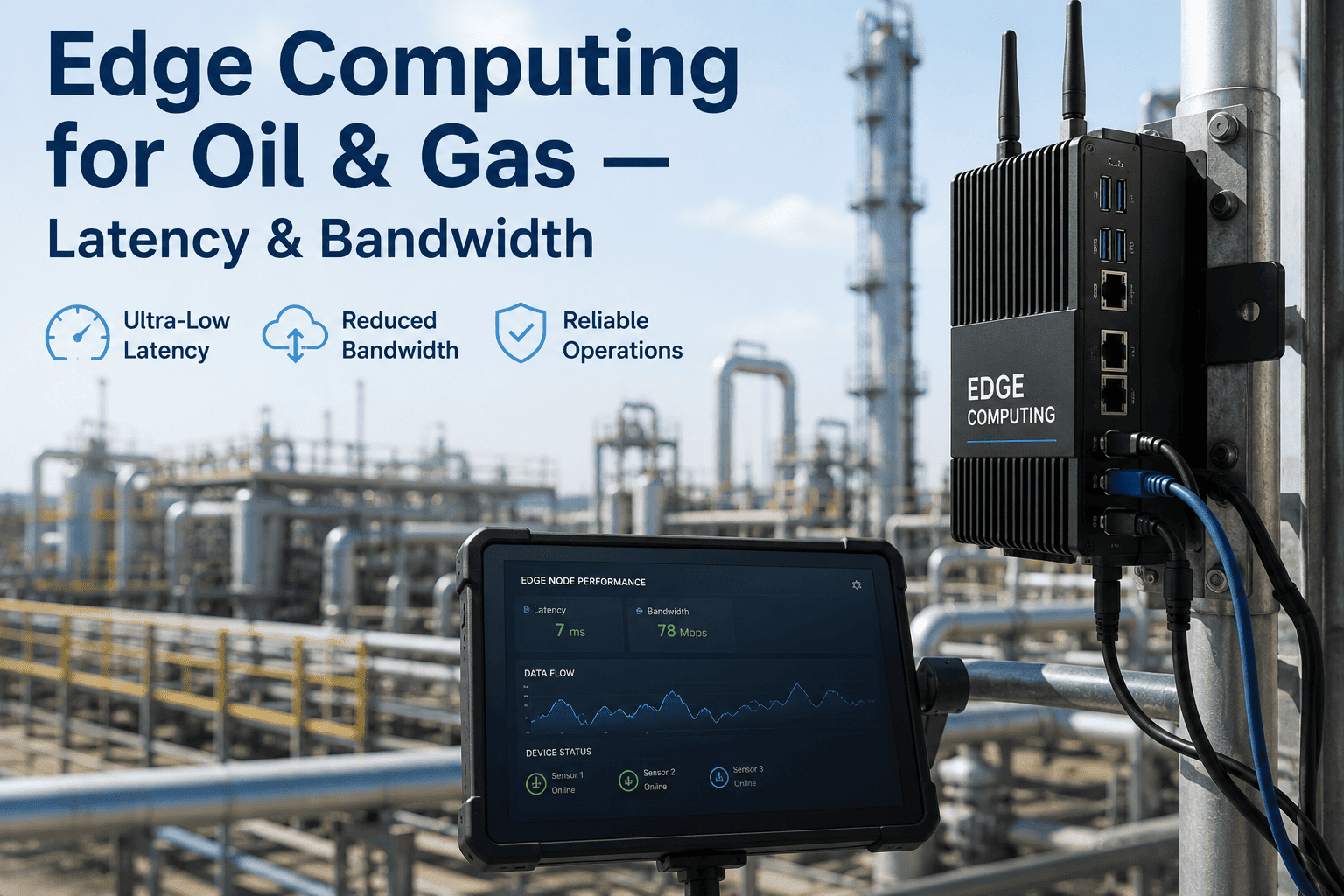
Oil and gas operations at remote wellsites, offshore platforms, and compressor stations generate thousands of data points per second from sensors, SCADA systems, and edge devices. Yet the industry continues to route the vast majority of this data to centralized cloud environments for processing, a pattern that introduces latency measured in seconds when field operations demand responses measured in milliseconds. This growing gap between what instruments can measure and what decision systems can act on costs operators millions in delayed responses, missed anomalies, and preventable equipment damage. Edge computing closes this gap by placing processing capability directly at the point of data generation, enabling real-time analytics and autonomous response without waiting for a round-trip to a distant data center. To see how edge architecture fits your remote monitoring strategy, Book a Demo with iFactory AI.
Process Data at the Edge, Not the Cloud. Decide in Milliseconds, Not Seconds.
iFactory AI delivers edge computing solutions purpose-built for wellsites, offshore platforms, and compressor stations — local processing, real-time decisions, dramatically lower bandwidth costs.
Why Cloud-Only Processing Fails Remote Oil and Gas Operations
The fundamental challenge is geography. Most high-value oil and gas assets exist far from the data centers that power cloud analytics. A wellsite in the Permian Basin may rely on satellite connectivity with round-trip latency of 800 to 2000 milliseconds. An offshore platform in the Gulf of Mexico faces similar constraints even with dedicated microwave links. When a compressor station experiences vibration anomalies, a pressure spike occurs in a pipeline, or a wellhead shows early signs of water cut change, the difference between a 15-millisecond local response and a 1200-millisecond cloud round-trip is the difference between a controlled adjustment and an unplanned shutdown.
How Edge Processing Works at Wellsites, Platforms, and Compressor Stations
Edge computing in oil and gas does not mean replacing your existing SCADA or historian infrastructure. It means inserting a intelligent processing layer between field instruments and upstream systems — one that filters, analyzes, and acts on data locally before deciding what actually needs to travel to the cloud. This architecture varies by asset type but follows a consistent pattern: ingest from field devices, process at the edge, respond locally, and transmit summaries upstream.
Wellsite Edge Processing
At the wellsite, edge devices sit between downhole sensors, surface meters, and the RTU. They continuously process flow rates, pressure differentials, temperature profiles, and artificial lift parameters locally. Anomalous patterns trigger immediate alerts to the field technician and automatic adjustments to choke settings or pump speeds without waiting for cloud analytics to cycle. Only processed summaries and exception data are transmitted upstream, reducing satellite bandwidth consumption by 70 to 90 percent.
Bandwidth reduced by 70-90%Offshore Platform Edge Computing
Offshore platforms generate exceptionally high data volumes from process sensors, rotating equipment monitors, and environmental systems. Edge servers deployed on-platform process this data in real time for equipment health monitoring, process optimization, and safety system validation. Critical outputs like vibration analysis for turbomachinery or flare system monitoring require sub-second response that satellite connectivity simply cannot support. Edge processing delivers deterministic local response while maintaining a reduced data stream to onshore teams.
Sub-second equipment responseCompressor Station Edge Analytics
Compressor stations along pipeline networks operate in remote locations with limited connectivity. Edge devices at these stations continuously monitor compressor performance, valve positions, gas composition sensors, and discharge temperatures. Local edge models detect performance degradation, predict maintenance windows, and optimize fuel gas consumption without requiring continuous cloud connectivity. When connectivity is interrupted — which happens frequently at remote stations — edge processing ensures monitoring continuity with no gaps in operational visibility.
Uninterrupted monitoring during outagesThe Financial Case for Edge: Bandwidth Costs Drop While Decision Speed Rises
Satellite bandwidth at remote oil and gas locations is expensive. A single wellsite transmitting raw sensor data at full resolution can consume $5,000 to $50,000 per month in satellite connectivity costs, depending on data volumes and transmission frequency. Edge computing fundamentally changes this economics by processing data locally and transmitting only what adds value to upstream systems — processed metrics, exception alerts, and periodic summaries instead of raw high-frequency sensor streams.
Reduction in satellite and cellular data transmission volumes when edge devices filter and summarize data locally before upstream transmission.
Per-site monthly savings on connectivity costs after edge deployment, depending on existing data volumes and satellite contract terms.
Edge-processed data is available for local decisions instantly, compared to batch-uploaded cloud data that may be minutes to hours old.
Typical payback period for edge computing hardware and deployment costs, driven primarily by bandwidth savings and avoided shutdown costs.
Edge Computing Use Cases Across the Oil and Gas Value Chain
Edge computing delivers measurable value at every stage of the oil and gas value chain. The use cases below represent the highest-impact deployments that operators are executing in 2025, each addressing a specific operational gap where cloud-only processing created unacceptable latency, cost, or availability constraints for remote asset monitoring.
Real-Time Wellhead Optimization and Artificial Lift Control
Edge devices at wellheads process high-frequency data from downhole gauges, surface flow meters, and rod pump load cards to optimize artificial lift parameters in real time. Pump-off detection, gas lock identification, and rod string stress analysis happen locally with sub-second response, preventing equipment damage that cloud-delayed analytics would miss. Operators report 8 to 15 percent production improvement and 25 percent reduction in lift-related workovers after edge-enabled optimization deployment. For operators looking to implement this capability, Book a Demo with iFactory AI to discuss wellsite edge architecture.
Pipeline Leak Detection and Integrity Monitoring at the Edge
Pipeline leak detection systems require continuous analysis of pressure, flow, and temperature data across multiple stations simultaneously. Edge computing enables localized mass-balance calculations and pressure-wave analysis at each station, detecting leaks in seconds rather than the minutes required when raw data must travel to a central system for processing. This speed difference is critical: a 10-inch pipeline operating at 1000 PSI can lose hundreds of barrels per minute during an undetected leak.
Refinery Process Control and Safety System Augmentation
While refineries typically have better connectivity than upstream assets, edge computing still delivers value by providing deterministic local processing for safety-critical control loops and equipment monitoring. Edge devices augment DCS systems by running advanced analytics — machine learning models for catalyst performance prediction, heat exchanger fouling detection, and distillation column optimization — directly at the process unit level without adding load to plant-wide control networks.
Edge Computing vs Cloud-Only Processing for Remote Oil and Gas Assets
The operational differences between edge-enabled and cloud-only architectures are not incremental — they fundamentally change what is possible at remote sites. The comparison below captures the practical impact that operations leaders experience when edge processing is deployed at wellsites, platforms, and compressor stations.
| Operational Dimension | Cloud-Only Processing | Edge-Enabled Processing | Field Impact |
|---|---|---|---|
| Anomaly response time | 1-3 seconds (after cloud round-trip) | 5-50 milliseconds (local) | Prevents cascading equipment damage |
| Bandwidth consumption | Full raw data stream transmitted | Processed summaries and exceptions only | 60-90% reduction in data costs |
| Monitoring during outages | Complete visibility loss | Full local monitoring continues | Zero gap in operational awareness |
| Satellite dependency | Critical path for all decisions | Optional for most operations | Resilient to connectivity failures |
| Processing cost per data point | Cloud compute + transfer costs | Local compute only | 40-70% lower total processing cost |
| SCADA integration | Cloud gateway adds latency | Direct local SCADA integration | Seamless with existing field systems |
How to Deploy Edge Computing at Remote Oil and Gas Sites Without Disrupting Operations
Successful edge deployment in oil and gas follows a structured approach that preserves operational continuity while progressively expanding edge processing coverage. The most effective implementations align with existing SCADA infrastructure, add edge capability as a parallel processing layer, and migrate decision logic to the edge only after validation against historical data.
Assessment and Edge Node Planning
Identify the highest-value processing targets — typically wellhead optimization, compressor monitoring, or pipeline leak detection — based on current latency pain points, bandwidth costs, and outage frequency. Select edge hardware rated for the environmental conditions at each site (temperature range, hazardous area classification, vibration tolerance) and map the data flow from existing sensors and RTUs to the proposed edge node location.
Duration: 2-4 WeeksEdge Deployment and Parallel Processing Validation
Deploy edge nodes at target sites running in parallel with existing cloud workflows. Edge processing results are logged but not yet used for automated decisions, allowing operations teams to validate accuracy against established cloud analytics outputs. This shadow mode typically runs two to four weeks, building confidence that edge models produce equivalent or superior results before any cutover. iFactory AI handles this integration across major SCADA and historian platforms.
Duration: 4-8 WeeksOperational Cutover and Continuous Optimization
Transition validated edge processing workflows to operational mode with automated decision triggers. Bandwidth transmission is reduced to summaries and exceptions. Monitoring dashboards are updated to reflect edge-processed metrics as the primary data source. Ongoing optimization includes refining edge models with new operational data, expanding edge processing to additional data streams, and implementing predictive maintenance capabilities that leverage accumulated local learning.
Duration: 8-16 Weeks and OngoingWhat Operators Measure After Edge Computing Deployment at Remote Assets
The value of edge computing in oil and gas is measured in operational terms that directly impact production, cost, and safety performance. The outcomes below reflect what operators deploying edge solutions through platforms like iFactory AI report after reaching steady-state operations.
From over one second with cloud round-trips to under 50 milliseconds with local edge processing at wellsites and compressor stations.
Reduction in unplanned shutdowns at edge-monitored assets due to faster anomaly response and continuous monitoring during connectivity outages.
Average reduction in monthly satellite and cellular bandwidth costs across edge-enabled wellsite portfolios after switching to summary-based transmission.
Continuous operational visibility maintained even during extended satellite or cellular connectivity outages that previously created complete blind spots.
Edge Computing for Oil and Gas — Answers for Operations and Digital Leaders
What exactly is edge computing in the context of oil and gas operations?
Edge computing in oil and gas means deploying processing hardware — industrial gateways, ruggedized servers, or integrated edge-PLC systems — directly at remote asset locations like wellsites, platforms, and compressor stations. These devices process sensor data locally for real-time analytics and automated responses, transmitting only processed summaries and exception alerts to cloud or onshore systems. This eliminates the latency and bandwidth constraints of sending raw data to centralized cloud environments for every analytical decision. To explore how this works for your specific assets, Book a Demo with iFactory AI.
Does edge computing replace our existing SCADA and historian systems?
No, edge computing does not replace SCADA or historian infrastructure — it complements it. The edge layer sits between field instruments and upstream systems, processing data locally for time-critical decisions while still feeding processed results into your existing SCADA and historian platforms. Your operations team continues to use the same dashboards and workflows, but with faster data, lower bandwidth costs, and uninterrupted monitoring during connectivity outages. If you have questions about integration with your specific systems, contact our support team.
What happens to edge monitoring when satellite or cellular connectivity goes down?
This is one of the strongest arguments for edge computing. When connectivity is lost, edge devices continue to process sensor data, run analytics models, trigger local alerts, and store processed results locally. Once connectivity is restored, the edge node synchronizes stored data and alerts with upstream systems. Operations teams maintain full monitoring visibility throughout the outage, compared to cloud-only systems where connectivity loss means complete blindness until the link is restored.
How much bandwidth can edge computing actually save at a typical wellsite?
Most operators report 60 to 90 percent reduction in data transmission volumes after edge deployment. A wellsite that previously transmitted raw high-frequency sensor data at 500 MB per day might transmit only 50 to 100 MB of processed metrics, exception alerts, and periodic summaries after edge processing is implemented. The exact savings depend on sensor count, sampling rates, and how aggressively filtering is configured, but the bandwidth cost reduction alone typically pays for edge hardware within three to six months.
What hardware is required to deploy edge computing at remote oil and gas sites?
Edge hardware requirements vary by processing workload but typically include an industrial-grade edge gateway or compact server rated for the environmental conditions at the site — including extended temperature ranges, hazardous area classifications, and vibration tolerance. Processing requirements range from simple filter-and-forward operations on gateway-class devices to full analytics model execution on edge servers with GPU acceleration for AI workloads. iFactory AI helps operators select and validate appropriate hardware for each deployment environment during the assessment phase.
Ready to Eliminate Latency and Cut Bandwidth Costs at Your Remote Assets?
Connect with iFactory AI to map your current data processing bottlenecks, identify the highest-value edge deployment targets across your wellsites, platforms, and compressor stations, and receive a deployment roadmap built for your specific operational environment.