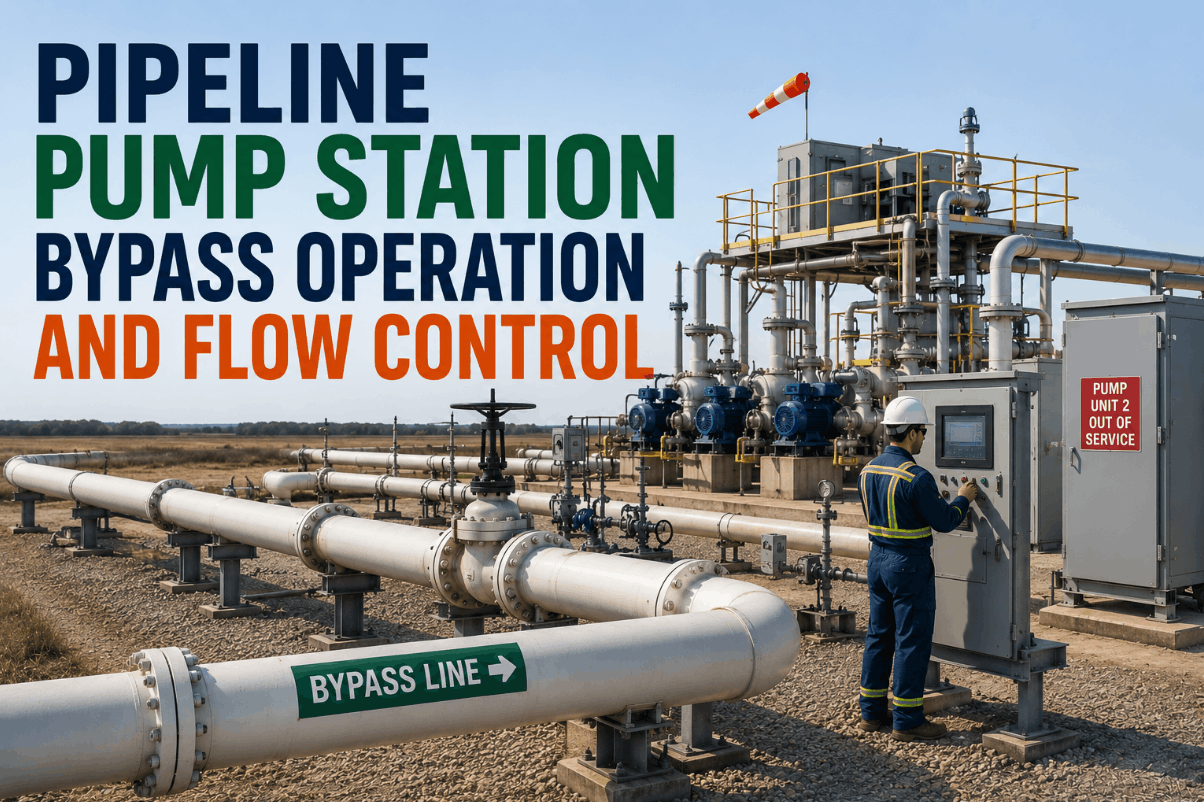
A pump station going down for scheduled maintenance or tripping unexpectedly should never mean the pipeline stops moving product. Yet that is exactly the failure mode that an under-designed bypass and flow control strategy produces — a single station outage cascading into a full shutdown, a surge event, or a multi-hour throughput loss that didn't need to happen. The fix is not complicated in concept: a properly sized bypass line with the right isolation valve philosophy, a pump sequencing strategy that brings capacity on and off line without slamming the system, and variable speed drives that absorb demand swings instead of forcing a station trip. What's complicated is keeping all three working together as conditions change shift to shift. Book a Demo to see how iFactory tracks bypass readiness and pump sequencing performance across your station fleet.
Why Pipeline Design Treats Station Bypass as Non-Negotiable
A long-haul liquid pipeline cannot tolerate a single point of failure at any one pump station, which is why bypass philosophy is built into the design from day one rather than added after an outage exposes the gap. The standard design condition for many liquid pipelines requires the motor-operated isolation valves at each station's battery limit, and on the bypass line around each station, to be capable of being locked open with power disconnected — guaranteeing the line cannot be completely shut in even during a total station failure. A bypass line routed around a check valve can also slow the rate of flow decay following a station trip, using the suction-side liquid column's own momentum to soften the transition rather than letting flow collapse instantly.
The Five Elements of a Resilient Pump Station Flow Control Strategy
Keeping throughput alive through a station outage depends on several systems working in sequence, not any single piece of equipment. Each element below addresses a different failure mode in the chain between "station goes down" and "pipeline keeps flowing."
Bypass Line and Isolation Valve Philosophy
A bypass routed around the station's pump units, sized so flow can continue past a fully isolated station, with battery-limit valves designed to remain locked open under the pipeline's standard operating philosophy.
Pump Sequencing Logic
A lead pump on a variable speed drive handles demand fluctuations smoothly, while constant-speed pumps are staged on or off as flow requirements exceed what the VSD pump can supply alone.
Minimum Flow Protection
Recirculation or bypass control prevents any pump from operating below its minimum flow rating, avoiding the vibration, overheating, or vapor lock that follows a run-dry condition.
Surge Relief Coordination
Surge relief valves and staged valve closure timing absorb the pressure wave generated by a sudden station trip, preventing the transient from propagating into a pipe rupture risk elsewhere on the line.
Continuous Verification
A bypass strategy is only as good as its last confirmed test — valve position, drive performance, and sequencing logic need ongoing verification, not a one-time commissioning check. Book a Demo to see how iFactory verifies this continuously.
VSD vs. Throttling vs. Fixed-Speed Sequencing: Matching Method to Station Demand
Not every pump station benefits equally from a variable speed drive, and the right flow control method depends on how much the station's demand actually varies. Book a Demo to map your station's demand profile against the right control strategy.
| Flow Control Method | How It Works | Energy Efficiency | Best Fit |
|---|---|---|---|
| Variable Speed Drive (Lead Pump) | Pump speed modulates continuously to match demand without throttling losses | High — avoids wasted head across a throttle valve | Stations with frequent, moderate demand swings |
| Throttle Valve / Bypass Line | Fixed-speed pump runs at full output; excess flow throttled or recirculated | Low — wastes head and bypassed flow as lost energy | High static head systems where VSD gains are limited |
| Fixed-Speed Pump Staging | Multiple constant-speed pumps switched on/off in parallel as demand changes | Moderate — efficient at each pump's rated point | Stations with large, infrequent step changes in demand |
| VSD + Staged Fixed-Speed Combination | One VSD pump fine-tunes flow; fixed-speed pumps add coarse capacity steps | High — combines fine control with efficient base-load pumps | Most multi-pump stations with variable throughput requirements |
What Happens When a Station Trips Without a Verified Bypass Path
The risk of an unverified bypass strategy rarely shows up during normal operation — it shows up the moment a station actually trips and the system has to prove the design assumptions were correct in the field, not just on paper.
A pump unit at a mid-line station trips on a protective fault. If the bypass isolation valves were never confirmed to be in their designed locked-open state — perhaps closed during a prior maintenance activity and never reopened — the station becomes a complete blockage instead of a bypassed segment. Flow upstream begins to pack against the closed path, building pressure, while downstream the line begins to see a rarefaction that can pull in reverse flow. What should have been a flow rate reduction to a fraction of design capacity instead becomes a full shutdown event, a surge investigation, and a multi-hour restart sequence. iFactory continuously tracks isolation valve position against the pipeline's defined bypass philosophy, flagging any deviation long before a trip turns a routine event into an incident.
Core Capabilities: How iFactory Supports Pump Station Flow Control
iFactory does not replace your station SCADA or pump control system — it sits alongside it, turning valve position data, VSD telemetry, and sequencing logic into a continuously verified record across every station on your pipeline.
Bypass Valve Position Verification
Continuously confirms isolation and bypass valves are in their designed state, flagging any deviation from the locked-open bypass philosophy before it becomes a blind spot during a trip.
VSD Performance Trending
Tracks variable speed drive output, motor load, and response time against historical baselines to catch degrading drive performance before it affects sequencing reliability.
Pump Sequencing Audit Trail
Logs every staging event — which pumps came online, in what order, and at what demand threshold — building a record reliability engineers can review after any unplanned event.
Minimum Flow Compliance Monitoring
Flags any period where a pump operated below its minimum flow rating, surfacing the run-dry risk before it produces vibration damage or seal failure.
"We had a station bypass valve that had been closed for a maintenance isolation eighteen months earlier and never reopened — nobody caught it because the station never tripped in that window. The first time it did trip, we found out the hard way that our 'bypass' was actually a dead end. Continuous valve position verification is the only way to know your bypass philosophy is real and not just a drawing in the design package." — Pipeline Operations Engineer, Liquid Pipeline Operator
Conclusion: Throughput Resilience Is a System, Not a Single Component
A pump station's ability to go down without taking the pipeline's throughput with it depends on the bypass line, the isolation valve philosophy, the pump sequencing logic, and the surge protection all performing as designed at the exact moment they're needed — not most of the time, every time. The gap between a design package that assumes this and an operation that has actually verified it is where unplanned shutdowns, surge events, and extended restart sequences come from. Continuous verification of valve position, drive performance, and sequencing behavior turns that design assumption into an operating fact your team can rely on.
Frequently Asked Questions: Pump Station Bypass and Flow Control
Why are pump station bypass valves designed to be locked open?
So that even a complete station failure cannot fully shut in the pipeline — flow continues past the isolated station at a reduced rate rather than stopping entirely.
How does a variable speed drive reduce energy losses compared to throttling?
A VSD modulates pump speed to match demand directly, avoiding the wasted head across a throttle valve and the wasted flow through a bypass recirculation line.
What is minimum flow protection and why does it matter?
It prevents a pump from operating below its rated minimum flow, which can cause excessive vibration, overheating, or vapor lock leading to a run-dry failure.
What happens to pipeline flow when one pump station trips?
With a properly designed bypass, flow rate drops to a reduced level — often well below design capacity — but continues rather than stopping completely.
Can iFactory work alongside our existing station SCADA and pump controllers?
Yes — iFactory ingests valve position, VSD, and sequencing data from your existing systems to provide continuous verification without replacing your control architecture.




.png)