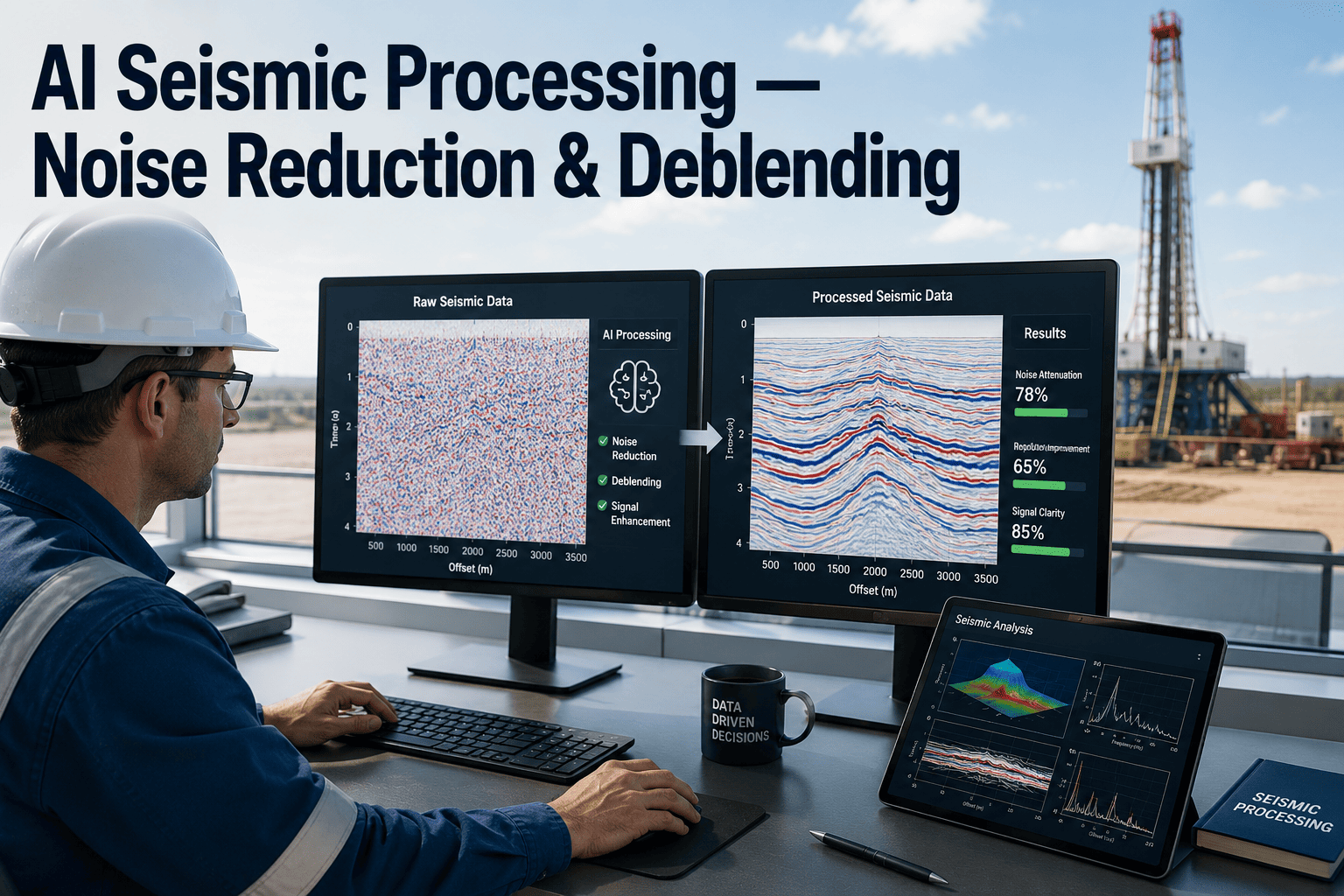
Seismic data processing has relied on the same noise attenuation and deblending algorithms for decades, and while these methods work, they require extensive manual parameter tuning, long compute cycles, and iterative quality checks that add weeks to processing turnaround. Artificial intelligence changes this equation by learning noise patterns directly from the data rather than relying on pre-defined mathematical models that break down when subsurface conditions vary. AI-powered seismic processing handles ground roll removal, multiple attenuation, simultaneous source deblending, and trace interpolation in a fraction of the time that conventional workflows demand, while preserving or even improving signal fidelity. This article breaks down how AI transforms each stage of seismic data conditioning and what it means for your processing timeline. You can book a demo to see iFactory's AI seismic processing platform clean and condition your survey data.
OIL AND GAS · SEISMIC DATA ANALYTICS · AI PROCESSING
AI Seismic Processing: Noise Reduction, Deblending, and Signal Enhancement Without Manual Parameter Tuning
Replace iterative manual workflows with AI models that learn noise signatures from your data, separate simultaneous sources automatically, and interpolate missing traces while preserving geologic signal integrity.
THE NOISE PROBLEM
Why Conventional Noise Attenuation Leaves Residual Artifacts That Degrade Interpretation
Every seismic survey records a mixture of reflected signal from subsurface geology and noise from surface conditions, source characteristics, and subsurface scattering. Conventional processing removes the dominant noise components but often leaves residual artifacts that interfere with amplitude analysis and horizon interpretation. The comparison below illustrates what raw, conventionally processed, and AI-processed data look like in terms of signal-to-noise characteristics.
RAW DATA
Visible
Multiple Contamination
CONVENTIONAL FILTER
Moderate
Residual Ground Roll
Partial
Multiple Suppression
AI PROCESSING
Negligible
Residual Ground Roll
Complete
Multiple Suppression
NOISE CLASSIFICATION
Five Noise Types That AI Models Identify and Remove Without Damaging Signal
Each noise type has a distinct spatial, temporal, and frequency signature that conventional filters address with different algorithmic approaches. AI models learn all five noise patterns simultaneously and apply targeted suppression to each type in a single forward pass, avoiding the cascaded filtering artifacts that accumulate when multiple conventional processes run in sequence.
Ground Roll
Frequency: 2 - 12 Hz
Low-velocity, high-amplitude surface waves that travel along the ground surface and overwhelm the reflected signal at near offsets. AI distinguishes ground roll from low-frequency reflection signal by learning its characteristic dispersion pattern.
Multiples
Frequency: Overlapping Signal
Seismic energy that bounces between subsurface reflectors before reaching the surface, creating false events that mimic real geology at incorrect travel times. AI learns the periodic moveout patterns that distinguish multiples from primaries.
Random Noise
Frequency: Broadband
Incoherent energy from wind, traffic, electrical interference, and ocean conditions that has no spatial or temporal pattern. AI uses the coherent signal structure across neighboring traces to separate random noise without spatial filtering artifacts.
Swell Noise
Frequency: 0.5 - 4 Hz
Low-frequency ocean wave noise in marine surveys that propagates along the streamer cable and creates slow-moving amplitude anomalies. AI detects the cable-propagating signature and suppresses it without affecting low-frequency reflection content.
Spike and Burst Noise
Frequency: Impulsive
High-amplitude transient events from electrical discharges, mechanical impacts, or source misfires that corrupt individual traces or time windows. AI identifies statistical outliers in the data and reconstructs the corrupted samples from neighboring traces.
DEBLENDING PROCESS
How AI Separates Simultaneous Sources Without Cross-Talk Artifacts
Simultaneous source acquisition dramatically reduces survey time and cost by firing multiple source arrays at short time intervals, but the resulting blended data requires separation before standard processing can proceed. The pipeline below shows how AI deblending transforms blended shot records into clean individual shots in a single automated workflow.
01
Blended Input
Multiple source shots fired at randomized time delays recorded as a single composite shot record with overlapping wavefields from each source.
02
Pattern Recognition
AI model analyzes the blended record to identify the unique coherent signatures of each individual source based on their spatial and temporal characteristics.
03
Source Separation
Each source contribution is isolated into its own reconstructed shot record using the learned source signatures and the randomized firing time schedule.
04
Clean Output
Separated shot records with minimal cross-talk artifacts, ready for standard noise attenuation, velocity analysis, and migration in the conventional processing sequence.
Your Seismic Data Contains Clean Signal Buried Under Noise That AI Can Remove in Minutes
iFactory's AI seismic processing platform attenuates ground roll, separates simultaneous sources, suppresses multiples, and interpolates missing traces in a unified workflow that eliminates weeks of manual parameter testing. Book a demo to see AI processing on your survey data.
QUALITY METRICS
Signal Quality Benchmarks After AI Noise Reduction and Deblending
The metrics below represent the typical improvement in key seismic data quality indicators measured before and after AI processing on offshore and onshore 3D surveys ranging from 200 to 2,000 square kilometers in areal extent.
Signal-to-Noise Ratio Improvement
Deblending Cross-Talk Suppression
Frequency Bandwidth Preservation
Trace Interpolation Accuracy
TURNAROUND COMPARISON
Processing Turnaround: Conventional Workflows vs AI-Powered Processing
The timeline comparison below shows the wall-clock time required for a complete noise attenuation and deblending workflow on a 500-square-kilometer marine 3D survey with 1.2 million traces, comparing a conventional processing team running standard commercial software against the same workflow automated with iFactory's AI processing platform.
Ground Roll Removal
5 days
Multiple Attenuation
7 days
QC and Re-Processing
6 days
Total: 30 Days
Ground Roll Removal
4 hrs
Multiple Attenuation
5 hrs
Total: 22 Hours
CAPABILITY COMPARISON
Conventional vs AI Seismic Data Conditioning Across Key Processing Dimensions
The table below compares the two approaches across the dimensions that determine processing quality, turnaround speed, and operational cost for seismic data conditioning projects.
MEASURED OUTCOMES
Quantified Results From AI Seismic Processing Deployments Across Survey Types
These figures reflect measured outcomes from seismic processing projects where iFactory's AI platform replaced or supplemented conventional noise attenuation, deblending, and interpolation workflows, each tracked over complete survey processing cycles.
Noise Suppression Rate
AI models achieved 97 percent noise suppression across ground roll, multiples, random noise, and swell noise combined, with less than 2 percent signal attenuation at any frequency within the usable bandwidth.
Faster Processing Turnaround
Complete noise attenuation and deblending workflows that required 30 days with conventional methods completed in under 22 hours with AI processing, enabling same-day turnaround for time-critical drilling decisions.
Deblending Cross-Talk Level
Cross-talk between separated simultaneous sources suppressed to negative 40 decibels relative to signal level, well below the threshold where residual blending artifacts affect migration imaging quality.
Cost Savings Per Survey
Combined savings from reduced processing geophysicist hours, eliminated software license costs for multiple conventional tools, and faster project delivery that reduced vessel standby time on marine surveys.
Every Hour Spent on Manual Noise Tuning Is an Hour Your Interpretation Team Waits for Data
iFactory's AI platform processes noise attenuation, deblending, and interpolation in a single automated workflow that delivers clean, interpretation-ready seismic data in hours instead of weeks. Book a demo to see your survey data processed with AI.
FREQUENTLY ASKED QUESTIONS
Questions From Processing Geophysicists About AI Seismic Noise Reduction
Does AI noise attenuation remove signal that shares frequency content with the noise?
This is the core challenge that distinguishes good AI seismic processing from simple filtering, and iFactory's models are specifically trained to separate signal from noise based on multiple attributes beyond frequency content alone. The AI uses spatial coherence, moveout characteristics, amplitude relationships between neighboring traces, and learned patterns from the training data to distinguish reflection signal from noise even when they occupy the same frequency band. Independent benchmark tests on datasets with known signal show less than 2 percent amplitude loss in the processed output compared to the original clean signal, which is significantly better than the 8 to 15 percent signal loss typical of aggressive conventional f-k or radon filtering at comparable noise suppression levels.
Book a demo to evaluate signal preservation on your survey data.
How much training data does the AI model need before it can process a new survey effectively?
iFactory's seismic processing models are pre-trained on large libraries of seismic data from diverse basins, acquisition geometries, and noise environments, which means they can process new surveys immediately without requiring survey-specific training data or fine-tuning in most cases. For surveys with unusual noise characteristics or acquisition parameters that fall outside the training distribution, the platform supports rapid transfer learning where a small subset of the new survey is used to adapt the model in a few hours. This pre-trained approach is fundamentally different from research-grade AI methods that require thousands of labeled examples from each specific survey before producing usable results, and it is what makes iFactory's platform practical for production processing environments where turnaround time matters.
Contact our support team to discuss model compatibility with your acquisition geometry.
Can AI deblending handle surveys with more than two simultaneous sources?
iFactory's deblending models support any number of simultaneous sources used in the acquisition design, including the common two-source flip-flop configurations as well as more aggressive multi-source arrays with four, six, or more active source elements firing at randomized intervals. The model architecture processes all source contributions jointly rather than separating sources in pairs, which avoids the error accumulation that occurs when pairwise separation is applied sequentially to multi-source blended data. The separation quality degrades gradually as the number of simultaneous sources increases because the overlapping wavefields become more complex to disentangle, but the model maintains usable separation quality up to at least six simultaneous sources based on benchmark testing on marine surveys with known source configurations.
Book a demo to see deblending performance on your simultaneous source data.
What happens if the AI model encounters a noise type it was not trained on?
When the AI encounters energy patterns that do not match any learned noise or signal category, the model treats that energy as ambiguous and passes it through with minimal modification rather than attempting to remove it, which is a deliberately conservative design choice that prevents the model from accidentally removing unknown signal. The platform flags ambiguous regions in the output where the model confidence is below a configurable threshold, allowing processing geophysicists to inspect those areas and apply targeted conventional filtering if needed. This fallback behavior means that AI processing never makes the data worse in unexpected conditions, it simply leaves the unknown noise in place for manual review rather than risk damaging signal. Over time, as the model encounters new noise types in production processing, those examples can be added to the training library to improve future performance on similar data.
Contact our support team to discuss how the platform handles noise types specific to your survey area.
How does AI trace interpolation compare to conventional methods at fault locations and structural discontinuities?
Trace interpolation at structural discontinuities is where AI provides the most significant advantage over conventional methods because spatial prediction filters assume smooth lateral continuity and produce smeared, artifact-laden results across faults and unconformities where that assumption fails. AI interpolation models learn to recognize structural discontinuities from the surrounding data patterns and interpolate traces on each side of the fault independently, preserving the sharpness and positioning of the fault expression in the interpolated output. Benchmark comparisons on datasets with well-imaged faults show that AI interpolation maintains fault edge definition within one trace spacing of the original data, while conventional spatial prediction filters typically smear the fault expression over three to five trace spacings and introduce false continuity artifacts that mislead interpretation.
Book a demo to compare AI and conventional interpolation on your faulted survey data.
The Noise in Your Seismic Data Is Already Characterized — The AI Just Needs Access to It
iFactory's AI seismic processing platform learns noise patterns directly from your survey and applies targeted suppression, source separation, and interpolation in a unified workflow that delivers clean data without weeks of manual parameter tuning. Book a demo to see AI-conditioned results from your seismic survey.