A pumping unit sized correctly for a well's peak output almost always outpaces the reservoir once that well matures, and the industry has been managing that mismatch with pump-off controllers for decades. The standard fix, a fixed idle timer that shuts the well down for a set period once fillage drops, was a reasonable answer when the alternative was a pumper manually adjusting stroke speed once a week. It is a much weaker answer when reservoir inflow changes hour to hour and the controller has no way to tell the difference between a temporary gas slug and a genuine decline in fluid level. AI-driven pump-off control reads the same dynamometer data the controller has always had access to, but adjusts stroke speed continuously instead of guessing at a fixed interval, and a demo of that adjustment logic running against a real well is available for artificial lift teams evaluating the upgrade.
Fixed-Interval Pump-Off Control Was Designed for a Well That Behaves the Same Way Every Day. Yours Doesn't
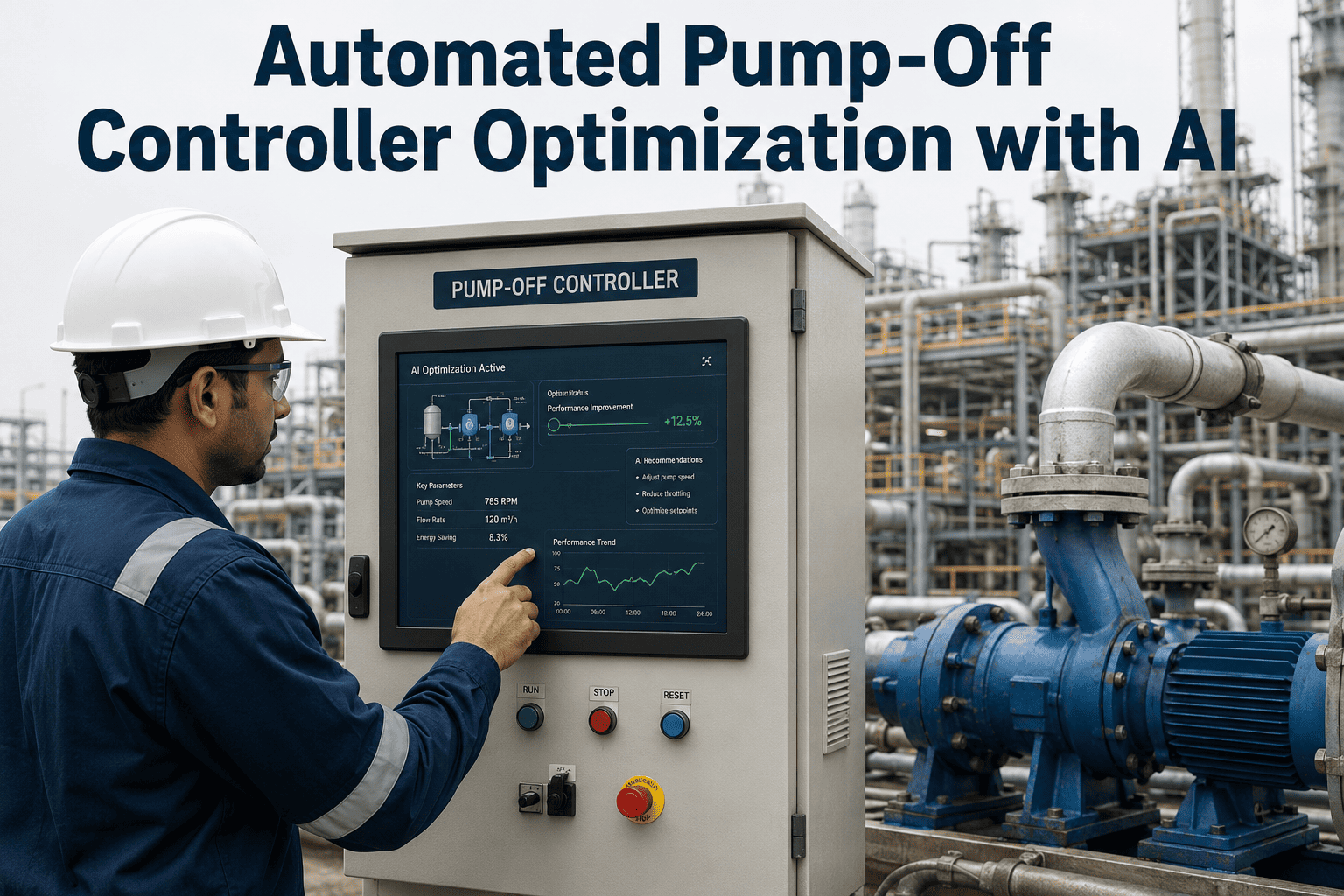
AI-based pump-off controller optimization reads dynamometer load, fillage percentage, and stroke rate in real time and continuously adjusts the VFD, replacing a static idle-time guess with a control loop that responds to what the well is actually doing right now.
Why "Pumped Off" Is Not a Single Event, It Is a Condition That Gets Worse the Longer It Runs Unmanaged
Sucker rod pumping units are routinely sized to lift faster than a well can actually produce, because the incremental cost of a larger unit is usually smaller than the value of capturing peak fluid rate when the reservoir can support it. The tradeoff is that the well periodically runs out of liquid to pump, the barrel fails to fill completely on the upstroke, and the plunger slams into an incomplete fluid column on the downstroke. That impact, known as fluid pound, sends a shock wave through the entire rod string on every single stroke it happens, and the same mechanism that makes rod pumps the most widely used artificial lift method worldwide, their mechanical simplicity, is also what makes them so exposed to this specific kind of cumulative wear when the controller managing them is slow to react.
A fixed-interval controller treats every pumped-off event the same way: shut down for a preset number of minutes, then restart and hope the well has recovered. It cannot distinguish a well that needs three minutes of recovery from one that needs thirty, and it cannot detect a slow decline in inflow until fillage has already dropped far enough to trip the shutdown threshold, by which point rod damage from the preceding cycles has already accumulated. Multiply that gap across a field of several hundred wells, each with its own decline curve, and the aggregate cost is not one bad well, it is a slow, field-wide leak of both production and rod life that never shows up as a single dramatic failure a reliability team can point to.
The reason this problem has persisted for decades despite widely documented improvements from even basic pump-off controllers is that conventional controllers still rely on indirect signals, load or current changes at the surface, to infer what is happening at the downhole pump. That inference is good enough to catch an obvious pumped-off condition, but it is not sensitive enough to catch the early warning signs that a well is trending toward one, which is exactly the window where a continuously adjusting control loop has the most room to help.
Rod String Fatigue
Every fluid pound cycle adds cumulative stress to the rod string, and a controller that reacts late lets more pound cycles occur before it intervenes, shortening the interval between rod failures.
Lost Production Time
A fixed idle period that runs longer than the well actually needed to recover is production sitting in the reservoir instead of in the tank, repeated on every single cycle for the life of the well.
Energy Spent Pumping Gas
A well running pumped-off is frequently pumping gas and partial fluid rather than a full column of liquid, which means motor energy is being spent moving the rod string without a proportional production gain.
Manual Retuning Overhead
Reservoir conditions shift with drawdown, workovers, and seasonal changes, and a fixed-timer controller only stays accurate if someone manually revisits and retunes its settings on a schedule most operators cannot keep up with across hundreds of wells.
Fixed-Interval Control Versus a Continuous AI Control Loop
The difference is not that AI adds a new sensor to the wellhead. Most of the wells running this optimization already have the load cells, position sensors, and dynamometer card generation a modern POC has used for years. What changes is what happens to that data after it is captured: instead of comparing a single fillage number against a fixed threshold, the AI model evaluates the shape of the dynamometer card, the trend in fillage over recent cycles, and the well's own historical behavior to decide the smallest effective adjustment to stroke rate at that moment. That decision is delivered as a sequence of commands to the same variable frequency drive an operator would adjust manually, so the physical control path into the pump does not change, only the intelligence deciding what command to send and when.
This also changes the failure modes the system can catch. A pump-off controller that only compares fillage against a fixed threshold has no memory of how that well behaved yesterday or last week, so a gradual decline that crosses the threshold slowly looks identical to a sudden change. A model that tracks each well's own trend line can flag the gradual case earlier, well before it reaches the point a static threshold would have caught it, which is often the difference between a proactive stroke-rate reduction and a reactive shutdown after several damaging pound cycles have already occurred.
Traditional Fixed-Interval POC
Shuts the well down for a preset idle period once fillage drops below a static threshold.
Idle time is set once during commissioning and rarely revisited as reservoir conditions change.
Cannot distinguish a temporary gas slug from a genuine decline in reservoir inflow.
Restarts the well at full stroke rate regardless of how much fluid has actually accumulated.
Requires a pumper or engineer to manually retune settings as the well ages.
AI-Optimized Pump-Off Control
Continuously adjusts VFD stroke speed based on the current dynamometer card shape and fillage trend.
Learns each well's individual behavior and adapts its response as inflow conditions shift over time.
Differentiates transient anomalies from a genuine decline using patterns learned across many wells.
Ramps stroke rate back up proportionally to actual fillage recovery instead of a fixed restart speed.
Recalibrates continuously in the cloud, pushing model improvements to every connected well automatically.
Your Wells Already Generate the Data This Optimization Needs
If your pump-off controllers are already capturing dynamometer cards, iFactory's AI layer can start reading them without new downhole hardware. Book a demo to see it evaluated against your own well data.
A Well's Optimal Settings on Day One Are Not Its Optimal Settings Three Years In
A newly completed well produces at rates and pressures that decline steadily as the reservoir depletes, and every stage of that decline curve calls for a different balance between stroke rate and idle time. Early in life, when inflow is high, the priority is usually capturing as much fluid as possible without overrunning the pump. Later in life, as inflow slows, the priority shifts toward avoiding unnecessary pound cycles on a rod string that is doing more idle-and-restart cycling than steady production. A fixed-interval controller commissioned once at the start of a well's life is, by definition, tuned for a condition that no longer exists a year later.
An AI-optimized control loop does not need a scheduled retuning visit to track that shift, because it is reading the same fillage and load trend data that changes as the well declines and adjusting its behavior accordingly. This matters most for operators managing large legacy well counts, where the engineering time required to manually revisit and retune hundreds of individual POC settings on any reasonable schedule simply does not exist, and settings drift further from optimal the longer a well goes unreviewed.
Four Signals the AI Reads on Every Stroke to Decide What to Do Next
None of this happens at the pace of a weekly report. The decision to hold stroke rate steady, slow it down, or bring a pumped-off well back online is made continuously, stroke by stroke, using the same load and position data the controller has always collected but was previously only checked against a static threshold. The model is also continuously refined using feedback from production engineering and data science teams reviewing outcomes across the connected well population, and because the system runs as a cloud solution, improvements to the underlying model reach every connected well without requiring a technician to visit each wellhead and reflash a controller.
Each of the four signals below is available to a conventional controller as raw data, but a fixed-threshold controller only ever asks one question of that data: has fillage crossed the shutdown line yet. An AI-driven loop asks a more useful question of the same data, which is whether the well's behavior right now suggests it is heading toward a pumped-off condition, holding steady, or already recovering, and adjusts before a hard threshold is even reached.
Dynamometer Card Shape
The load-versus-position curve for each stroke is compared against known fillage and fluid pound signatures to determine how completely the barrel filled on that specific cycle.
Fillage Trend
Fillage is tracked across a rolling window of recent strokes rather than a single reading, so a genuine decline is distinguished from short-term noise before any action is taken.
Stroke Rate and Load
Motor load and current stroke speed are read continuously to calculate how much of the energy being spent is actually producing fluid versus moving an underfilled rod string.
Recovery Behavior
When a well is brought back online after an idle period, the model watches how quickly fillage recovers and uses that to fine-tune the restart speed for the well's next cycle.
What Operators Report After Moving From Fixed-Timer to AI-Optimized Control
These figures reflect ranges reported by operators after transitioning a portion of their rod-pumped well count from fixed-interval pump-off control to a continuous AI-driven control loop, measured over a full production cycle rather than a short pilot window. The comparison is deliberately framed by mechanism rather than a single headline percentage, because the actual improvement on any given well depends heavily on how far its existing fixed-timer settings had drifted from what current reservoir conditions require.
| Metric | Fixed-Interval POC | AI-Optimized POC | Typical Change |
|---|---|---|---|
| Non-productive idle time | Fixed regardless of recovery | Scales to actual fillage recovery | Reduced meaningfully |
| Fluid pound cycles per week | Detected after threshold breach | Reduced through earlier response | Fewer pound events |
| Energy spent per barrel produced | Includes gas-only strokes | Stroke rate matched to fluid available | Lower energy per barrel |
| Rod and pump failure interval | Shortened by cumulative pound damage | Extended as pound cycles decrease | Longer run life |
The pattern across these metrics points to the same underlying mechanism: every reduction in fluid pound cycles compounds into less rod fatigue, which extends run life, which in turn reduces the workover frequency that otherwise erodes the production gains from better fillage management. None of these outcomes require a different pumping unit or a different downhole pump, only a different decision loop running on the data already available at surface. Operators who track cost per barrel across their fixed-interval and AI-optimized well populations separately tend to see the gap widen over time rather than shrink, since rod fatigue is cumulative and a well that avoids pound cycles this month is also avoiding the compounding damage that would otherwise have shortened its next workover interval.
It is also worth being direct about where this optimization does not help. A well limited by reservoir inflow rather than by controller settings will not produce meaningfully more oil no matter how well its stroke rate is tuned, and a well with a mechanical problem such as a worn traveling valve or a split rod will still need a physical repair that no control algorithm can substitute for. What AI-optimized pump-off control does reliably deliver is making sure the well is never the bottleneck on its own production, and that the mechanical stress it experiences on the way to depletion is no higher than the well's actual inflow conditions require.
Questions Production and Artificial Lift Engineers Ask About AI Pump-Off Optimization
Stop Managing Every Well With the Same Fixed Timer
iFactory's AI reads the dynamometer data your controllers already generate and continuously tunes stroke rate to what each well can actually deliver. Book a demo and see it running against wells from your own field.