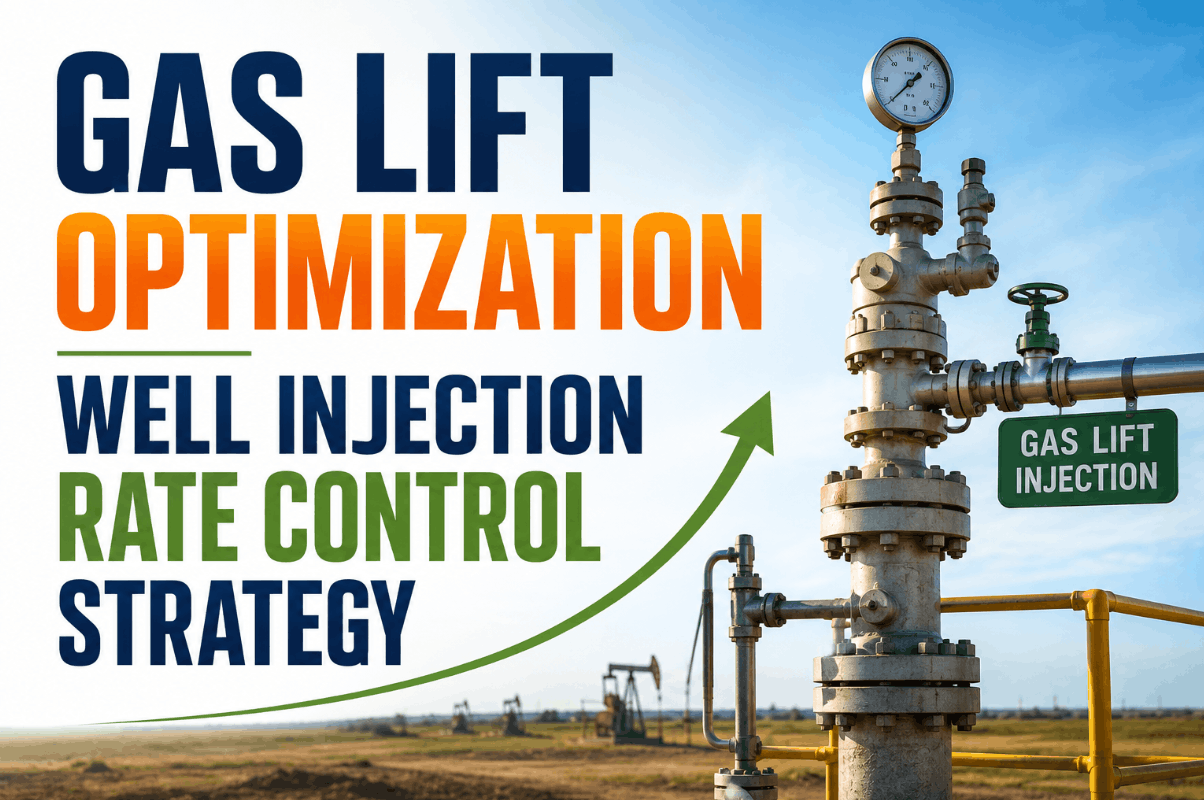
Every gas lift platform runs into the same constraint eventually: compression capacity is fixed, lift gas is expensive to produce and compress, and a platform with twenty or more wells competing for a limited gas supply has to decide, well by well, exactly how much gas each one gets. Get the allocation wrong and the platform leaves oil in the ground that the gas supply could have produced — either by starving a high-potential well of gas it needs, or by over-injecting a well past its optimum point where additional gas actually reduces production instead of increasing it. Traditional allocation practice tests one or two wells at a time and applies rule-of-thumb adjustments across the rest, which means most of the platform is running on stale, sub-optimal setpoints most of the time. AI-driven optimization treats the whole platform as a single constrained allocation problem, solved continuously, well by well, against the gas the platform actually has available right now. iFactory's artificial lift optimization team maps the well models, gas constraints, and closed-loop control architecture to each platform's specific production network.
Artificial Lift Intelligence · Gas Lift Optimization
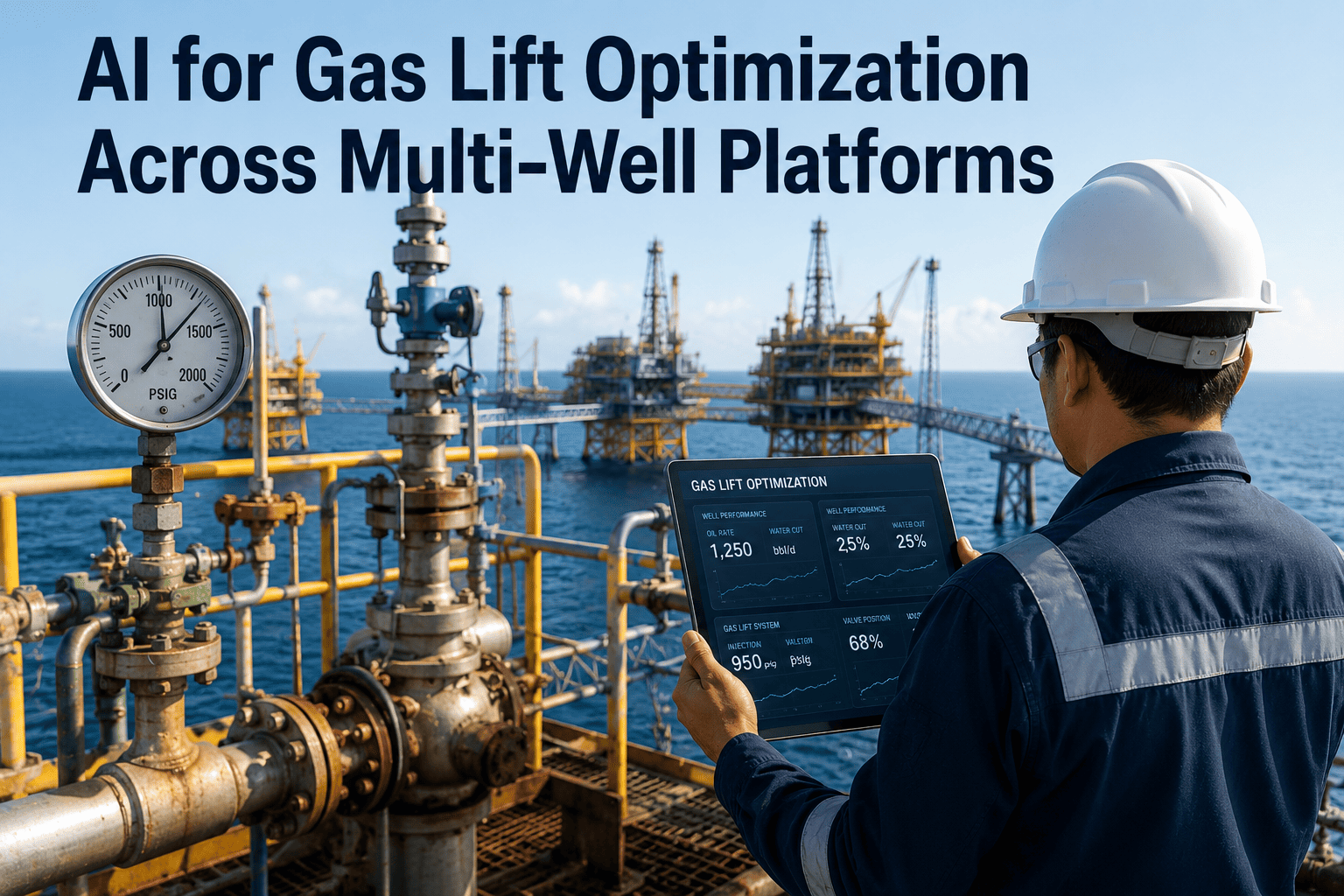
AI for Gas Lift Optimization Across Multi-Well Platforms
Lift gas is limited and expensive. AI allocates it dynamically across every well on the platform to maximize total oil production, replacing fixed injection rates and one-well-at-a-time testing with continuous, whole-platform optimization that adjusts as reservoir conditions change.
The Allocation Problem
20+
wells typically competing for one platform's fixed gas supply
50%+
of Permian Basin oil production runs on gas lift
1–2
wells manually tested per round under legacy practice
Why Allocation Is Hard
The Constrained Optimization Problem Every Platform Faces
Gas lift works by injecting compressed gas into the production tubing to reduce the effective density of the fluid column, which lowers the bottomhole flowing pressure and lets the reservoir push more fluid to surface. Each well has its own performance curve relating gas injection rate to oil production, and that curve isn't linear — production rises with additional gas up to a point, then flattens, and eventually declines as excess gas increases friction losses faster than it reduces fluid density. The single most important fact about gas lift optimization is that the platform's job isn't to maximize every well individually — it's to allocate a fixed total gas supply across all wells in whatever combination produces the most total oil, which sometimes means deliberately under-injecting a strong well to free up gas for a well where the same gas volume produces a bigger marginal return.
That's a genuinely hard optimization problem. With twenty or more wells on a platform, each with its own performance curve, its own current reservoir conditions, and its own sensitivity to gas rate changes, finding the allocation that maximizes total platform output is a constrained, multi-variable, non-linear problem — precisely the kind of problem that gets solved poorly by rule-of-thumb heuristics and precisely the kind of problem that optimization algorithms and machine learning models are built to handle well. Research groups have applied genetic algorithms, sequential quadratic programming, dynamic programming, and more recently hybrid AI approaches to this exact allocation challenge, consistently finding that the traditional field practice of testing one or two wells and holding the rest at legacy setpoints leaves meaningful production on the table.
The gap between traditional and optimized allocation compounds over time because well performance curves aren't static — they shift as reservoir pressure declines, as water cut changes, and as mechanical conditions in the wellbore evolve. An allocation that was optimal six months ago is very likely not optimal today, and a platform running on setpoints from the last manual optimization round is silently leaving production on the table for every day that passes until the next round of testing. That's the core problem AI-driven optimization solves — not by finding a smarter one-time allocation, but by continuously re-solving the allocation problem as conditions change.
Traditional vs AI-Driven Allocation
What Actually Changes When Allocation Goes Continuous
The shift from traditional gas lift management to AI-driven optimization isn't a single feature change — it's a different operating model for how the platform's gas budget gets managed day to day. The comparison below lays out what changes across the dimensions that actually affect production.
| Dimension |
Traditional Practice |
AI-Driven Optimization |
| Wells Actively Tested |
1–2 wells per testing round |
All wells modeled and optimized continuously |
| Reoptimization Frequency |
Weeks to months between rounds |
Nightly or continuous, as conditions change |
| Allocation Method |
Rule-of-thumb and engineer judgment |
Constrained optimization against well performance models |
| Response to Reservoir Change |
Lagged — waits for next scheduled test |
Adaptive — model updates as new data arrives |
| Compressor Failure Response |
Manual reallocation, often reactive |
Closed-loop reallocation preserves output automatically |
| Engineer Time Per Well |
High — manual test design and analysis |
Low — engineer reviews recommendations, sets constraints |
The pattern that runs through every row is the same: traditional practice treats optimization as an event that happens periodically, while AI-driven optimization treats it as a continuous state the platform maintains. That distinction is where the production upside actually comes from — not from a smarter allocation on any single day, but from never letting the platform drift far from optimal in the weeks and months between manual testing rounds.
See Continuous Optimization Live
Watch AI Reallocate Gas Across a 20-Well Platform in Real Time
Book a walkthrough with iFactory's lift optimization engineering team and see live allocation recommendations running against real multi-well performance data — constraint handling, compressor failure reallocation, and the closed-loop control that keeps every well near its optimum continuously.
How the Optimization Actually Works
From Well Data to Allocation Recommendation
Effective AI gas lift optimization runs through a defined pipeline from raw well data to actionable allocation setpoints. Each stage builds on the one before it, and the quality of the final recommendation depends on every stage being done well — a sophisticated allocation algorithm fed by stale or noisy well models produces confident-looking recommendations that don't actually hold up in the field.
01
Real-Time Well Data Acquisition
Wellhead pressure, gas injection rate, fluid rate, water cut, and downhole conditions where available are captured continuously via SCADA or IoT sensors. The optimization is only as good as the data feeding it — gaps or noise here propagate directly into allocation error.
02
Well Performance Curve Modeling
Each well's relationship between gas injection rate and oil production is modeled, using historical multi-rate test data combined with machine learning to capture the non-linear shape of the curve — including the point where additional gas stops helping and starts hurting.
03
Constraint Definition
Total available lift gas, compressor capacity, separator handling limits, and any well-specific operating constraints are defined as boundaries the optimization must respect. The solution has to be not just mathematically optimal but operationally feasible.
04
Multi-Well Constrained Optimization
An optimization algorithm — genetic algorithm, gradient-based method, or hybrid AI approach depending on the platform's specific problem structure — solves for the gas allocation across all wells that maximizes total oil production within the defined constraints.
05
Setpoint Recommendation or Automated Control
The optimized allocation is either presented to engineers as a setpoint recommendation for review and approval, or in closed-loop deployments, pushed directly to well controllers via remote setpoint control — with engineer-defined guardrails on how much any single setpoint can move per cycle.
06
Continuous Model Refinement
As new production data arrives following each allocation change, the well performance models update to reflect current reservoir behavior, and the next optimization cycle runs against the refreshed models — keeping the allocation aligned with actual well conditions rather than stale test data.
Where the Value Shows Up
Four Scenarios Where AI Allocation Outperforms Manual Practice
The production upside from AI-driven gas lift optimization isn't evenly distributed across every situation — it concentrates in specific operational scenarios where manual practice is structurally slow to respond. The four scenarios below are where the gap between traditional and AI-driven allocation is largest and most measurable.
S1
Compressor Capacity Reduction
When a compressor goes down or runs at reduced capacity, the platform's total available gas drops immediately, and every well's optimal allocation shifts. Manual reallocation under this pressure is slow and reactive; closed-loop optimization reallocates automatically to preserve as much total production as the reduced gas supply allows.
S2
Reservoir Pressure Decline
As individual wells decline, their performance curves shift, and the gas that used to be optimal for that well often isn't anymore. Continuous reoptimization catches this drift automatically, reallocating gas toward wells where it currently produces the best marginal return instead of where it did months ago.
S3
Water Cut Increase
Rising water cut changes the fluid column density and the gas volume needed to achieve the same lift effect. A well whose optimal injection rate was correct six months ago may need meaningfully different gas today, and continuous model updates catch that shift without waiting for the next scheduled well test.
S4
New Well Addition to the Platform
Adding a new well to a shared gas supply changes the optimal allocation for every existing well on the platform, not just the new one. Manual practice often under-reacts to this, leaving the new well under-optimized while established wells keep their prior setpoints unchanged.
The Business Case
Where the Production Upside Actually Comes From
The ROI case for AI-driven gas lift optimization is unusually clean compared to many industrial AI applications, because the value shows up directly as incremental barrels — a metric every operator already tracks and prices without needing a new measurement framework. The categories below are where that incremental production consistently originates.
R1
Incremental Production From Better Allocation
The core value driver — reallocating the same total gas supply to the combination of wells that produces the most total oil. On platforms running stale, months-old allocation, the incremental production from re-optimization alone is often measurable within weeks of deployment.
R2
Faster Response to Changing Conditions
Continuous reoptimization means the platform spends far less time running sub-optimal allocation between manual test rounds. The cumulative production gained from staying near-optimal every day, rather than only right after a testing round, compounds significantly over a full year.
R3
Reduced Engineering Time Per Well
Automating the routine allocation calculation frees production engineers to focus on higher-value diagnostic work — investigating underperforming wells, evaluating workover candidates, and reviewing edge cases the model flags — instead of manually running multi-rate tests on a rotating schedule.
R4
Resilience to Compression Constraints
Closed-loop reallocation during compressor outages or capacity reductions preserves more total platform output than manual reaction would, directly limiting the production loss from equipment constraints that are otherwise treated as simply unavoidable downtime.
Field Perspective
"
The mistake I see production engineers make when they first evaluate AI gas lift optimization is thinking about it as a smarter version of the multi-rate test — like it just runs the same test faster. That's not really what changes the numbers. The real shift is that the platform stops treating optimization as an event and starts treating it as a state it maintains continuously. Every well's performance curve is drifting all the time — reservoir pressure, water cut, mechanical condition — and traditional practice only catches that drift when someone happens to schedule a test on that specific well. Most of the platform, most of the time, is running on setpoints that were correct months ago and aren't correct anymore. When you re-solve the allocation problem every night against fresh data, you're not finding one clever allocation — you're keeping the whole platform close to its true optimum continuously, and that's where the incremental barrels actually come from. Engineers who've run this for a full year consistently tell me the same thing: it's not one big win, it's never letting the small losses accumulate.
Osric Bellweather-Nakagawa
Upstream Production Optimization Lead · 17 years in artificial lift engineering, gas lift network optimization, and closed-loop production control
Common Questions
Frequently Asked Questions
Does AI gas lift optimization require replacing existing well controllers or SCADA infrastructure?
No, in most deployments. The optimization platform typically reads existing SCADA and well controller data through standard industrial protocols and issues setpoint recommendations or remote setpoint changes through the same infrastructure that already manages the wells. Most platforms already have the instrumentation needed — wellhead pressure, injection rate, fluid rate — since these are standard gas lift monitoring points. The deployment work is primarily in data integration, well model calibration, and defining operating constraints, not in replacing field hardware.
Talk to lift optimization engineering about your specific SCADA environment.
How does the system handle wells with limited or unreliable production test data?
Well performance models are built from whatever historical test data is available and improve continuously as new production data arrives from operating the well under different injection rates over time. Wells with sparse historical test data start with wider uncertainty bounds on their performance curve, and the optimization is configured to be more conservative on setpoint changes for those wells until the model has accumulated enough operating history to narrow the uncertainty. This is a standard part of the deployment process — the system doesn't require a complete historical dataset before it can begin contributing value, though allocation confidence improves as data accumulates.
Can the optimization run in an advisory mode before moving to fully automated closed-loop control?
Yes, and this is the standard deployment path for most operators. Early phases typically run the optimization in advisory mode, where recommendations are presented to production engineers for review and manual implementation, allowing the team to validate the model's recommendations against field judgment before trusting it with automated setpoint control. Once confidence is established — typically after several optimization cycles showing recommendations that match or beat manual judgment — operators commonly move to closed-loop automated control with engineer-defined guardrails limiting how much any setpoint can change per cycle.
Book a demo to walk through the advisory-to-automated deployment path.
What happens to the allocation if total available lift gas suddenly drops, such as during a compressor failure?
This is one of the highest-value scenarios for the optimization. When total available gas drops due to a compressor failure or capacity reduction, the constrained optimization problem is automatically re-solved against the new, lower gas budget, and the system reallocates gas to the combination of wells that preserves the most total production under the reduced supply. In closed-loop deployments, this reallocation happens without waiting for an engineer to manually recalculate and push new setpoints — which is exactly the scenario where manual response is typically slowest and where the production loss from delayed reaction is largest.
How much incremental production can a platform realistically expect from switching to AI-driven allocation?
The realistic incremental production depends heavily on how far the platform's current allocation has drifted from optimal — a platform running recently-tested, well-maintained setpoints has less upside than one running on setpoints that haven't been revisited in months. Published research and field case studies across multiple operators consistently show measurable incremental oil production from moving off manual, infrequent testing toward continuous optimization, with the largest gains typically seen on platforms with many wells, limited gas supply relative to demand, and infrequent historical testing cadence. A proper assessment starts with reviewing the platform's specific well count, gas constraint, and current allocation practice.
Stop Leaving Production on the Table
Turn Your Fixed Gas Supply Into Maximum Platform Production
iFactory's AI gas lift optimization platform continuously solves the constrained allocation problem across every well on your platform — replacing infrequent manual testing with real-time, closed-loop optimization that keeps every well near its production optimum, even as reservoir conditions and gas availability change.