While your competitors have embedded AI into clinical workflows, the majority of hospitals still operate without governance frameworks — and that gap is costing the U.S. healthcare system an estimated $935 billion annually in preventable waste, misdiagnosed conditions, and documentation friction. The question is no longer whether to adopt AI — it's whether you can afford the operational hemorrhage of waiting.
Is Your Hospital Losing Revenue to Manual Workflows?
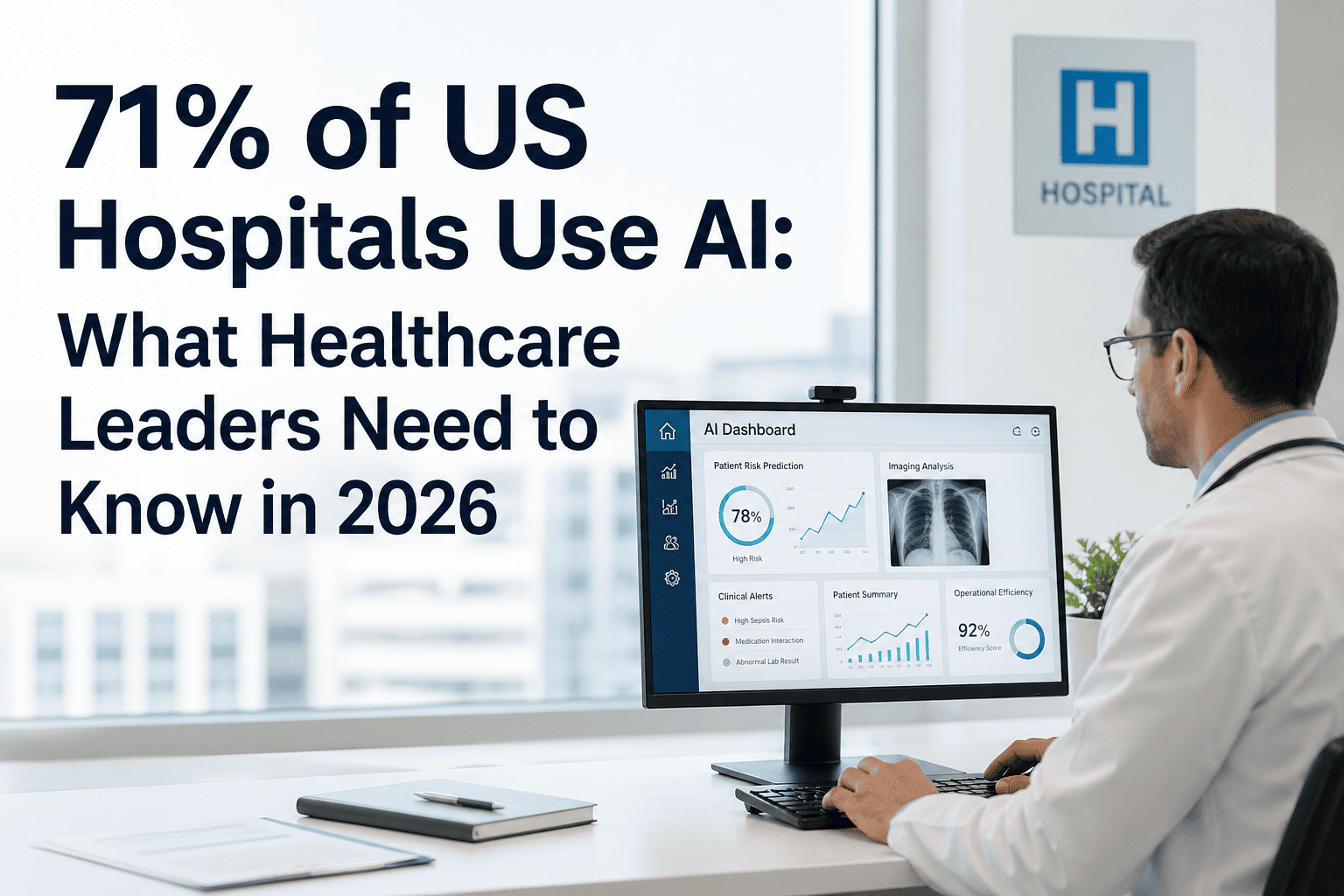
iFactory's AI Dashboard centralizes clinical intelligence, documentation, and operational analytics into a single governance-ready platform for modern health systems.
The State of Hospital AI in 2026 — What the Data Actually Tells You
The headline is striking: 71% of U.S. hospitals now use AI in daily operations. But underneath that adoption rate is a governance crisis that most C-suite leaders are not prepared for.
What Hospitals Without AI Governance Are Actually Losing
Fragmented AI deployments without a unified dashboard don't just create inefficiency — they create measurable, recurring financial and clinical exposure.
Manual documentation without AI-assisted coding leaves 12–18% of billable complexity systematically uncaptured per quarter.
Physicians spend 4.5 hours daily on documentation. Without AI relief, burnout costs average $500K per physician in turnover expenses.
Ungoverned AI generates noise — not signal. 69% of critical alerts are overridden by clinicians desensitized by irrelevant notifications.
Without immutable AI decision logs, hospitals face increasing CMS and Joint Commission scrutiny with no defensible documentation chain.
Point solutions from competing AI vendors create data fragmentation that prevents cross-domain clinical intelligence and ROI measurement.
75% of hospital AI pilots never reach system-wide deployment — stalling ROI and leaving investments stranded at the department level.
Legacy Friction vs. iFactory Optimized Excellence
The performance gap between fragmented AI deployments and a governed, unified AI Dashboard is not incremental — it is structural.
| Operational Dimension | Legacy Friction | iFactory AI Dashboard | Financial Impact |
|---|---|---|---|
| Documentation Workflow | Manual EHR entry, 4.5 hrs/day per physician | AI-assisted notes, structured auto-coding | ↑ 40% time savings |
| Clinical Decision Support | Isolated, ungoverned alerts — high override rates | Context-aware, prioritized, explainable AI alerts | ↓ 60% alert fatigue |
| Revenue Cycle Intelligence | Retrospective coding audits, missed complexity | Real-time risk-adjusted coding recommendations | ↑ 15% net revenue capture |
| AI Governance & Audit | No centralized log; vendor-siloed decision trails | Immutable, unified AI action log per patient encounter | Full CMS compliance |
| Operational Analytics | Departmental dashboards, no cross-domain view | System-wide AI performance & utilization dashboard | ↑ 3× ROI visibility |
| Scalability | Pilot-stage only; no enterprise rollout path | Modular architecture: scales from 1 unit to 50 hospitals | Zero re-architecture cost |
How iFactory's AI Dashboard Solves Your Highest-Cost Clinical Problems
Staff Burnout Reversal
- AI-generated SOAP notes reduce charting by 55%
- Ambient voice documentation eliminates after-hours EHR sessions
- Intelligent task routing removes non-clinical burden from nurses
- Burnout risk scoring flags at-risk staff before turnover events
Patient Throughput Acceleration
- Predictive bed management reduces ED boarding by 28%
- AI triage scoring accelerates acuity classification at intake
- Discharge prediction models activate care transitions earlier
- OR scheduling AI eliminates block-time waste by up to 22%
Diagnostic Accuracy at Scale
- Computer vision flags radiology anomalies with 94% sensitivity
- Sepsis early-warning models activate 6 hours before clinical signs
- Medication reconciliation AI reduces adverse drug events by 35%
- All models validated, explainable, and audit-ready for clinical review
The iFactory 5-Phase Deployment for Health Systems
Operational Gap Audit
A structured assessment of your current AI maturity, documentation burden, revenue cycle gaps, and governance posture — delivered within 5 business days.
EHR & Data Integration
HL7 FHIR-native connectors for Epic, Oracle Health, and Meditech. Zero-disruption onboarding with live data mirroring from day one.
AI Model Configuration & Governance
Deploy pre-validated clinical AI models with explainability layers. Governance committee receives full model cards, bias audits, and drift monitoring dashboards.
Clinical Staff Activation
Role-based training tracks for physicians, nurses, and administrators. Average time-to-proficiency: 4 hours. Change management playbook included.
ROI Measurement & System Scaling
90-day ROI report with benchmarks against peer health systems. Expansion modules activated per service line without infrastructure re-architecture.
What Healthcare Leaders Ask Before Deploying AI at Scale
How does iFactory ensure our AI models are clinically validated and unbiased?
Every AI model deployed on the platform undergoes prospective validation against your patient population. Bias audits are run across race, age, and payer cohorts. Full model cards are provided to your clinical governance committee before go-live.
Is the platform compliant with HIPAA, 21st Century Cures Act, and CMS AI guidelines?
Yes. The iFactory AI Dashboard is built on HIPAA-compliant cloud infrastructure with AES-256 encryption, immutable audit logs, and full ONC certification alignment. Compliance documentation is available for regulatory review at any time.
What is the realistic ROI timeline for a mid-sized health system?
Most health systems with 200–500 beds achieve positive ROI within 6–9 months. The primary drivers are documentation time savings, revenue cycle improvement, and reduced locum/agency spend from lower burnout. Book a Demo to run your system-specific ROI model.
Can this replace our existing AI vendor contracts?
The platform is designed as a vendor-neutral orchestration layer — it can integrate with existing AI tools while adding governance, unified analytics, and cross-domain correlation. It can also fully replace fragmented point solutions over time, consolidating licensing costs significantly.
Deploy a Governed AI Platform Across Your Entire Health System
Stop managing AI in silos. iFactory centralizes clinical AI, documentation intelligence, and operational analytics into one audit-ready dashboard — built for enterprise health systems.