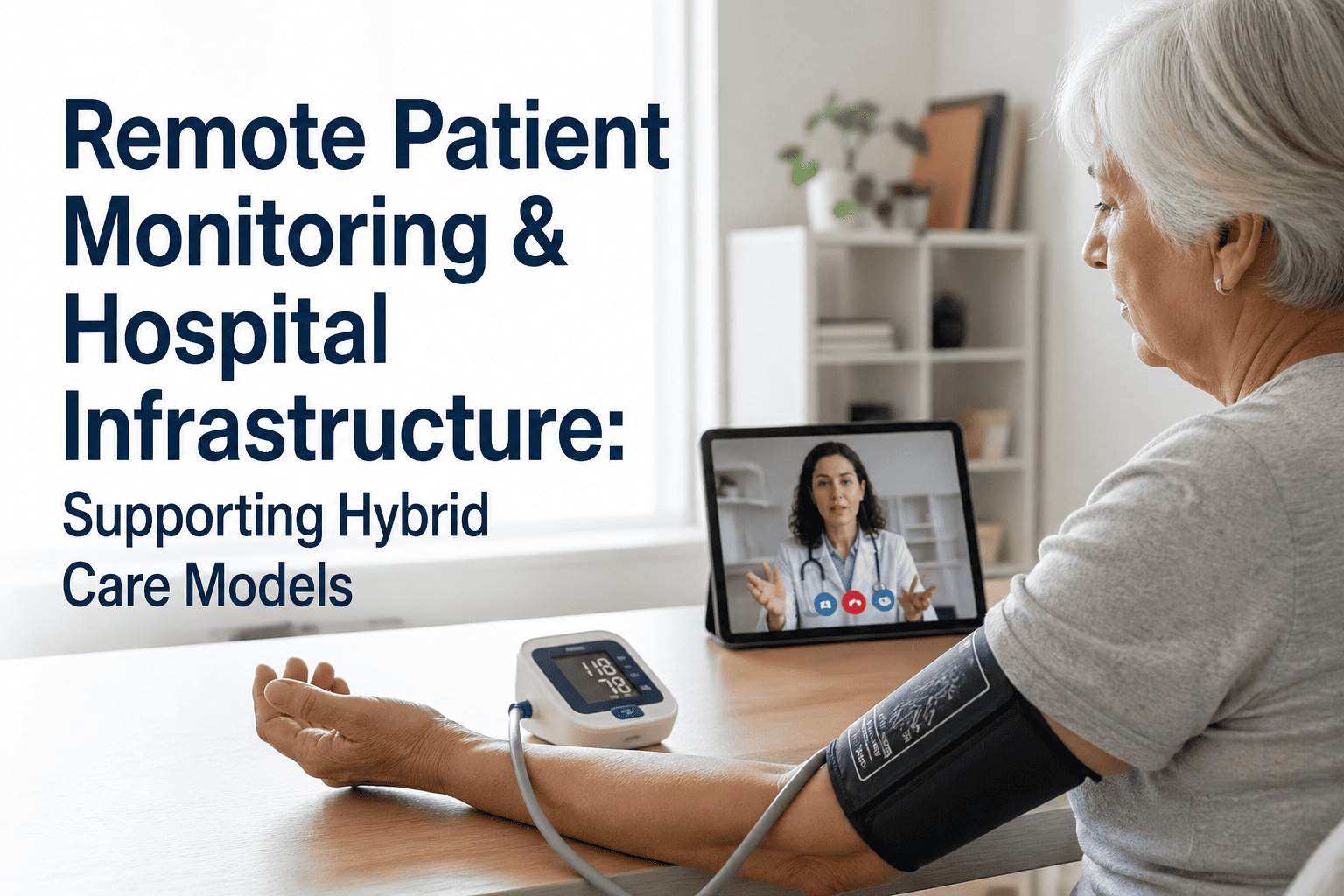
Every hour your hospital runs without integrated remote patient monitoring infrastructure, you are losing — revenue from avoidable readmissions, staff hours to manual check-ins, and clinical outcomes that could have been prevented. The question is not whether to modernize. The question is how much longer inaction costs you.
Is Your Hospital Ready for Remote Patient Monitoring at Scale?
iFactory's IoT Integration platform unifies RPM devices, telehealth workflows, and clinical data into one compliant, scalable infrastructure built for hybrid care.
Why RPM Infrastructure is Now a Financial Imperative
Hybrid care models are no longer optional — CMS reimbursement codes, MACRA incentives, and patient expectations have converged to make RPM a baseline standard. Yet most hospitals are running RPM pilots on fragmented infrastructure that was never designed for scale. The result is operational drag, compliance exposure, and revenue left uncaptured.
Revenue Leakage
- Unbilled RPM CPT codes (99453, 99454, 99457)
- Missed chronic care management billing cycles
- Avoidable 30-day readmissions reducing value-based scores
Operational Hemorrhage
- Nursing staff manually logging device readings
- Siloed device dashboards requiring duplicate data entry
- No automated alert routing to care teams
Patient Safety Gaps
- Delayed escalation due to manual monitoring cycles
- No cross-device vital correlation in real time
- Missed deterioration signals in high-risk populations
Compliance Exposure
- HIPAA gaps in unsecured device telemetry pipelines
- No audit trail for remote monitoring interactions
- Non-compliant data residency in third-party RPM apps
What a Scalable RPM Infrastructure Actually Requires
Building for hybrid care demands more than procuring devices. The architecture must handle real-time telemetry, enforce clinical workflows, and integrate cleanly with your EHR. iFactory's IoT Integration layer is engineered for exactly this.
| Infrastructure Layer | Core Function | iFactory Capability | Clinical Outcome | Priority |
|---|---|---|---|---|
| Device Connectivity | Multi-vendor IoT onboarding | Vendor-neutral API bridge | Unified device fleet | Critical |
| Network Capacity | Real-time telemetry throughput | Edge + cloud hybrid routing | Zero-latency alerts | Critical |
| EHR Integration | Bi-directional data sync | HL7 FHIR R4 pipelines | Eliminates manual entry | Critical |
| Alert Orchestration | Clinical escalation routing | AI-driven threshold logic | Faster intervention | High |
| Billing Automation | RPM CPT code capture | Time-tracking + audit logs | Recovered revenue | High |
| Data Sovereignty | HIPAA-compliant storage | AES-256, GovCloud-ready | Zero compliance gaps | Standard |
Legacy Friction vs. iFactory Optimized Excellence
The gap between a fragmented RPM pilot and a fully integrated hybrid care infrastructure is measurable in dollars, staff hours, and patient outcomes. This comparison defines exactly where your organization stands today — and where it needs to be.
- Separate dashboards per device vendor
- Manual vital sign transcription into EHR
- Alert fatigue from unconfigured thresholds
- No automated billing for RPM interactions
- Nurses triaging device alarms via phone calls
- Data stored in vendor cloud, not hospital-owned
- No patient engagement layer for remote coaching
- Readmission rates unchanged post-discharge
- IT team managing dozens of one-off integrations
- No cross-device correlation for deterioration signals
- Single unified dashboard for all RPM devices
- Automatic EHR write-back via FHIR R4 pipeline
- AI-tuned, patient-specific alert thresholds
- Automated CPT code capture and billing audit trail
- Care team routing with severity-based escalation logic
- Sovereign, HIPAA-compliant hospital-controlled storage
- Integrated patient portal with remote coaching workflows
- Predictive discharge risk scoring reduces readmissions
- One IoT integration layer manages all device types
- Multi-parameter AI correlation for early deterioration flags
Clinical Impact Across Three Critical Dimensions
iFactory's RPM infrastructure directly addresses the three forces that drain hospital performance: staff burnout, patient throughput constraints, and care quality degradation in remote populations.
Staff Burnout Reduction
- Eliminates manual device data entry shifts
- AI filters non-actionable alerts before nurse review
- Automated documentation saves 45+ min per nurse per shift
- Structured escalation reduces decision fatigue
- Care team dashboards surface only priority patients
Patient Throughput Gains
- Remote step-down reduces unnecessary inpatient days
- Post-discharge RPM extends monitored care without beds
- Predictive readmission flags enable early intervention
- Telehealth visit automation replaces low-acuity admissions
- Chronic disease panels managed at 3x higher capacity
Remote Care Quality
- Continuous monitoring vs. episodic clinic snapshots
- AI trend analysis detects deterioration 48–72 hrs early
- Patient-reported outcomes integrated into care plans
- Medication adherence tracking via connected devices
- Clinical-grade data quality from consumer wearables
Phased Deployment for Hospital-Scale RPM Infrastructure
Successful RPM infrastructure deployments follow a disciplined phased approach that minimizes clinical disruption while accelerating time-to-value. iFactory structures every engagement around measurable milestones.
Operational Gap Audit
- Map all existing RPM devices and vendor platforms
- Identify unbilled CPT codes and revenue leakage points
- Assess EHR integration readiness and FHIR compliance gaps
IoT Integration Layer Deployment
- Connect all device types via vendor-neutral API framework
- Configure FHIR R4 bi-directional EHR data pipelines
- Establish HIPAA-compliant data sovereignty architecture
AI Alert & Workflow Configuration
- Define patient-specific threshold logic per condition protocol
- Build care team escalation routing and notification rules
- Activate automated billing capture and audit trail generation
Clinical Validation & Scale
- Pilot with high-risk chronic disease population cohort
- Measure readmission rates, alert accuracy, and billing capture
- Expand to full patient panel with performance benchmarks locked
Stop Leaving RPM Revenue and Patient Outcomes on the Table
iFactory's IoT Integration platform gives your hospital the unified infrastructure to run remote patient monitoring at scale — compliantly, efficiently, and profitably.
RPM Infrastructure — Frequently Asked Questions
Can iFactory integrate with our existing EHR (Epic, Cerner, Oracle Health)?
Yes. iFactory uses HL7 FHIR R4 pipelines to support bi-directional integration with all major EHR platforms. Data flows automatically — no manual transcription, no duplicate entry. Book a Demo to review our EHR connector library.
How does the platform handle multi-vendor RPM device fleets?
iFactory's vendor-neutral API bridge connects devices from any manufacturer — Withings, Philips, iHealth, Dexcom, and others — into a single unified dashboard without requiring proprietary hardware lock-in.
Is the platform compliant with HIPAA and CMS RPM billing requirements?
Absolutely. All telemetry is stored in AES-256 encrypted, hospital-sovereign cloud environments. The platform auto-generates immutable interaction logs required for CPT 99457 and 99458 billing compliance. Book a Demo to review our compliance architecture.
What is the typical ROI timeline for RPM infrastructure investment?
Most hospital clients recover implementation costs within 6–9 months through captured RPM billing revenue alone. By month 12, reductions in avoidable readmissions and nursing labor costs generate compounding returns. Request an ROI Projection specific to your patient panel.
How does iFactory handle patient connectivity gaps in low-bandwidth environments?
Edge intelligence embedded in the device layer stores and forwards telemetry during connectivity interruptions. Data syncs automatically when bandwidth is restored, with zero loss to the clinical record or billing audit trail.
Launch Your RPM Infrastructure Pilot with iFactory Today
Connect your devices, automate your workflows, and capture every reimbursable RPM interaction — all within a single HIPAA-compliant platform built for hospital scale.


.png)