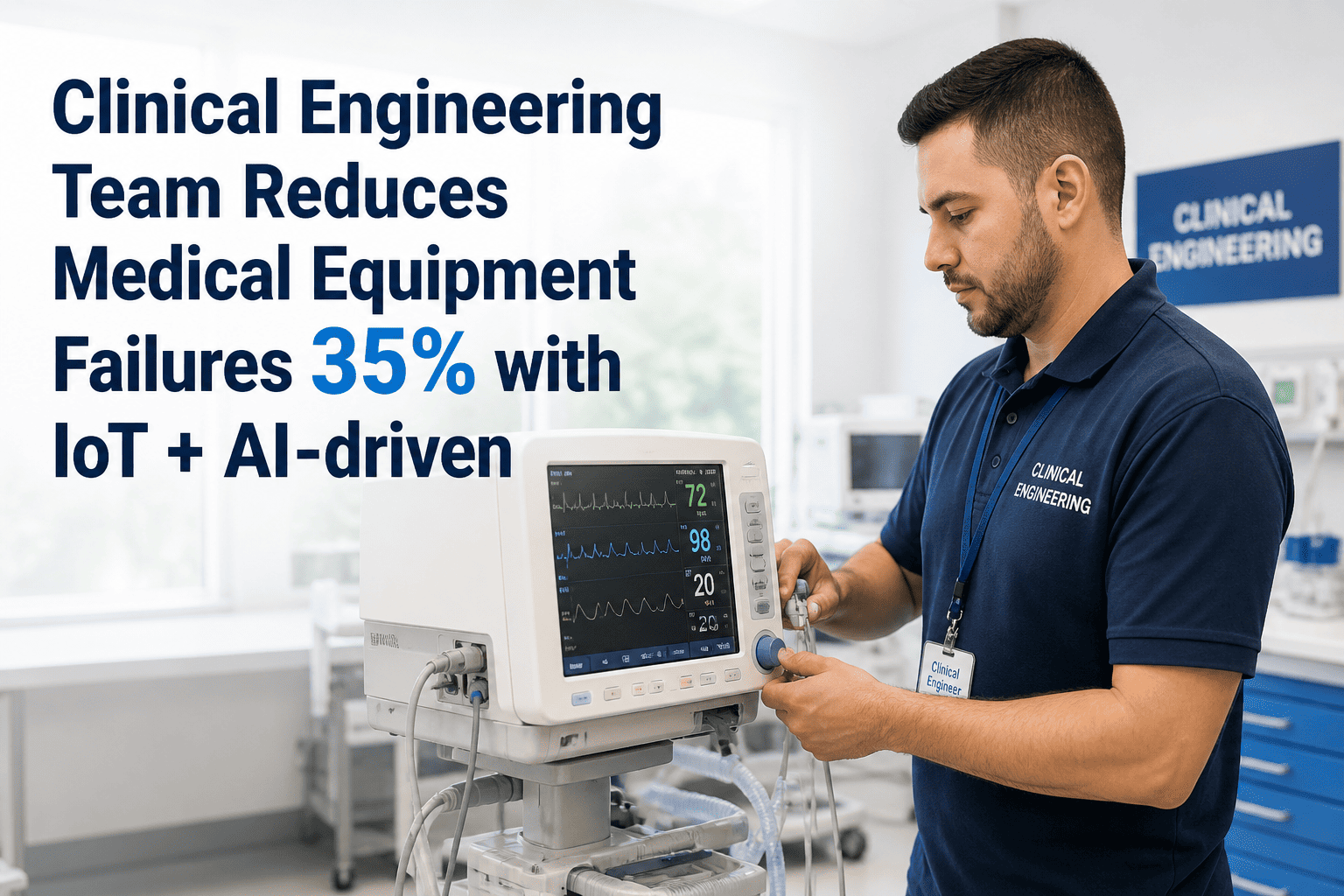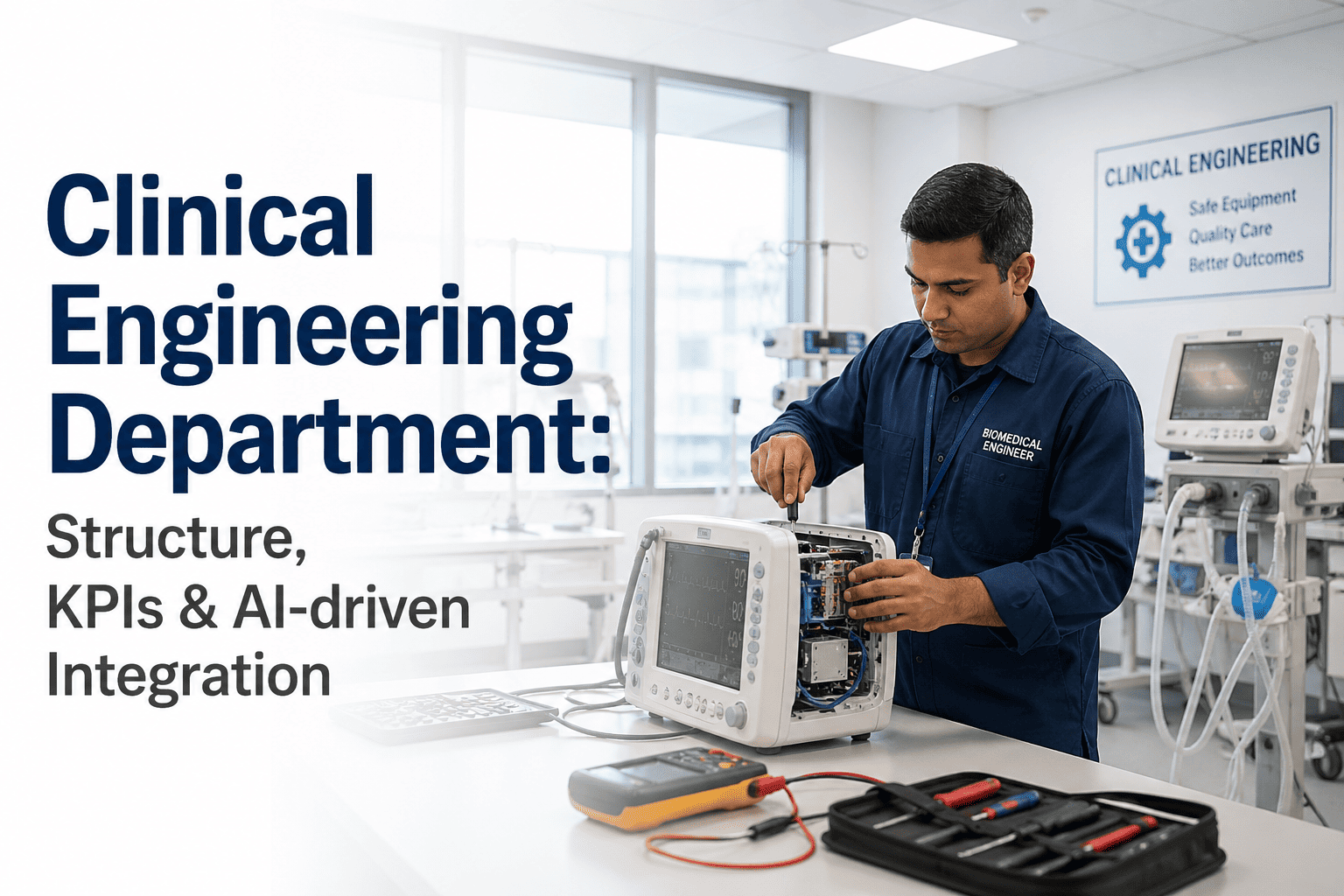
Every hour a ventilator sits unscheduled, every preventive maintenance task that slips past its due date, every reactive repair that pulls a biomed technician off a planned workflow — these are not isolated inefficiencies. They are compounding revenue leaks and patient safety exposures that cost hospital systems an estimated $93,000 per unplanned equipment downtime event. If your Clinical Engineering department is still operating on spreadsheets, siloed CMMS entries, and reactive triage, the question is no longer if a critical failure will occur — it is how expensive it will be when it does.
Is Your Biomed Department Losing Revenue You Can't See?
iFactory's AI-driven platform unifies team management, equipment lifecycle, and KPI dashboards into a single clinical engineering command center.
Clinical Engineering Department: The Structural Blueprint
A high-performing CE department is not defined by headcount — it is defined by role clarity, escalation logic, and accountability layers. Without a formal structure, experienced biomed technicians absorb administrative chaos, senior engineers spend time on tier-1 tickets, and department directors lose visibility into real-time asset health. Below is the operational hierarchy that leading hospital systems use to align talent with outcomes.
Director of Clinical Engineering
- P&L ownership of the biomed department
- Vendor contract negotiation & OEM management
- Capital planning & technology roadmapping
- Regulatory compliance oversight (TJC, CMS)
Clinical Engineer (CE)
- Equipment risk stratification & PM scheduling
- Incident investigation & root cause analysis
- New technology integration protocols
- Technical training program management
Biomedical Technician (BMET)
- Preventive maintenance execution & logging
- Corrective repair triage & documentation
- Safety inspection & IEC 62353 testing
- Clinical staff equipment support
CMMS & Data Analyst
- Work order lifecycle management
- KPI dashboard maintenance & reporting
- Asset inventory reconciliation
- Compliance documentation audits
The 7 Clinical Engineering KPIs That Define Department Health
KPIs without benchmarks are vanity metrics. The following table maps each core CE KPI to its industry benchmark, the financial risk of underperformance, and how iFactory's AI-driven platform closes the gap automatically — without requiring manual data aggregation by your team leads.
| KPI Metric | Industry Benchmark | Risk of Underperformance | iFactory Automation | Priority |
|---|---|---|---|---|
| PM Compliance Rate | ≥ 95% | TJC citation, equipment failure | AI-scheduled PM queues | Critical |
| Mean Time to Repair (MTTR) | < 4 hours | Clinical workflow disruption | Predictive failure alerts | Critical |
| Equipment Uptime Rate | ≥ 98% | Revenue loss per downtime hour | Real-time asset health scoring | Critical |
| Work Order Backlog Ratio | < 10% | Staff burnout, deferred risk | Dynamic workload balancing | High |
| Repair vs. Replace Index | Context-driven | Capital budget misallocation | Lifecycle cost modeling AI | High |
| Technician Utilization Rate | 75–85% | Overstaffing or hidden burnout | Capacity analytics dashboard | Medium |
| Regulatory Audit Readiness | 100% at all times | CMS deficiency, accreditation loss | Automated compliance logging | Critical |
The Operational Gap: Legacy Friction vs. iFactory Optimized Excellence
The following comparison is not theoretical. It reflects what iFactory client CE departments experienced before and after platform deployment. The operational delta represents real financial recovery, measurable risk reduction, and documented improvements in technician productivity and satisfaction scores.
- PM schedules managed in Excel — missed deadlines invisible until audit
- Work orders logged manually — average 22-minute documentation overhead per ticket
- No real-time equipment location tracking — technician search time averages 34 min/day
- Reactive repair model — 67% of repairs are unplanned, driving overtime costs
- Vendor contract renewals missed — auto-renewals at inflated rates average $180K/year
- Compliance reports assembled manually — 40+ hours per TJC survey cycle
- KPI visibility limited to monthly director reports — operational blindness between reviews
- Technician assignments based on availability, not competency matrix
- AI-generated PM queues with escalation alerts — 97%+ compliance rate achieved
- Mobile-first work order capture — documentation reduced to under 4 minutes per ticket
- Live asset location layer — RTLS-integrated dashboard eliminates search overhead
- Predictive maintenance engine — shifts ratio to 80%+ planned work within 90 days
- Contract lifecycle manager with expiry alerts — average savings of $140K per contract cycle
- Automated audit trail generation — survey-ready report export in under 15 minutes
- Real-time KPI dashboards for directors, engineers, and technicians simultaneously
- Skills-based dispatch engine — assigns tickets to certified, available technicians automatically
Clinical Impact Grid: Staff, Safety & Throughput
iFactory's CE platform is engineered to solve the three pain points that clinical engineering leaders consistently identify as their highest-stakes operational challenges. Each domain below maps the problem, the mechanism of impact, and the measurable outcome delivered by the platform.
Technician Burnout Reduction
- Eliminates duplicate data entry via mobile-first CMMS integration
- Reduces non-clinical administrative burden by up to 60%
- Provides clear daily work queues — removes ambiguity and decision fatigue
- Skills-based routing ensures technicians work within certified competencies
- Measurable outcome: 28% improvement in biomed staff retention (12-month cohort)
Patient Safety Assurance
- Zero-gap PM compliance eliminates equipment-related adverse event exposure
- Automated FDA recall alerts cross-referenced against live asset inventory
- Electrical safety testing logs maintained with immutable audit trail
- Incident reports linked directly to equipment history for root cause analysis
- Measurable outcome: 41% reduction in equipment-related safety incidents reported
Patient Throughput Optimization
- Uptime-maximized equipment fleet reduces clinical workflow bottlenecks
- Rapid loaner asset deployment protocols minimize care delays
- OR equipment readiness dashboards shared with perioperative teams in real time
- Predictive scheduling aligns equipment availability with surgical block times
- Measurable outcome: 19% reduction in equipment-related case delays in first 6 months
AI-Driven Clinical Engineering: Five Core Capabilities
Predictive Failure Modeling
Analyzes maintenance history, utilization patterns, and manufacturer MTBF data to predict failure probability per asset — enabling proactive intervention before clinical disruption occurs.
Intelligent Work Order Triage
Automatically classifies incoming work orders by urgency, asset criticality, and clinical risk score — routing high-priority tickets to available, competency-matched technicians within seconds.
Lifecycle Cost AI
Calculates the real cost-per-use and repair-to-replace threshold for every capital asset — giving CE directors defensible, data-driven recommendations for budget committee presentations.
Compliance Automation Engine
Continuously monitors PM completion rates, documentation completeness, and regulatory deadlines — generating real-time alerts and survey-ready compliance packages without manual assembly.
Vendor Performance Scoring
Aggregates OEM response times, parts availability, and service contract ROI into a live vendor scorecard — giving procurement teams objective leverage in contract renegotiations.
Transform Your Clinical Engineering Department Into a Revenue-Protecting Asset
iFactory's platform gives CE directors real-time KPI visibility, AI-driven PM scheduling, and automated compliance documentation — all in a single, audit-ready dashboard.
Clinical Engineering Platform — Frequently Asked Questions
Does iFactory integrate with our existing CMMS or EHR systems?
Yes. iFactory provides HL7 FHIR and REST API connectors for major CMMS platforms including TMS, Nuvolo, and ServiceMax, as well as Epic and Oracle Health EHR environments. Data migration is managed by our implementation team with zero downtime deployment protocols.
How does the platform support multi-site health system CE departments?
iFactory's enterprise tier supports multi-facility hierarchies with site-level KPI isolation and system-wide rollup dashboards. Directors can benchmark individual hospital CE performance, identify resource sharing opportunities, and standardize PM protocols across the entire IDN from a single platform instance.
What is the typical implementation timeline for a mid-size hospital?
For a facility with 3,000–8,000 managed assets, our structured onboarding program achieves full operational deployment in 6–8 weeks. This includes asset inventory import, PM schedule migration, technician training, and KPI baseline establishment. Book a Demo to review our implementation roadmap specific to your asset volume.
How does the AI handle FDA recall alerts for managed medical devices?
iFactory's compliance engine ingests FDA MedWatch recall feeds in real time and cross-references every alert against your live asset inventory using UDI and model number matching. Affected assets are flagged immediately in the dashboard, a work order is auto-generated, and the CE director receives a priority notification with documented response protocols.
Is the platform compliant with TJC EC.02.04.01 and CMS Conditions of Participation?
iFactory is purpose-built to support compliance with TJC Environment of Care standards, CMS Conditions of Participation, and NFPA 99 healthcare facility requirements. Every PM completion, corrective repair, and safety test is logged with immutable timestamps and technician credentials, creating a continuously audit-ready documentation environment. Book a Demo to review our compliance documentation framework.
See iFactory's Clinical Engineering Platform Live
Book a personalized demo or request an Operational Gap Audit to benchmark your CE department against industry-leading performance standards.