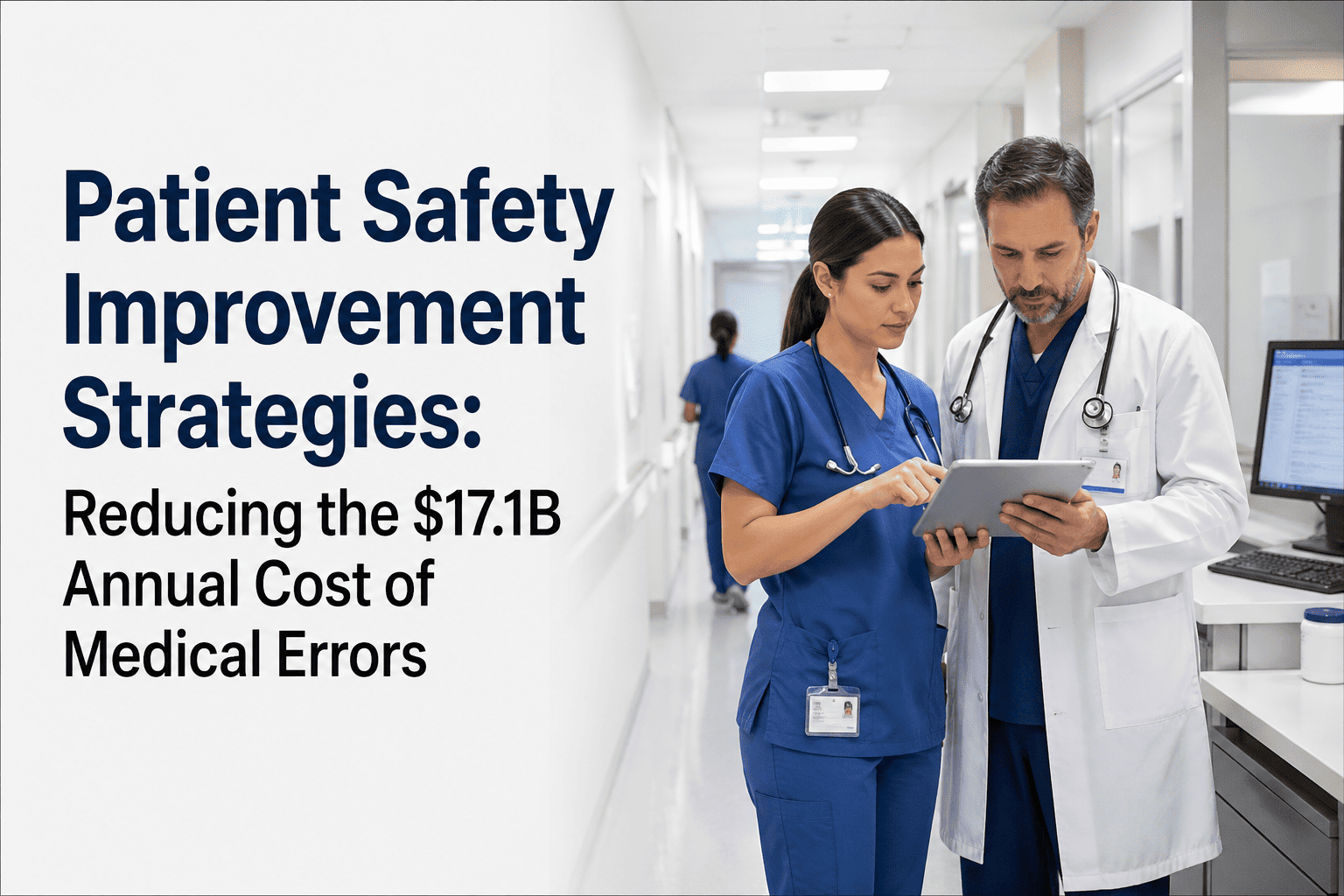
US hospitals bleed $17.1 billion every year from preventable medical errors — not from lack of care, but from fragmented systems, reactive maintenance, and invisible compliance gaps that compound silently until a patient is harmed, a regulator files, or a lawsuit lands. The cost of inaction is not theoretical: it is measured in adverse events, staff burnout, and regulatory penalties that erode both margin and mission.
Is Your Compliance Infrastructure Protecting Patients — or Exposing Them?
iFactory's Compliance Management platform closes the operational gaps that drive the $17.1B annual cost of medical errors across US healthcare systems.
The $17.1B Problem: What Medical Errors Are Really Costing Your Health System
Medical errors rank among the leading causes of preventable death in the United States. Behind every statistic is an operational failure — a missed equipment check, an unlogged compliance gap, or a maintenance backlog that cascaded into a clinical incident. The financial and human toll is staggering:
Where the Gaps Are: Six Operational Drivers of Preventable Patient Harm
Before a strategy can close these gaps, clinical and operational leadership must identify precisely where system failures originate. iFactory's compliance data across healthcare clients consistently surfaces six high-risk domains:
Unplanned device downtime and missed preventive maintenance cycles are directly linked to adverse patient events and regulatory citations under Joint Commission standards.
HVAC failures, improper pressure differentials in sterile areas, and temperature excursions in medication storage create infection and dispensing risk that is often invisible until harm occurs.
Incident data trapped in paper forms or disconnected systems prevents the cross-functional pattern analysis required to eliminate systemic risk before it repeats.
Fixing equipment after failure rather than before it means every unplanned repair carries embedded patient risk, staff disruption, and unbudgeted capital cost.
Manual, periodic compliance checks miss the continuous monitoring required to satisfy CMS Conditions of Participation, TJC standards, and state health department requirements.
When reporting a near-miss or hazard requires navigating complex systems, staff underreport — eliminating the early-warning signal that prevents escalation to serious harm.
Legacy Friction vs. iFactory Optimized Excellence: The Operational Gap
The following matrix documents the measurable performance gap between reactive, legacy compliance operations and an iFactory-powered continuous safety management environment:
| Operational Domain | Legacy Friction State | iFactory Optimized Excellence | Clinical Outcome Impact |
|---|---|---|---|
| Equipment Maintenance | Reactive; post-failure repairs | Predictive AI-scheduled PM cycles | Up to 60% fewer unplanned device failures |
| Environmental Monitoring | Manual spot-checks; delayed alerts | Real-time sensor-driven compliance dashboards | Sterile field integrity maintained 24/7 |
| Incident Reporting | Paper-based; siloed data | Digital, mobile-first; instant escalation routing | Near-miss capture rate increases 3× |
| Regulatory Compliance | Point-in-time audits; citation risk | Continuous monitoring; auto-generated audit trails | Reduced TJC and CMS citation exposure |
| Maintenance Budgeting | Emergency spend unpredictable | Lifecycle cost modeling; CapEx forecasting | 15–30% reduction in emergency repair costs |
| Staff Reporting Experience | High friction; low adoption | One-tap mobile reporting with anonymous option | Safety culture scores improve measurably |
How iFactory Compliance Management Translates to Clinical & Financial Outcomes
The clinical and financial case for structured compliance management is no longer speculative — it is documented. Here is how iFactory's platform converts operational improvements into measurable outcomes across three critical dimensions:
Patient Safety
- Automated equipment PM eliminates device-related adverse events
- Environmental alerts prevent HAIs before exposure occurs
- Closed-loop incident reporting stops repeat harm patterns
- Digital audit trails support root cause analysis and FMEA
Staff & Operations
- Reduced administrative burden on clinical and facilities teams
- Mobile-first workflows eliminate paper-based compliance tasks
- Centralized dashboards replace fragmented spreadsheet tracking
- Automated escalation removes manual follow-up loops
Financial & Regulatory
- 40% average reduction in first-year inspection operational costs
- Defensible compliance records reduce litigation exposure
- Predictive CapEx modeling prevents emergency budget overruns
- Continuous readiness eliminates costly survey preparation cycles
Five-Phase Deployment: From Compliance Gaps to Continuous Safety Excellence
Operational Gap Audit
Benchmark your current compliance posture against TJC, CMS, and OSHA standards to identify highest-risk failure points and immediate remediation priorities.
Asset & Environment Digitization
Map all clinical equipment, environmental control systems, and compliance checkpoints into iFactory's unified asset registry with lifecycle histories and maintenance schedules.
Automated Monitoring Activation
Deploy real-time sensor integrations and automated compliance workflows that continuously validate environmental and equipment standards without manual intervention.
Staff Reporting Enablement
Launch mobile-first incident and near-miss reporting tools with configurable escalation paths, anonymous submission options, and closed-loop resolution tracking.
Predictive Intelligence & Scaling
Leverage aggregated compliance data to generate predictive maintenance priorities, CapEx forecasts, and regulatory readiness scores across every facility in your portfolio.
Stop the $17.1B Bleed. Start With a Free Operational Gap Audit.
iFactory's compliance specialists will benchmark your current safety posture and deliver a prioritized remediation roadmap — at no cost.
Frequently Asked Questions: Compliance Management for Patient Safety
How does iFactory's platform directly reduce medical errors?
By automating preventive maintenance schedules, monitoring environmental controls in real time, and closing the incident reporting loop, iFactory eliminates the three most common operational pathways through which preventable errors reach patients.
Can the platform integrate with our existing CMMS or EHR systems?
Yes. iFactory uses vendor-neutral APIs to integrate with leading CMMS platforms, EHR systems, and building management systems — ensuring your compliance data is unified rather than duplicated across siloed tools.
How does continuous monitoring satisfy TJC and CMS requirements?
The platform generates immutable, timestamped compliance logs for every monitored parameter and maintenance action — creating the defensible audit trail required for TJC accreditation surveys and CMS Conditions of Participation reviews. Book a Demo to review our regulatory compliance framework.
What is the typical time-to-value for a new deployment?
Most health systems achieve measurable compliance improvements within 60 days of deployment. Full predictive maintenance and reporting capabilities are typically operational within a single quarter, with ROI documented at the 12-month mark.
How does iFactory support staff safety reporting adoption?
The mobile-first interface, anonymous reporting option, and visible closed-loop resolution workflow are designed specifically to overcome the cultural and friction barriers that suppress near-miss reporting in traditional systems.
Transform Compliance from a Cost Center into a Patient Safety Engine
Join leading health systems using iFactory to eliminate preventable harm, satisfy regulators, and protect both patients and financial performance.