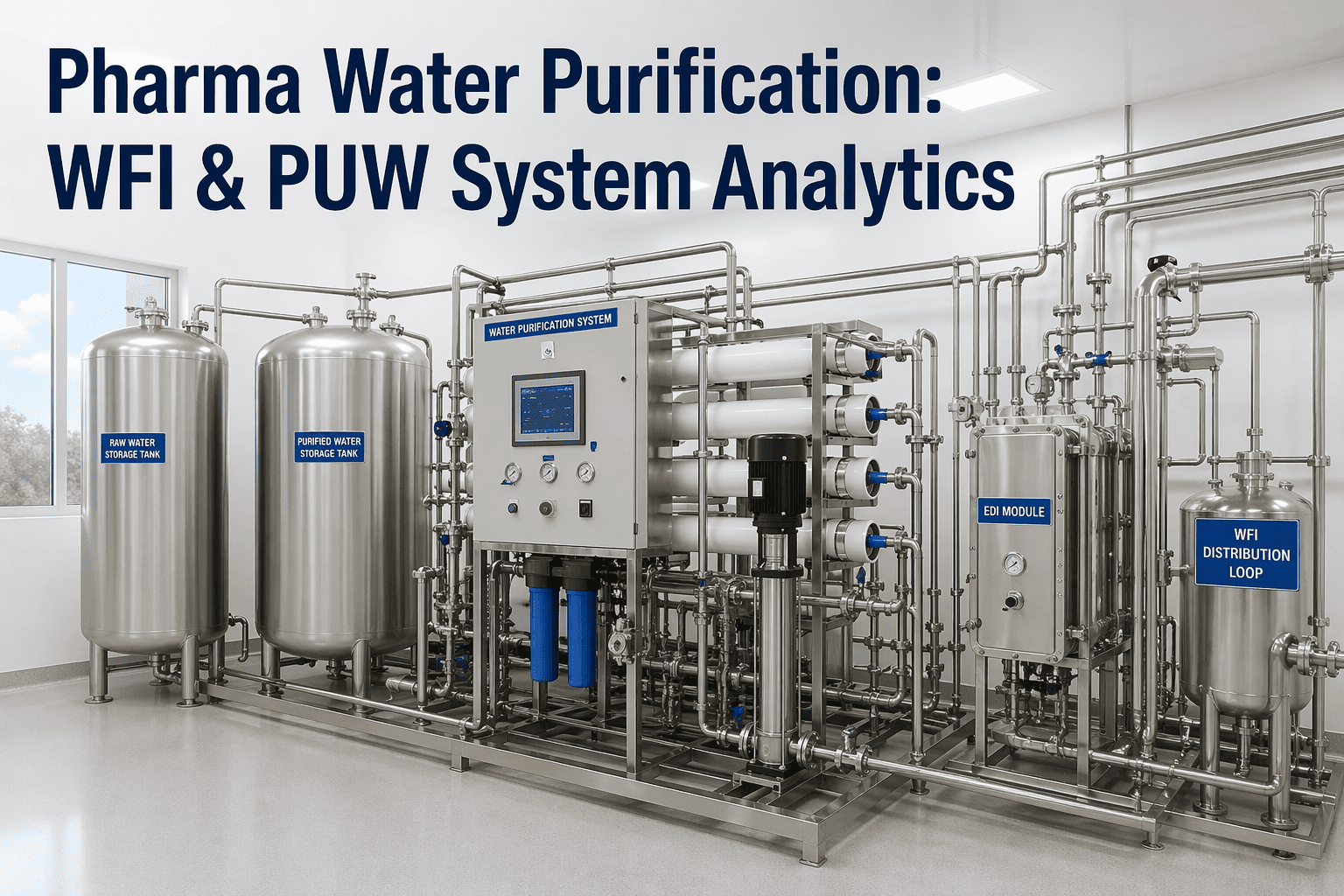
Every hour your WFI generation system runs without predictive intelligence, your facility silently absorbs six-figure regulatory exposure, irreversible batch contamination risk, and the invisible hemorrhage of unplanned downtime. USP <1231> compliance is not a checkbox — it is a life-safety imperative — and legacy scheduled-maintenance models are statistically guaranteed to fail it. iFactory's Pharma Water System Analytics platform is the only enterprise-grade solution purpose-built to eliminate this operational liability at scale.
Is Your WFI & Purified Water System One Anomaly Away from a 483?
iFactory transforms WFI loops, RO membranes, EDI modules, and distribution networks into a unified predictive intelligence layer — eliminating contamination events before they reach QA.
The Financial & Clinical Case for WFI Predictive Analytics
A single undetected biofilm event in a pharmaceutical water loop can trigger a voluntary recall averaging $10M–$50M in direct costs — before litigation, regulatory remediation, or brand erosion. WFI system failures are not random: they are predictable, detectable, and entirely preventable with continuous sensor intelligence. iFactory's platform monitors conductivity drift, TOC exceedances, temperature gradients, and flow anomalies in real time — converting raw sensor telemetry into clinical risk scores and maintenance work orders that your QA team can act on before a batch is compromised. The ROI is not theoretical. It is measurable within the first quarter of deployment.
WFI Generation Analytics
Continuous monitoring of still performance, distillation column efficiency, and endotoxin risk indicators. Automated alerts at configurable USP thresholds before quality events occur.
RO & EDI Module Intelligence
Predictive fouling detection across membranes and electrodeionization modules. Track normalized flux, salt rejection, and conductivity trends to schedule interventions at optimal economic windows.
Distribution Loop Analytics
Map stagnation zones, thermal excursions, and dead-leg risk across the entire purified water distribution network. Maintain circulation velocity compliance 24/7 without manual patrol rounds.
USP Compliance Automation
Auto-generated deviation records, trend reports, and audit-ready documentation mapped to USP <1231>, <645>, and <643> requirements. Every data point is an immutable, timestamped regulatory artifact.
Legacy Friction vs. iFactory Optimized Excellence
Healthcare VPs managing pharmaceutical water infrastructure face a compounding liability: systems designed for manual inspection in an era of 21 CFR Part 11 digital accountability. The following matrix quantifies the operational gap between conventional maintenance protocols and the iFactory predictive intelligence standard. Book a Demo to benchmark your current water system posture against this framework.
| Operational Domain | Legacy Friction State | iFactory Optimized Excellence | Financial Delta | Risk Impact |
|---|---|---|---|---|
| WFI Quality Monitoring | Periodic grab samples, 24-hr lab lag | Real-time TOC & conductivity streaming | $180K–$2M per event avoided | Critical |
| RO Membrane Management | Fixed 6-month replacement schedules | Condition-based replacement at optimal flux | 30–45% membrane cost reduction | High |
| Distribution Loop Integrity | Manual velocity checks, weekly rounds | Continuous flow mapping with stagnation alerts | Eliminates manual patrol labor cost | High |
| Regulatory Documentation | Manual logbooks, retroactive reconstruction | Automated 21 CFR Part 11 compliant records | 60–80% audit preparation time saved | Medium |
| EDI Module Performance | Reactive replacement on quality failure | Predictive conductivity degradation modeling | Unplanned downtime eliminated | Medium |
| Sanitization Cycle Validation | Scheduled hot water or ozone cycles | AI-triggered cycles based on biofilm risk score | 25% utility cost reduction | Lower |
How iFactory Resolves Staff Burnout & Increases Manufacturing Throughput
Pharmaceutical water system failures do not occur in isolation. They cascade — from QA holds to production shutdowns to staff crisis response cycles that accelerate turnover in your most senior technical talent. iFactory addresses the human capital dimension of water system risk with an automation architecture that removes reactive burden from your team entirely. Book a Demo and speak directly with our pharmaceutical water system architects.
Automated exception alerts replace continuous manual monitoring. Your QA and engineering staff receive prioritized notifications — not raw data floods — freeing cognitive capacity for high-value compliance work.
AI-driven biofilm risk scoring and endotoxin trend modeling creates a multi-layer safety net that catches quality deviations 48–72 hours before they manifest as confirmable failures in finished product testing.
Continuous water quality certification data eliminates the QC hold queue created by periodic sampling gaps. Real-time compliance status accelerates batch release by an average of 2.4 days per production cycle.
From Legacy Water System to Predictive Intelligence Platform in 5 Phases
iFactory's deployment methodology is engineered around zero production disruption. Our pharmaceutical water system architects have validated this framework across multi-site enterprise deployments and single-facility pilot programs alike. Every phase delivers measurable value before the next begins. Book a Demo to receive a site-specific deployment timeline estimate from our implementation team.
Water System Digital Audit
iFactory engineers map your complete water system topology — WFI stills, RO trains, EDI modules, distribution loops, and point-of-use drops — into a validated digital twin that becomes the persistent operational record.
Sensor Integration & Baseline Calibration
Deploy or integrate existing conductivity, TOC, temperature, flow, and pressure instrumentation into the iFactory edge intelligence layer. Establish baseline performance envelopes for every monitored component.
Predictive Model Activation
AI models trained on pharmaceutical water system failure signatures are activated against your live data stream. Alert thresholds are configured to your site-specific USP limits and internal quality standards.
Compliance Workflow Automation
21 CFR Part 11 compliant deviation records, trend analysis reports, and sanitization validation certificates are auto-generated and routed to your QA workflow — eliminating manual documentation backlogs.
Enterprise Scaling & Multi-Site Governance
Expand the unified intelligence layer across multiple manufacturing sites, enabling enterprise-wide water system benchmarking, cross-site anomaly correlation, and centralized regulatory reporting for your entire portfolio.
Eliminate Your Water System Compliance Liability — Starting This Quarter
Join pharmaceutical manufacturing leaders who have replaced reactive water system management with iFactory's predictive intelligence platform — and permanently closed the gap between regulatory expectation and operational reality.
Pharmaceutical Water System Analytics — Executive Questions Answered
Does iFactory integrate with existing SCADA and DCS systems already monitoring our water plant?
Yes. iFactory uses vendor-neutral OPC-UA, Modbus, and REST API connectors to integrate with all major SCADA, DCS, and LIMS platforms including Siemens PCS 7, Rockwell PlantPAx, and LabVantage. Your existing instrumentation investment is fully preserved. Book a Demo to review our integration architecture.
How does the platform maintain 21 CFR Part 11 compliance for all generated records?
Every data point, alert, and generated document is written to an immutable, time-stamped audit log with electronic signature workflows and role-based access controls. The platform has been validated under GAMP 5 Category 4 guidelines and is inspection-ready from day one of deployment.
What is the expected ROI timeline for a mid-size pharmaceutical manufacturing site?
Most sites achieve payback within 8–14 months. The primary value drivers are avoided batch failures (typically $500K–$5M per event), reduced membrane and consumable costs (30–45%), and labor reallocation from routine surveillance to value-added compliance work. Book a Demo to run your site-specific ROI model with our team.
Can iFactory support both USP and EP (European Pharmacopoeia) water quality standards simultaneously?
Absolutely. Alert thresholds, trend limits, and report templates are fully configurable to USP <1231>, EP 0169, JP, and custom internal specifications. Multi-standard monitoring is supported natively for facilities supplying both US and European regulated markets.
How does iFactory handle the cybersecurity requirements for operational technology networks in pharma?
iFactory deploys on isolated OT network segments with AES-256 encryption at rest and in transit, role-based zero-trust access controls, and full data residency in GovCloud or private cloud environments meeting NIST SP 800-82 industrial cybersecurity guidance.
Schedule Your Pharmaceutical Water System Operational Gap Audit
Speak with iFactory's pharmaceutical water system architects and receive a confidential assessment of your current WFI, PUW, and distribution loop compliance posture.
.png)