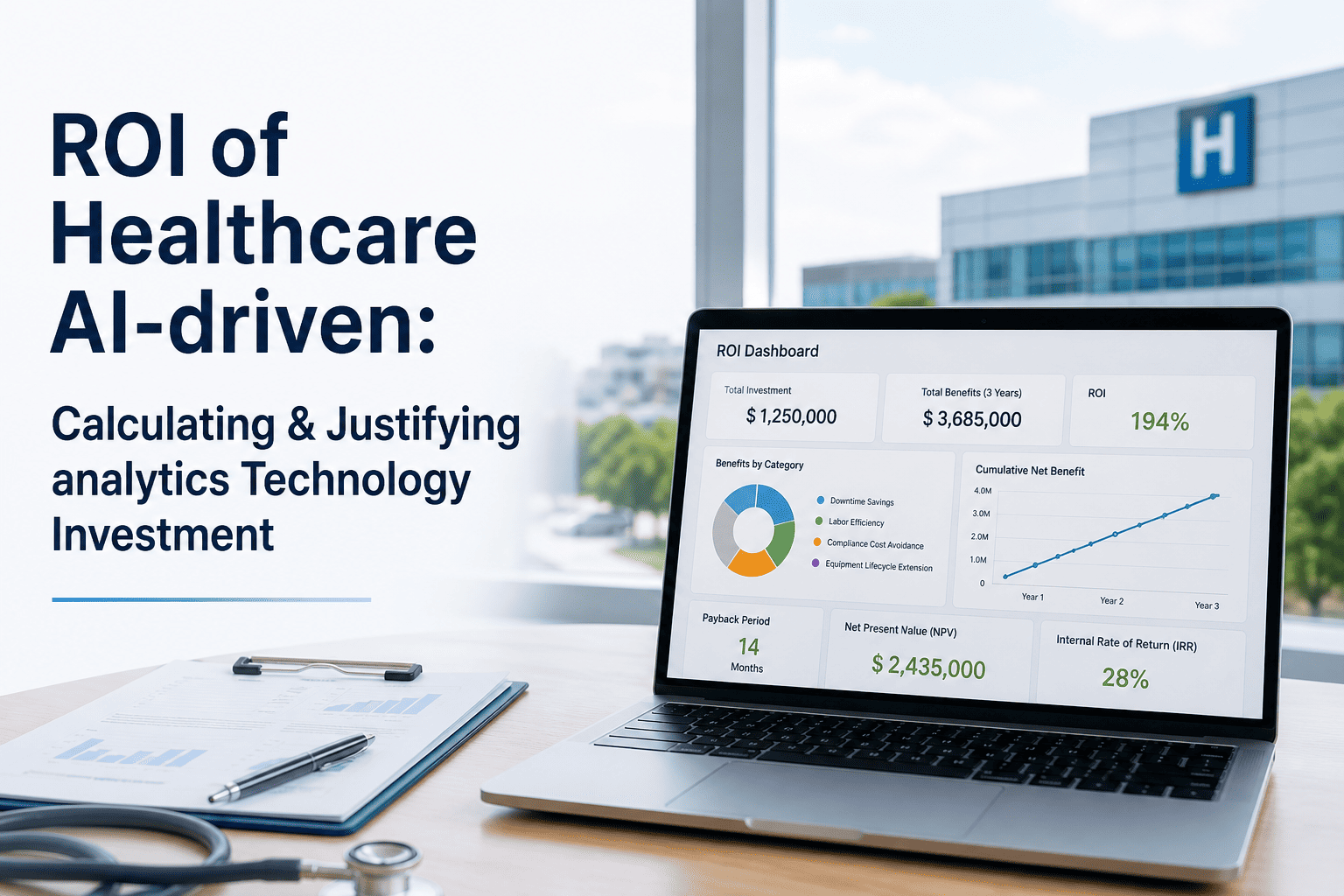
Every hour your hospital operates without unified AI-driven analytics, revenue quietly hemorrhages through missed charge captures, inefficient staffing ratios, and compliance penalties that compound silently — the cost of inaction is not a future risk, it is today's financial reality.
Is Your Analytics Investment Delivering Measurable ROI?
Quantify every dollar your AI-driven analytics platform saves — from labor efficiency to compliance cost avoidance — in CFO-ready, board-level terms.
The Financial Case for Healthcare AI-Driven Analytics
Healthcare CFOs face a decisive inflection point: analytics platforms are no longer operational tools — they are direct drivers of margin recovery, regulatory compliance, and workforce sustainability. iFactory's Analytics Dashboard translates raw clinical data into outcomes that belong in a board deck.
Downtime Savings
- Predictive alerts prevent costly equipment failures
- Average 34% reduction in unplanned downtime
- OR and ICU continuity protected by real-time dashboards
Labor Efficiency
- AI-matched staffing reduces overtime spend
- Automated reporting frees 6–10 hours per manager weekly
- Charge capture accuracy improved by up to 28%
Compliance Avoidance
- Real-time audit trails eliminate CMS penalty exposure
- Automated HIPAA and Joint Commission flagging
- Regulatory fines reduced by documented analytics workflows
Lifecycle Extension
- AI forecasts equipment replacement cycles accurately
- CapEx planning shifted from reactive to predictive
- Asset lifespan extended by 18–36 months on average
Legacy Friction vs. iFactory Optimized Excellence
The performance gap between fragmented legacy reporting and a unified AI-driven analytics platform is not incremental — it is structural. The table below quantifies the operational and financial delta your leadership team needs to justify investment.
| Metric | Legacy Friction | iFactory Optimized | Financial Impact | Priority |
|---|---|---|---|---|
| Charge Capture Accuracy | Manual, error-prone | AI-automated, 98%+ accuracy | +$1.2M–$4M annually | Critical |
| Staffing Ratio Alignment | Static schedules, overtime spikes | Demand-matched, AI-driven shifts | 20–30% OT cost reduction | Critical |
| Compliance Reporting | Manual audits, delayed responses | Real-time flags, automated trails | Avoids $500K–$2M penalties | Critical |
| Equipment Downtime | Reactive maintenance, revenue loss | Predictive alerts, zero-downtime cycles | 34% downtime cost reduction | High |
| CapEx Planning | Annual guesswork budgets | AI lifecycle forecasting | 18–36 month asset extension | High |
| Manager Reporting Time | 6–10 hrs/week manual effort | Automated dashboards, instant exports | Reclaimed clinical leadership | Medium |
How AI Analytics Solves the Three Critical Hospital Pressure Points
Beyond financial return, iFactory's Analytics Dashboard directly addresses the operational and human factors that determine hospital performance ratings, staff retention, and patient throughput at scale.
- AI removes manual reporting burden from nursing staff
- Predictive scheduling prevents chronic overtime exposure
- Real-time workload dashboards trigger proactive support
- Measurable reduction in FMLA and turnover costs
- Bed management analytics reduce LWBS rates by up to 22%
- ED flow models identify bottlenecks in real time
- Discharge planning AI shortens average LOS by 0.4–0.9 days
- OR utilization dashboards improve first-case on-time starts
- AI-driven DRG validation catches undercoding at point of care
- Denial prevention analytics reduce write-offs by up to 31%
- Payer mix dashboards guide contract renegotiation strategy
- Every workflow linked to a traceable financial outcome
Building the CFO-Ready Business Case in Five Steps
A defensible analytics ROI model is not built on vendor promises — it is built on your hospital's own baseline data. Use this framework to present a payback period that your CFO and board can validate independently.
Baseline Cost Audit
- Quantify current charge capture error rate and revenue leakage
- Document annual overtime spend and agency staffing costs
- Log compliance penalties and audit response costs from prior 24 months
Identify High-Impact Modules
- Prioritize Analytics Dashboard modules by department revenue risk
- Map iFactory features directly to your top three cost drivers
- Focus Phase 1 deployment on OR, ED, and Revenue Cycle
Model the Payback Period
- Apply conservative improvement benchmarks (20–30% gains) to baseline costs
- Calculate 12-month, 24-month, and 36-month cumulative savings
- Include avoided CapEx from equipment lifecycle extension in Year 2–3
Risk-Adjust the Model
- Apply a 15–20% haircut to savings projections for board conservatism
- Include implementation timeline and change management costs
- Document compliance risk avoidance as a separate, non-dilutable benefit
Present & Govern
- Deliver a single-page ROI summary with payback period clearly stated
- Establish quarterly KPI reviews tied to iFactory dashboard outputs
- Use live analytics data to validate and update the board model in real time
Get a Custom ROI Model Built for Your Hospital
iFactory's clinical architects will map your baseline costs to measurable analytics outcomes and deliver a CFO-ready payback model within one session.
Healthcare AI Analytics Investment — Executive FAQ
How quickly can we expect a measurable ROI after deployment?
Most facilities see quantifiable charge capture and staffing efficiency gains within 90 days of go-live. Full payback on the analytics platform investment is typically achieved between 14 and 22 months, driven primarily by revenue integrity improvements and compliance cost avoidance.
Can iFactory's Analytics Dashboard integrate with our existing EHR and billing systems?
Yes. iFactory uses HL7 FHIR-compliant APIs to connect with Epic, Cerner, Meditech, and all major billing platforms. Data flows bidirectionally without requiring a system replacement, protecting your existing technology investment while adding the AI intelligence layer on top.
How does this platform address HIPAA and CMS compliance requirements?
Every action within the Analytics Dashboard generates an immutable, timestamped audit log. Compliance workflows are automated and mapped directly to current CMS and Joint Commission standards. The platform is deployed on HIPAA-compliant, SOC 2 Type II certified infrastructure. Book a Demo to review our compliance architecture.
What is the implementation burden on our clinical IT team?
iFactory deploys a dedicated implementation team that manages data pipeline configuration, dashboard setup, and staff training. Typical go-live for a mid-size hospital is 6–10 weeks. Ongoing platform management requires no dedicated internal FTE, as our support team handles monitoring, updates, and optimization.
How do we validate that the AI recommendations are clinically sound?
iFactory's Explainable AI framework provides full transparency into every recommendation — surfacing the underlying data points, model confidence scores, and historical validation benchmarks. Clinical leadership can review, override, and audit every AI-generated output before it drives a workflow decision. Book a Demo to see our validation layer in action.
Book a Strategic Workflow Audit with iFactory Healthcare
Our clinical architects will benchmark your current operations against AI-optimized benchmarks and deliver a board-ready ROI model — at no cost to your team.