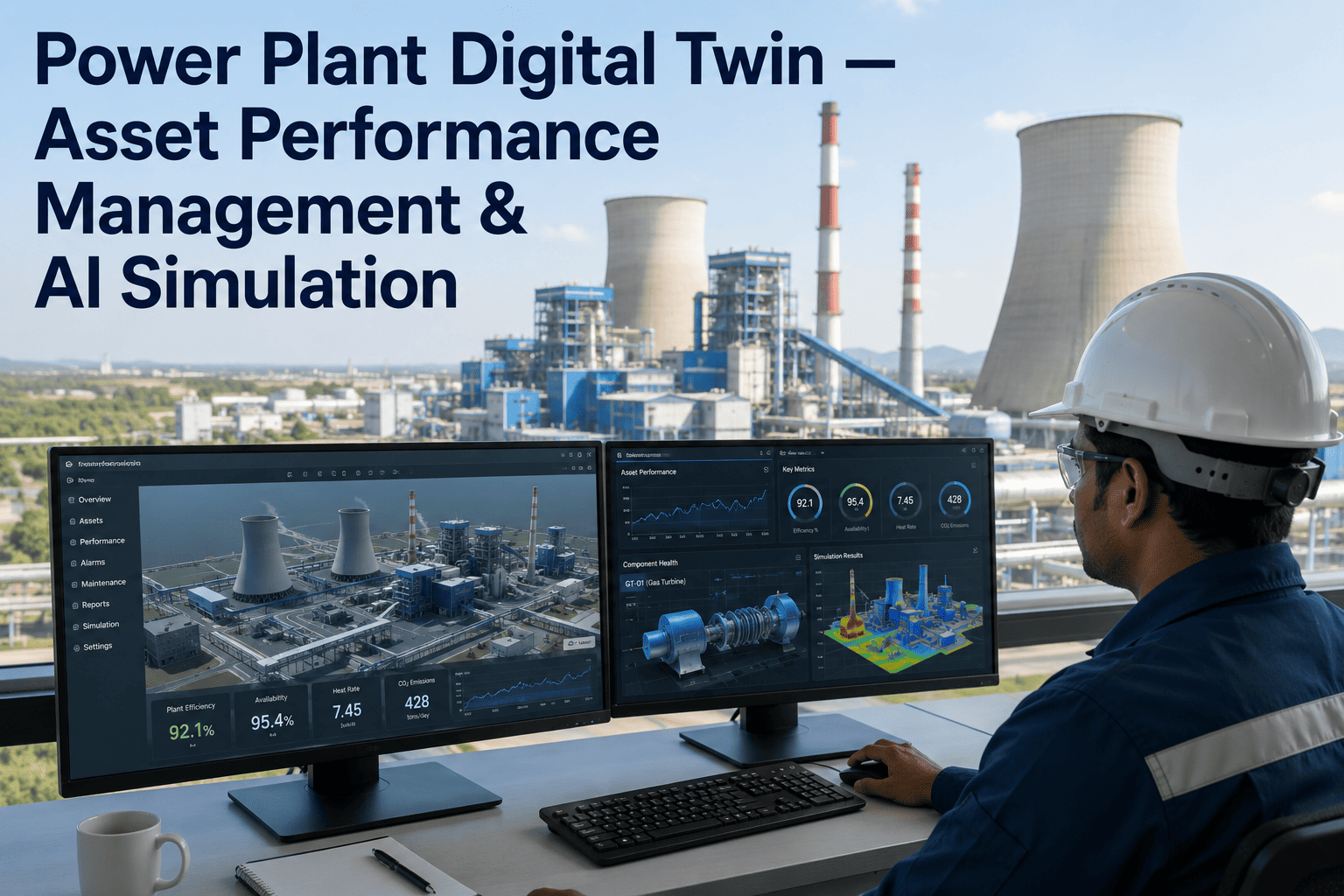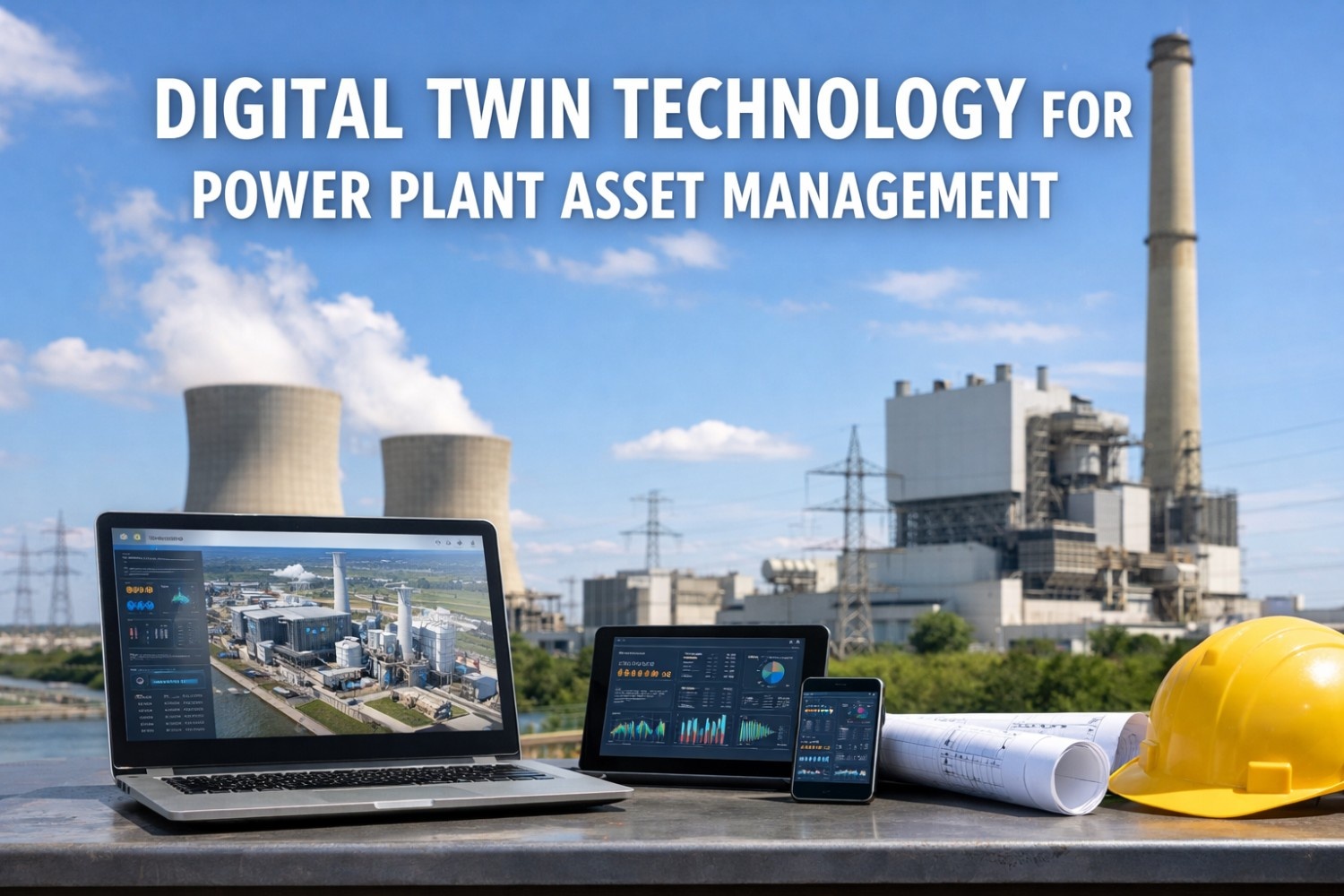
A power plant digital twin is not a 3D visualisation of your turbine. It is a physics-based computational model of your specific machine — calibrated to your actual performance data, running continuously in parallel with the real asset, and capable of answering questions your DCS cannot ask: what will this bearing's failure trajectory look like over the next 90 days at current operating stress? What would happen to heat rate if we advance the IP turbine admission timing by 2 degrees? What is the probability this transformer will reach the next planned maintenance window? iFactory's digital twin platform builds and continuously calibrates physics-based models for every major asset class in your plant — using your operational data, your failure history, and your design specifications — giving your engineering and operations teams a simulation environment that answers those questions in real time. Book a free digital twin assessment.
iFactory's digital twin platform builds continuously calibrated physics-based models of your turbines, generators, boilers, and BOP systems — enabling failure trajectory simulation, what-if scenario testing, shutdown sequence validation, and heat rate optimisation without touching the real asset. First digital twin operational within 6 weeks of deployment, running on NVIDIA GPU compute inside your facility perimeter.
How iFactory's Digital Twin Solves Problems Physics Cannot Answer at Runtime
Real assets give you one data stream — what is actually happening. A digital twin gives you a second stream — what will happen, and what would happen differently under alternative operating conditions. The combination is what transforms monitoring into decision support. Book a demo to see digital twin simulation applied to your asset configuration.
iFactory's digital twin deployment includes a pre-build assessment that maps your asset configuration, defines the simulation scope, and produces the first model calibration — before you commit to full deployment.
Deployment Roadmap — First Digital Twin Operational in 6 Weeks
iFactory connects to your existing DCS, historian, and design specifications. No new control infrastructure. First physics model calibrated and running within 6 weeks. Book a demo for your plant-specific digital twin build plan.
Asset modelling scope defined — turbines, generators, boilers, HRSGs, cooling systems, or BOP as prioritised. Design specifications, OEM performance curves, and thermodynamic data collected per asset. DCS and historian connected read-only for live calibration data. NVIDIA DGX commissioned for GPU simulation compute.
Physics-based models built per asset class — thermodynamic cycle for boilers and turbines, rotor dynamics for rotating machinery, electromagnetic for generators. Initial calibration run against 12–36 months of historian data. Model-vs-actual deviation baseline established per parameter.
What-if scenario testing interface deployed. Failure trajectory simulation activated. Shutdown sequence simulation module configured with your work pack structure. Heat rate optimisation scenario library built for your specific combustion and thermodynamic configuration.
Full digital twin operational. Continuous calibration from live DCS data active. Model-vs-actual divergence monitoring live as an additional fault detection signal. First what-if scenario results delivered to operations and engineering. 90-day support included.
Our Numbers — Digital Twin Performance Across Power Generation Deployments
Results from power generation plants that completed a minimum 12-month period running iFactory digital twin simulation alongside live asset operations.
iFactory's pre-deployment twin assessment identifies which asset classes and operating decisions would benefit most from simulation — and builds a business case for digital twin deployment using your plant's actual operating history.
iFactory vs Competitor Digital Twin Platforms for Power Plants
GE Vernova Digital, ANSYS Twin Builder, Siemens Simit, and AVEVA Process Simulation each offer digital twin or simulation capability. None combines continuous live-data calibration, GPU-accelerated on-premise simulation, shutdown sequence validation, and NERC CIP compliance in a single platform deployable in 6 weeks. Book a demo to see iFactory mapped against your current simulation toolset.
| Capability | iFactory | GE Vernova Digital | ANSYS Twin Builder | Siemens Simit | AVEVA Sim |
|---|---|---|---|---|---|
| Live Calibration & Real-Time Operation | |||||
| Continuous live-data calibration | Every sensor cycle | GE assets — periodic | Engineering tool | Training simulation | Periodic update |
| Model-vs-actual divergence as fault signal | Additional detection layer | GE equipment only | Not available | Not available | Limited |
| Failure trajectory forecasting | 7 / 30 / 90 day | GE turbines only | Engineering study | Not available | Process only |
| Simulation Scope | |||||
| What-if scenario testing — operations | Full scenario engine | GE assets only | Engineering design | Training scenarios | Process scenarios |
| Shutdown sequence simulation | Full work pack validation | Not available | Not available | Operator training | Not available |
| Heat rate optimisation simulation | 5–8% improvement | GE equipment only | Engineering focus | Not available | Process focus |
| Infrastructure & Compliance | |||||
| On-premise GPU / NERC CIP compliant | NVIDIA DGX — full | Cloud primary | Workstation / cloud | On-prem available | Cloud primary |
| Multi-manufacturer asset support | All manufacturers | GE assets primary | Engineering agnostic | Siemens primary | AVEVA ecosystem |
| Deployment timeline to first live twin | 6 weeks | 12–18 months | 6–12 months | 6–12 months | 6–18 months |
Based on publicly available product documentation as of Q1 2025. Verify current capabilities with each vendor before procurement decisions.
Regional Compliance — Digital Twin Data Never Leaves Your Facility
iFactory runs all digital twin computation on NVIDIA DGX servers inside your facility — your operational data, your simulation parameters, and your engineering decisions never leave your perimeter. Every major power generation regulatory framework is satisfied by this architecture, not by compliance configuration. Book a demo to confirm compliance configuration for your region.
| Region | Key Frameworks | How iFactory Solves It |
|---|---|---|
| USA & Canada | NERC CIP-005–013, NIST 800-82, IEC 62443, FERC, ISO 55001 | All digital twin computation and simulation data inside Electronic Security Perimeter on NVIDIA DGX. CIP-005 through CIP-013 by architecture — no cloud data transmission from simulation or calibration. ISO 55001 scenario testing decisions logged as Clause 6.2 evidence automatically. |
| UK & EU | EU NIS2, IEC 62443, GDPR, ISO 55001, UK Grid Code, EU ETS | GDPR satisfied — all operational and simulation data on-premise. IEC 62443 OT security zones enforced at NVIDIA edge level. ISO 55001 simulation-based maintenance decisions recorded as Clause 6.2 evidence. NIS2 OT incident reporting automated. |
| Australia | AEMO NEM, SOCI Act 2018, ISO 55001, Safe Work Australia, AS 61511 | SOCI critical infrastructure obligations met by on-premise simulation compute. ISO 55001 scenario testing evidence continuous. Shutdown simulation records support Safe Work Australia planned maintenance documentation. All data onshore. |
| Germany | BSI IT-Grundschutz, KRITIS, IEC 62443, VDI 3693 (digital twin), ISO 55001, BDSG | KRITIS obligations met without cloud transfer of simulation data. VDI 3693 digital twin framework compliance supported on-premise. ISO 55001 maintenance decision evidence assembled continuously. BDSG data protection fully satisfied. |
| Saudi Arabia | NCA ECC-1, IEC 62443, CITC, Saudi Aramco SAES, Saudi Vision 2030 | NCA ECC-1 OT security and CITC data localisation met by on-premise NVIDIA DGX architecture. Simulation results and operational data never leave the facility. SAES-compatible asset records. Arabic platform outputs supported. |
Your operational parameters, equipment performance data, and shutdown sequences are commercially and operationally sensitive. iFactory's NVIDIA DGX architecture keeps all simulation compute — and all the data that feeds it — inside your facility perimeter, always.
What Our Clients Say
Frequently Asked Questions
Continue Reading
iFactory digital twin connects to your existing DCS and historian. Physics models built and calibrated in 6 weeks. All simulation compute on NVIDIA DGX inside your facility. NERC CIP compliant from day one. Zero cloud dependency.