Energy companies that deploy AI report an average 170% ROI on their investments, but the variance between use cases is enormous — predictive maintenance delivers 200 to 300% ROI with payback in 9 to 18 months, while digital twin programs require 24 to 36 months to reach positive return despite higher long-term value. The difference between a VP Operations who delivers measurable AI results in Year One and one who is still justifying pilot budgets in Year Three comes down to sequencing: starting with high-ROI, low-complexity use cases that fund the next phase, rather than betting the first budget on transformational programs that take years to prove. iFactory has deployed AI across 1,000+ power generation facilities, and the pattern is consistent — plants that start with quick wins in predictive maintenance and combustion optimization build the data foundation, organizational confidence, and demonstrated returns that make the larger programs fundable and executable. Book a demo to see how the priority matrix maps to your plant's specific equipment and operational data.
AI STRATEGY · ROI MATRIX · IMPLEMENTATION ROADMAP · USE CASE PRIORITIZATION
40+ AI Use Cases Mapped by ROI, Complexity, and Time-to-Value — So You Start With the Ones That Pay for Everything Else
iFactory's priority matrix organizes every power generation AI opportunity by expected return, implementation difficulty, and timeline — giving VP Operations a data-driven sequence for building an AI program that delivers results in quarters, not years.
170%
Average AI ROI in Energy Sector
9-18 mo
Payback on Predictive Maintenance
60%
Higher Cumulative ROI With Sequenced Deployment
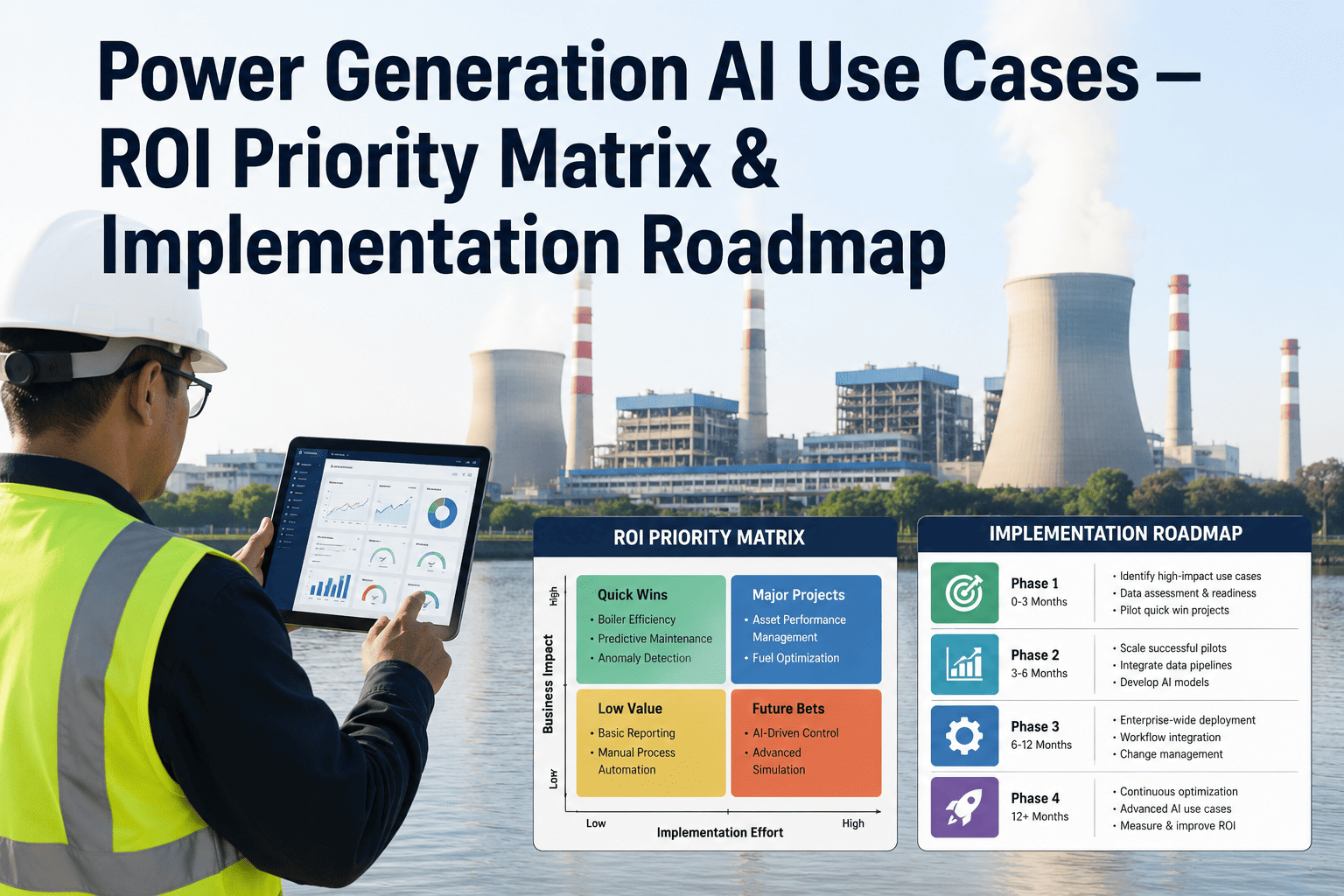
THE PRIORITY MATRIX
Four Tiers of AI Use Cases — Ranked by Time-to-Value and Implementation Complexity
Not every AI use case deserves the same investment timing. The matrix below organizes power generation AI opportunities into four tiers based on how quickly they deliver measurable returns and how much organizational effort they require. Start at Tier 1, reinvest returns into Tier 2, and build toward Tier 3 and 4 with demonstrated momentum and data infrastructure.
Vibration-Based Predictive Maintenance
$8K-15K/MW/yr savings
Combustion Tuning Optimization
1-2.5% heat rate improvement
Condenser Fouling Detection
0.5-1.5% efficiency recovery
Automated Regulatory Reporting
150-200% ROI, 4-8 mo payback
Cooling Tower Performance Monitoring
Prevents 2-4% capacity derating
AI Vision PPE Compliance
Reduces safety incidents 30-50%
Turbine Performance Degradation Tracking
Catches 3-8% efficiency loss early
Boiler Tube Failure Prediction
Prevents 52% of forced outages
Emissions Soft Sensor and Prediction
Avoids violations before CEMS reading
Auxiliary Power Consumption Optimization
Reduces station service load 5-12%
Coal Blend and Fuel Quality Optimization
$0.50-2.00/MWh fuel cost reduction
Transformer Dissolved Gas Analysis AI
8-16 week failure lead time
Dispatch Flexibility and Ramp Rate Optimization
Unlocks ancillary services revenue
AI-Driven Condition-Based Overhaul Planning
Extends overhaul intervals 15-25%
Water Chemistry Optimization
Reduces chemical costs and tube failure risk
Drone and Robot Inspection Analytics
Eliminates $200K+ scaffolding per cycle
NERC CIP Compliance Automation
Immutable audit trail, zero manual gaps
Full Plant Digital Twin
Real-time simulation of entire unit
Autonomous Plant Operation Advisory
AI-guided operator decision support
Fleet-Wide Asset Lifecycle Optimization
CapEx/OpEx trade-off across portfolio
AI-Native Grid Services Trading
8-15% margin improvement on trading
THE SEQUENCING PRINCIPLE
Why the Order You Deploy AI Matters More Than Which Use Cases You Pick
Research shows that energy companies starting with two to three high-feasibility use cases and reinvesting returns achieve cumulative ROI 60% higher than those attempting ambitious programs first. The sequencing creates three compounding advantages that organizations skipping to Tier 3 or 4 never build.
1
Data Infrastructure Builds Naturally
Tier 1 deployments connect historian, SCADA, and DCS data streams to the AI platform. By the time Tier 2 projects begin, the data pipelines, quality checks, and integration points are already operational — eliminating the months of data engineering that stalls ambitious projects launched from cold start.
2
Organizational Trust Compounds
Operations teams that see AI catch a real bearing failure or recover a real heat rate point become advocates, not skeptics. This credibility makes later projects easier to staff, fund, and implement because the people who have to change their workflows have already seen the system work on their equipment.
3
Returns Fund the Roadmap
A 500 MW plant recovering $1.2-2.4 million annually from combustion optimization in Tier 1 has already paid for the next three years of AI program investment. Each tier's returns create the budget for the next tier, making the AI program self-funding rather than dependent on annual capital allocation battles.
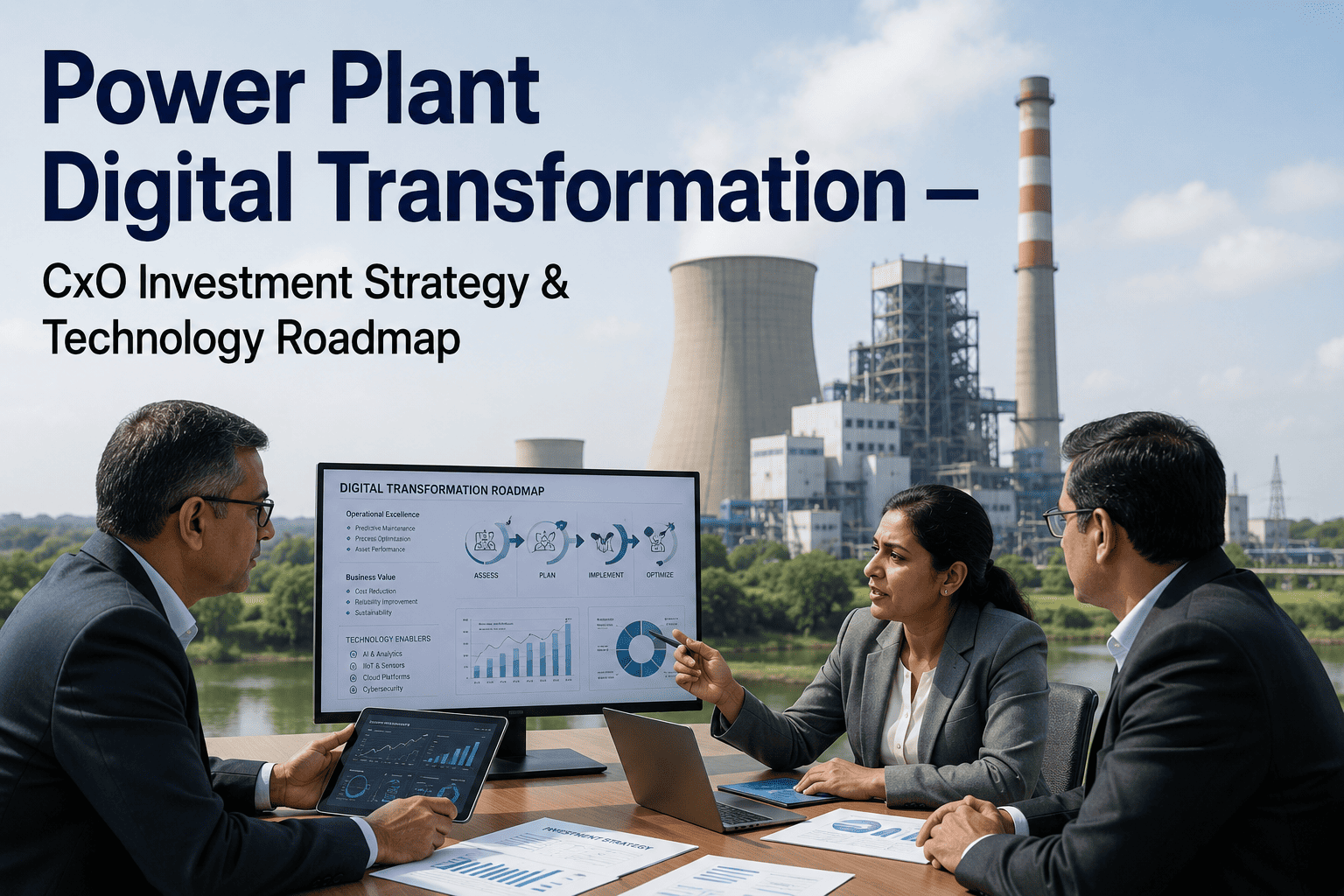
The VP Operations Who Delivers $2 Million in AI Savings in Year One Gets the Budget for the $10 Million Program in Year Three
iFactory's AI roadmap session maps your plant's specific equipment, data infrastructure, and operational priorities to the priority matrix — identifying which Tier 1 quick wins to deploy first and building a sequenced program that compounds returns across every subsequent phase.
IMPLEMENTATION ROADMAP
A Four-Phase AI Program That Moves From First Alert to AI-Native Operations
This roadmap reflects the deployment pattern that has delivered consistent results across iFactory's 1,000+ power generation implementations — each phase building on the infrastructure, trust, and returns of the previous one.
PHASE 1 — FOUNDATION
Months 1-3
Connect DCS/SCADA historian to AI platform. Deploy vibration monitoring on critical rotating equipment. Establish baselines. Deliver first predictive alerts.
Outcome: First prevented failure documented. Data pipeline validated. Operations team engaged.
PHASE 2 — PROVEN VALUE
Months 3-12
Activate combustion optimization, condenser monitoring, and emissions prediction. Expand predictive maintenance to BOP equipment. Generate first measurable ROI from heat rate improvement and avoided outages.
Outcome: Documented financial returns. Board-level AI investment case built on measured results, not projections.
PHASE 3 — SCALING
Months 12-24
Extend AI across full asset base. Deploy dispatch optimization, condition-based overhaul planning, and drone inspection analytics. Formalize AI operating model with dedicated support team. Target 60%+ asset coverage.
Outcome: AI embedded in daily operations. Maintenance driven by condition data rather than calendar schedules.
PHASE 4 — AI-NATIVE OPERATIONS
Months 24-36+
Digital twin deployment, autonomous advisory systems, fleet-wide lifecycle optimization, and AI-driven grid services trading. AI embedded in core operational decision-making across the generation portfolio.
Outcome: Plant operations fundamentally transformed. AI is the operating system, not a tool.
ROI BENCHMARKS
Measured Returns From AI Deployments Across Power Generation Facilities
These figures reflect documented returns from iFactory AI deployments across coal, gas, combined cycle, and renewable generation facilities, organized by use case category.
$3.2M
Annual / 500 MW
AI Combustion Tuning Fuel Savings
AI continuously optimizes fuel-air ratios, burner tilt, excess oxygen, and mill loading across every load point — recovering the 2-4% heat rate gap that exists between design efficiency and actual operating efficiency at most plants.
45%
Reduction
Forced Outages From Predictive Maintenance
AI monitoring of vibration, temperature, and performance parameters across turbines, generators, and balance-of-plant equipment detected developing failures 4-16 weeks before they would have caused forced outages under reactive maintenance.
$200K+
Per Cycle
Scaffolding Costs Eliminated by AI Vision Inspection
Drone and robot-based inspection with AI defect analysis replaced manual boiler tube inspections that required scaffolding erection, confined space entry, and extended outage duration for visual access to tube surfaces.
5-8%
Improvement
Overall Heat Rate From Combined AI Optimization
Plants running the full AI stack — combustion tuning, condenser monitoring, auxiliary optimization, and steam cycle management — achieved cumulative heat rate improvements of 5-8% compared to pre-deployment baselines over 12-month measurement periods.
Your Plant Has Dozens of AI Opportunities — the Question Is Which Ones to Deploy First, Second, and Third to Build a Self-Funding Program
iFactory's AI roadmap session maps your specific plant equipment, data infrastructure, and operational pain points to the priority matrix, identifying your highest-ROI quick wins and building a sequenced deployment plan that compounds returns across every phase.
FREQUENTLY ASKED QUESTIONS
Questions From VP Operations About AI Prioritization and Implementation
How do we determine which Tier 1 quick wins are the best starting point for our specific plant?
The selection depends on three plant-specific factors: your current data infrastructure maturity (which determines how quickly each use case can be connected), your highest-cost operational pain points (which determines where the largest ROI opportunities exist), and your equipment mix (which determines which predictive models are most applicable). A 500 MW coal plant with chronic boiler tube failures will start differently from a combined cycle plant with heat rate concerns or a fleet of gas turbines with cycling fatigue issues. iFactory's pre-deployment assessment evaluates all three factors against your plant's historian data and maintenance records to rank the Tier 1 opportunities by expected ROI specific to your facility.
Book a demo to run the priority assessment on your plant's operational and maintenance data.
What data infrastructure do we need before deploying the first AI use case?
Most plants already have the data infrastructure required for Tier 1 deployment. If your plant has a DCS or SCADA system with a historian that records process data, you have the core data source needed for combustion optimization and performance monitoring. If your critical rotating equipment has vibration monitoring points, you have the sensor base for predictive maintenance. iFactory connects to your existing historian through standard industrial communication protocols — OPC-DA, OPC-UA, PI, or similar — without requiring any changes to your control system. The platform deploys on-premise within your plant boundary, keeping all operational data inside your security perimeter. Plants without a historian or with significant data gaps typically start with a focused instrumentation phase that establishes the minimum sensor coverage needed for the first use cases.
Contact our support team to discuss your current data infrastructure and identify any gaps before deployment.
How do we build the internal business case for AI investment when our leadership team is skeptical about AI hype?
The most effective business case is built on your own plant's data, not on generic AI promises. iFactory's pre-deployment assessment analyzes your plant's historian data, maintenance records, outage history, and heat rate trends to produce a site-specific ROI projection grounded in your actual operational performance gaps. This projection identifies specific dollar values — this many forced outage hours avoided at this cost per hour, this much heat rate recovered at this fuel cost — rather than abstract percentage improvements. The assessment is designed to produce a board-ready investment case with conservative projections that operations leadership can defend because the numbers come from their own plant's data. Starting with a single Tier 1 pilot further de-risks the investment by proving results before committing to a broader program.
Book a demo to see how the pre-deployment assessment builds a data-driven investment case from your plant's operational history.
Can iFactory's AI platform deploy across a fleet of plants with different fuel types, OEMs, and control systems?
Yes. iFactory's platform is designed for heterogeneous generation fleets — coal, gas, combined cycle, and renewable assets from different OEMs with different DCS and SCADA systems. Each plant gets its own on-premise AI deployment trained on its specific equipment and operating characteristics, while fleet-level analytics aggregate insights across all plants to identify portfolio-wide patterns and optimization opportunities. The platform supports the major industrial control systems and historians including Emerson Ovation, ABB Symphony, Siemens T3000, GE Mark VIe, Honeywell Experion, OSIsoft PI, and AVEVA Wonderware. Cross-fleet deployment typically follows the same tiered sequence — proving value at one pilot plant, then extending the validated use cases across the fleet with site-specific model retraining at each facility.
Contact our support team to discuss fleet deployment planning across your generation portfolio.
What happens to the AI models when plant operating conditions change, such as fuel switches, equipment replacements, or load profile changes?
AI models in power generation must adapt to changing operating conditions or they become stale and inaccurate. iFactory's platform includes automated model retraining that detects when operating conditions have shifted beyond the model's training envelope — new fuel characteristics, replaced equipment with different performance signatures, or changed dispatch patterns — and triggers a retraining cycle using the new operational data. The retraining runs automatically without manual intervention, and the platform alerts the operations team when a model has been updated so they can review the changes. For major plant modifications like equipment replacement or fuel switching, iFactory's engineering team supports a targeted recalibration that establishes new baselines and validates model accuracy under the changed conditions before resuming automated operation.
Book a demo to see how model lifecycle management works across changing plant conditions.
The Best Time to Start Your AI Program Was Three Years Ago — the Second Best Time Is With a Tier 1 Quick Win That Pays for Itself in Six Months
iFactory has deployed AI across 1,000+ power generation facilities worldwide. The pattern is consistent: plants that start with high-ROI quick wins and sequence their deployment build self-funding AI programs that transform operations within 24 months. Book a roadmap session to map your plant's AI priorities.