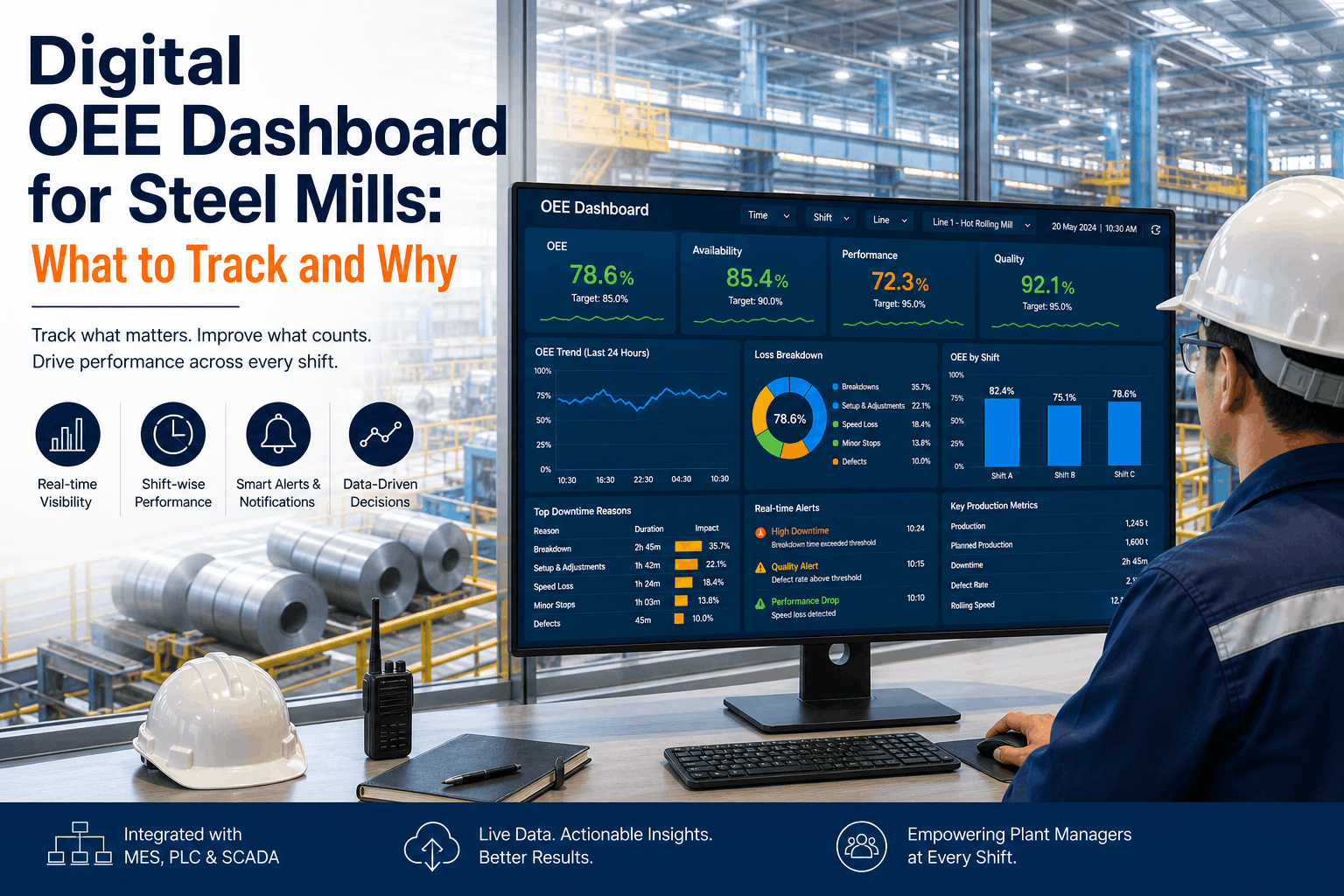
Evaluating AI-driven vs SAP steel mill software is the most consequential digital decision a plant manager will make this decade. While legacy on-premise ERP systems like SAP PM and IBM Maximo manage corporate financial ledgers flawlessly, they frequently fail on the active melt shop floor. Their rigid architectures demand heavy desk-bound data entry, creating massive administrative burdens for mechanics working around blast furnaces and continuous casters. Conversely, modern cloud AI-driven steel platforms offer native mobile execution, predictive IoT sensor syncing, and rapid shift operator adoption. The battle of steel ERP vs AI-driven solutions revolves entirely around bridging the 'DCS-to-Wrench' gap. Book a demo to explore exactly how modern mills are deploying agile cloud analytics layers as a powerful SAP alternative steel strategy to secure a 90-day ROI without ripping out their enterprise financial backend.
Modernize Your Steel Mill Without Ripping Out SAP
Deploy cloud-based AI analytics that natively syncs bidirectionally with your existing SAP or Oracle architecture, granting unparalleled mobile freedom to your floor mechanics while keeping your CFO's ledgers perfectly balanced.
Why Legacy SAP PM Fails on the Steel Plant Floor
A multi-million dollar SAP PM steel mill deployment is completely useless if mechanics refuse to use it. Traditional ERPs practically require a computer science background to close out a basic maintenance ticket. When mechanics spend 20 minutes walking to a desktop terminal to type out a 5-digit transaction code for a broken caster bearing, the facility loses tens of thousands of dollars in mechanical wrench time. Book a demo to witness mobile execution bypass this bottleneck instantly.
What an Integrated Cloud AI-Driven Platform Delivers to Steel Mills
iFactory's steel software comparison layer integrates directly over your heavy ERP. It turns rigid SAP data into actionable, conversational, and highly mobile workloads that technicians can access instantly directly near the BOF.
AI Troubleshooting vs SAP Rigid Protocols: Floor Scenarios
The true value of a cloud AI-driven steel implementation is resolving chaotic mechanical crises instantly. These scenarios highlight the contrast between legacy IT bottlenecks and agile AI models.
Scenario 1: Midnight Caster Defect Alarm
A hydraulic warning triggered. In SAP, the mechanic would walk 15 mins to a desktop to hunt for the code. With the AI edge platform, their tablet immediately flashed the failure, the required parts list, and the exact bin number in the warehouse.
Scenario 2: Emergency Spares Procurement
A gearbox began vibrating wildly. Conventional ERPs flag the breakdown only post-failure. The AI flagged it 18 days prior, automatically initiating a procurement ticket to SAP to ship the $80,000 spare part precisely in time for the repair window.
Scenario 3: LOTO Safety Verification
Entering a high-voltage zone requires isolation. Paper LOTO forms get lost or carbon-copied improperly. The mobile AI platform forced a geofenced barcode scan of the exact electrical breaker before unlocking the digital work order.
Scenario 4: The 6 AM Shift Handover
Rather than deciphering muddy handwriting on a clipboard, the incoming supervisor opens a generated dashboard instantly sorting what was fixed, what spare parts were consumed in SAP, and the exact priority queue for the pouring shift.
Cloud AI-Driven Edge vs Legacy SAP PM: Side-by-Side
For operations executives debating a complete Maximo steel alternative vs stacking a Cloud logic layer, this matrix breaks down the reality of plant-floor execution.
| Operational Capability | Stock SAP PM UI | Custom ERP Mobile Wrapper | iFactory AI-Driven Cloud |
|---|---|---|---|
| Technician Adoption Rate | Very Low (Cumbersome GUI) | Moderate (Limited offline viability) | High (Consumer app simplicity) |
| Predictive Anomaly Routing | Requires 3rd-party bolt-ons | Static threshold checks | Native FFT vibration ingestion |
| Offline Working Capability | Breaks without internet | Partial text caching only | Full multimedia & checklist caching |
| Deployment Velocity (Time to Live) | 18 to 36 Months | 9 to 14 Months | 60 to 90 Days total overlap |
| Financial Data Lock | Absolute core truth | Prone to synchronization tears | Flawless bi-directional API write-back |
How the SAP & AI-Driven Bridge Is Constructed
Deploying a SAP alternative steel optimization layer does not require blowing up your IT budget or dismantling ERP servers. The architecture natively slides over the top of existing enterprise systems via secure integrations.
Master Data Clone mapping
Connects to your SAP core to ingest exactly how your plant structures its current asset hierarchy. If you have 20,000 functional locations in your ERP, they map identically to the mobile layer without rewriting taxonomies.
Edge Device Provisioning
Rugged field tablets are distributed directly to the union mechanics. The application operates in the background, utilizing strict 256-bit encryption and native ISO security standards for corporate data privacy.
IoT Ingestion Layer
Data streaming directly from the Level 1 historian networks (OPC-UA/Modbus) feeds the AI brain, merging raw vibration numbers with the mechanical work history from SAP.
The Bi-Directional Lock
When a technician completes a ticket and signs it, the AI executes a hyper-reliable REST payload directly into the SAP/Oracle servers, instantly validating labor hours in the general ledger without human data clerks.
The Agile 90-Day Deployment vs Legacy Mega-Projects
Ditching the multi-year implementation paradox of heavy ERPs. We utilize a targeted, phased rollout that proves massive operational ROI within the first single fiscal quarter.
API Handshakes & SAP Clone
IT teams collaborate to open the designated secure API tunnels between SAP ECC and the AI cloud. Asset data is mirrored entirely passively while blast furnaces operate normally.
Shadow Operations & Alarm Tuning
The AI triggers theoretical alerts and digital work orders on the tablet architecture based on historian feeds. Managers compare AI deductions against actual SAP paper tickets to tune out false positive alarm noise.
Pilot Team Floor Activation
The strongest mechanic unit (e.g., the rolling mill team) receives iPads. They begin executing live repairs via the app. The system immediately writes back payload data into SAP for ledger tracking.
Plant-Wide Scaling
Armed with undeniable proof of efficiency gains from the pilot group, the rest of the facility aggressively adopts the interface. The transition from legacy paper protocols is executed universally.
AI-Driven Cloud vs SAP Steel: Frequently Asked Questions
Stop Allowing Clunky ERPs to Halt Physical Wrench Time.
Partner with an AI-driven platform intentionally built to keep heavy steel assets spinning smoothly while funneling ironclad financial ledgers seamlessly back to your SAP core. Stop fighting your tech and start crushing your production quotas.