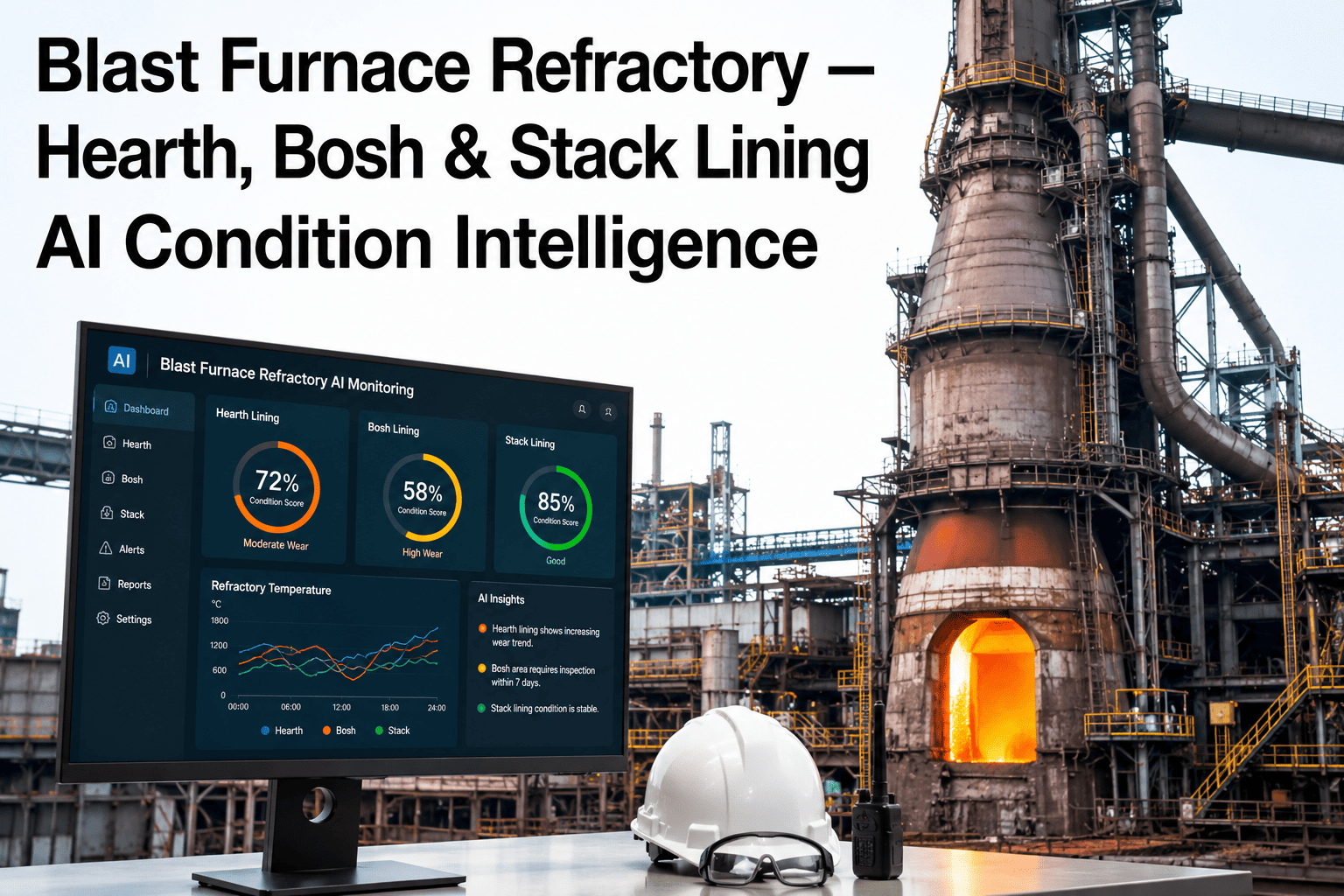
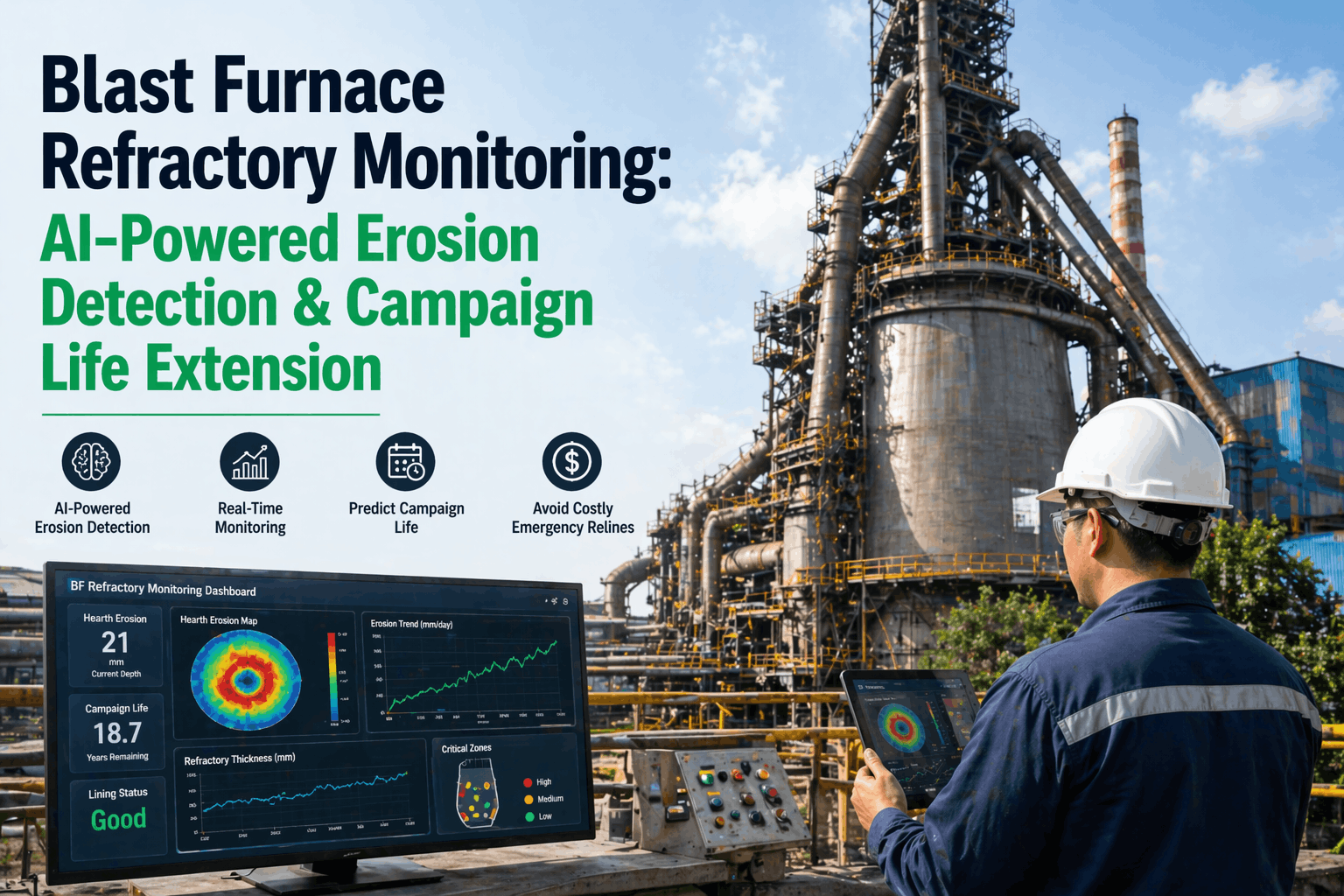
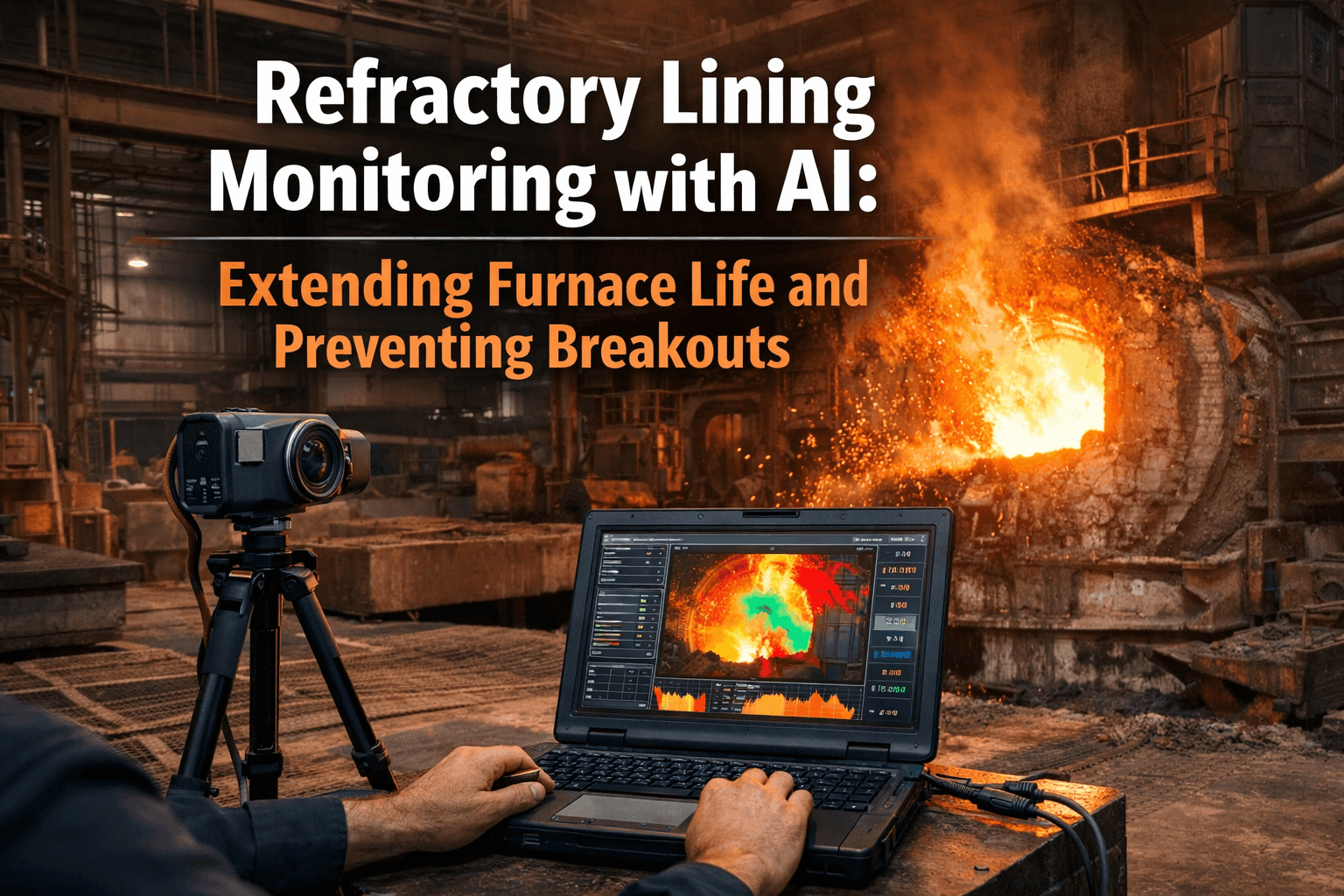
A modern blast furnace campaign is the longest continuous heavy industrial process on earth—frequently running 15 to 20 years without a true "off" switch. The singular variable dictating the absolute limit of that campaign is the structural integrity of the refractory lining, particularly deep within the molten hearth. If the micropore carbon blocks forming the crucible erode past the minimum safety threshold, a catastrophic multi-million-dollar molten iron breakout is mathematically guaranteed. Historically, estimating remaining wall thickness was an imprecise art. Today, elite ironmaking operations rely on unified blast furnace AI-driven refractory monitoring. By continuously ingesting dense arrays of embedded thermocouple data, this architecture utilizes inverse heat conduction algorithms to trace the exact boundaries of the protective internal 'skull' dynamically. Book a thermal mapping demo to see how we accurately predict massive capital relining schedules within ±2 weeks of exact physical necessity.
IRONMAKING REFRACTORY ANALYTICS
Map The Invisible Boundaries of Your Blast Furnace Hearth.
Eliminate relining guesswork. Secure your 15+ year campaign life via real-time 3D thermocouple tracking, carbon wash prevention, and exact wall thickness modeling.
The Chemical and Thermal Destruction of the Iron Crucible
Protecting blast furnace refractory lining requires tracking vastly different thermal attack vectors based on furnace elevation. In the upper shaft, hard descending burden aggressively abrades high-alumina bricks. In the violently churning bosh and belly, molten gas and slag launch extreme thermal shock and alkali/zinc vapor attacks against the silicon carbide (SiC) lining. However, the ultimate 'game over' scenario occurs strictly in the hearth. Here, intense liquid iron flow velocities physically scour the micropore carbon blocks—a phenomenon known strictly as 'carbon wash'.
Operating a blast furnace with a dangerously thin hearth means crossing a redline where the external copper cooling staves can no longer extract heat faster than the molten iron delivers it. Legacy systems lack the computational density to track localized thermal spikes accurately across hundreds of thermocouple strings simultaneously. AI-driven tracking environments natively run highly complex 3D heat-transfer matrixes, allowing metallurgical directors to literally 'see through' the blast furnace shell.
The corner where the vertical hearth wall meets the flat bottom pad (the elephant foot) is highly susceptible to vicious vortex erosion. High-density thermocouple charting directly flags asymmetric thermal climbing in this specific radius.
When the AI confirms a critically thin skull, operators push high-titanium ores (ilmenite) into the burden. The platform tracks the subsequent thermodynamic temperature drop, visually confirming the successful formation of the protective Ti(C,N) titanium bear layer.
During the tapping cycle, molten iron shear forces rip across the refractory immediately surrounding the taphole channel. Predictive modeling measures heat fluctuations around the mud-gun clay injection zone, preventing lateral gas channeling behind the stave cooler jacket.
Ascending hot gases heavily laden with volatile potassium and zinc infiltrate the refractory pores, causing massive volumetric expansion (alkali burst). The AI cross-references Top Gas compositional data against localized stave delta-Ts to isolate bursting regions.
Executing the AI-Driven Strategy for Refractory Wear Analytics
Transforming raw thermocouple voltage drops into a pristine, actionable 3D model of your furnace lining demands rigorous mathematical interpolation. Enterprise mills that schedule an implementation review discover that bypassing manual excel entry for automated SCADA data ingestion permanently shifts their campaign lifespan curve.
Passive Historian Thermocouple Integration
The platform taps deep into the Level 1 historian networks, autonomously ingesting thousands of temperature points per minute. The algorithm immediately maps every single sensor to precise Cartesian coordinates against the original structural engineering diagrams of the furnace shell.
Solving the Inverse Heat Conduction Problem
The core analytical breakthrough. By utilizing the known thermal conductivity of distinct refractory grades (carbon vs high-alumina) against the external water-cooling heat extraction rates, the software calculates backwards—arriving at the exact millimeter depth where the 1150°C liquid iron solidification isotherm exists.
Automated Sensor 'Ghosting' and Redundancy
In a 15-year environment, internal sensors physically burn out or drift. The AI continuously runs peer-correlation checks. If a single thermocouple spikes entirely out-of-band compared to the four sensors immediately surrounding it, the system automatically tags it as mathematically degraded, preventing false-positive evacuation alarms.
Campaign Lifetime Reline Forecasting
By graphing the micro-millimeter erosion rate over thousands of data shifts, the neural network calculates an absolute trajectory horizon. It explicitly outputs the projected calendar month the safety refractory margin will be totally compromised, giving Capital Project teams the exact window to order multi-million-dollar replacement carbon blocks.
Secondary Refractory Stability Metrics
Protecting the main blast furnace campaign life means hunting for peripheral abnormalities affecting the overall burden descent and hot gas flow before the damage physically impacts the refractory walls.
Tracking the exact vertical elevation where the ferrous burden transitions from solid to plastic. If the cohesive 'roots' push directly against the walls, severe asymmetrical refractory spalling occurs rapidly.
Measuring Watt/m² removed by the copper cooling jackets. A sudden 30% drop in expected heat flux implies a thick accretion formation, narrowing the working volume of the furnace.
Charting the exact drilling depth required to hit molten iron every cast. Shortening tapholes immediately indicate severe degradation of the protective inner mushroom cap shielding the refractory.
Constantly scanning the 360-degree temperature spread across localized shaft elevations to identify 'channeling'—where hot gases cut severe isolated chimneys through the burden directly against the wall.
Monitoring water speed and Delta-T directly at the blast injection nozzles to ensure the refractory surrounding the blowpipes isn't being consumed by rogue hot blast back-pressure.
Correlating top radar profile data against sidewall thermals to ensure the raw materials descent is perfectly horizontal, preventing scouring avalanches on weak lining sections.
Financial ROI: Evaluating BF Relining Economics
A full blast furnace reline requires a massive $40M–$80M injection of upfront structural capital and sidelines production entirely for 45 to 90 days. Misjudging reline timing by a single year burns astronomical margin capital needlessly. Schedule an ROI review to build the business case for extending your specific campaign target.
Routinely extending the time-horizon between major relining procedures allows CFOs to heavily defer giant CapEx outlays, significantly expanding the net present value (NPV) of the ironmaking asset.
Shutting a furnace down three years early simply because the 'calendar math' said so destroys profitability. True data logging definitively proves there is safe refractory depth remaining to keep running.
A major sidewall or taphole breakout requires massive mechanical rebuilding surrounding the shell, enormous downtime, and immense environmental hazard mediation directly absorbed by the corporate ledger.
Because refractory strictly protects the copper cooling staves, monitoring the erosion boundaries forces early titanium pushes, inherently saving the multi-million dollar internal stave cooling grid.
Global Target Matrix: Furnace Wall Health Limits
Evaluating campaign stability means measuring your specific BF against absolute "World-Class" metallurgical tolerances. Ironmakers globally rely on strict baseline benchmarks to validate internal modeling algorithms.
| Hearth Metric Parameter | Severe Alarm Threshold | World-Class Operation Baseline | AI Platform Control Mechanism |
|---|---|---|---|
| Absolute Remaining Sidewall Thickness | < 30% of Original Design Depth | > 60% Intact After 12 Years | Live 3D modeling triggers TiO2 (Ilmenite) burden shifts accurately. |
| Elephant Foot Thermocouple Shift | Sudden +30°C spike in 24 Hrs | Flatline stable ±5°C globally | Predicts specific localized carbon wash mechanisms instantly before rupture. |
| Taphole Drilling Depth Length | < 1.5 Meters (Lost inner mushroom) | 2.5 - 3 Meters Consistent | Graphs drill lengths against clay injection volume to measure exact taphole pad tear. |
| Stave Delta-T Variance (Belly Zone) | Extreme fluctuations (Channeling gas) | Low, uniform heat flux spread | Maps isolated hot-spots warning of scabs or accretions violently peeling off the wall. |
| Hearth Bottom Pad Undercutting | Deep molten root penetration | Stable upper pad wear limits | Isolates downward dissolution vectors caused by excessive liquid iron standing intervals. |
Critical Challenges in Refractory Degradation Mapping
The Inverse Mathematical Correlation Blockade
You simply cannot bolt sensors "into" the liquid iron. You must place sensors deep in the carbon block and solve the math backwards to find the 1150°C iron freeze line. Basic maintenance softwares simply chart basic rising temperatures visually. Elite AI engines actually execute the thermal-conductivity math across thousands of variables to yield exact structural distances.
The Danger of the 'Fake Runaway' Alarm
When the burden descent suddenly shifts or a piece of skull detaches internally, hundreds of thermocouples will universally spike. A naive system throws a massive red-alert evac alarm. An intelligent AI determines the sheer volume of uniformly spiking sensors implies a sudden blast-gas event rather than an actual physical wall disappearing in under ten minutes.
Managing Inevitable Probe Darkness
By year ten of a BF campaign, perhaps 20% of the internal stave and hearth thermocouples have permanently failed or snapped via extreme expansion forces. The model must be robust enough to mathematically 'mesh' the thermal space utilizing only the surviving functional sensors without breaking the entire predictive visualization algorithm.
Frequently Asked Questions: Blast Furnace Relining & Refractory
Can the AI determine exactly when we must shut down for a major Category 1 reline?
Yes. By extrapolating the exact millimeter-per-month wear rate mapped across your hearth against the absolute physical boundaries of your outer shell logic, the system issues a definitive forecast narrowing the exact ±2 week window where safe running is no longer statistically possible.
What is 'Carbon Wash' and how does the software stop it?
Carbon wash occurs when massive iron production accelerates liquid iron velocity spinning across the carbon blocks, effectively dissolving the carbon into the iron itself. The AI flags irregular temperature surges specifically at the taphole sides, cueing operators to heavily adjust tapping schedules and mud-gun timing to slow the internal vortex.
How does pushing Titanium (Ilmenite) into the furnace fix a refractory problem?
Titanium possesses an exceptionally high melting point. Adding it to the ore burden precipitates titanium carbo-nitride Ti(C,N) layers that explicitly freeze against the hearth walls during operation. The AI proves this is working by confirming the corresponding temperature drop on the outer hearth shell sensors.
Do we need to drill new sensors to use this analytics program?
No. The platform utilizes OPC-UA to map directly over the hundreds of embedded thermocouple streams already wired into your Level 1 SCADA databases. Zero new drilling is required during operational campaigns.
ABSOLUTE CAMPAIGN LIFE PREDICTABILITY
Demand Flawless Visibility Into Your Blast Furnace Refractory.
iFactory's heavy ironmaking platform continuously executes inverse 3D thermal mapping to trace exactly how much protective carbon remains within your furnace walls. Confidently push campaign life out to 20 years without ever risking a breakout.