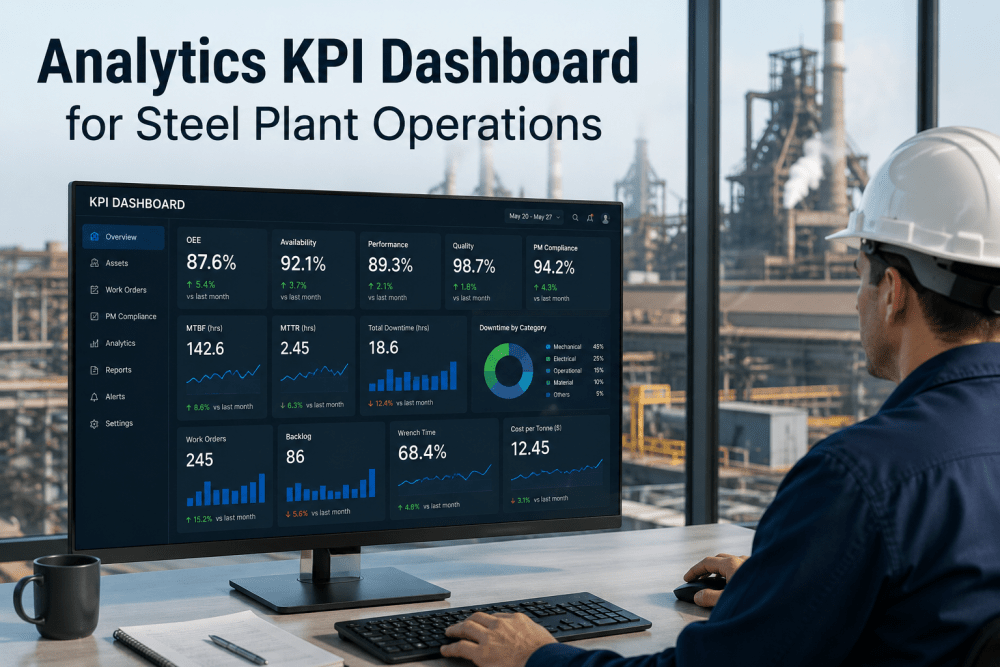
Mastering steel analytics KPIs is the most decisive factor separating highly profitable mills from those constantly bleeding margin due to heavy mechanical crisis. Operational metrics tracking continuous casters, hot strip mills, and primary blast furnaces must move far beyond simplistic CMMS reports. As global steel demand fluctuates, plant managers maintaining rigorous oversight of MTBF (Mean Time Between Failures), MTTR (Mean Time to Repair), OEE (Overall Equipment Effectiveness), and precise availability metrics gain total control over their predictive maintenance timelines. Without robust KPI tracking, emergency work order ratios skyrocket, drastically deteriorating actual mechanical wrench-time. Book a dashboard demo to see how iFactory's reliability analytics layer forces heavy steel KPIs directly into elite operational boundaries.
STEEL RELIABILITY ANALYTICS DASHBOARD
Capture Every Steel Plant KPI on One Intelligence Platform.
Aggregate your MTBF, OEE, downtime availability, and PM compliance ratios natively. Convert chaotic mechanical breakdown data into flawlessly actionable predictive oversight.
Why Inaccurate Steel Reliability Metrics Destroy Iron Production Targets
Steel plant analytics engineered without rigorous digital mapping often rely on delayed data sets and 'pencil-whipped' operator logs. When a hot metal overhead crane degrades, tracking its MTBF (Mean Time Between Failures) using 30-day-old SAP exports prevents reliability directors from actually seeing the impending collapse. The result is a massive accumulation of 'ghost downtime'—unaccounted micro-stops lasting three to eight minutes that silently murder total plant OEE (Overall Equipment Effectiveness) over an annual operating cycle.
Unlike generic manufacturing where a tripped conveyor causes minor delays, a breakdown in a heavy steel environment (e.g. cooling bed sheer block) immediately halts hundreds of tons of casted product from advancing. Measuring steel AI-driven metrics means treating performance ratios—like PM compliance and breakdown tracking—not strictly as maintenance goals, but as primary production safeguards.
Calculates Availability x Performance x Quality. In steel production, slipping below 75% OEE often signals catastrophic margin compression. Perfecting OEE requires actively capturing every micro-delay on the caster to eliminate invisible mechanical inefficiencies.
The absolute indicator of heavy equipment health. Stretching MTBF on main drive gearboxes from 8 months to 24 months represents millions in saved capital. It relies heavily on strict preventative routines masking active degradation.
When a breakdown happens at 3 AM, how fast does your union mechanic isolate the fault, grab the correct bearings from the SAP warehouse, tag out the power, and execute? AI-driven CMMS interfaces drive MTTR drastically downward.
A mill operating on 50% emergency tickets operates in constant chaos, burning massive overtime capital. Tracking and enforcing an 80% planned maintenance ratio pulls the facility into a tightly regulated, predictive operational model.
The AI-Driven Strategy for Tracking Steel Analytics KPIs
Tracking critical metrics across a three-mile-long heavy integrated steel mill requires moving entirely away from lagging spreadsheet indicators. Elite reliability managers that book a KPI demo quickly discover that integrating AI logic natively into MTBF measurement allows the software to predict failure horizons rather than just reacting to broken machinery parameters after the shift finishes.
Passive KPI Ingestion from Level 1 SCADA
Eliminate extreme human error in downtime logging. Integrating directly into the PLC historians pulls precise downtime timestamps down to the millisecond. This removes the 'operator bias' where 15-minute micro-stops are frequently ignored, bringing total truth to the baseline steel OEE calculation.
Digital PM (Preventative Maintenance) Compliance
PM Compliance is useless if mechanics are merely 'pencil-whipping' paper sheets. Transitioning to mobile tablet checklists incorporating barcode verification ensures that a 95% PM Compliance metric actually translates directly to true asset lubrication and health, massively extending MTBF ratios plant-wide.
Aggressive Backlog Control & Ratio Balancing
A soaring maintenance backlog severely threatens overall plant availability. AI dashboards automatically rank thousands of open SAP work orders, pushing critical bearing tasks to the top of the queue. This continuously enforces a healthy Planned-to-Emergency maintenance distribution ratio, stabilizing the mill floor.
Wrench-Time Velocity Enhancements (Crushing MTTR)
You fundamentally cannot compress MTTR without giving floor workers better tools. Mobile analytics layers hand mechanics direct access to lock-out lists, PDF explosion diagrams, and immediate SAP spare parts bin locations directly at the breakdown site, completely bypassing desk-bound logistics hunting.
Secondary Steel Performance Metrics for Total Plant Oversight
Beyond foundational MTTR and MTBF reporting, heavy capital intensive operations rely on nuanced secondary ratios to ensure the workforce itself is operating efficiently to prevent systemic bottlenecking.
The gross ratio of time mechanics spend physically executing tool work versus time spent walking, hunting for parts, or waiting for safety permits. Increasing this from 30% to 55% effectively doubles maintenance capacity.
Measures what percentage of the assigned weekly maintenance schedule was actually fully executed versus delayed due to runaway emergency work or parts shortage.
How often a drive or pump breakdown is successfully repaired on the first attempt without generating 're-work' tickets 48 hours later due to improper diagnosis.
Calculates exactly how much good tonnage is shipped out of the coil bay versus scrap weight lost directly to mechanical tracking or thermal variances on the line.
Tracks extreme premium labor payouts directly tied to 'run-to-failure' breakdowns occurring heavily on off-shifts and Sunday pouring operations.
Critical early-stage AI metric identifying how rapidly an abnormality (vibration spike, thermal climb) is officially recognized by the system before actual failure commences.
Global Benchmarking: Steel Analytics KPIs Alignment Matrix
Understanding where your specific mill ranks geographically against top-tier global metallurgical producers is vital. The iFactory AI layer actively pulls your facility up toward these "World Class" boundaries. Track your path by scheduling a diagnostic review with our reliability platform engineers.
| KPI Metric | Danger Zone Base | World-Class Steel Benchmark | How AI Analytics Directly Impacts Metric |
|---|---|---|---|
| Overall Equipment Effectiveness (OEE) | < 65% (Heavy Margin Loss) | 85%+ | Removes micro-stop biases by hard-tracking SCADA historian variables 24/7. |
| PM Compliance Ratio | < 60% (Pencil-whipped) | 95%+ (Digitally verified) | Forces geofenced tablet check-ins, eliminating skipped routes entirely. |
| Planned vs Emergency Ratio | 50% / 50% (Reactive Chaos) | 85% / 15% (Controlled) | Predictive anomaly catching generates early tasks, crushing runaway emergency calls. |
| Schedule Attainment | < 50% completed weekly | 90%+ completed weekly | Intelligent backlog queuing ensures parts exist before tasks are assigned. |
| Mean Time To Repair (MTTR) | 5+ Hours per critical event | < 2 Hours per event | Supplying precise schematic, safety, and SAP data directly to wrench operators instantly. |
| Wrench-Time Efficiency | 25% - 30% of shift | 55% - 60% of shift | Bypassing legacy desktop data entry, recovering 90 mins of walking per mechanic per shift. |
The AI-Driven Mechanism Controlling the MTBF & MTTR Divide
Pushing Mean Time Between Failures outward while compressing Mean Time to Repair requires flawless automated pipeline sequences acting autonomously on the shop floor. By implementing these visibility blocks into heavy SCADA tracking environments, failure is structurally cornered.
Passive Degradation Sensing
Continuous behavioral monitoring maps exact IoT vibration FFT bands alongside actual thermal camera sweeps in extreme zones (like BOF cooling). Alerts are generated weeks before hard failure parameters execute.
Automated Triage Generation
The moment a leading anomaly is identified on a reversing mill drive, the AI dynamically opens fully framed maintenance tickets locally, ensuring precise priority tagging is heavily injected directly into the SAP general backlog.
Immediate Digital Isolation Playbooks
When executing the subsequent repair, mechanics possess LOTO (Lock Out/Tag Out) isolation paths directly on rugged tablets, rapidly improving safety metrics while ensuring 0% time is lost validating circuit breaker zones manually.
Automated Part Requisitioning
To compress the MTTR stat deeply, the system checks internal SAP ERP databases to verify the bearings are geographically physically located in warehouse bin A7 before the mechanic has even walked off the line.
Validating ROI Through Flawless KPI Control
For corporate steel controllers, KPIs are not generic graphs—they represent vast mathematical reservoirs of trapped cash. A 1% movement in plant availability on an integrated slab line commands millions of dollars. Agencies looking to financially validate these metrics internally should book a KPI demo to run custom operational modeling variables on their exact steelmaking parameters.
Providing mechanics unified mobile edge data rapidly drops diagnostic and logistical hunting times required during catastrophic shutdowns.
Tracking hard data rather than manual operator log delays ensures precision root-cause analysis is successfully deployed to eliminate repeat offenders permanently.
Relentless verified PM mapping ensures complex gear configurations never structurally run dry, pushing capital replacement needs deeper into the future.
Stabilizing the floor shifts expensive double-time Sunday maintenance operations comfortably into standard daylight shifts via predictive routing.
Best Practices for Elevating Iron and Steel KPI Governance
Stop Treating 'Micro-Stops' as Acceptable Casualties
Two-minute delays on a rolling mill happen so frequently that operators stop logging them manually. Hardwired SCADA analytics must be utilized to aggregate these minor hits. Addressing 50 micro-stops yields higher output velocity than rushing one major 3-hour breakdown repair.
Strictly Define 'Wrench-Time' Against CMMS Parameters
Stop blaming operators for slow MTTR. If a mechanic requires 45 minutes to locate a forklift and extract parts from warehouse receiving, that is a logistics flaw, not a mechanic flaw. Mobile edge analytics exposes these gaps to fix the macro-process.
Force Digital Check-Ins for PM Quality
A 'completed' paper PM sheet provides 0% protection if the tasks were rushed. Embedding barcode checks or NFC sweeps into the preventive route guarantees mechanics physically visited the asset, establishing genuine MTBF protection.
Isolate 'Wait for Parts' Downtime Mathematically
When generating reporting arrays, never blend 'time waiting for spares to ship' alongside baseline MTTR. Clear taxonomy allows corporate controllers to aggressively adjust supply chain float vs firing maintenance directors arbitrarily.
Frequently Asked Questions: Steel Plant Analytics & OEE
Why is 85% considered the absolute 'World Class' standard for Steel OEE?
Given the extreme thermal destruction occurring inside primary steel metallurgy, achieving 85% accounts inherently for necessary refractory rebuilds and vast thermal schedule maintenance. Surpassing 85% often implies cutting necessary safety buffers too thin on primary hot-side melting equipment.
How does predictive AI actively compress the MTTR (Mean Time to Repair) threshold?
MTTR is primarily logistics hunting. AI removes the delay by simultaneously fetching exact technical drawings, LOTO procedures, SAP bin-location parts data, and priority routing directly to a mechanic's rugged tablet the instant the machine dies locally.
What happens if our steel plant lacks deep native IoT vibration sensors?
You can build exceptionally profitable KPI governance strictly on mobile mechanic adoption. Tracking accurate execution metrics, enforcing 100% genuine PM compliance, and optimizing shift backlogs yields massive OEE stability long before expensive sensors are finally mounted.
Is PM Compliance tracking natively mapped back to SAP/Oracle?
Yes. Highly mobile digital execution acts as a pristine interface overlay. The moment the technician signs off on the grease route on their tablet, it writes via robust secure API direct to SAP, satisfying financial auditors fully.
How long does an AI metrics dashboard take to successfully deploy?
Deploying the mobile edge interface atop existing legacy heavy frameworks generally reaches full adoption in 60 to 90 days depending on union negotiation cycles and facility scale training.
READY TO SECURE 90% AVAILABILITY GOALS
Dominate Steel Analytics KPIs From One Mobile Infrastructure.
iFactory's heavy reliability platform delivers continuous MTBF, MTTR, and OEE dashboarding across blast furnaces, casters, and smart mill environments — passively enforcing 'world-class' compliance thresholds every single shift.

.png)