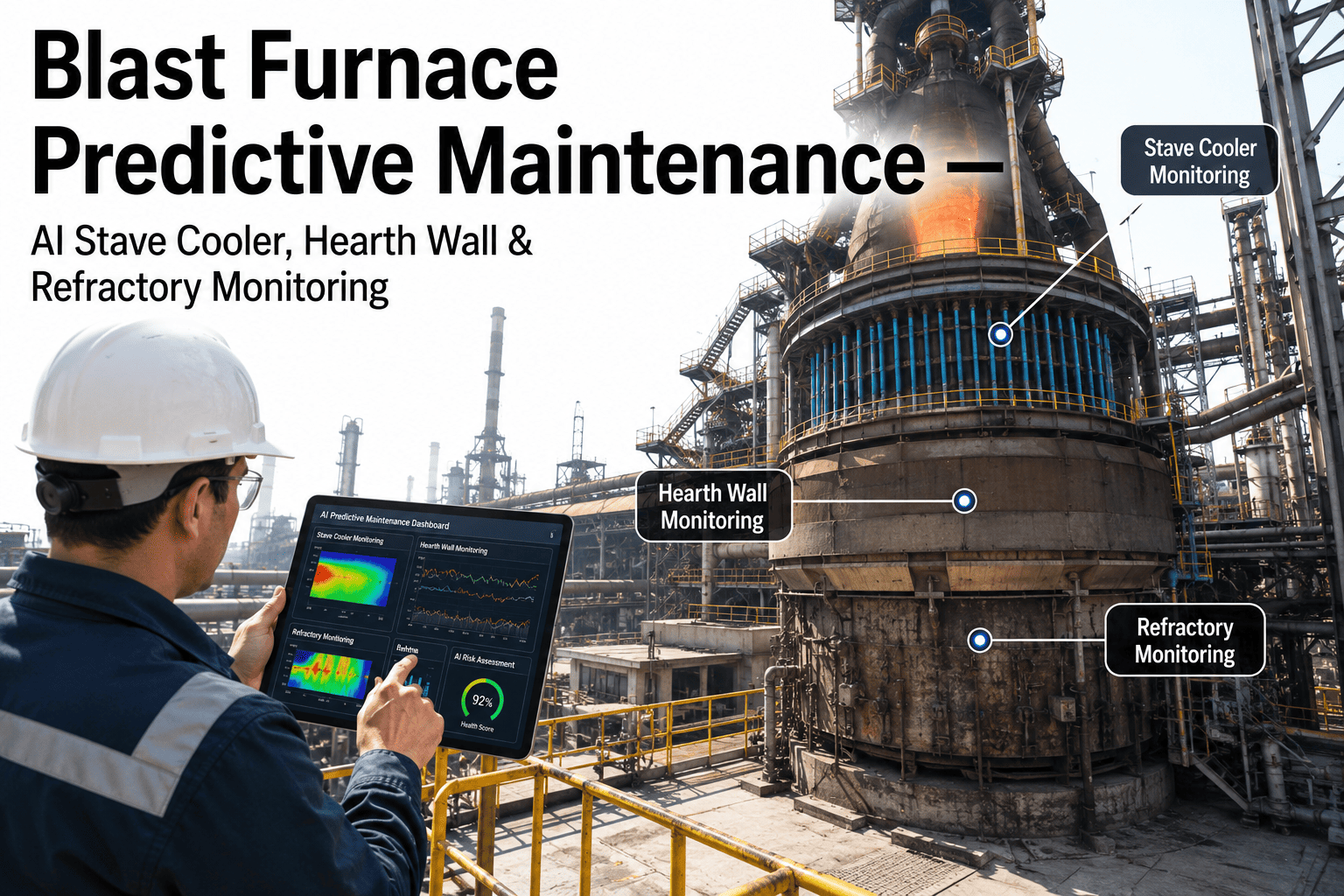
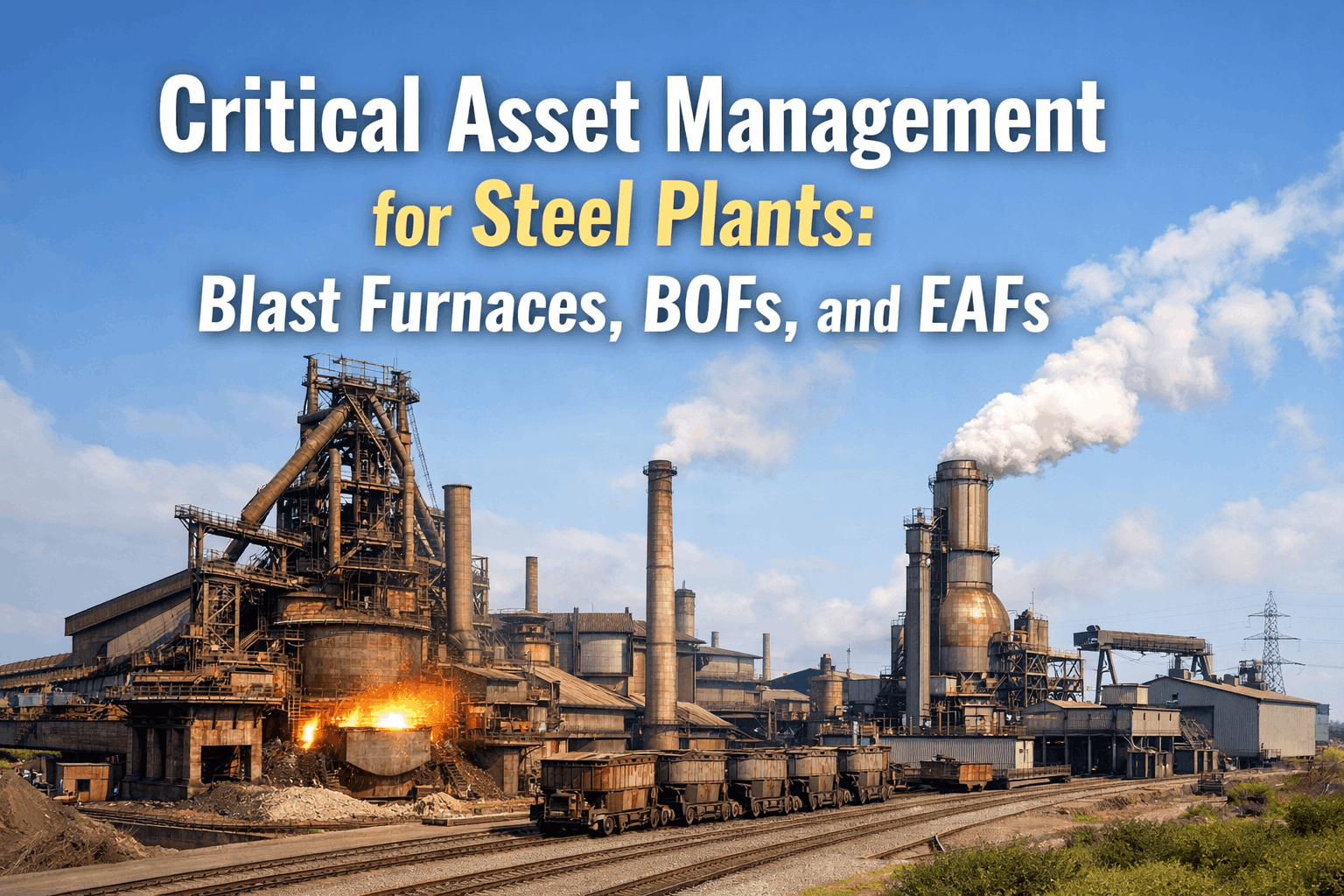
A blast furnace operates at 2,300°C with pressures up to 4 bar, processing thousands of tonnes of raw material daily through a continuous campaign lasting 15-20 years between relines. Inside this towering reactor, you cannot see, touch, or directly inspect anything. Every decision depends on what your sensors tell you—and traditional sensors tell you only a fraction of the story. AI changes this by correlating thousands of data points from every zone of the furnace simultaneously, detecting degradation signatures 2-8 weeks before they reach critical thresholds, and turning invisible thermal patterns into actionable intelligence that protects both production and campaign life.
Blast Furnace Intelligence
2,300°C. Zero Visibility. 4,000+ Data Points. One AI Brain Watching Everything.
Smart sensors and AI monitor every zone of your blast furnace in real time—from throat to hearth—detecting refractory wear, cooling failures, and burden irregularities weeks before operators see symptoms on the control room screen.
200+
Thermal zones monitored simultaneously
$2.3M
Cost of a single undetected thermal drift
2-4 yrs
Campaign life extension with AI monitoring
Sources: Oxmaint Steel Industry Data, Primetals Technologies, IspatGuru Process Reference
Anatomy of a Blast Furnace: 5 Zones, 5 Failure Domains
A blast furnace is not a single reactor—it is five distinct thermal and chemical environments stacked vertically, each with unique degradation patterns, sensor requirements, and failure modes. AI monitors all five simultaneously because a problem in one zone cascades through the entire furnace within hours. Understanding these zones is the foundation for intelligent monitoring.
The Blast Furnace Zone Map: What AI Watches and Why
What Happens Here
Raw materials (iron ore, coke, limestone) enter the furnace. Burden descends through alternating layers. Top gas exits at 100-250°C carrying CO, CO2, and dust particles.
What AI Monitors
Stock line level and descent rate per circumferential zone. Top gas temperature and composition (CO/CO2 ratio indicates reduction efficiency). Burden distribution pattern from charging chute. AI detects hanging, slipping, and channeling before they cascade downward.
Sensor Array
Above-burden temperature probes, profile meters, stock line recorders, top gas analyzers, infrared cameras.
What Happens Here
The tallest section of the furnace. Iron oxides are heated and reduction begins. Ascending CO gas strips oxygen from iron ore (Fe2O3 to Fe3O4 to FeO). This is the primary reduction zone where gas-solid contact efficiency determines fuel rate.
What AI Monitors
Shell temperature mapping at 8-hour intervals. Refractory wear rate from embedded thermocouples at 4-5 depth levels. Gas flow distribution patterns. AI correlates stack temperature anomalies with burden distribution to detect scaffolding and channeling that reduce reduction efficiency by 5-10%.
Sensor Array
Embedded thermocouples (400+ points), shell temperature scanners, sub-burden gas probes, thermal imaging during wind-rate adjustments.
What Happens Here
The belly is a short cylindrical transition section. Below it, the bosh is the hottest zone in the furnace. Materials reach softening temperature (1,000-1,100°C) and begin to melt. The cohesive zone forms here—where everything melts except coke, which must maintain gas permeability.
What AI Monitors
Cooling water flow differentials across 30+ circuits. AI detects 3-5% flow reduction indicating blockage 4-8 weeks before critical. Stave temperature arrays for localized hotspots indicating refractory loss. Heat flux calculations per stave zone correlating with erosion acceleration. Cohesive zone position tracking.
Sensor Array
500+ electromagnetic flowmeters, copper stave thermocouples, heat flux sensors, pressure differential gauges, cooling water ΔT monitors.
What Happens Here
Hot blast air (1,000-1,300°C) enters through 15-40 tuyeres around the furnace circumference. Coke combustion produces CO at extreme temperatures. This is where the furnace's energy is generated. Pulverized coal injection (PCI) supplements coke as a fuel source.
What AI Monitors
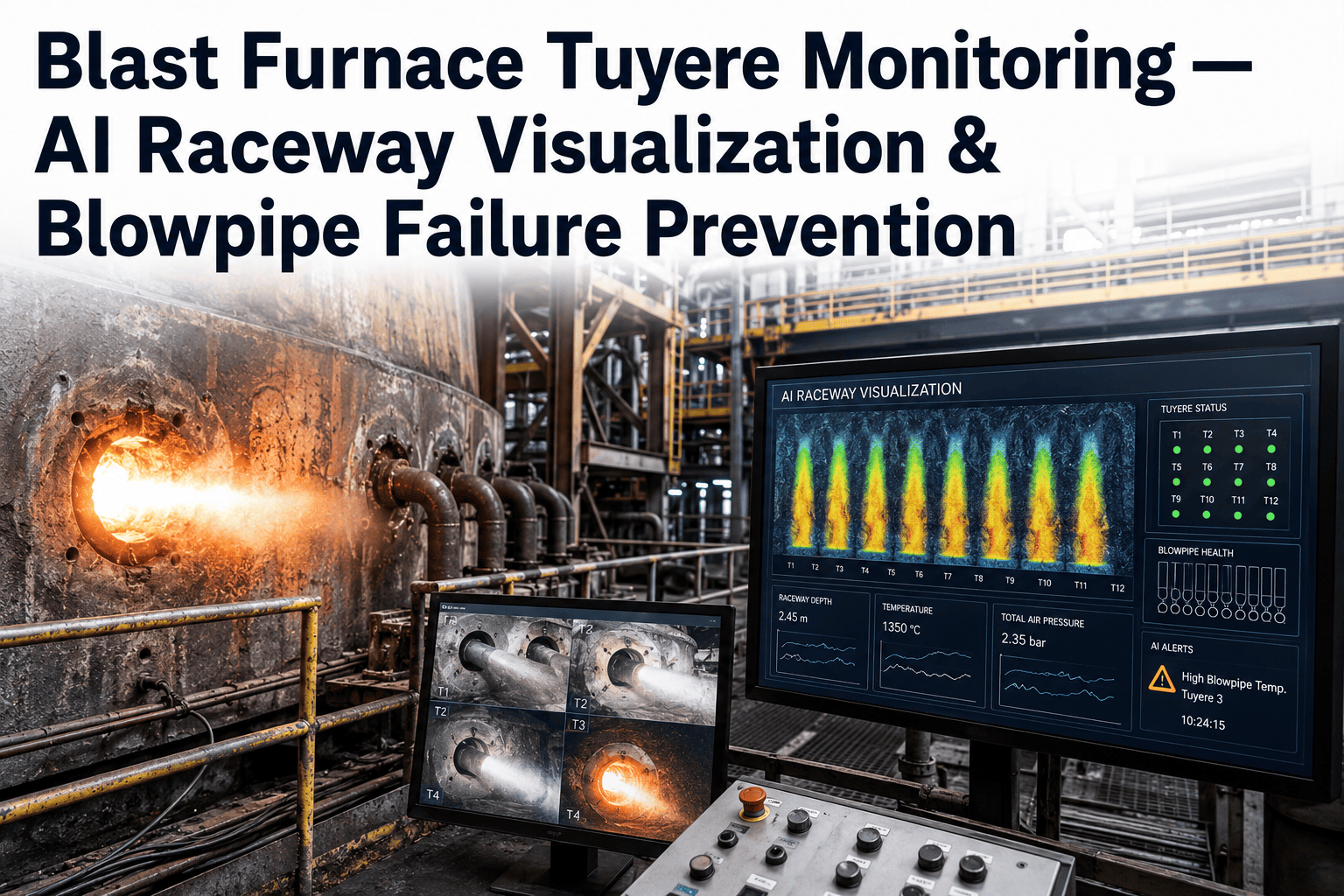
Individual tuyere condition monitoring—heat distribution across all tuyeres must stay within ±15°C to prevent scaffold formation. AI tracks raceway adiabatic flame temperature (RAFT), PCI combustion efficiency, and blast parameters. Tuyere failure prediction from cooling water analysis and thermal cycling patterns.
Sensor Array
Tuyere cameras, blast flow meters, oxygen analyzers, pyrometers, PCI injection rate monitors, individual tuyere cooling circuits.
What Happens Here
Molten iron and slag accumulate here, separated by density. Hot metal is tapped at ~1,500°C via tapholes. The deadman—a packed bed of unreacted coke—sits at the center. Carbon dissolves into molten iron here. This zone determines the furnace's ultimate campaign life.
What AI Monitors
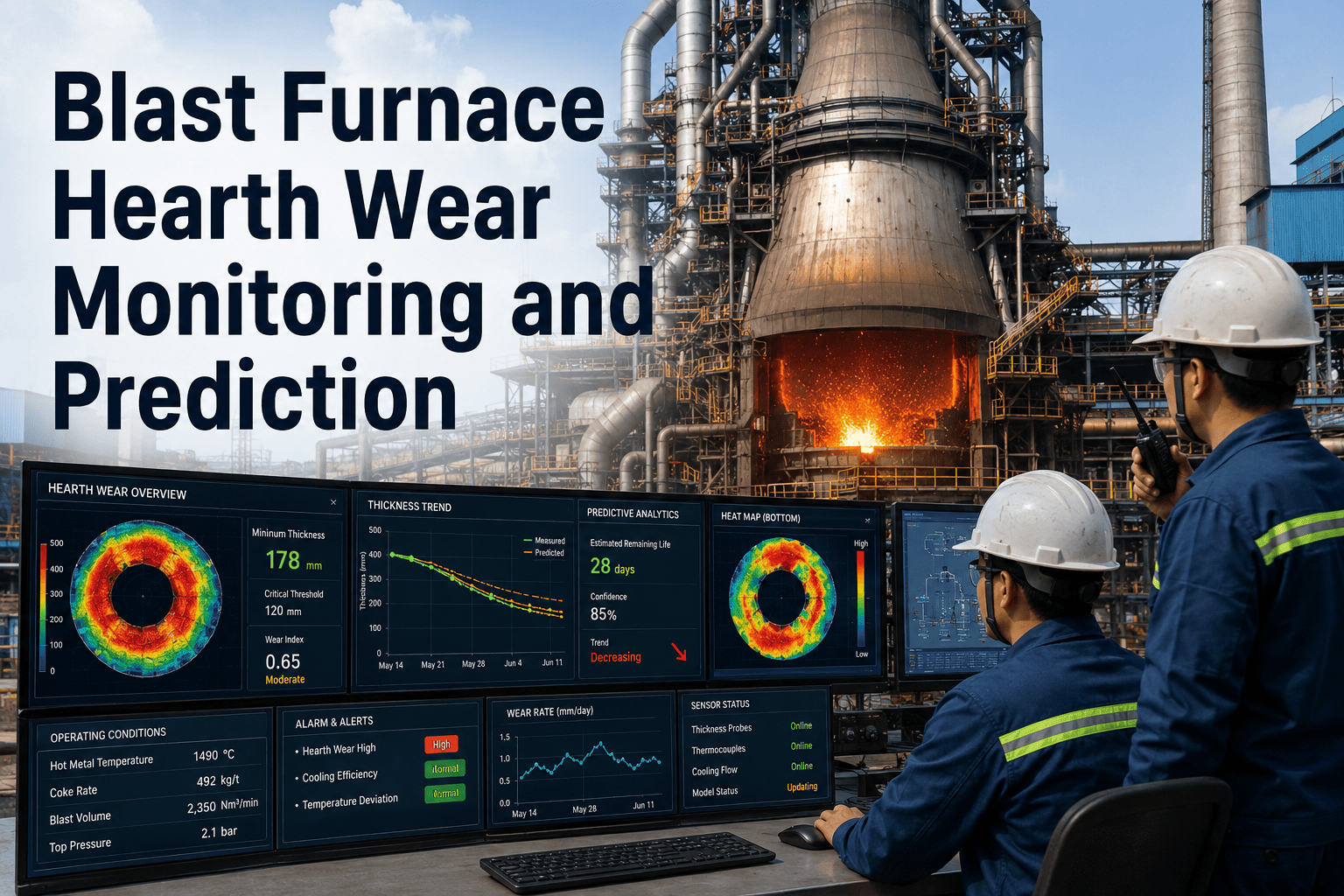
Hearth wall erosion profiling from embedded thermocouple arrays. Liquid level estimation in real time. Hearth pad temperature trending to detect hot spots approaching shell breakthrough. Tap-to-tap timing and hot metal temperature/composition analysis. AI estimates remaining hearth wall thickness and predicts reline timing years in advance.
Sensor Array
Hearth thermocouple arrays (multiple depths), taphole drill monitoring, hot metal temperature probes, slag analysis sensors, bottom pad thermocouples.
Your Furnace Has 4,000+ Data Points. How Many Are Connected to Maintenance Decisions?
iFactory's AI platform connects your existing blast furnace sensors to intelligent maintenance workflows—turning process data into predictive alerts, auto-generated work orders, and documented campaign life extension.
Temperature Intelligence: What AI Sees That Operators Cannot
The blast furnace generates a continuous temperature profile from 150°C at the throat to 2,300°C at the tuyeres. Traditional monitoring captures snapshots. AI captures the full thermal story—tracking gradients, drift rates, and anomaly patterns across every zone simultaneously to detect problems invisible to human analysis.
The Thermal Gradient: How AI Reads the Furnace's Vital Signs
1,000-1,600°C
Belly & Bosh
Thermal Drift Detection
A 2% blast temperature drift went undetected for 3 weeks at a major integrated mill—resulting in 4,200 tonnes of off-spec pig iron and $2.3M in reprocessing costs. AI catches drifts of 0.5% within hours.
Hotspot Prediction
Localized stave temperature rises indicate refractory loss exposing copper to direct thermal load. AI correlates hotspot patterns with cooling water data to predict failure location 4-8 weeks in advance with 95% accuracy.
Cohesive Zone Mapping
The cohesive zone—where materials soften and melt—determines gas flow and furnace efficiency. AI tracks its position and shape from temperature and pressure data, alerting operators when it shifts toward unstable configurations.
The Sensor Ecosystem: What You Need and Where
Modern blast furnaces already have 80-90% of the monitoring data needed for AI-powered predictive maintenance. The gap is not sensor technology—it is connecting process data to intelligent maintenance decision-making. Here is what a comprehensive AI sensor architecture looks like.
Embedded at 4-5 depth levels across furnace walls. Track refractory erosion rate by measuring temperature gradient through the lining. Each point tells the story of how much refractory remains between molten iron and the steel shell.
Throat, Stack, Belly, Bosh, Hearth
Electromagnetic Flowmeters
500+
Monitor individual cooling circuits measuring supply-return differential. Detect leaks as small as a few drips per minute—critical because water contact with molten iron at 2,000°C creates explosive conditions requiring immediate response.
Bosh, Belly, Stack Staves, Tuyeres
Non-contact infrared temperature measurement across throat, tuyere peepholes, stove domes, and hot blast delivery. Track temperature distribution for controlling stove heating cycles and monitoring blast consistency across all tuyeres.
Throat, Tuyeres, Stoves, Hot Blast Main
Continuous monitoring of top gas composition (CO, CO2, H2, N2). The CO/CO2 ratio directly indicates reduction efficiency—poor utilization means wasted coke and increased emissions per tonne of hot metal produced.
Throat (top gas), Tuyere Zone, Stoves
Track pressure drops across furnace zones indicating permeability changes. Sudden pressure spikes signal hanging or slipping events. Differential pressure between zones maps burden descent behavior and gas flow patterns in real time.
All Zones (multi-level)
Infrared and optical cameras monitor tuyere condition, burden surface profile, casthouse operations, and molten metal levels. Computer vision detects abnormal flame patterns, tuyere degradation, and taphole condition with 95% hotspot detection accuracy.
Tuyeres, Casthouse, Burden Surface
What Happens When AI Connects All the Dots
Individual sensors tell you what. AI tells you why—and what to do about it. By correlating data from every zone simultaneously, AI detects complex failure cascades that no single monitoring system can identify alone.
AI Cascade Detection: Real Scenarios
Scenario 1
Invisible Refractory Erosion
Signal
Stave cooling water ΔT rises 0.3°C over 2 weeks in bosh zone
AI Correlates
Heat flux increase matches embedded thermocouple gradient shift—refractory thinning at 2mm/week
AI Action
Auto-generates work order: schedule stave inspection during next wind-down. Estimated 6 weeks to critical. Cost of planned repair: $50K vs $2M emergency.
Scenario 2
Burden Distribution Drift
Signal
Top gas temperature asymmetry: east side 12°C hotter than west over 3 days
AI Correlates
Charging chute angle data shows 0.4° drift. Stack pressure sensors confirm uneven gas channeling developing
AI Action
Alerts operator with chute recalibration recommendation. Prevents scaffolding that would reduce fuel efficiency 5-10% and risk furnace instability.
The Numbers Behind Smart Blast Furnace Monitoring
15-25%
Energy consumption reduction with AI optimization
$500K-$2M
Daily cost of unplanned blowdown avoided
2-5%
Fuel rate improvement from AI burden distribution
$3-8M/yr
Value of optimized fuel rate at current coke prices
Frequently Asked Questions
What are the main zones of a blast furnace and why does each need different monitoring?
A blast furnace has five main zones from top to bottom: the throat (150-400°C, where burden enters and top gas exits), the stack or shaft (400-1,000°C, where iron ore reduction begins), the belly and bosh (1,000-1,600°C, where materials melt and the cohesive zone forms), the tuyere zone (1,900-2,300°C, where hot blast enters and coke combusts), and the hearth (1,450-1,550°C, where molten iron accumulates). Each zone has different temperature ranges, chemical processes, and degradation mechanisms, requiring specialized sensors and AI models tuned to zone-specific failure signatures.
Do we need to install new sensors for AI monitoring?
Most blast furnaces already have 80-90% of the monitoring data needed. The 4,000+ data points collected by existing Level 1 and Level 2 systems—cooling water flows, stave temperatures, hearth thermocouples, gas compositions, burden distribution, and blast parameters—can feed directly into the AI platform via OPC-UA, process historian APIs, and MQTT protocols. The gap is typically not data collection but the intelligent connection between process data and maintenance decision-making.
How does AI detect refractory wear before it becomes critical?
AI monitors embedded thermocouples at multiple depths through the refractory lining. As refractory erodes, the temperature gradient shifts—temperatures at outer thermocouples rise as insulating material thins. AI correlates this with cooling water heat flux data and shell temperature arrays to calculate the remaining wall thickness and erosion rate. This enables prediction of when refractory will reach minimum safe thickness weeks or months in advance, allowing planned repairs during scheduled maintenance windows at 5-10% of emergency repair cost.
What is the biggest safety risk AI monitoring prevents?
Water leaks in the cooling system represent the most dangerous failure mode. When coolant contacts molten iron at temperatures exceeding 2,000°C, it creates explosive steam generation. AI-powered monitoring with electromagnetic flowmeters detects leaks as small as a few drips per minute, with pressure-based detection providing response times of seconds. This early detection is critical for preventing catastrophic events that threaten both personnel safety and furnace integrity.
How does AI extend blast furnace campaign life?
A blast furnace campaign typically lasts 15-20 years between relines—a capital investment of up to $400 million. AI extends campaign life by 2-4 years through continuous monitoring of hearth wall erosion, optimized cooling system management, burden distribution optimization that reduces refractory stress, and early intervention on degradation that would otherwise accelerate wear. The combined value of extended campaign life and avoided unplanned shutdowns typically delivers $14-24M in annual value for integrated mills.
Your Blast Furnace Already Generates the Data. It Just Needs a Brain.
iFactory's AI platform connects to your existing sensors, process historians, and control systems—delivering zone-by-zone predictive intelligence, automated maintenance workflows, and documented campaign life extension from Week 1.