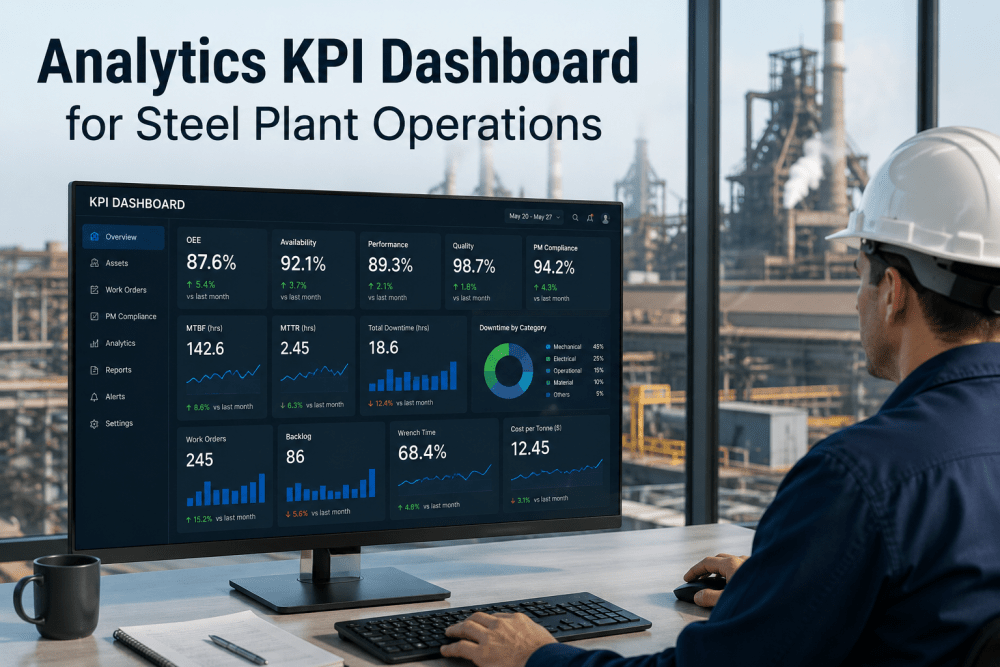
While the industry is currently saturated with Industry 4.0 "connectivity" solutions, the global steel leaders are already transitioning toward Manufacturing 6.0 — the era of Cognitive Autonomy. In a standard Industry 4.0 plant, analytics act as a "dashboard" for human intervention; in a 6.0 environment, the analytics system is the decision-maker. Powered by Autonomous Analytics, these systems don't just predict a bearing failure in a rolling mill; they simultaneously cross-reference the digital supply chain, re-schedule the production queue to minimize strain on the affected asset, and execute a "Self-Healing" control sequence to stabilize vibration until a planned maintenance window. Manufacturing 6.0 is the final bridge to the "Dark Factory" — where cognitive AI manages the physical world with a level of precision that exceeds human operational capacity. See the 6.0 Roadmap Demo.
Manufacturing 6.0 in Steel: Beyond Connectivity to Autonomous Analytics
True autonomy isn't about more sensors — it's about the cognitive ability to self-diagnose and self-optimize without human intervention. iFactory is the engine behind the world's first 6.0-ready steel mills.
The Industrial Evolution Breakdown — Where Does Your Plant Sit?
Transitioning to 6.0 is a multi-generational jump. Most plants are currently stuck in the "Industry 4.0 Gap" — where they have data but lack the cognitive loops to act on it autonomously. iFactory provides the bridge from reactive automation to cognitive autonomy.
Under the Hood: How 6.0 Autonomous Analytics "Thinks"
In Manufacturing 6.0, the analytics system follows a cognitive loop that mimics a PhD metallurgist, but at millisecond speeds. See the 4-stage autonomous sequence triggered during a ladle-teeming anomaly.
Multi-Modal Perception
The system ingests vibration, thermal imagery, and acoustic emissions simultaneously. It doesn't just see a "hot spot"; it perceives the internal refractory wear pattern.
Digital-Twin Simulation
Before acting, the system runs 100,000 "what-if" scenarios in the digital twin to determine the safest possible operational adjustment without stopping production.
Autonomous Execution
The cognitive engine sends a direct command to the PLC to adjust ladle tilt-speed and cooling water flow. No human approval is required for this standard safety-compensation.
Self-Healing Verification
The system monitors the result. If the refractory wear stabilizes, it auto-schedules a repair for the specific 4:00 PM shift where part availability is confirmed.
The Pillars of a Manufacturing 6.0 Ecosystem
Generative Metallurgy
AI that designs new alloy compositions autonomously to meet specific customer requirements for strength and ductility.
Self-Healing Assets
Predictive maintenance that doesn't just alert — it adjusts machine parameters to extend component life automatically.
Cognitive Supply Chain
An autonomous link between the blast furnace and the global iron ore market, buying feedstock based on real-time energy prices.
Dark Unit Autonomy
Entire process sections (e.g., continuous caster) operating with zero human presence, managed by iFactory's cognitive kernel.
Predictive vs. Autonomous — Closing the Information Gap
| Analytic Trait | Industry 4.0 (Predictive) | Manufacturing 6.0 (Autonomous) |
|---|---|---|
| Primary Goal | Informing human decisions | Executing machine decisions |
| Human Role | The Active Operator | The Policy Strategist |
| Response Time | Minutes to Hours (Alert -> Action) | Milliseconds (Cognitive Loop) |
| Data Integration | Siloed by department | Holistic / Self-Correlating |
| Reliability | Variable (dependent on operator skill) | Standardized (deterministic cognitive AI) |
Frequently Asked Questions — The Future of Autonomous Steel
Is Manufacturing 6.0 just another name for completely automated plants?
Not exactly. Automation is about repetition (doing the same thing). Autonomy is about cognition (doing the right thing when variables change).
Industry 3.0 automated the physical task; Manufacturing 6.0 autonomizes the mental task of operational decision-making.
Will autonomous analytics eliminate the need for experienced metallurgists?
It shifts their focus. Instead of babysitting sensor data, metallurgists become "Model Architects" and "Policy Managers."
They define the physical boundaries and safety rules (the Policy) within which the autonomous systems operate at much higher speeds than humans could manage.
What is the #1 technical barrier to reaching 6.0 maturity?
It is usually "Data Latency." For a system to be autonomous, it must ingest, simulate, and act in real-time.
Many plants have the right sensors but have "swampy" data architectures that take seconds to process — which is too slow for high-speed rolling or furnace control loops.
Can a legacy brownfield steel plant ever reach 6.0 status?
Yes, via "Edge-Cognition" retrofitting. By layering iFactory's autonomous kernel over existing PLCs, even 40-year-old casters can exhibit autonomous behaviors.
The 6.0 revolution is primarily a software and mental-model shift, not necessarily a physical machinery replacement.
Stop Measuring Performance. Start Automating Performance.
Join the select group of Tier-1 steel producers transitioning to the world's first autonomous cognitive plant model.