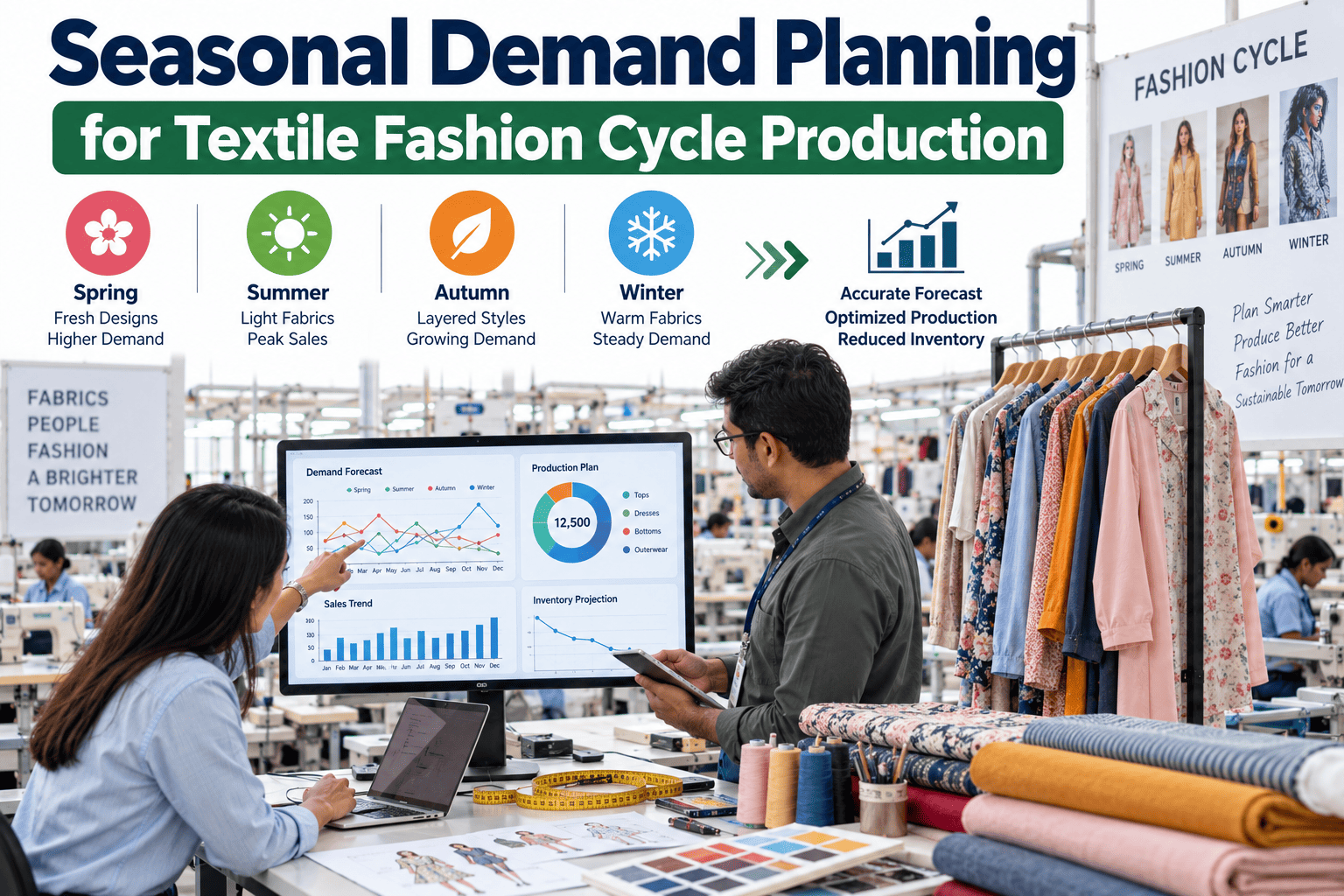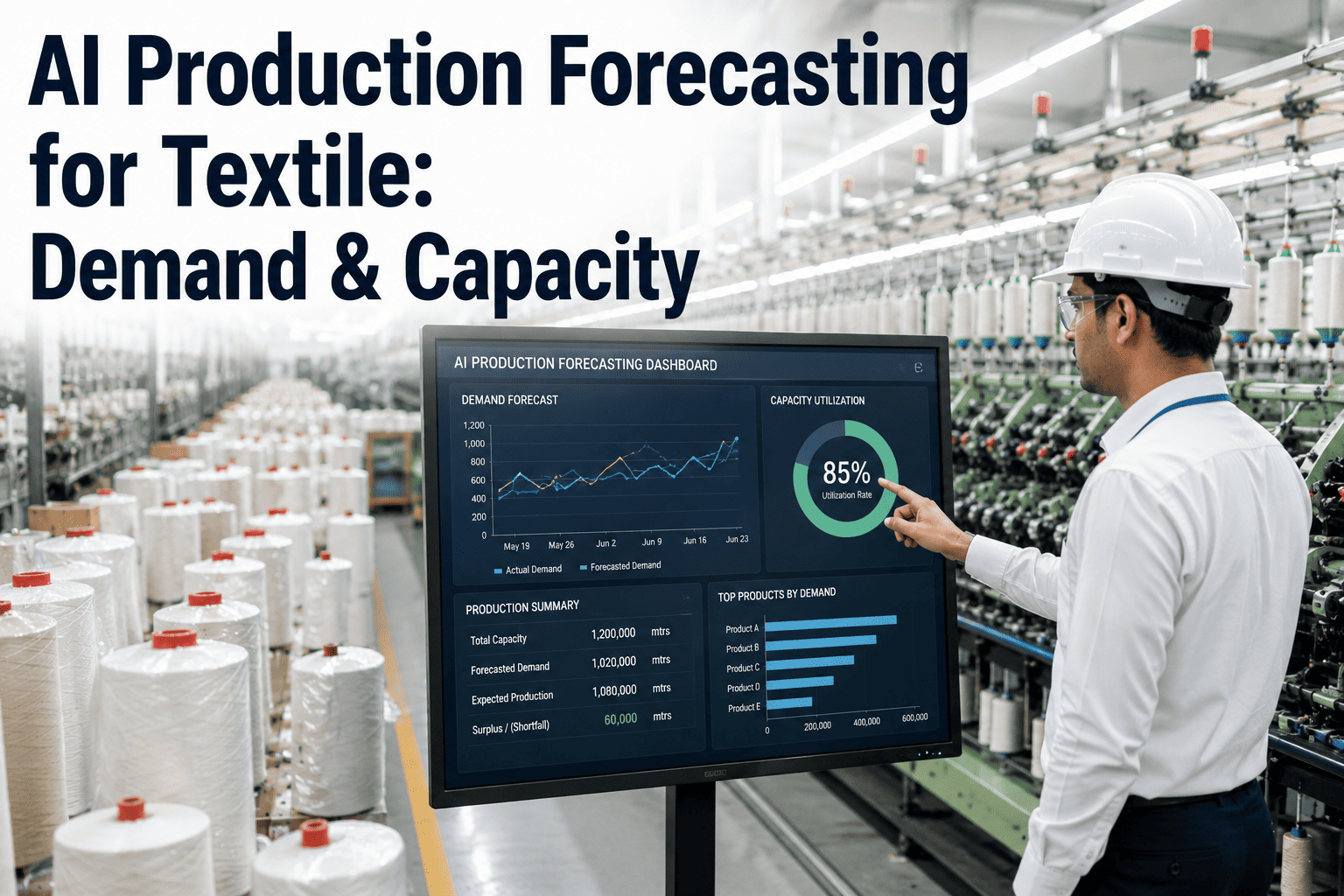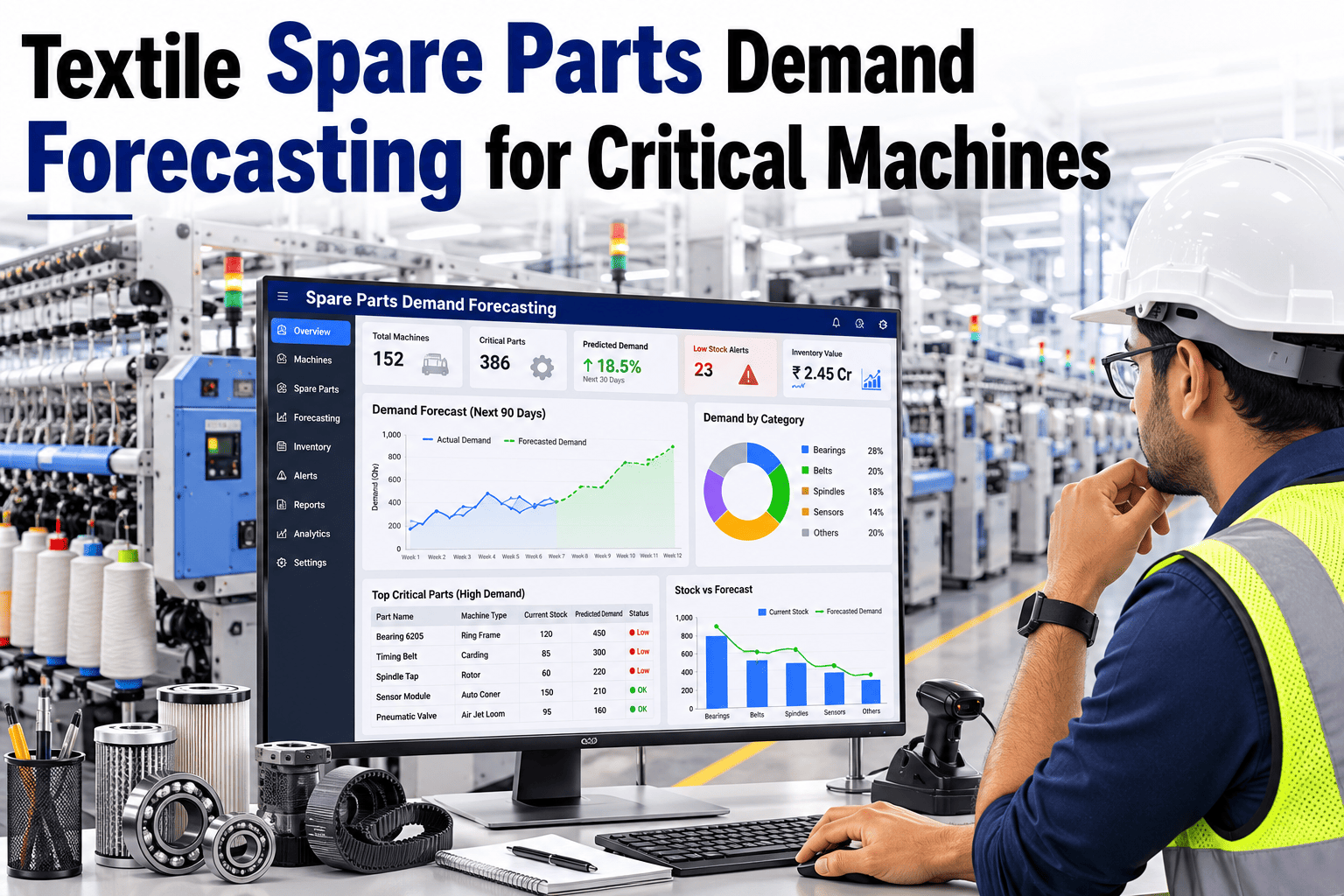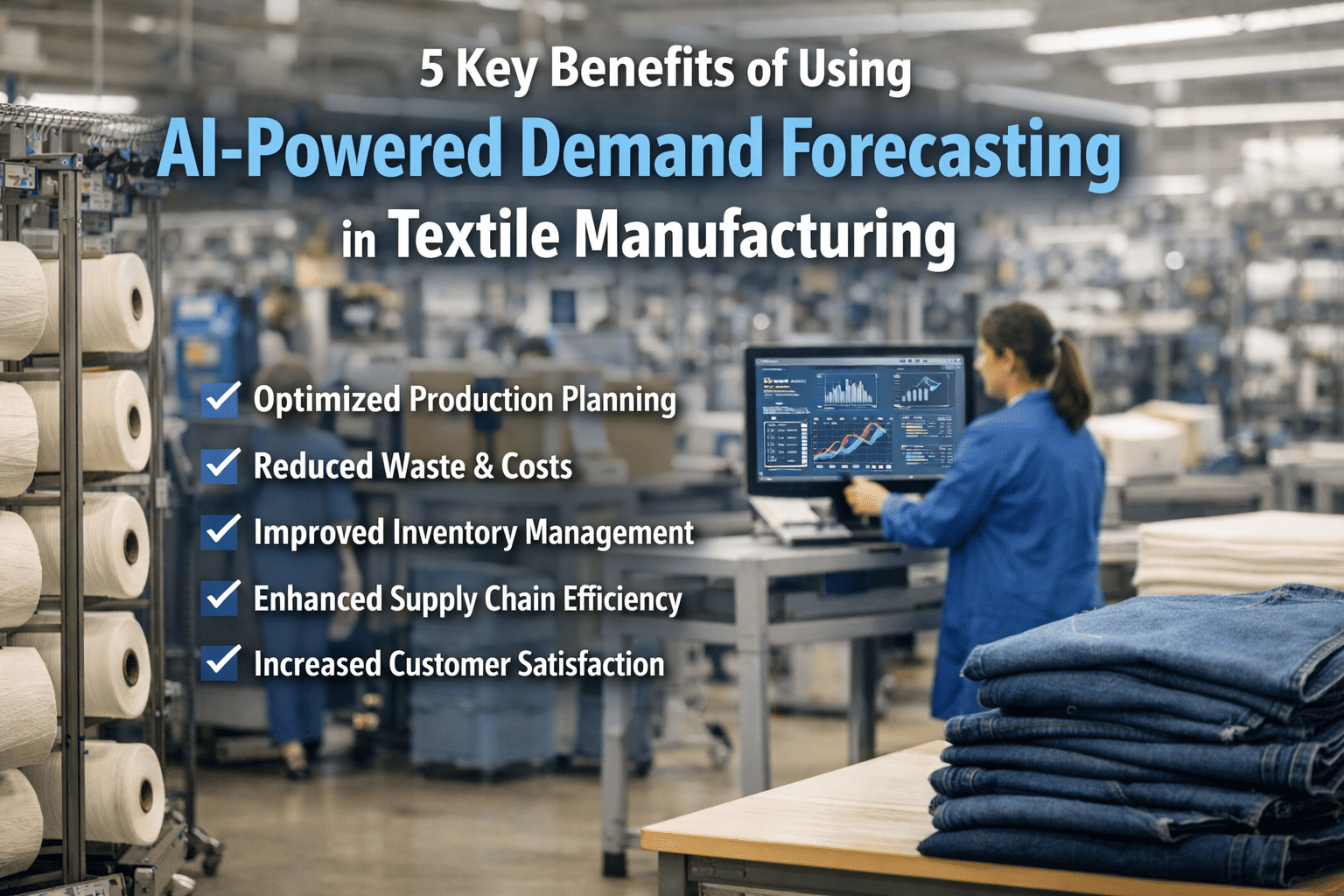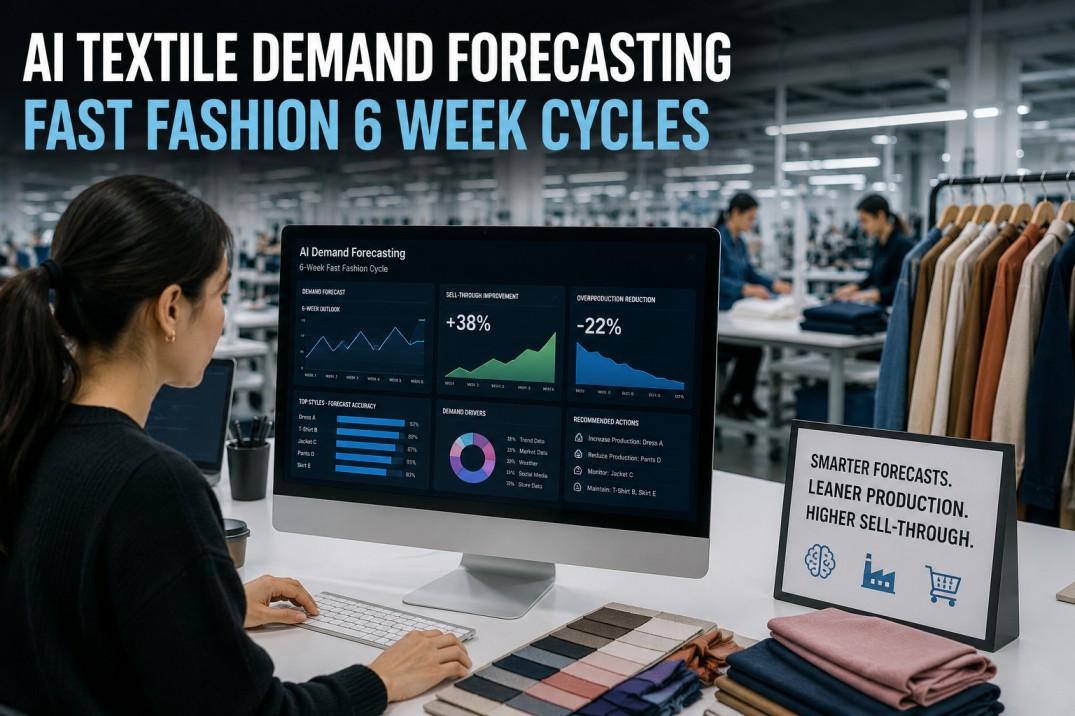
Fast fashion's 6-week design-to-shelf cycle has made demand forecasting the single highest-impact lever for textile manufacturers and apparel brands, with overproduction wasting an estimated 28% of all fashion production and markdowns consuming 30–40% of retail margins across the industry. Traditional forecasting methods — seasonal averages adjusted by buyer intuition — typically achieve 55–65% accuracy at the SKU level, leaving manufacturers caught between costly stockouts that lose revenue and costly overruns that destroy margins. AI-powered demand forecasting changes this equation fundamentally, using machine learning models trained on years of sell-through data, real-time point-of-sale feeds, trend signals from social media and search, and external variables like weather patterns and macroeconomic indicators to predict demand at the SKU-region-week level with 82–90% accuracy. This page presents the six-week fast fashion sprint cycle, compares AI versus traditional forecast accuracy across four critical retail metrics, profiles six AI capabilities that reduce overproduction 22% and improve sell-through 38%, describes the on-demand microfactory workflow that makes short-run replenishment economically viable, and outlines a phased implementation roadmap for manufacturers transitioning to AI-driven demand planning.
AI Textile Demand Forecasting for Fast Fashion 6-Week Cycles
The shift from seasonal fashion calendars to continuous, data-driven demand cycles creates both pressure and opportunity for textile manufacturers. Brands that once placed orders four to six months ahead now require 4–6 week lead times with ongoing replenishment decisions driven by real-time sell-through data. Manufacturers that integrate AI demand forecasting into their production planning can reduce overproduction exposure, capture premium pricing through higher sell-through rates, and secure preferred supplier status with brands pursuing AI-driven inventory optimization across their sourcing networks.
Build AI-Driven Demand Planning Into Your Production Workflow
iFactory's platform integrates AI demand forecasting with production planning, inventory management, and order tracking across your factory floor. Schedule a demo to see how leading manufacturers are reducing overproduction and improving sell-through with AI-powered demand insights.
The Fast Fashion 6-Week Sprint Cycle
Fast fashion operates on a compressed, continuous cycle that repeats every six weeks, with each week playing a distinct role in moving from trend identification to customer purchase. Understanding this cycle is the foundation for aligning AI demand forecasting with production planning, because each week requires different data inputs and generates different demand signals that the forecasting model must incorporate in real time.
Trend analysis, AI-generated style recommendations, digital sample development
Material procurement based on AI demand forecasts, fabric commitment by SKU
Initial production run sized by AI volume recommendation, quality verification
Allocation to stores and DCs based on regional AI demand heat maps
In-market sell-through tracking, real-time POS data fed back to forecasting model
AI-driven restock decisions, markdown optimization, next cycle forecast recalibration
AI vs Traditional Forecast Accuracy
The gap between traditional and AI-driven demand forecasting is measurable across four retail metrics that directly impact manufacturer production planning and brand buying behavior. AI models that incorporate sell-through data, trend signals, and external variables consistently outperform manual forecasting methods by 20–30 percentage points across all four metrics.
Bring AI Forecasting Accuracy to Your Factory Floor
Connect your production planning to AI-driven demand signals. iFactory's platform integrates with retail POS data feeds, trend analytics, and your MES to align production runs with real market demand. Book a demo to see how AI forecasting reduces overproduction and captures more full-price sales.
AI Capabilities Driving Overproduction Reduction and Sell-Through Improvement
Six AI capabilities form the core of modern demand forecasting for fast fashion textile production, each addressing a specific failure point in the traditional forecasting-to-production cycle. Together they deliver the 22% overproduction reduction and 38% sell-through improvement that AI-optimized supply chains report.
ML models trained on 3+ years of sell-through data predict optimal initial order quantities at the SKU level, reducing the safety buffer that drives overproduction.
Time-series forecasting with real-time POS feedback adjusts production allocation weekly, directing capacity to SKUs with accelerating demand velocity.
Demand sensing models detect early sell-through acceleration and trigger automatic replenishment orders before stockout occurs, during the 6-week cycle.
AI models predict end-of-season inventory risk by SKU-region and recommend optimal markdown timing and depth to clear inventory at maximum margin.
Ensemble models combining gradient boosting, LSTM neural networks, and causal inference improve SKU-region-week accuracy from 55–65% to 82–90%.
Fewer unsold units means less fabric waste, reduced sample production, lower returns processing, and decreased end-of-life disposal per unit sold.
On-Demand Microfactory Workflow for Fast Fashion Replenishment
On-demand microfactories bridge the gap between AI demand signals and physical production by enabling economically viable short-run replenishment within the 6-week cycle. Unlike traditional bulk production that requires minimum order quantities of 500–2,000 units per SKU, microfactory workflows can economically produce runs of 50–300 units per SKU with a 2–3 week turnaround from digital design to finished goods, enabling true demand-driven replenishment.
AI-generated pattern specifications from trend data, no physical samples needed
Nesting algorithms minimize fabric waste 15–20% vs traditional manual layout
Single-ply laser or knife cutting with zero changeover between SKU runs
Modular workstations configured for quick-change sewing cells, batch-of-one capability
Individual or small-batch fulfillment direct from microfactory to customer
Implementation Roadmap for AI-Driven Demand Forecasting
Implementing AI demand forecasting in a textile manufacturing environment follows a phased approach that builds data infrastructure, model capability, and production integration sequentially. The full deployment timeline spans 8–12 months from initial data audit to fully integrated AI-driven production planning.
- Data audit of 3+ years of order, production, and sell-through records
- Integration point identification between retail systems, MES, and ERP
- KPI baseline for overproduction, stockout, sell-through, and markdown rates
- Single category or SKU group AI model training and validation
- Parallel run comparing AI recommendations vs traditional forecasts
- Model calibration and accuracy threshold setting for production use
- Multi-category expansion with automated data pipeline from retail sources
- Production planning integration: AI forecasts feed directly into MES scheduling
- Dashboard deployment for merchandising, production, and brand teams
- Continuous model retraining with weekly accuracy monitoring
- Automated replenishment triggers linked to microfactory production cells
- Full P&L impact tracking: overproduction, margin recovery, sell-through gains
Frequently Asked Questions About AI Textile Demand Forecasting
What data does an AI demand forecasting model need to be effective?
An effective AI demand forecasting model requires at least three years of historical sell-through data at the SKU-region-week level, including sales volume, price, promotional activity, and inventory position. Additional predictive accuracy comes from incorporating trend signals (social media mentions, search volume, fashion week coverage), external variables (weather, economic indicators, calendar events), and real-time POS feeds that enable mid-cycle forecast adjustments. The most accurate models combine all three data types and retrain weekly to capture emerging patterns.
How does AI forecasting integrate with existing production planning systems?
AI forecasting integrates with existing production planning through API-based data pipelines connecting the forecasting engine to the manufacturer's MES and ERP systems. The forecasting model outputs SKU-level demand predictions in a format that the production scheduling system can consume, typically as weekly production quantity recommendations with confidence intervals. Leading implementations use a human-in-the-loop workflow where the AI generates a recommended production plan, the planning team reviews and adjusts within specified thresholds (typically ±10%), and the final plan is executed in the MES.
What is the typical ROI timeline for AI demand forecasting deployment?
Manufacturers deploying AI demand forecasting typically achieve positive ROI within 6–12 months of production deployment, driven by three primary impact areas. Overproduction reduction (22% average) translates to direct raw material savings of 15–25% in the first year. Sell-through improvement (38% average) increases full-price revenue 12–18% as fewer units require markdown. Stockout reduction (11 percentage point decrease) recovers 5–8% in previously lost revenue. Total first-year impact for a mid-sized manufacturer (500–2,000 workers) typically ranges from $500,000–$2,000,000, depending on product category mix and starting forecast accuracy baseline.
Can AI forecasting work for small and mid-sized textile manufacturers?
Yes, and small to mid-sized manufacturers often see the largest relative improvement because their starting forecast accuracy is typically lower than large manufacturers with dedicated planning teams. Cloud-based AI forecasting platforms have reduced the cost barrier significantly — implementation for a 200–500 worker factory starts at $30,000–$80,000 with a 3–6 month deployment timeline. These platforms use pre-built models that require minimal customization, connect to standard MES and ERP systems through existing APIs, and deliver measurable results within the first production cycle.
How does AI forecasting handle fashion trend changes and novelty items?
Novelty items and trend-driven SKUs with no historical sales data are the most challenging forecasting scenario. AI models handle this through similarity-based transfer learning, where the model identifies analogous products from previous seasons (same category, similar price point, comparable silhouette) and uses their demand patterns as a baseline. Social media sentiment analysis and search trend data provide additional signals for trending styles. For true new-to-world products, manufacturers should plan initial production at 40–50% of the AI's upper confidence bound and use the first two weeks of sell-through data to recalibrate the remaining production allocation.
Transform Your Demand Planning With AI Forecasting
iFactory's AI-powered demand forecasting platform helps textile manufacturers and brands reduce overproduction, improve sell-through, and optimize inventory across the 6-week fast fashion cycle. Connect your production planning to real demand signals and capture more full-price sales with every season.