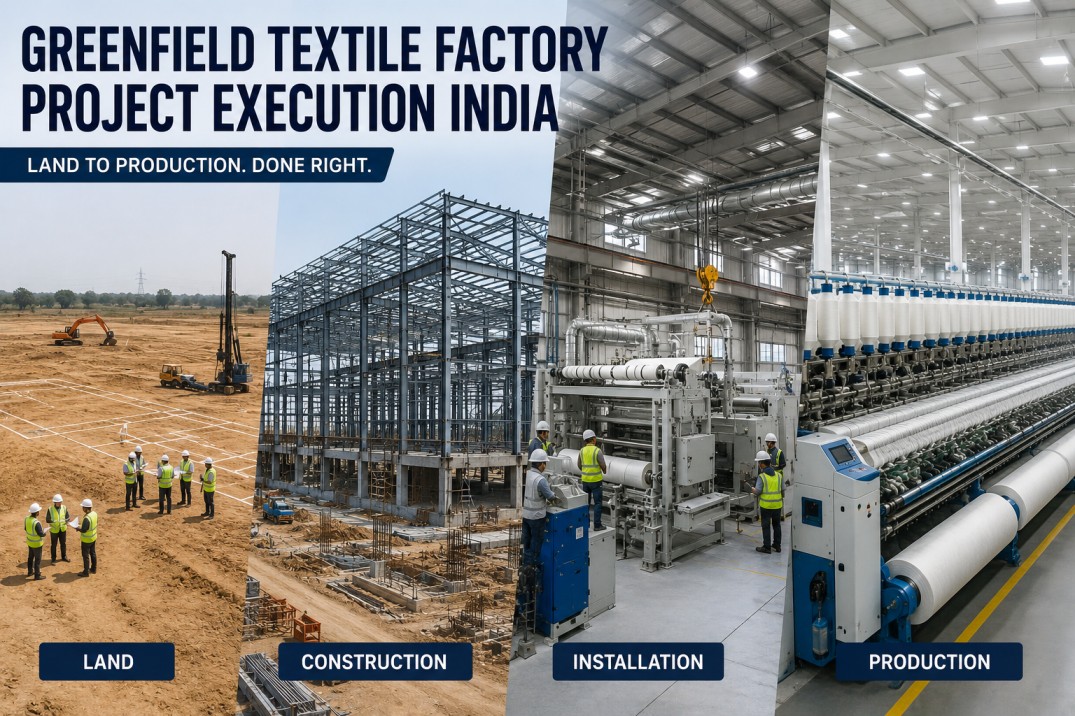
Building a textile factory from empty land to commercial production is one of the most complex capital projects in manufacturing, requiring coordinated execution across civil engineering, utility infrastructure, machinery procurement, installation sequencing, and digital systems integration — all within a 12–18 month window that determines the project's financial viability. A greenfield textile factory in India with 25,000–50,000 ring spindles, 200–400 looms, and integrated processing facilities typically requires ₹200–₹500 crore total investment, of which 45–50% is machinery, 25–30% land and building, 10–15% utilities and infrastructure, 5–8% digital and automation systems, and 5% contingency and project management. The difference between projects completed on time and within budget versus those that run 6–12 months late and 15–30% over budget is almost always the quality of upfront planning — site selection, layout design, utility sizing, machinery sequencing, and digital backbone specification must be completed in the first 3–4 months before any construction begins. This page presents the 14-month execution roadmap with a Gantt-style phase overview, detailed phase cards covering the complete project lifecycle, a utility sizing dashboard for an integrated mill, the digital backbone architecture that enables Industry 4.0 from day one, and a budget allocation breakdown by cost category.
Greenfield Textile Factory — From Land to Production in 14 Months
A well-planned greenfield textile factory project follows six sequential phases, each with clearly defined deliverables, approval gates, and resource allocations. The timeline assumes a mid-sized integrated mill with spinning, weaving, and processing capabilities on a 20–25 acre site. Larger projects or those with additional capabilities like garmenting or home textiles typically require 16–20 months but follow the same phase structure and sequencing principles.
Plan Your Greenfield Factory With Confidence
iFactory's platform helps project teams design and simulate the digital backbone, MES architecture, and production workflows before construction begins, ensuring your greenfield factory is Industry 4.0 ready from day one. Book a demo to see how leading project consultants plan the digital infrastructure of new textile factories.
14-Month Execution Roadmap — Phase Overview
The Gantt overview below shows the six project phases mapped across the full 14-month execution timeline. Each phase has a defined start and end point, with dependencies between phases that determine the critical path. Concurrent execution of non-dependent activities is the primary driver of overall project speed — the phases below are designed to maximize parallel work streams.
Project Phase Deep-Dive — Activities and Deliverables
Each phase in the execution roadmap includes specific activities, deliverables, and approval gates that must be completed before the next phase can begin. The descriptions below provide a practical overview of what each phase entails for a typical greenfield integrated textile mill project.
- Site evaluation and geotechnical survey
- Production capacity and machinery configuration finalization
- Building layout, material flow, and utility system design
- Environmental clearance and approvals applications
- Vendor shortlisting and initial procurement orders
- Site grading, road network, and drainage construction
- Power substation, transformer, and HT cable installation
- Borewell, water treatment plant, and storage tank construction
- Boiler foundation and steam piping network
- Compressed air system and distribution piping
- Spinning hall, weaving shed, and process house construction
- Warehouse, godown, and raw material storage buildings
- Administrative building, canteen, and worker facilities
- HVAC system, humidity control, and dust extraction
- Fiber optic backbone for digital infrastructure
- Spinning line: blowroom, carding, draw frame, ring frame, winding
- Sizing and warping for weaving preparatory section
- Loom installation and alignment by machine group
- Dyeing machines and finishing equipment positioning
- Material handling systems and conveyor network
- Individual machine dry run and performance verification
- Integrated production line trial from blowroom to finished fabric
- MES and digital system integration with production equipment
- Quality parameter validation against specification targets
- Operator training and standard operating procedure finalization
- Gradual capacity ramp from 30% to 85% over 12 weeks
- Quality and efficiency optimization through process tuning
- Supply chain activation for raw material and spares procurement
- Customer qualification samples and order fulfillment
- Project close-out and handover to operations team
Build Your Factory's Digital Backbone From Day One
iFactory's platform provides the MES, production monitoring, and quality management systems that should be specified during Phase 1 design and deployed before Phase 5 commissioning. Book a demo to learn how leading project consultants integrate digital infrastructure into greenfield textile factory projects from the start.
Utility Sizing Dashboard for an Integrated Textile Mill
Utility infrastructure is the backbone of a textile factory and must be sized correctly during the design phase to avoid costly retrofits during production. The dashboard below shows the key utility requirements for a mid-sized integrated mill with 35,000 spindles and 300 looms, including estimated investment and typical supplier options for each utility system.
Digital Backbone Architecture for Industry 4.0 Ready Factories
The digital backbone of a greenfield textile factory should be designed and specified during Phase 1 alongside the building layout and utility systems, not added after construction is complete. A well-architected digital infrastructure deployed during construction costs 50–60% less and delivers 2–3x more capability than retrofitting the same systems into an existing factory.
Greenfield Factory Budget Allocation by Cost Category
The total investment for a mid-sized integrated textile mill typically ranges from ₹200–₹500 crore, depending on land location, building specifications, machinery configuration, automation level, and utility infrastructure requirements. The donut chart below shows the typical allocation across major cost categories for a 35,000 spindle + 300 loom integrated mill.
Frequently Asked Questions About Greenfield Textile Factory Projects
How long does it really take to build a textile factory from scratch?
A well-planned greenfield integrated textile mill with spinning, weaving, and processing typically takes 14–18 months from land acquisition to commercial production. The critical path is determined by the building construction timeline (6–8 months) and machinery delivery lead time (3–6 months for most equipment from order placement). Projects that complete within 14 months achieve this through parallel execution of site preparation, building design, and machinery procurement during the first 3 months. Delays most commonly occur during the approvals stage (environmental clearance, building permits, power connection) which can add 2–6 months if not started early.
What are the most common causes of budget overruns in greenfield projects?
The three most common causes of budget overruns are inadequate geotechnical investigation (leading to foundation redesign costing ₹2–5 Cr), incomplete utility sizing at the design stage (requiring expensive retrofits to power, water, or steam capacity), and machinery selection changes during construction (vendor switches or specification upgrades that require building layout modifications). Together these three factors account for 60–70% of all budget overruns in greenfield textile projects. A thorough front-end engineering and design phase costing 2–3% of total project investment typically saves 10–15% in avoided changes and delays during construction.
When should the digital infrastructure be planned and installed?
Digital infrastructure should be designed during Phase 1 (months 1–3) alongside the building layout and electrical design, with the physical backbone — fiber optic cabling, structured data cabling conduits, server room, and edge device mounting points — installed during Phase 3 building construction (months 3–8). The MES platform and production monitoring systems should be deployed during Phase 5 commissioning (months 8–11) and integrated with machinery during the individual machine trial stage. Factories that plan digital infrastructure during Phase 1 pay 50–60% less for installation and get 2–3x more integration capability than factories that retrofit digital systems after production has started.
How should machinery procurement be sequenced to avoid installation delays?
Machinery procurement should be sequenced by delivery lead time and installation dependency. Long lead time items (ring frames with 4–6 month delivery, looms with 3–5 month delivery, dyeing machines with 3–4 month delivery) must be ordered in Phase 1 to arrive in time for Phase 4 installation. Critical dependency items — boilers and compressed air systems must be installed and commissioned before production machinery can be tested — should be ordered early and expedited for delivery before the main production equipment arrives. A well-managed procurement schedule places all machinery orders within the first 4 months, with staggered delivery dates aligned to the installation sequence.
What approvals and clearances are needed before construction can begin?
A greenfield textile mill requires environmental clearance from the State Pollution Control Board (category based on project scale), building plan approval from the local municipal or development authority, consent to establish under the Water and Air Acts, fire department NOC, factory license from the Chief Inspector of Factories, and power connection approval from the state electricity board. The environmental and building approvals typically take 2–4 months and should be initiated during Phase 1 immediately after site finalization. Engaging an experienced project consultant who has worked with the relevant authorities on similar projects typically reduces approval time by 30–50% through proper documentation and application sequencing.
Start Your Greenfield Factory Project With a Solid Digital Foundation
iFactory's MES and production management platform is designed to be specified during factory design and deployed during commissioning, giving your new factory Industry 4.0 capabilities from the day production starts. Book a demo to see how leading project consultants integrate iFactory into greenfield textile factory projects across India.