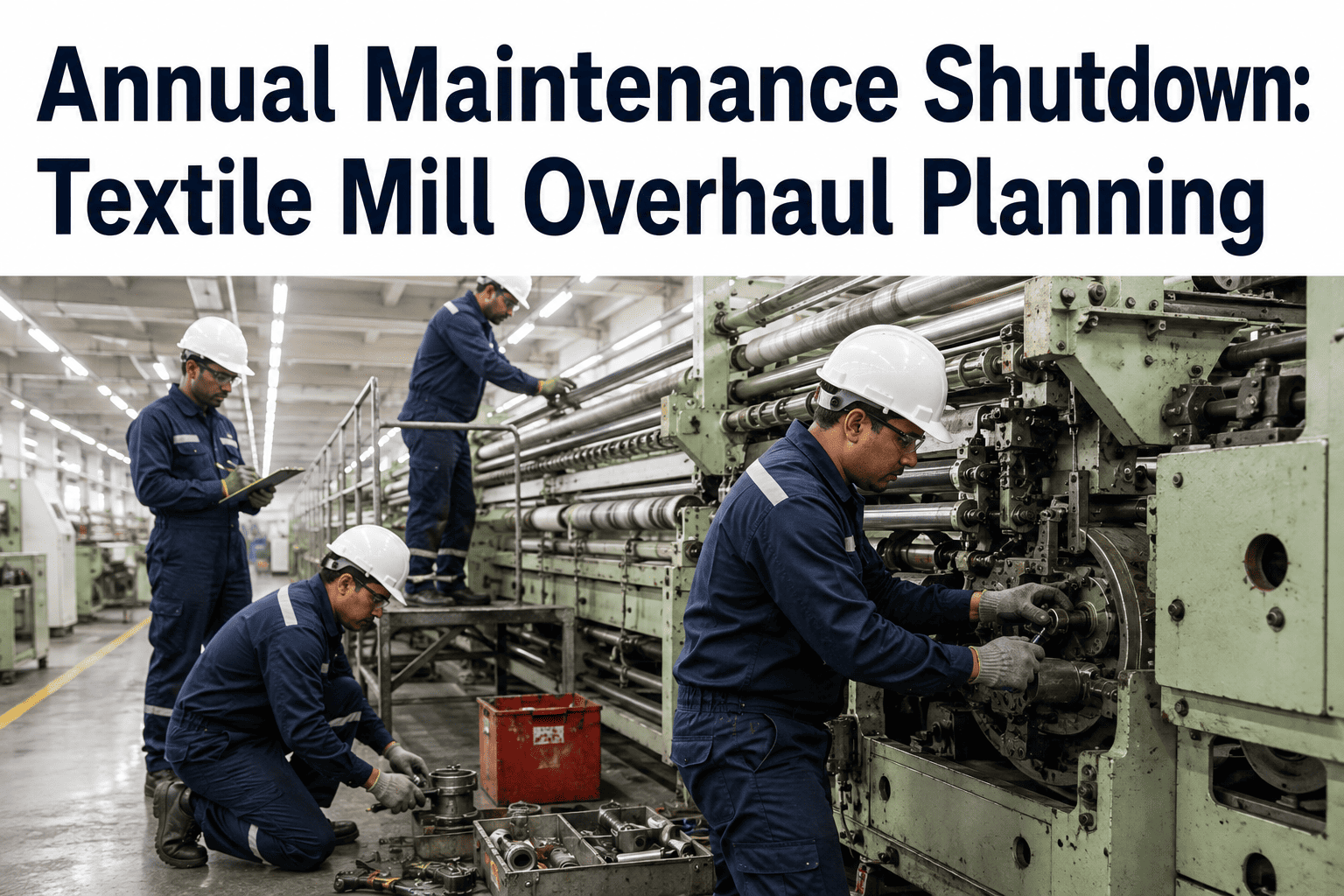
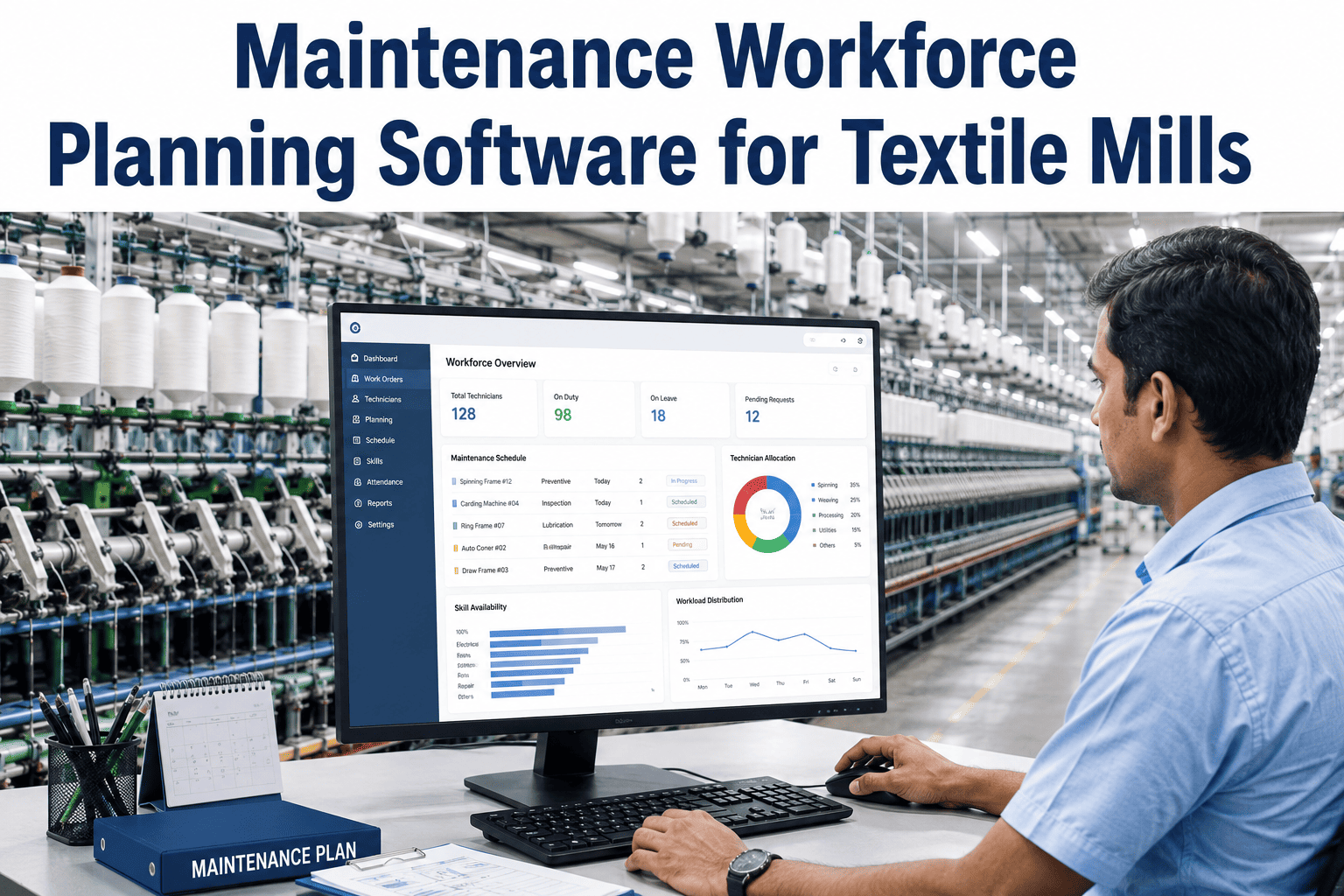
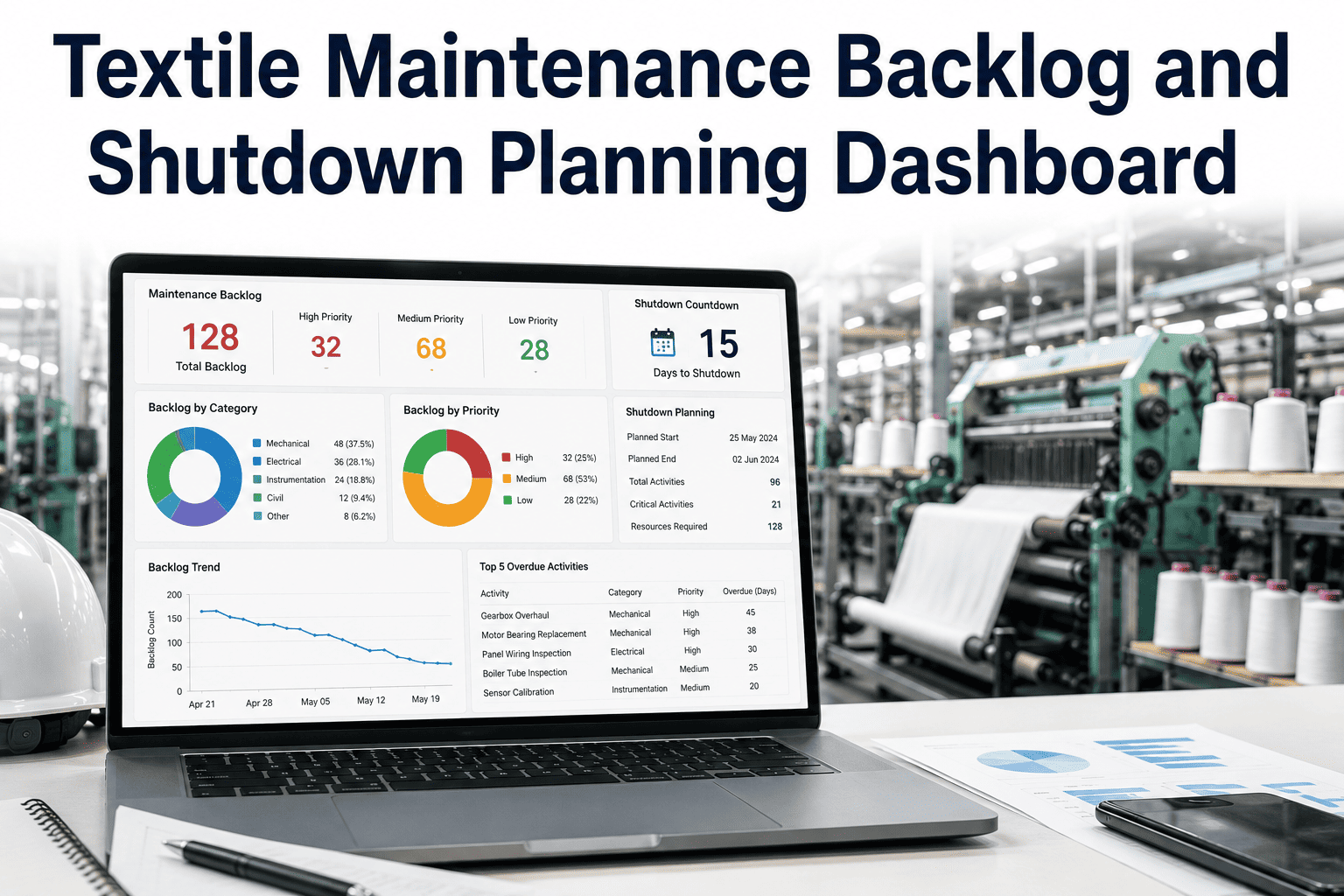
A five-day annual shutdown sounds like a short window until you try to fit forty-seven overdue repairs, a gearbox change on a ring frame line, and a full sizing machine overhaul into it. Textile mills that treat the annual shutdown as "the week we catch up on everything" almost always run long, and running long on a shutdown does not just cost overtime — it delays the restart of every spinning, weaving, or finishing line that depends on that equipment being back online. The mills that consistently hit their restart date treat the shutdown as a scoped, scheduled project with a scope freeze, a critical path, and a procurement calendar that starts months before anyone picks up a wrench, not as a reactive scramble that begins the Monday the lines go down. What separates a shutdown that finishes on time from one that spirals is rarely the amount of work — it is how far in advance that work was planned, and mills that want to see how a connected maintenance platform tracks scope and schedule against a live restart date can book a demo.
TEXTILE MILL MAINTENANCE
Annual Shutdown Planning: Get Maximum Work Done in a Fixed Window
A scope-freeze discipline, a procurement calendar, and a critical path schedule turn a chaotic outage week into a predictable, on-time overhaul.
80%+of industrial turnarounds run over budget by more than 10%
3–5xhigher cost for unplanned outage time versus planned shutdown time
8–12weeks minimum lead time needed for specialty spare parts
1/3of an annual maintenance budget often consumed by a single shutdown week
Why Scope Discipline Decides Whether the Shutdown Finishes On Time
Textile mills running ring frames, draw frames, carding lines, and weaving sheds share a structural problem with any process plant that only stops once a year: every department wants their overdue jobs added to the list, and every added job without a corresponding hour of removed work pushes the restart date. The single biggest predictor of an overrun shutdown is not the total number of jobs on the scope register — it is how many jobs got added after the scope freeze, typically set at eight to ten weeks before the shutdown window opens. Mills that enforce written sign-off from both production and maintenance leadership for any post-freeze addition consistently finish closer to schedule than mills that treat the scope list as a living document until the day work starts.
Shutdown Countdown — Where Discipline Has to Hold
Week -12Scope register opens across all departments
Week -10Risk-based selection: mandatory vs discretionary work sorted
Week -8Scope freeze — written sign-off required for any addition
Week -6Work packages built: labor, materials, tools, permits
Week -2Crew assignments, spares staged, contractor confirmations locked
Week 0Shutdown window opens
Building the Scope Register: Mandatory vs Discretionary
Every job that lands on the shutdown scope register should be challenged with one question before it earns a place: does this genuinely require the line to be stopped, or can it be done during normal running or deferred to next quarter's minor outage? Mills that skip this filter end up spending shutdown hours on work that never needed the machine to be down in the first place, crowding out the jobs — gearbox overhauls, roller regrinding, spindle alignment, sizing box descaling — that genuinely cannot happen any other way.
| Category | Examples in a Textile Mill | Typical Share of Scope Hours |
|---|
| Mandatory — Safety/Regulatory | Guard replacement, e-stop testing, dust extraction certification, fire suppression checks | 15–20% |
| Mandatory — Reliability-Critical | Ring frame spindle bearing change, loom gearbox overhaul, carding wire replacement | 35–45% |
| Discretionary — Improvement | Draw frame autoleveler upgrade, humidification retrofit, sensor installation for condition monitoring | 15–25% |
| Discretionary — Deferred Minor Work | Cosmetic repairs, non-critical panel replacement, low-priority calibration | 10–15% |
| Capital Project Tie-Ins | New winder installation, sizing machine upgrade coordinated with shutdown window | Varies by year |
SEE YOUR OWN SCOPE REGISTER TRACKED LIVE
Stop Managing Shutdown Scope on Spreadsheets
A connected platform tracks every work order, crew assignment, and spare part against the restart date so scope creep gets caught before it costs a day.
The Critical Path: Work Backward From the Restart Date
A shutdown schedule built by adding up estimated durations and hoping they fit inside the window is a schedule built for an overrun. The more reliable approach starts from the fixed restart date and works backward, mapping the critical path — the longest chain of dependent jobs, such as gearbox removal, bearing delivery, reassembly, and alignment — and testing whether the available crew hours genuinely support that chain finishing on time. Every job not on the critical path has schedule float; every job on it does not, and protecting that chain from delay is the scheduler's actual job during the shutdown week.
1Map Job DependenciesIdentify which repairs cannot start until another finishes — a loom cannot be realigned until the new gearbox is installed and torqued.
2Identify the Longest ChainTrace the sequence of dependent jobs with the greatest total duration — this chain, not the total job count, sets the minimum shutdown length.
3Flag Critical Path ItemsAny delay on a critical path job — a late-delivered bearing, a no-show contractor crew — pushes the restart date by the same number of hours.
4Protect Float on Everything ElseNon-critical jobs can absorb minor delays without threatening restart — resource them second, after the critical chain is fully staffed.
5Track in Real Time, Not on PaperA shutdown schedule that only gets updated at the daily 7am meeting is already hours behind reality on a multi-crew, multi-department outage.
Contractor and Crew Coordination Across Departments
A textile mill shutdown typically pulls together internal maintenance crews, specialty contractors for gearbox and electrical work, and OEM service technicians for spinning and weaving machinery — often three or four organizations working in the same shed on overlapping timelines. Coordination failures between these groups are one of the most common causes of shutdown delay, and they rarely show up as a single dramatic incident; they show up as a contractor crew standing idle for two hours waiting on an isolation permit, or an OEM technician arriving before the machine has been prepped for their scope of work.
Internal Maintenance CrewOwns machine isolation, guard removal, and general mechanical work across spinning, weaving, and finishing departments.
Specialty ContractorsHandles gearbox rebuilds, electrical panel work, and structural repairs requiring certifications the internal crew may not hold.
OEM Service TechniciansPerforms warranty-covered or precision calibration work on ring frames, looms, and sizing machines that requires factory training.
Quality and Production LiaisonConfirms handback readiness and signs off that each restored line meets running spec before production resumes.
Material and Spare Parts Procurement Lead Times
Waiting until thirty days before the shutdown to order a replacement gearbox or a specialty bearing guarantees a delay, because the parts that most commonly hold up a textile mill overhaul are exactly the ones with the longest lead times. Ordering discipline — flagging long-lead items the moment they hit the scope register, not after the work package is finalized — is one of the cheapest ways to protect a restart date, and it costs nothing beyond the habit of checking lead time before checking price.
Common Fasteners, Belts, Filters
Standard Bearings, Rollers
Ring Frame / Loom Gearboxes
OEM-Specific Electronic Cards
The Overrun Traps That Catch Even Experienced Teams
Most shutdown overruns are not caused by a single catastrophic failure — they are caused by a handful of familiar, well-documented traps that experienced teams still fall into when the pressure of a fixed window meets an incomplete plan. Recognizing these patterns before the shutdown starts is the difference between a team that adapts and a team that spends the last two days explaining the delay upward.
Compressing Scope Instead of Cutting ItAssuming labor hours will "somehow fit" the window instead of honestly removing discretionary jobs when the critical path is already full.
Post-Freeze Additions Without Sign-OffThe single largest documented cause of shutdown budget overruns across process industries, including textile manufacturing.
Ordering Long-Lead Parts Too LateA gearbox ordered at week -4 with a ten-week lead time is not arriving before the shutdown starts, regardless of how urgently it is chased.
Skipping the Isolation Handover StepRushing equipment handover from operations to maintenance creates safety risk and rework when a machine is not actually ready for the scoped work.
TRACK SCOPE, SCHEDULE, AND SPARES IN ONE PLACE
Give Your Planning Lead a Live View of the Whole Shutdown
See exactly which work orders are on the critical path, which parts are still in transit, and which crews are behind schedule — before the daily standup, not during it.
Closing the Loop: Post-Shutdown Review and the Next Cycle
The best time to start planning next year's shutdown is the week this one ends, while the schedule variances, cost overruns, and near-misses are still fresh enough to analyze honestly. Mills that skip the structured post-shutdown debrief tend to repeat the same scheduling mistakes every cycle, because the lessons live only in the memory of whoever happened to be on shift when the delay occurred, and that memory fades faster than the planning calendar resets.
01Startup Sign-OffOperations formally accepts each line back, closing the work orders tied to that asset.
02Debrief Within 2 WeeksMaintenance, production, and contractor leads review schedule adherence, cost variance, and safety findings together.
03Analyze Scope GrowthEmergency work orders raised mid-shutdown are reviewed for patterns that should move into next year's planned scope.
04Archive for BenchmarkingFinal labor, parts, and cost data is captured so next year's estimates are built on real numbers, not guesses.
Frequently Asked
Textile Mill Shutdown Planning — Common Questions
How far in advance should a textile mill start planning its annual shutdown?
Best-practice facilities open the scope register roughly twelve months before the shutdown window, though the intensive planning work concentrates in the final ten to twelve weeks before the outage begins. The early opening matters most for capital-tied work — a sizing machine upgrade or a new winder installation coordinated with the shutdown needs long-lead equipment ordered and civil or electrical prep completed well before the mechanical scope is finalized. Mills that only start planning eight weeks out are almost always working with a compressed scope-freeze window, which increases the odds that legitimate mandatory work gets cut to protect the schedule rather than protected as it should be. A rolling planning calendar, where the next shutdown's register opens the week the current one closes, removes this compression entirely.
What is the scope freeze and why does it matter so much for staying on schedule?
The scope freeze is the point, typically eight to ten weeks before the shutdown, after which any new job requires written sign-off from both operations and maintenance leadership before it can be added to the register. It matters because post-freeze additions are consistently the single largest documented cause of shutdown budget and schedule overruns — a "while we're in there" job that seemed reasonable in isolation carries hidden hours and dependencies that were never accounted for in the critical path schedule. Enforcing the freeze does not mean genuinely urgent safety issues get ignored; it means every addition goes through a deliberate approval step rather than sliding onto the list informally, which is usually enough friction to keep the scope honest without blocking real emergencies.
How should a mill prioritize scope when the critical path is already full before the window closes?
The honest answer is to cut discretionary scope rather than compress estimated durations, because labor hours for confirmed jobs do not shrink just because the calendar feels tight. Every job on the register should be challenged against a simple test — does this genuinely require the line to be down, and can it be deferred to a minor outage or done during normal running instead — and mandatory safety and reliability-critical work should always be protected first. When the critical path chain, the longest sequence of dependent jobs, does not honestly fit the available window, that is information the planning team should act on by trimming discretionary work, not a gap to be closed by hoping the crew moves faster than their estimates suggest.
Which spare parts most commonly cause textile shutdown delays, and how early should they be ordered?
Specialty gearboxes for ring frames and looms, OEM-specific electronic control cards, and precision bearings are the parts most likely to hold up a restart, with lead times commonly running six to twelve weeks or longer depending on the manufacturer and part availability. The practical rule is to flag any part with a lead time longer than the remaining time to the shutdown the moment it appears on a work package, rather than waiting until the full scope register is finalized to start ordering. Mills that build a parts and inventory system into their shutdown planning, cross-referencing every planned work order against on-hand stock as soon as the scope is set, catch these long-lead risks weeks earlier than mills relying on a manual parts list reviewed once before the outage.
What should a post-shutdown review actually cover to improve next year's planning?
A structured debrief held within two weeks of restart should bring operations, maintenance, and contractor leads together to review schedule adherence against the original critical path, cost variance against the baseline budget, any safety incidents or near-misses, and the quality of the handback process. Reviewing emergency work orders raised during the shutdown for patterns — recurring failure types, jobs that should have been on the planned scope but weren't caught until the equipment was already open — turns those incidents into inputs for next year's register rather than one-off surprises. For teams that want a platform to run this whole cycle, from scope register through work order tracking to the archived benchmark data,
support can walk through how it fits an existing maintenance workflow.
STOP PLANNING YOUR NEXT SHUTDOWN ON A SPREADSHEET
One Platform for Scope, Schedule, Spares, and the Restart Date
See exactly where every work order, crew, and part stands against the critical path — and finish this year's overhaul closer to on time than last year's.