Most textile mills do not have a maintenance problem so much as a maintenance culture problem. Machines get fixed after they break, operators are told to run the equipment and leave the fixing to maintenance, and the same spindle or loom fails for the same reason every few months because nobody owns the small daily checks that would have caught it early. Total Productive Maintenance restructures that relationship by making equipment care a shared responsibility between operators and maintenance technicians, built around eight defined pillars rather than a vague call to "work together better." iFactory helps textile mills put the data infrastructure behind a TPM rollout, and you can book a demo to see how machine-level data supports each of the eight pillars.
Total Productive Maintenance for Spinning, Weaving, and Wet Processing
TPM turns equipment reliability from a maintenance department task into a plant-wide discipline, and iFactory provides the machine data that makes each of the eight pillars measurable rather than aspirational, so leadership can track progress the same way it tracks production output.
Why Reactive Maintenance Quietly Drains Mill Output
A reactive maintenance culture feels normal from the inside because everyone is busy all the time, but that constant activity is a symptom rather than a sign of good management. Technicians spend their shift running from one urgent breakdown to the next, which leaves no time for the inspection and lubrication routines that would prevent the next breakdown, and the cycle repeats itself indefinitely. Operators, meanwhile, are trained to run the machine and report a fault, not to notice the early vibration, unusual sound, or temperature drift that a technician would recognize as a warning sign days before failure. Over months and years this dynamic compounds, because every hour spent firefighting is an hour not spent building the preventive systems that would reduce the fires in the first place, and mill leadership ends up budgeting for a maintenance department sized to handle constant emergencies rather than one sized to prevent them. The four patterns below describe what this looks like on a typical spinning or weaving floor before TPM is introduced.
Maintenance technicians spend most of their shift responding to active breakdowns, leaving no scheduled time for the preventive checks that would reduce the number of breakdowns in the first place, so the department is always one step behind the next failure.
Operators are told equipment care is a maintenance department responsibility, so early warning signs like unusual noise, vibration, or minor leaks go unreported until they become full failures that stop the line mid-shift.
The same machine fails for the same root cause repeatedly because each breakdown is treated as an isolated repair rather than an input into a documented improvement process that could prevent recurrence.
Maintenance training stops at basic repair skills, so technicians never build the diagnostic capability needed to catch failures before they stop a machine mid-shift, and expertise stays locked in a few senior individuals.
None of these patterns are a sign that a maintenance team is not working hard, they are a sign that hard work is being spent in the wrong place, on repairs instead of prevention, because the systems that would redirect that effort were never built. TPM exists specifically to redirect that effort, one pillar at a time, without requiring the mill to hire an entirely new maintenance department to do it.
The Eight Pillars of Total Productive Maintenance
TPM is not a single initiative, it is eight interlocking disciplines that together shift a mill from reacting to breakdowns toward preventing them and eventually designing them out entirely. Each pillar addresses a different gap in a typical maintenance organization, from the operator's daily relationship with their machine to how a brand new loom is specified before it ever arrives on the floor. Mills that try to adopt all eight at once usually stall, because there is not enough training capacity or management attention to change eight habits simultaneously, so the sequence below reflects the order in which most successful textile TPM rollouts introduce each pillar, starting with the ones that build operator engagement early and finishing with the ones that require the most organizational maturity.
Autonomous Maintenance
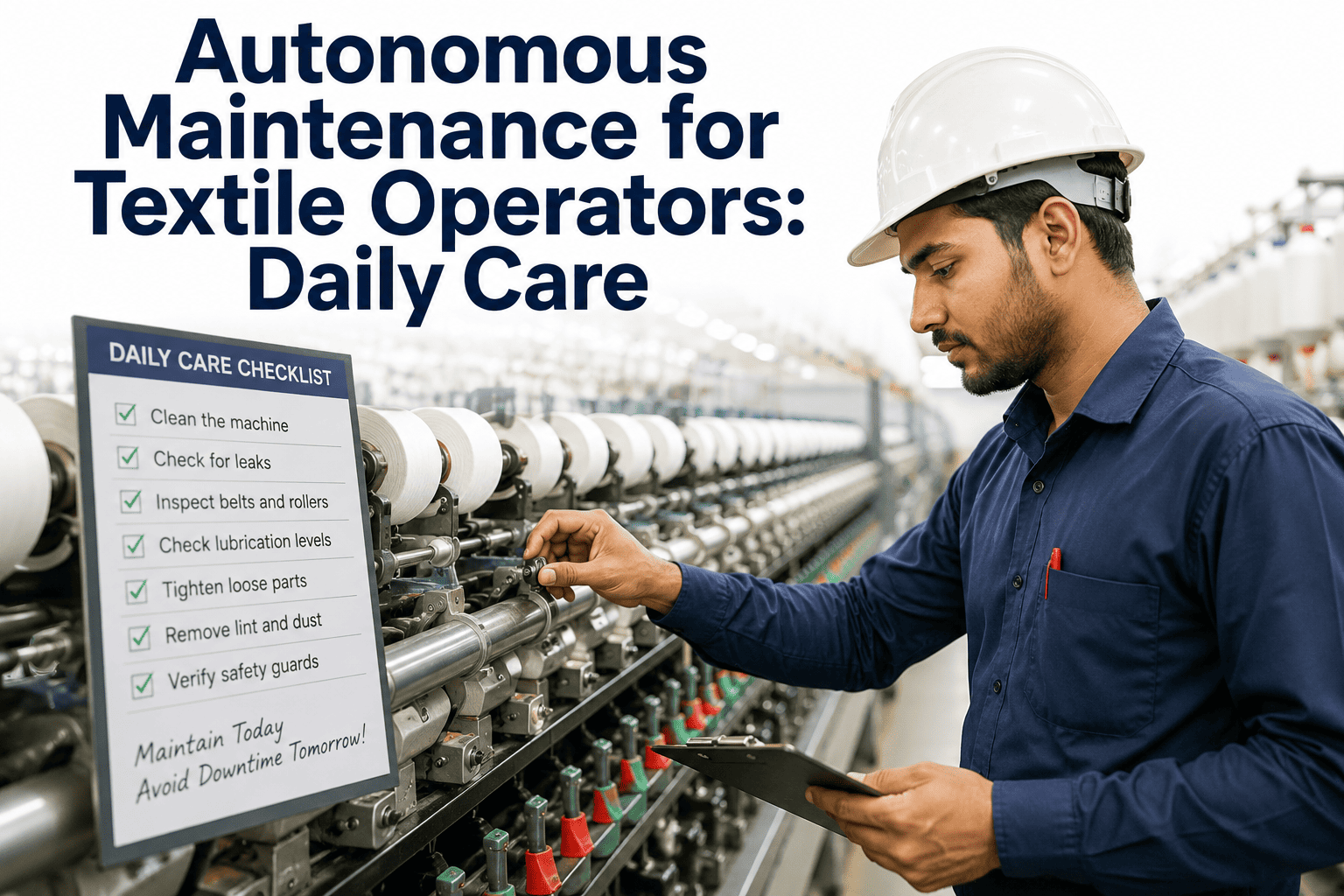
Operators take ownership of cleaning, lubrication, and basic inspection on their own machines, catching early warning signs before they escalate into a stoppage.
Planned Maintenance
Maintenance shifts from reactive repair to a scheduled program based on actual failure history and manufacturer intervals for each specific machine type on the floor.
Quality Maintenance
Equipment conditions that cause defects, such as tension drift, roller wear, or temperature variance, are identified and controlled before they ever reach the fabric.
Focused Improvement
Cross-functional teams target the specific machines and failure modes causing the largest share of downtime using structured root cause analysis and follow-up tracking.
Early Equipment Management
Maintainability and reliability requirements are built into the specification of new looms and frames before purchase rather than discovered after installation.
Training and Skill Development
Operators and technicians progress through a defined skill matrix so equipment knowledge does not depend entirely on one senior person's memory or tenure.
Safety, Health, Environment
Equipment-related safety incidents are tracked with the same rigor as breakdowns, since poor equipment condition is consistently a leading cause of floor injuries.
Office TPM
Planning, procurement, and administrative processes that support maintenance, such as spare parts ordering and work order tracking, are held to the same discipline as the shop floor.
What Autonomous Maintenance Actually Looks Like on the Spinning Floor
Autonomous maintenance is usually the first pillar a mill introduces because it delivers visible results within weeks and builds the operator engagement that every later pillar depends on. In practice, it starts with a single machine and a single operator, not a plant-wide mandate. The operator is trained to recognize the difference between normal running condition and early signs of wear, such as a slight change in spindle sound, an unusual bobbin build, or a minor oil residue near a bearing housing, and to log those observations on a simple checklist rather than waiting for a full breakdown to report anything. A maintenance technician reviews these logs daily during the first few weeks, using them to catch issues the operator flagged correctly and to coach on issues that were missed, building the operator's diagnostic skill over time rather than assuming it exists from day one. As confidence grows, the checklist expands to cover basic cleaning and lubrication tasks the operator can safely perform, freeing maintenance technicians to focus on the planned maintenance and root cause work that autonomous maintenance alone cannot solve. The mills that get this pillar right typically see a meaningful drop in minor stoppages within the first quarter, simply because problems that used to run unnoticed for days are now caught within a single shift. This shift also changes the tone of the relationship between operators and maintenance technicians, which matters more than it sounds. In a reactive culture, a technician arriving at a broken machine is often met with frustration or blame, but in a mill running autonomous maintenance, the technician arrives to review a log the operator kept, and the interaction becomes a shared diagnosis rather than an adversarial handoff. That change in tone is quietly one of the strongest predictors of whether a TPM program survives its first year, because the later pillars all depend on operators and technicians trusting each other enough to share information honestly.
What Planned Maintenance Requires Once Autonomous Maintenance Is Established
Planned maintenance only works as well as the failure history feeding it, which is why it is introduced after autonomous maintenance rather than before. Once operators are logging observations consistently, that data becomes the raw material for building a schedule based on how machines actually fail in this specific mill rather than how a manufacturer assumes they fail on average. A technician reviewing three months of operator logs alongside the maintenance department's own repair records can usually identify which failure modes are truly time-based, such as bearing wear that tracks reliably with running hours, and which are condition-based, such as tension drift that depends more on humidity and fiber type than on the calendar. Time-based failures move onto a fixed schedule, while condition-based failures are better served by the inspection checkpoints operators are already performing under autonomous maintenance, avoiding unnecessary teardown of equipment that is still running well. This distinction is one of the most common places mills get planned maintenance wrong when they skip straight to it without first building the autonomous maintenance data, because a schedule built purely on manufacturer defaults treats every failure as time-based and ends up either over-maintaining machines that do not need it or under-maintaining the ones that do.
Why Some TPM Rollouts Stall After a Strong Start
A TPM program that shows great pilot results sometimes still fails to spread across the rest of the mill, and the reasons are usually organizational rather than technical. The most common cause is treating the pilot line's success as proof that TPM works everywhere without adapting the checklists and training approach to the different machine types and shift patterns found elsewhere in the plant, which leads operators on the second and third lines to see the program as a poor fit for their equipment rather than a proven method. A second common cause is losing management attention once the pilot's early results are reported, since sustaining a culture shift requires visible leadership involvement well past the first successful quarter, not just an announcement at the launch. A third cause is failing to give maintenance technicians the time relief that planned maintenance is supposed to create, so they remain too busy firefighting to properly coach operators on the next line, which stalls the rollout at exactly the stage where it needs momentum. Mills that succeed treat the pilot as the first of several deliberate expansions rather than as the finish line, with a clear owner responsible for carrying the program to each new department.
Reactive Maintenance Versus a TPM Culture
The table below contrasts the day-to-day reality of a reactive maintenance department against a mill that has embedded the TPM pillars into its daily routine. The differences show up less in any single dramatic change and more in the accumulation of small habits that, over a year, separate a mill constantly chasing breakdowns from one that plans its maintenance work the same way it plans production.
| Dimension | Reactive Maintenance | TPM Culture |
|---|---|---|
| Operator Role | Runs the machine, reports faults after they occur | Performs daily cleaning, inspection, and early fault detection |
| Maintenance Focus | Repairing active breakdowns as they happen | Scheduled inspection and prevention based on failure history |
| Failure Analysis | Repair and move to the next call, no documented root cause | Structured root cause analysis feeding a continuous improvement log |
| New Equipment | Maintainability issues discovered after installation | Reliability requirements specified before purchase through early equipment management |
| Skill Development | Informal, dependent on individual experience | Structured skill matrix with defined progression for operators and technicians |
Introducing TPM Without Stopping the Mill
A TPM rollout fails when it is announced plant-wide on day one, because there is no way to train every operator and technician at once without disrupting production, and a mandate with no proof of results tends to be treated as a passing initiative rather than a lasting change. The stages below describe the pilot-first approach that gives a mill working proof points before asking every department to change how it operates.
Select a Pilot Line
One spinning or weaving line with a clear downtime problem is chosen as the pilot, giving the rollout a visible, measurable success story before wider adoption begins across the mill.
Train Autonomous Maintenance
Operators on the pilot line are trained on daily cleaning, inspection, and fault-reporting checklists, with maintenance technicians coaching during the first several weeks of the program.
Introduce Planned Maintenance
Maintenance schedules are rebuilt around actual failure history from the pilot line rather than generic manufacturer intervals, freeing technicians from constant firefighting for the first time.
Expand Plant-Wide
The pilot line's results and checklists become the template for rolling autonomous and planned maintenance out to every remaining department in the mill on a defined schedule.
What Changes After a Mill Adopts TPM
The figures below reflect the typical range of improvement textile mills report after a pilot line completes its first two quarters under a structured TPM program, measured against the same line's performance before the rollout began, and are consistent enough across mills of different sizes that they are commonly used as the business case for expanding a pilot to the full plant.
Early fault detection through autonomous maintenance checklists catches wear-related issues days before they would have caused a full stoppage on the line.
Fewer unplanned stops and shorter changeovers combine to lift the OEE score on pilot lines within the first two quarters of the program.
Structured root cause analysis under the focused improvement pillar prevents the same failure mode from recurring on the same machine month after month.
Technicians spend less time on emergency call-outs once planned maintenance absorbs the workload that used to arrive unpredictably throughout the week.