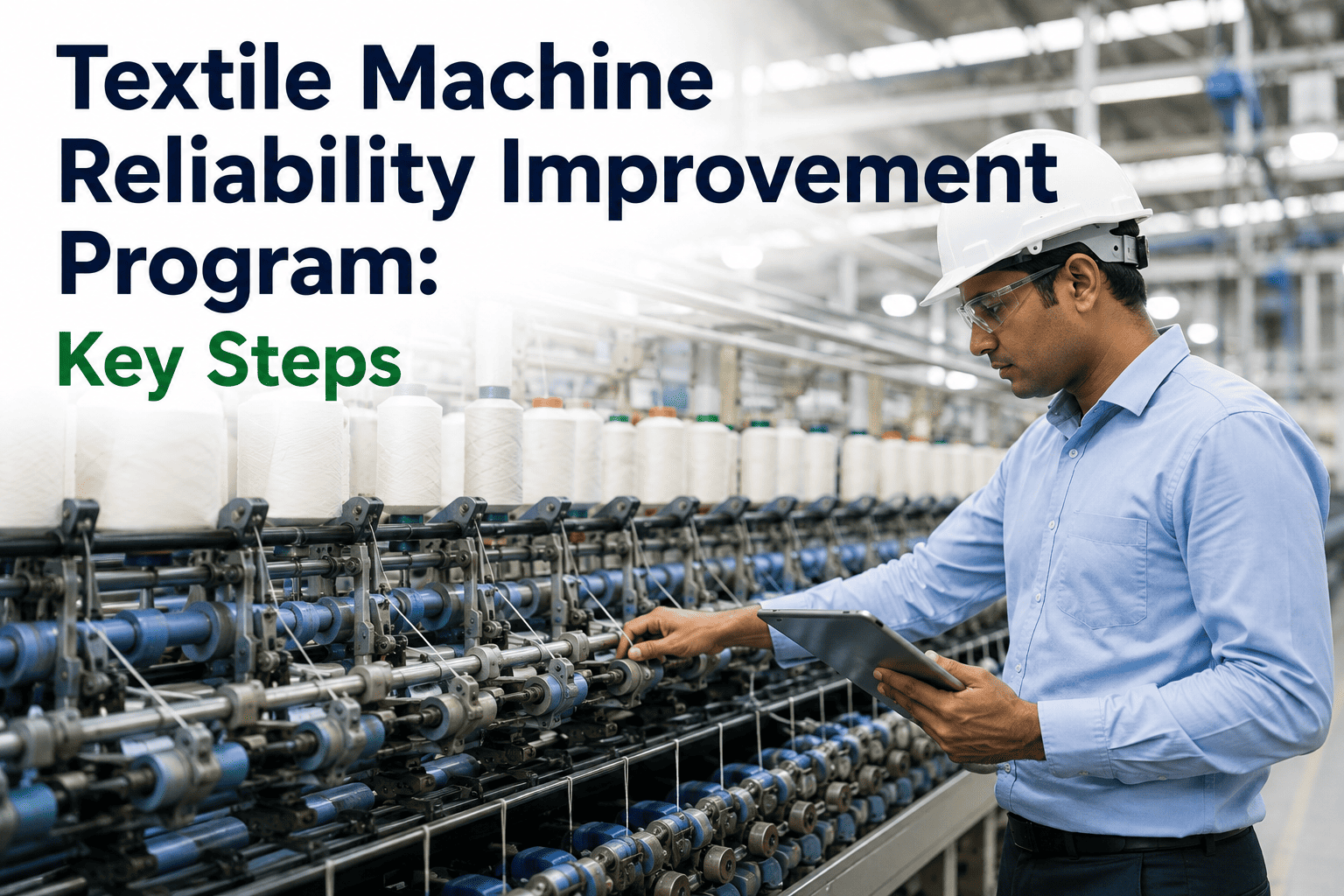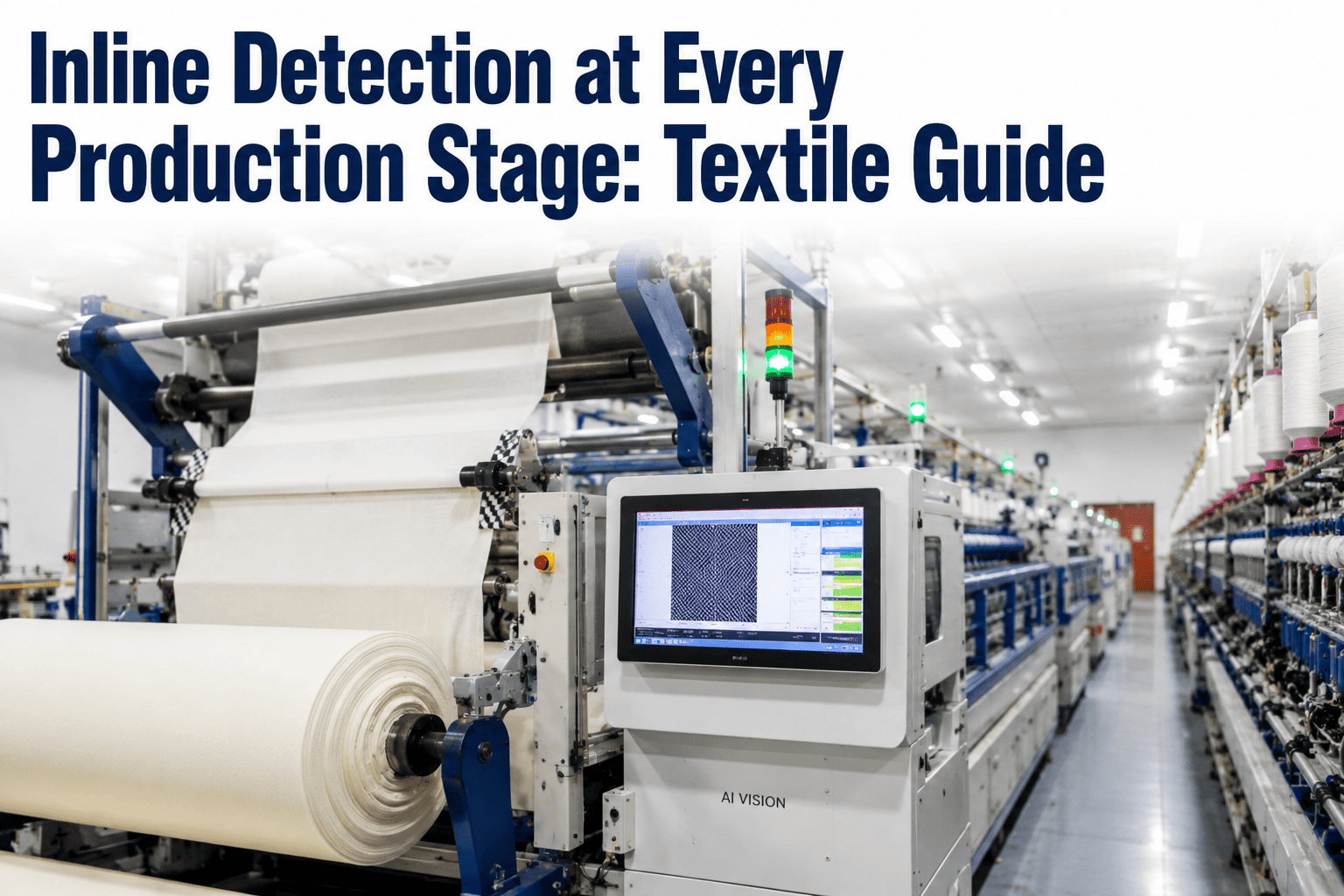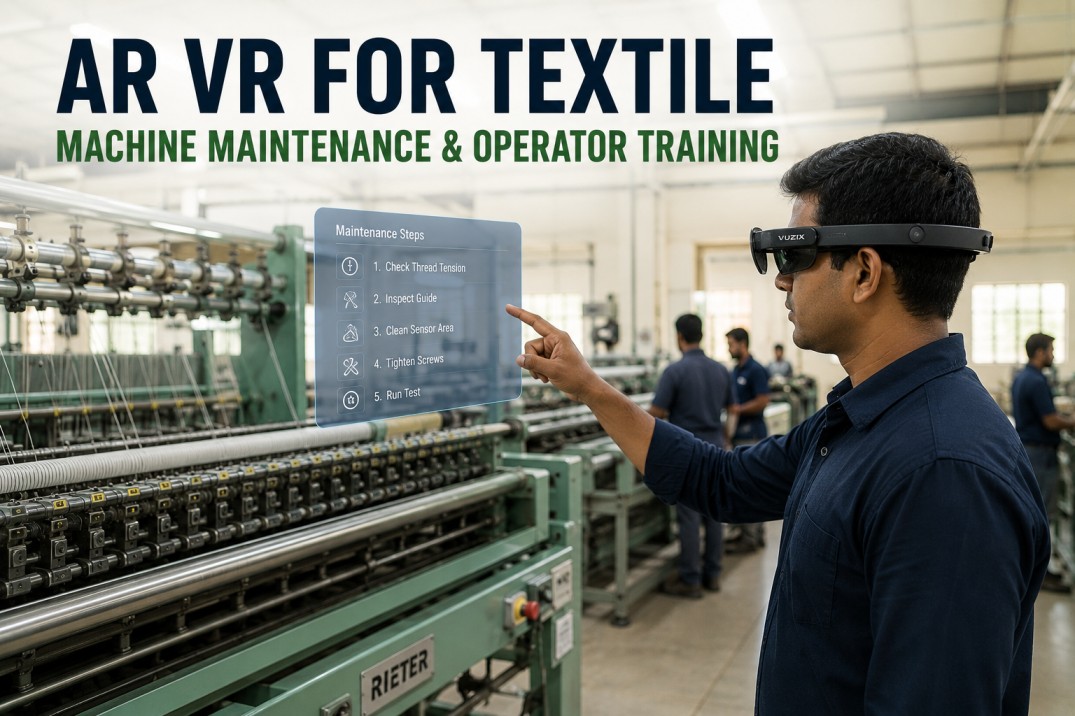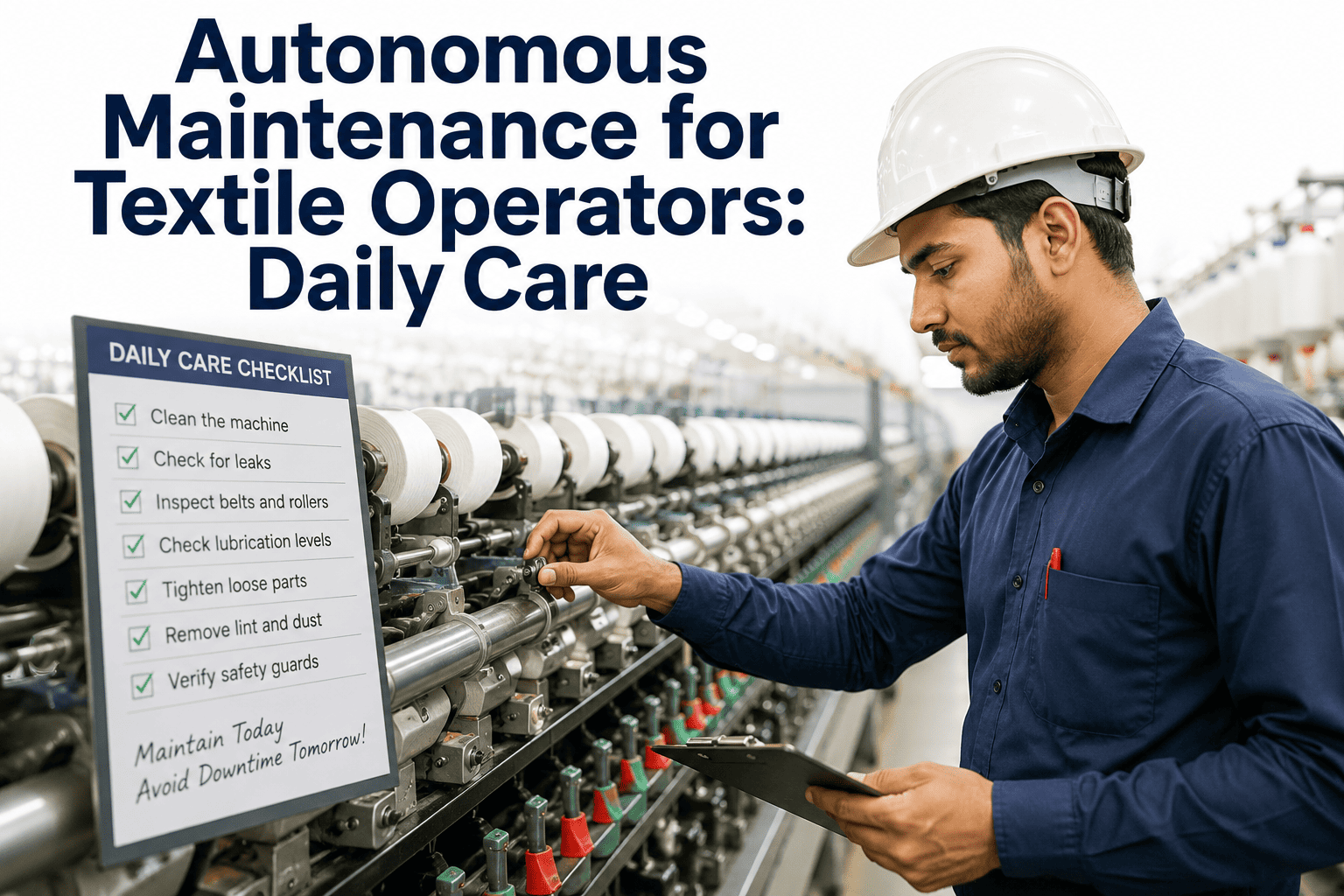
Seventy-eight percent of operators never perform a routine equipment inspection, even though they stand closer to the machine than anyone else in the plant, every single shift. In a textile mill, that gap is especially costly — lint, fiber fly, and dust accumulate on spinning frames, looms, and knitting machines faster than almost any other manufacturing environment, and a bearing quietly running hot under a layer of built-up fiber debris rarely announces itself before it seizes. The people best positioned to catch that early warning sign are standing at the machine already, watching it run every single shift — the only thing missing in most mills is a structured way to make that observation count. iFactory's autonomous maintenance module turns the operator's daily walk-around into a structured, mobile-guided routine — so lint buildup, loose fasteners, and early bearing wear get caught during a ten-minute check instead of during an unplanned stop.
The Operator Who Runs the Loom Every Shift Is Your Best Early-Warning System
Autonomous maintenance is the foundational TPM pillar that moves daily cleaning, lubrication, and inspection from "eventually someone will notice" to a structured operator routine — built through seven progressive steps.
What Autonomous Maintenance Actually Asks of a Textile Operator
Autonomous maintenance, known in the original TPM literature as Jishu Hozen, transfers ownership of basic equipment care — cleaning, inspecting, lubricating, tightening, and detecting early abnormalities — from the maintenance department to the operator running the machine. It does not turn operators into mechanics. It trains them to notice the difference between a machine that looks and sounds normal and one that doesn't, and to report or correct minor issues before those issues become a maintenance department's emergency work order.
What Autonomous Maintenance Is
Daily, operator-performed cleaning, visual inspection, lubrication checks, and minor tightening — continuous, built into every shift, and focused on catching deterioration early rather than fixing failures.
What It Is Not
Not a replacement for the maintenance department's skilled work — component replacement, calibration, and complex repairs remain planned, technician-executed tasks. AM and PM work together, not as substitutes for each other.
Why Textile Equipment Needs This More Than Most Manufacturing Environments
Fiber fly, lint, and airborne dust are not an occasional nuisance in a textile mill — they are a continuous, unavoidable byproduct of the process itself, generated every second a spinning frame, carding machine, or loom is running. That contamination settles into bearing housings, motor vents, and moving mechanisms far faster than dust does in most other industrial environments, which means the interval between "clean enough to hide a problem" and "dirty enough to cause one" is shorter here than almost anywhere else in manufacturing.
The Daily Routine: What a 10-15 Minute AM Check Actually Covers
A well-designed autonomous maintenance routine takes ten to fifteen minutes per shift and covers roughly twenty to thirty specific checkpoints on the machine — not a vague instruction to "check the equipment," but a defined sequence an operator can complete consistently regardless of experience level. This is not additional work layered on top of production; it replaces the unstructured time operators already spend reactively dealing with equipment problems once they've become visible.
Clear lint and fiber buildup from access points
Motor vents, bearing housings, guide rails, and moving mechanisms accumulate fiber fly continuously — clearing these access points every shift prevents the packed-in buildup that traps heat and accelerates wear on bearings and drive components.
Visual inspection of belts, bearings, and gauges
A trained operator checks belt tension and wear, listens and feels for unusual bearing heat or vibration, and confirms pressure and tension gauges are reading within their normal operating range for that specific machine.
Lubrication point check
Confirming lubrication points identified on the machine's visual standard are neither dry nor over-lubricated — both conditions accelerate wear, and fiber-heavy environments make over-lubricated points a magnet for lint that then packs into the mechanism.
Fastener and guard check
Continuous machine vibration works fasteners loose over time — a quick visual and tactile check on identified critical fasteners catches this before a loose guard or bracket becomes a safety issue or a source of abnormal vibration.
Tag and report any abnormality
Anything outside the defined normal range — a sound, a smell, a reading, a visible defect — gets tagged immediately through the mobile checklist and routed to maintenance, rather than mentioned informally at end of shift if it's remembered at all.
A Composite Scenario: The Spinning Frame Nobody Was Watching Closely
Picture a mid-size cotton spinning mill running three shifts across a bank of ring spinning frames, each one a significant capital investment expected to run for years with proper care. On one frame, a spindle bearing had been running slightly hotter than its neighbors for close to two weeks — not dramatically hot, not alarm-triggering hot, just a few degrees warmer than the identical bearings on the adjacent spindles. No operator had been trained to check spindle bearing temperature as part of a defined routine, so nobody noticed, because nobody was specifically looking.
The fiber fly accumulating around that bearing housing made the problem worse in a way that compounded quietly. Lint trapped against a slightly warm bearing insulates it further, pushing the temperature up incrementally each shift, and the increasingly packed housing began restricting the small amount of airflow that would otherwise have helped dissipate heat. By the time the bearing finally seized, mid-shift, on a Tuesday afternoon, the frame had to be shut down for an emergency repair that took the maintenance team most of a day — pulling the spindle assembly, sourcing a replacement bearing, and cleaning out weeks of packed fiber debris that had built up around the failure point.
When the mill's reliability team reviewed the incident afterward, the uncomfortable finding wasn't that the failure was unusual — it was that the same failure pattern showed up in the maintenance history of at least four other spindle bearing seizures over the prior eighteen months, none of which had ever been connected to each other because nobody had been tracking bearing temperature as a routine data point. The mill's subsequent response was to build spindle bearing temperature checks directly into the operator's daily AM routine, with a simple touch-test standard and a defined escalation threshold. Within the first quarter of the new routine, operators flagged three separate spindles running warm before any of them progressed to seizure — each one caught during a shift, corrected with routine bearing service, and never becoming an emergency repair at all.
Fiber Contamination: The Textile-Specific Failure Mechanism Most AM Programs Miss
Generic autonomous maintenance training, borrowed from a general manufacturing context, tends to treat "cleaning" as a cosmetic task — wipe down visible surfaces, empty obvious waste bins. In a textile environment, that framing misses the actual mechanism by which contamination causes equipment failure, which is fundamentally different from dust accumulation in a typical discrete manufacturing plant, and understanding the mechanism is what turns a checklist item into something an operator actually believes matters rather than a box to tick without context.
Insulation Effect
Packed fiber around a bearing or motor housing acts as an insulating layer, trapping heat that would otherwise dissipate normally — turning a minor, self-correcting temperature fluctuation into a progressive, worsening problem.
Airflow Restriction
Motor cooling vents and extraction points designed around a specific airflow rate lose effectiveness as lint accumulates across their surface, degrading cooling performance gradually enough that the change is easy to miss shift to shift.
Abrasive Contamination
Fiber dust combined with lubricant creates an abrasive paste in exposed moving mechanisms, accelerating wear on components that would otherwise run within their expected service life under clean conditions.
Fire Risk
Beyond mechanical failure, accumulated lint near heat-generating components represents a genuine fire hazard in textile facilities — a safety dimension that makes daily contamination clearing a compliance issue as much as a reliability one.
Understanding these mechanisms is what separates an AM checklist item that says "clean the machine" from one that specifies exactly which access points, housings, and vents need clearing, at what frequency, and why — the difference between an operator going through the motions and one who understands what they're actually protecting against.
Textile-Specific Checkpoints by Machine Type
A generic autonomous maintenance checklist built for general manufacturing misses the specific failure patterns that show up on spinning, weaving, and knitting equipment. Textile-specific checkpoints, tied to the actual contamination and wear patterns of each machine type, are what make the difference between a checklist operators actually use and one they learn to rush through.
| Machine Type | Primary Contamination Risk | Key Daily Checkpoints |
|---|---|---|
| Spinning Frames | Fiber fly around spindle bearings and drive belts | Spindle bearing temperature, belt tension, traveler wear, roller cleanliness |
| Carding Machines | Dense lint accumulation on cylinder and licker-in | Wire condition, cylinder-to-flat settings, licker-in clearance, waste extraction airflow |
| Looms | Dust and size buildup on heddles, reed, and shuttle mechanism | Heddle and reed condition, shuttle or rapier alignment, tension settings, warp stop motion |
| Knitting Machines | Lint packing in needle beds and cam tracks | Needle condition, cam track cleanliness, yarn tension, sinker wear |
| Dyeing & Finishing Equipment | Chemical residue and scale buildup on rollers and nozzles | Roller surface condition, nozzle clogging, seal integrity, temperature gauge accuracy |
Why 68% of Autonomous Maintenance Programs Fail in Year One
Roughly two-thirds of autonomous maintenance programs fail within their first year, and the reasons are strikingly consistent across facilities: reliance on paper checklists that get filled in from memory at end of shift, inconsistent training that leaves operators unsure what "abnormal" actually looks like on their specific machine, and no system to verify whether the checks were genuinely completed or simply signed off. Roughly a quarter of equipment failures trace back to careless work habits, improper training, or basic human error — exactly the category structured AM is designed to prevent, and exactly the category a poorly implemented program fails to catch. The pattern is rarely a single dramatic failure; it's a slow drift where compliance on paper diverges further and further from what's actually happening at the machine, until the checklist becomes a formality nobody genuinely believes in anymore.
Paper Checklists, No Verification
A signed paper form proves someone held a pen, not that a bearing was actually inspected. Without photo evidence or a digital timestamp, compliance becomes a formality rather than a genuine daily check.
No Visual Standard for "Normal"
Telling an operator to "check for abnormal wear" without a photo reference or a defined acceptance range leaves the judgment entirely up to individual experience, producing wildly inconsistent results across shifts.
Defect Tags Disappear Into a Void
When an operator flags a loose fastener or a hot bearing and nothing visibly happens for weeks, the behavior that follows is predictable — operators stop tagging issues, because reporting has proven pointless.
Treating AM as a One-Time Training Event
A single onboarding session on the checklist, never reinforced or updated as machines age or checklists evolve, produces a program that looks complete on paper but decays in practice within months.
A Defect Tag Only Matters If It Actually Reaches Maintenance
iFactory routes every operator-flagged abnormality directly into the maintenance work order queue, with photo evidence attached — so a tagged issue gets acted on, not lost between a paper form and a filing cabinet.
The Seven Steps, Applied to a Textile Floor
The classic Jishu Hozen framework progresses through seven steps, moving operators from a one-time deep clean toward genuine, sustained ownership of their equipment's condition. Applied to a textile floor specifically, the early steps carry extra weight, because contamination control is the step where most of the fiber-related failure risk actually gets addressed — skipping ahead to inspection training before contamination sources are genuinely under control tends to produce operators checking clean equipment on paper while the underlying fiber accumulation problem continues unaddressed.
Steps 1-2: Clean and Control the Source
An initial deep clean removes years of accumulated lint and buildup, exposing problems that had been hidden under debris. Step 2 identifies where fiber fly and dust actually originate and reduces contamination at that source — guard modifications, improved extraction, sealed access points — rather than only cleaning up after the fact.
Steps 3-4: Standards and Training
Cleaning and lubrication standards are documented with photos, specific frequencies, and acceptance criteria per machine type. General inspection training teaches operators the mechanical fundamentals behind what they're checking, not just a list of boxes to tick.
Steps 5-7: Ownership and Standardization
Operators progress to fully autonomous inspection, integrated into 5S visual management across the floor, culminating in genuine ownership where equipment condition becomes a point of operator pride rather than an assigned chore.
Who Owns What: Keeping AM and Maintenance From Working at Cross-Purposes
A common failure pattern in autonomous maintenance rollouts is an unclear boundary between what operators are responsible for and what remains the maintenance department's job — leading either to operators feeling burdened with tasks beyond their training, or maintenance technicians resenting a program that seems to duplicate work they were already doing. A clear division prevents both problems.
Operator Responsibility
Daily cleaning of contamination access points, visual and tactile inspection against a defined standard, basic lubrication point checks, minor fastener tightening, and immediate tagging of anything outside normal range — continuous, built into every shift.
Maintenance Responsibility
Component replacement, calibration, complex repairs, and any task requiring specialized tooling or technical training beyond the operator's AM scope — scheduled, technician-executed, and often triggered directly by an operator's defect tag.
Shared Responsibility
Reviewing recurring defect patterns together, refining the AM checklist as machines age or new failure modes emerge, and closing the loop so operators see that a tagged issue actually led to a completed repair — the feedback cycle that keeps the whole program credible.
That last point — closing the loop visibly — is frequently the difference between a program that sustains itself and one that quietly decays. When an operator tags a hot bearing and sees, within a reasonable timeframe, that a technician actually addressed it, the behavior reinforces itself. When tagged issues seem to disappear into a queue nobody ever clears, operators stop tagging things within a few months, and the entire early-warning value of the program evaporates regardless of how well the checklist itself was designed.
Frequently Asked Questions
These are the questions that come up most often as textile mills move from an informal, inconsistent approach to equipment care toward a genuinely structured autonomous maintenance program.
How is autonomous maintenance different from a general operator cleaning duty?
A general cleaning duty is unstructured — wipe down what looks dirty, with no specific checkpoints or acceptance standards. Autonomous maintenance is a defined sequence of cleaning, inspection, and lubrication tasks tied to specific checkpoints with documented visual standards for what "normal" looks like, designed to detect early deterioration rather than just maintain appearance. Visit support to see how textile-specific AM checklists are structured.
How long does a full autonomous maintenance rollout take on a textile floor?
Most facilities complete the initial steps on a pilot group of machines within six to eight weeks, establishing the cleaning standards and training approach. Full rollout through the later ownership steps across an entire textile floor typically takes six to twelve months, depending on workforce size, machine count, and how many shifts need to be brought through training. Book a demo to see a realistic rollout timeline for your floor.
Do operators need mechanical training before starting an AM program?
No prior mechanical background is required to begin — the early steps specifically build that knowledge through structured training on the machine's normal operating condition. What matters more than prior experience is consistent reinforcement and a clear visual standard showing exactly what an abnormality looks like on each specific machine and checkpoint.
What happens when an operator tags a defect they're not qualified to fix themselves?
That's the expected outcome for most tagged issues — autonomous maintenance trains operators to detect and report, not necessarily to repair. A tagged defect routes directly to the maintenance team's work order queue with the operator's notes and, ideally, photo evidence attached, so a technician arrives already informed rather than starting the diagnosis from zero. Contact support for details on defect tag routing.
How much downtime does a structured 10-15 minute daily check actually prevent?
Facilities that implement structured AM routines consistently report that the fifteen minutes of daily structured care saves considerably more unplanned stoppage time per shift than it costs — often in the range of forty-five to ninety minutes — by catching contamination buildup, loose fasteners, and early wear before they escalate into a stopped machine and a scrapped run.
Turn Every Shift Change Into a Structured Equipment Check
iFactory guides textile operators through a mobile, photo-verified daily routine — cleaning, lubrication, and inspection checkpoints specific to spinning, weaving, and knitting equipment — so early warning signs reach maintenance before they become a stopped line.