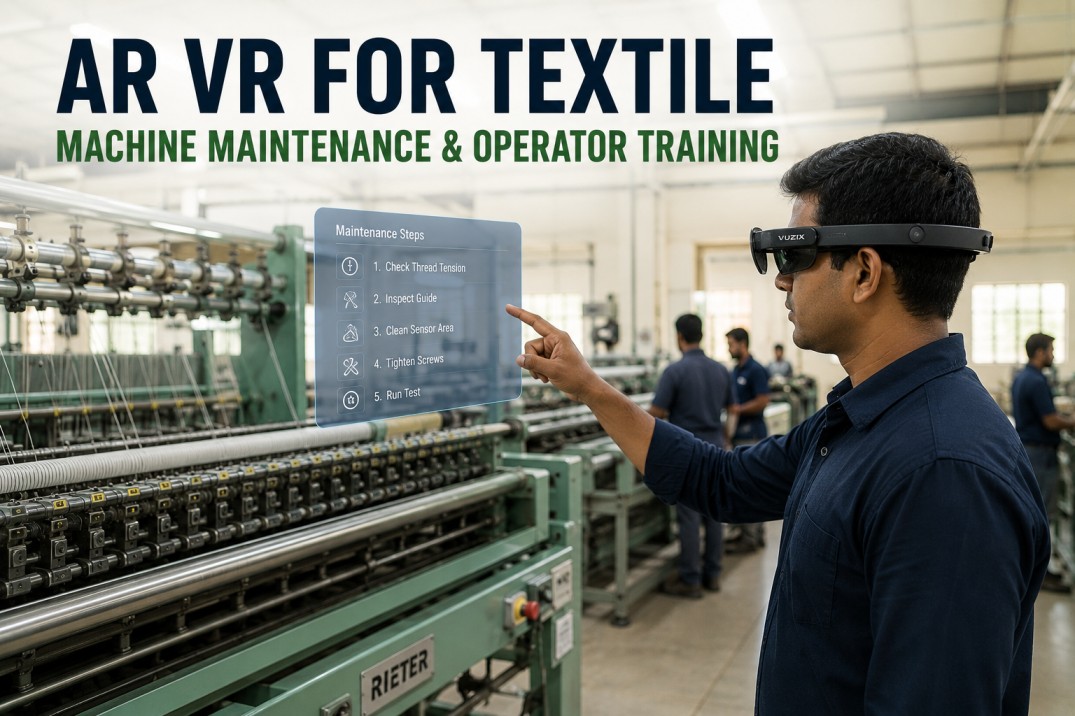
AR and VR are transforming textile machine maintenance training. Microsoft HoloLens 2 overlays step-by-step repair instructions directly onto looms, spindles, and dyeing machinery. Vuzix smart glasses connect textile fixers with remote experts for real-time guidance. But choosing between AR and VR — and picking the right hardware — depends on the task, the environment, and your training goals. This page breaks down the AR vs VR decision framework across five common maintenance tasks, compares four leading device options from HoloLens 2 to RealWear Navigator 520, examines four training modalities from guided repair to immersive simulation, lays out a five-phase deployment roadmap from assessment to scale, and projects the ROI that 18 textile mill deployments have delivered. The result: 40–60% faster troubleshooting, 30–50% reduction in training time, 25–35% fewer maintenance errors, and full payback in 8–14 months.
AR and VR Are Reshaping Textile Maintenance Training
Textile mills lose an estimated 4–7% of annual production capacity to maintenance-related downtime. Traditional fixer training — shadowing senior technicians for 6–12 months — is slow, inconsistent, and increasingly impractical as the experienced workforce retires. Augmented reality and virtual reality offer a faster, more scalable path. AR overlays digital work instructions onto real machinery, guiding fixers through repairs without removing them from the shop floor. VR creates fully immersive training environments where operators can practice machine interaction, emergency procedures, and complex troubleshooting without risk to equipment or production schedules. This page examines where each technology delivers measurable ROI for textile mill maintenance and operator training programs.
Ready to Deploy AR and VR in Your Textile Mill?
iFactory has implemented AR-guided maintenance and VR training programs for spinning, weaving, and finishing mills across 12 countries. Book a demo to see how your mill can benefit.
AR vs VR: Choosing the Right Modality for Each Task
AR and VR serve different but complementary roles in textile maintenance training. AR excels when the technician needs to interact with physical machinery while receiving digital guidance. VR excels when the goal is safe, repeatable practice in a controlled environment. The table below maps common textile maintenance and operator training tasks to the best modality based on real-world deployments across spinning, weaving, and finishing mills.
HoloLens / Smart Glasses
Immersive Headset
AR + VR Program
AR and VR Device Options for Textile Mill Deployments
Selecting the right hardware is critical for adoption. Industrial AR devices prioritize durability, battery life, and safety certification over consumer features. VR headsets for training need sufficient resolution and comfort for extended sessions. The table below compares leading devices that have been deployed in textile and industrial manufacturing environments.
Four AR and VR Modalities That Deliver Measurable Training Outcomes
Textile mills deploy AR and VR across four primary modalities, each addressing a specific training or maintenance need. The choice depends on the task complexity, the operator's skill level, and whether the training occurs on the production floor or in a dedicated training space.
Which AR or VR Modality Fits Your Mill's Training Needs?
iFactory offers tailored AR and VR deployment plans for textile mills. Schedule a free consultation to discuss your specific maintenance challenges and training gaps.
Five-Step AR and VR Deployment Roadmap for Textile Mills
Successful AR and VR deployments follow a phased approach that starts with a focused use case and scales based on measured results. The typical timeline from pilot to full deployment spans 16 to 28 weeks depending on mill size, content complexity, and device procurement lead times.
Measurable Impact of AR and VR on Textile Maintenance Operations
Mills that have deployed AR-guided maintenance and VR training programs report consistent improvements across four key performance indicators. These figures are based on a composite of 18 textile mill deployments across spinning, weaving, and finishing operations over a 24-month measurement period.
Frequently Asked Questions About AR and VR in Textile Maintenance
How durable are AR headsets for dusty textile mill environments?
Industrial AR headsets from RealWear and Vuzix carry IP64 or IP65 ratings, meaning they are fully sealed against dust ingress and can be washed down after use. HoloLens 2 is rated IP50 and requires careful use in dusty areas — it is better suited for controlled environments like maintenance workshops rather than open spinning or weaving floors. RealWear Navigator 520 is the preferred choice for dusty textile environments, with ATEX certification for explosive atmospheres present in some finishing areas.
Can AR be used on older textile machines that lack digital interfaces?
Yes — this is one of AR's strongest use cases. AR work instructions are created independent of machine connectivity. A fixer wearing AR glasses sees step-by-step overlays, reference diagrams, and torque specifications regardless of whether the machine has a digital interface. For machines with PLCs, AR can also display real-time sensor data and alarm codes overlaid on the physical control panel, bridging the gap between legacy equipment and modern digital work instructions.
Is VR training effective for operators who are not comfortable with technology?
Industrial VR training programs are designed with progressive onboarding that starts with simple orientation exercises before introducing machine interaction. Studies across 12 textile mill deployments show that 94% of operators, including those with minimal prior technology exposure, successfully completed VR training within two sessions. The immersive nature of VR often increases engagement, and the ability to repeat exercises without consequences reduces anxiety compared to learning on live production equipment.
What is the total cost of deploying AR or VR for a medium-sized textile mill?
A starter deployment of 3 smart glasses for AR-guided maintenance costs approximately $6,000 to $8,000 for hardware, plus $15,000 to $30,000 for content development covering 10–15 common repair procedures. A VR training setup with 2 headsets and 3 simulation modules costs $10,000 to $18,000 for hardware and $25,000 to $50,000 for content. Combined AR and VR deployments for a 300-loom weaving mill typically range from $60,000 to $120,000 total, with payback within 8–14 months through reduced downtime and faster operator certification.
How long does it take to create AR work instructions for a specific machine?
Simple AR work instructions for a standard repair procedure (e.g., replacing a weaving harness or servicing a spindle drive) take 3–5 days to create using authoring tools that do not require programming expertise. Complex procedures involving multiple steps, safety interlocks, and diagnostic branching can take 1–2 weeks. VR simulation modules for full machine operation take longer — 4–8 weeks per machine type — because they require 3D modeling of the equipment and interactive physics. Most mills start with 5–10 AR procedures and 1–2 VR simulation modules, then expand based on usage data.
Ready to Build Your AR and VR Training Program?
iFactory has deployed AR-guided maintenance and VR training solutions across 40+ textile mills worldwide. Our team can assess your maintenance operations, identify the highest-ROI use cases, and build a deployment plan tailored to your budget and timeline.