Reducing Textile Manufacturing Downtime with Smart Maintenance Systems
By Johnson on March 10, 2026
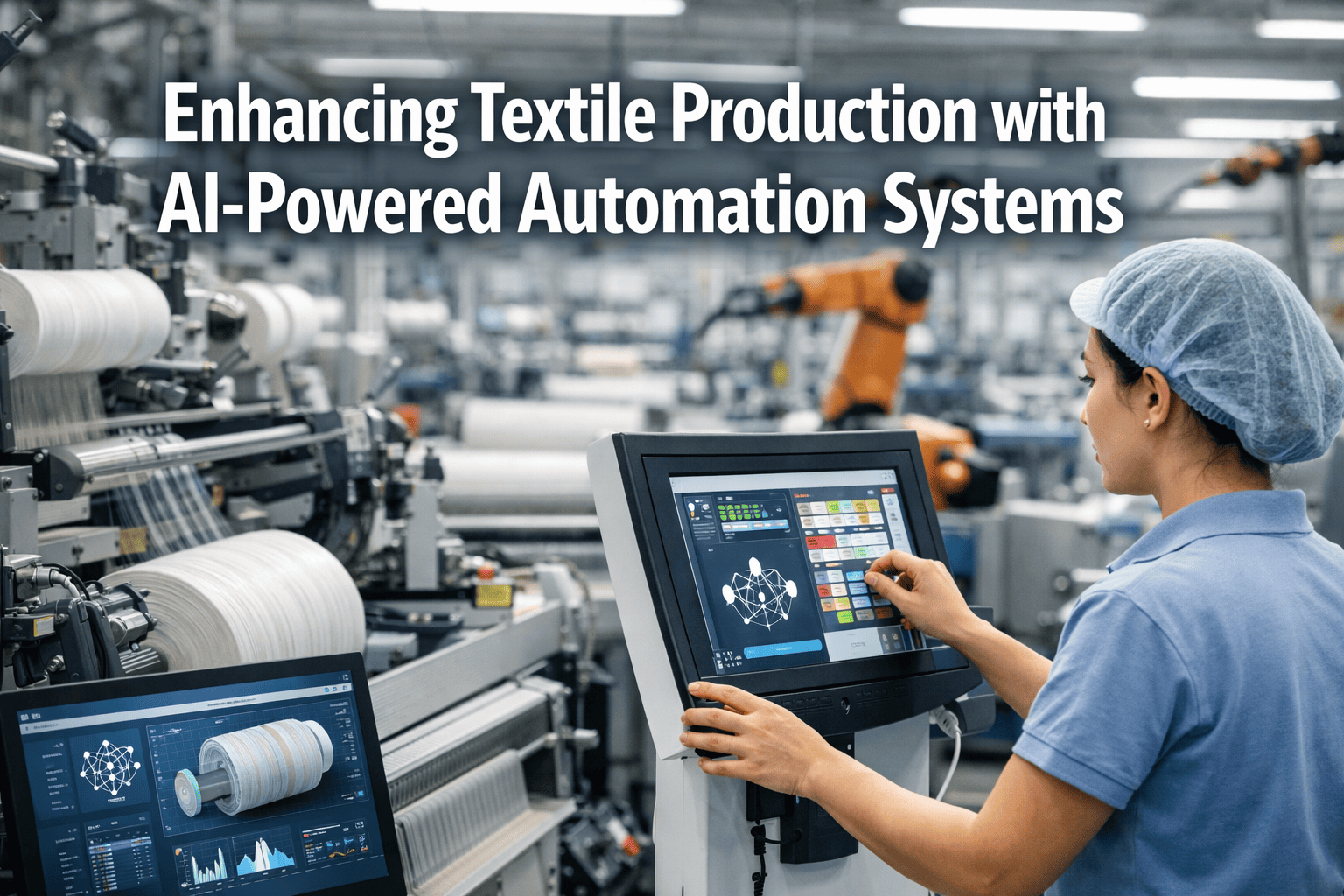
Every hour a loom sits idle, a dyeing tank overheats, or a spinning frame jams without warning, a textile factory is losing money it can never recover. Unplanned downtime in textile manufacturing costs an average of $40,000 per hour — yet most mills still rely on reactive repairs and gut-feel scheduling. Smart maintenance systems change that. From IoT-connected sensors to automated work orders and real-time dashboards, modern maintenance platforms give textile factories the visibility they need to stop breakdowns before they start. Want to see how it works in practice? Book a demo with our team and we'll walk you through a live deployment.
Smart Maintenance · Textile Industry
Is Unplanned Downtime Quietly Draining Your Textile Factory?
Most textile manufacturers lose 15% of annual production to equipment failures they never saw coming. Smart maintenance systems flip that equation — predicting faults, automating responses, and keeping every machine running at peak efficiency.
Cost per hour of unplanned textile manufacturing downtime
45%
Downtime reduction achievable with predictive maintenance
15%
Average annual production lost to equipment failures in textile mills
30%
Maintenance cost reduction with smart monitoring systems
The Problem
Why Textile Machines Keep Breaking Down Without Warning
Textile production lines are among the most mechanically demanding environments in manufacturing. Spinning frames run at thousands of RPM. Looms beat with relentless repetition. Dyeing machines cycle through extreme temperature swings. Every machine has a breaking point — and in most factories, nobody knows where that point is until the machine stops.
Bearing Wear & Vibration
Spinning frames and weaving looms develop bearing wear that goes undetected for weeks. By the time vibration becomes audible, bearing failure — and a full line stoppage — is hours away.
Overheating in Dyeing Equipment
Temperature irregularities in dyeing and finishing machines cause both equipment damage and quality defects. Without real-time thermal monitoring, both problems multiply before any alarm sounds.
Motor & Drive Failures
Drive motors across knitting, spinning, and winding machines degrade silently. Current draw anomalies and power fluctuations precede motor failure by days — but only if someone is watching the data.
Tension & Alignment Drift
Yarn tension drift and roller misalignment cause quality failures before mechanical breakdown. Smart sensors catch these deviations in real time, preventing both waste and downstream machine damage.
42%of all unplanned manufacturing downtime is caused by equipment failure
326 hrsof downtime per year in the average manufacturing facility
81 minaverage time to repair — up from 49 minutes due to skills gaps
The Shift
From Reactive to Predictive: The Three Stages of Maintenance Maturity
Most textile factories are stuck in stage one. Here's what the journey to smart maintenance actually looks like — and what becomes possible at each level.
Stage 1
Reactive Maintenance
Fix it when it breaks. Machine fails → production stops → emergency repair → restart. No data. No warning. Maximum cost.
What Smart Maintenance Actually Does in a Textile Factory
Smart maintenance is not a single tool — it's a connected system of sensors, data pipelines, and response workflows that gives your maintenance team complete visibility into every machine on the floor. Here's how it maps to textile production realities.
01
Sensor-Driven Machine Monitoring
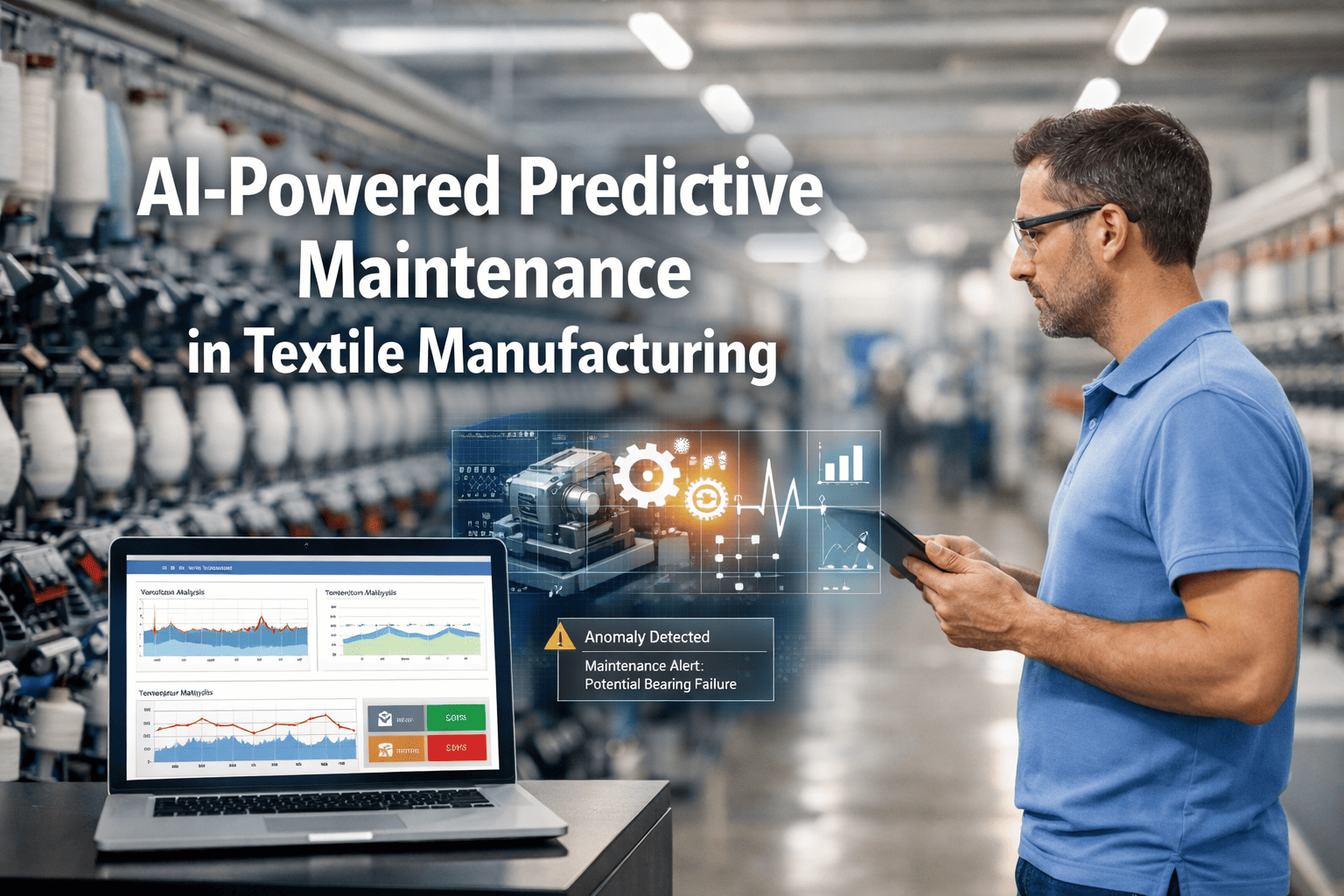
Vibration, temperature, current draw, and pressure sensors attach non-invasively to spinning frames, looms, dyeing machines, and finishing lines. They transmit condition data continuously — establishing a baseline and detecting deviation in real time.
When sensor readings cross configurable thresholds — a vibration spike on a loom bearing, a temperature climb in a dryer motor — the system triggers an alert instantly. No waiting for a technician to notice. No relying on operator intuition.
Alert speed: under 90 seconds from anomaly detection to mobile notification
03
Automated Work Order Generation
Each alert auto-creates a maintenance work order with machine ID, fault type, priority level, and assigned technician. Work orders reach the right person before the fault becomes a stoppage — eliminating the communication gap that turns a minor fix into a major shutdown.
Work order to technician: under 60 seconds · full audit trail maintained
04
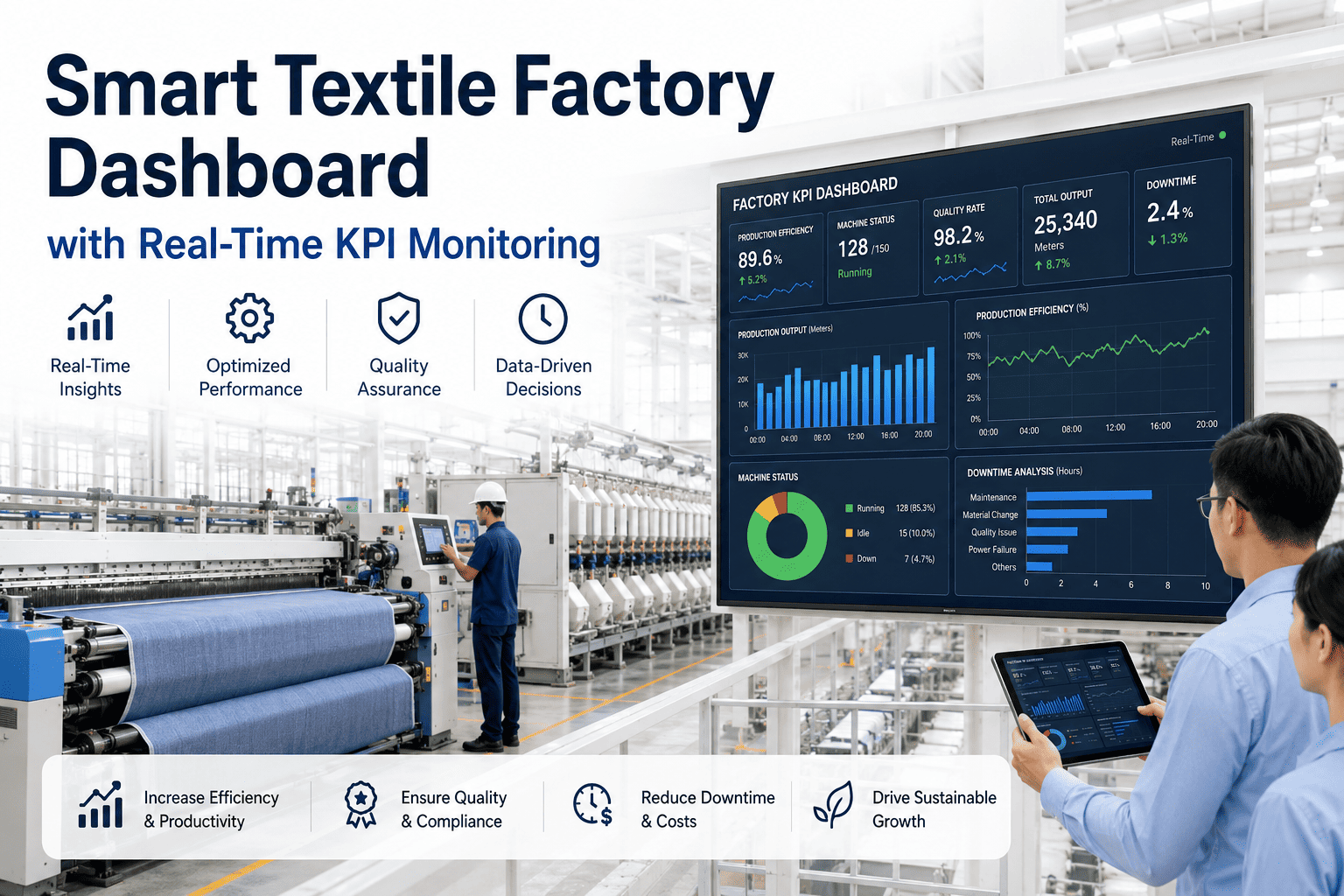
Centralized Maintenance Dashboard
All machines, all alerts, all open work orders, and all maintenance history in a single platform. Maintenance managers see the health of the entire factory floor in one view — identifying recurring failure patterns and optimizing maintenance schedules around production peaks.
Visibility: live machine health · OEE trends · MTBF analysis · spare parts tracking
Not sure which machines in your factory need sensor coverage first? Our support team can help you run a risk-priority assessment and map smart maintenance coverage to your specific production line before any hardware is installed.
Real Numbers
What Textile Factories Gain When They Switch to Smart Maintenance
45%
Reduction in Unplanned Downtime
Predictive maintenance systems reduce unplanned machine stoppages by 20–45% in textile environments by catching faults days before failure — turning emergency shutdowns into scheduled micro-interventions.
30%
Lower Maintenance Costs
Eliminating unnecessary preventive tasks and emergency callouts cuts total maintenance spend by 15–30%. Parts are replaced when condition warrants it — not when the calendar says so.
15%
Higher OEE
IoT-connected textile factories report an average 15% improvement in Overall Equipment Effectiveness — the single metric that ties machine availability, performance, and quality together.
40%
Longer Equipment Life
Machines that are maintained on condition rather than calendar last 20–40% longer. For expensive textile machinery, that represents a significant deferral of capital expenditure.
20%
Less Production Waste
Tension drift, temperature anomalies, and roller misalignment cause quality defects long before mechanical failure. Real-time monitoring catches these earlier, reducing material waste and rework costs.
Maintenance Metric
Without Smart Maintenance
With iFactory Smart Maintenance
Fault Detection
After breakdown — hours to days late
Real-time sensor alert within 90 seconds
Work Order Creation
Manual report — 30–120 min delay
Auto-generated in under 60 seconds
Repair Decision Basis
Operator intuition or visible failure
Data-driven condition thresholds
Downtime Duration
4+ hours average per event
Prevented or reduced to minutes
Maintenance History
Paper logs — incomplete, hard to access
Full digital audit trail per machine
Spare Parts Planning
Emergency orders — premium costs
Forecast-driven stock replenishment
Ready to Stop Reacting and Start Predicting?
iFactory gives textile manufacturers a single platform for sensor alerts, automated work orders, machine health dashboards, and full maintenance audit trails. Most factories are fully deployed and seeing results within 14 days.
Most textile machinery can be instrumented with non-invasive IoT sensors in 1–4 hours per machine, with no production stoppage required. Vibration and temperature sensors clamp or adhesive-mount to existing machine housings without any modification. A typical 20-machine textile production line can be fully instrumented in 2–3 days by a standard maintenance technician — no specialist engineering required. iFactory's platform connects and begins establishing baselines within hours of sensor installation.
Alert thresholds are configurable and calibrated to each machine's normal operating range — not generic industry defaults. During the initial 1–2 week baseline period, the system learns each machine's normal vibration, temperature, and current patterns before alert thresholds are set. This means alerts are triggered by genuine anomalies, not by normal production variation. Most factories report fewer than 3–5 actionable alerts per week once the system is calibrated — each one representing a real fault that would otherwise have become an unplanned stoppage.
The highest ROI comes from monitoring machines where failure causes the longest downstream stoppages: spinning frames, weaving looms, dyeing machines, and finishing line dryers. These are high-cycle, high-temperature, or high-tension machines where bearing wear, motor degradation, and temperature drift are the primary failure modes — all detectable by vibration, thermal, and current sensors well before failure. Knitting machines, winding units, and yarn gassing equipment also benefit significantly. iFactory's pre-deployment assessment helps prioritise which machines to instrument first based on your specific failure history and production flow.
No. iFactory is a cloud-based platform designed for maintenance managers and factory floor teams — not IT departments. The web and mobile interface requires no server infrastructure, no custom integrations out of the box, and no ongoing IT maintenance. Maintenance technicians access work orders and alerts via a mobile app. Managers access dashboards and reports via a browser. Most teams are fully operational within the first week of deployment with standard onboarding support included.