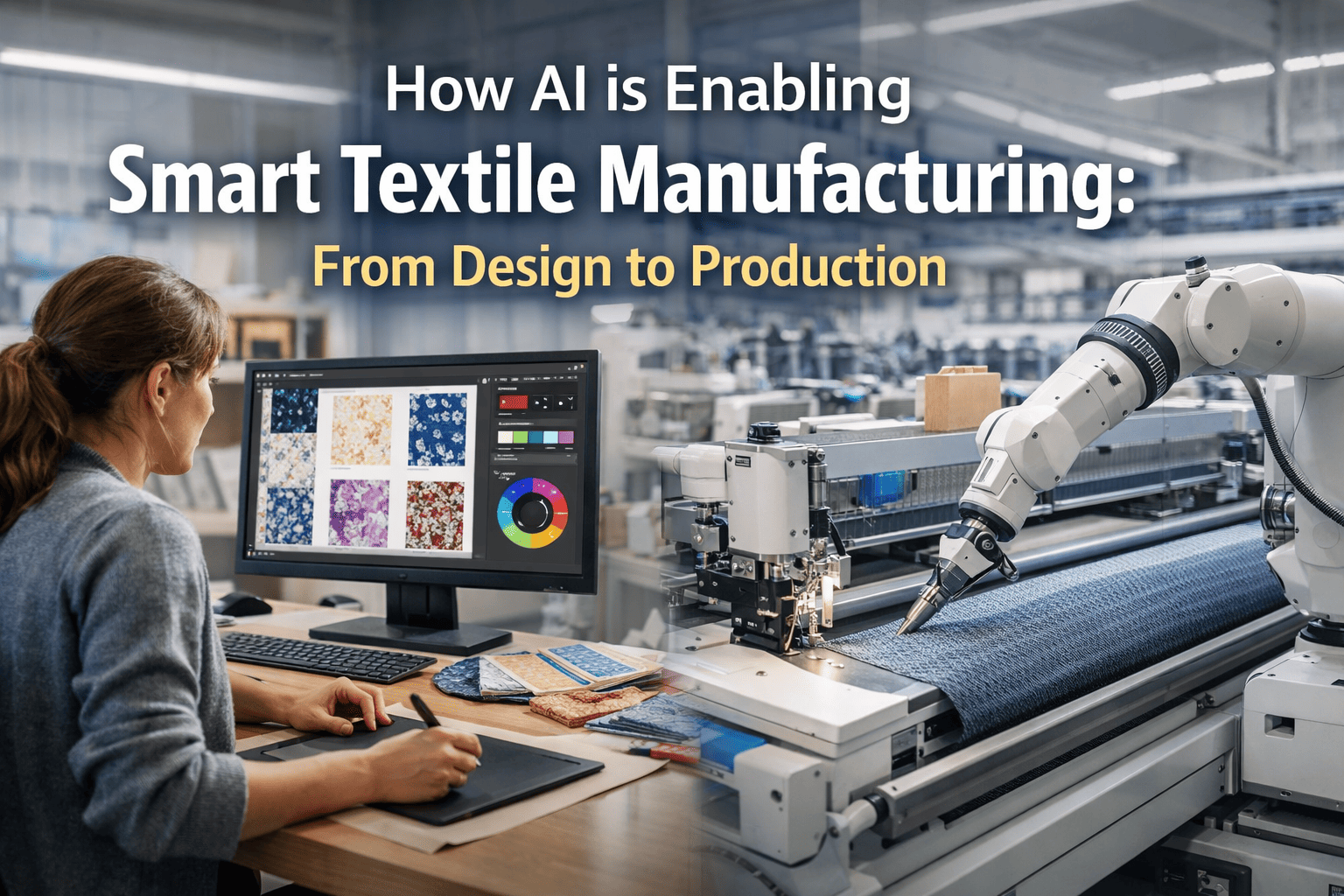
Smart cities are not built from concrete and steel alone — they are woven from intelligent materials, energy-aware supply chains, and manufacturing ecosystems that respond to the world around them in real time. Textile factories are quietly becoming one of the most critical contributors to the smart city revolution, producing the technical fabrics, e-textiles, and sustainable materials that power everything from urban air quality sensors to smart building insulation. If your factory is still running on paper workflows and disconnected systems, you are already behind the curve — book a free demo with iFactory and discover how AI and IoT can transform your textile operations into a smart manufacturing engine ready for the cities of tomorrow.
How AI & IoT Are Powering Textile Manufacturing for Smart Cities
From energy-harvesting fabrics to IoT-connected production floors — textile manufacturers are at the center of the smart city transformation.
The Textile–Smart City Connection Most Manufacturers Don't See Yet
When people think of smart cities, they picture screens, sensors, and self-driving vehicles. What they miss is the fabric layer underneath — the technical textiles woven into smart roads, filtration membranes in urban water systems, conductive threads embedded in wearable health monitors, and geotextiles stabilising green urban infrastructure. Textile manufacturers who understand this connection — and build the production intelligence to serve it — are entering a market with exponential growth and premium-margin buyer relationships.
Smart Road & Safety Textiles
Reflective, pressure-sensitive, and temperature-regulating fabrics embedded in road surfaces, pedestrian zones, and cyclist gear — communicating real-time data to city management systems.
Advanced Filtration Membranes
Nano-fibre textile membranes are replacing conventional filters in urban air purification towers and water treatment plants — requiring precision spinning and consistent porosity at industrial scale.
E-Textiles & Wearable Health Tech
Conductive fabrics that monitor body temperature, ECG, and movement are powering the next generation of remote patient monitoring — a critical pillar of smart city healthcare infrastructure.
Smart Insulation & Solar Fabrics
Phase-change fabrics, solar-cell-integrated textiles, and thermochromic coatings are being specified into smart building envelopes — demanding strict batch consistency and traceability from manufacturers.
What AI Is Doing Inside Textile Factories Right Now
Artificial intelligence in textile manufacturing is not a future concept being piloted in research labs. It is running on production floors today — optimizing schedules, flagging quality deviations, predicting machine failures, and reducing energy consumption in ways that were impossible with manual systems. Here is exactly what it looks like in practice.
See AI-powered production management in action for your textile factory. Book a free 30-minute demo — our specialists will show you what these capabilities look like on your specific floor.
IoT in Textile Manufacturing: The Sensor Layer That Changes Everything
IoT — the Internet of Things — means connecting your physical machines to a digital nervous system. In a textile factory, this transforms every spinning frame, loom, dyeing machine, and finishing unit from an isolated piece of equipment into a real-time data source. The factory stops being a black box and starts being a transparent, optimizable system.
IoT Hub
Energy Efficiency: The Smart City Mandate Textile Factories Must Meet
Smart cities are built on sustainability targets. As urban centers set net-zero goals and buyers increasingly mandate environmental compliance from their supply chains, textile manufacturers face a clear choice: measure and optimise energy use digitally, or lose orders to competitors who do. The numbers make the case without ambiguity.
Smart City Textile Categories Growing Fastest in 2025–2026
These are the specific product categories where smart city procurement demand is creating the fastest revenue growth opportunities for textile manufacturers who can meet quality, consistency, and traceability requirements.
Geotextiles for Urban Green Infrastructure
Cities expanding green roofs, permeable urban paving, and bioswale networks are driving massive procurement of high-strength woven and non-woven geotextiles. Buyers require full batch traceability and tensile strength consistency — quality levels only achievable with digital production management.
Conductive & E-Textile Components
Wearable health monitors, smart uniforms for public safety personnel, and embedded sensors for urban mobility infrastructure are creating extraordinary demand for precisely manufactured conductive fabrics — a segment where production error tolerance is near zero.
High-Performance Filtration Fabrics
As air pollution management and water purification become core smart city infrastructure priorities, demand for consistently manufactured nano-fibre and micro-fibre filtration membranes is accelerating across Asia, Europe, and the Middle East.
Solar-Integrated & Phase-Change Fabrics
Smart building architects are specifying energy-harvesting fabrics for awnings, facades, and shade structures. These high-value technical textiles command 4–8× the price per metre of conventional fabric — but demand manufacturing precision that only digitally managed factories can consistently deliver.
How iFactory Positions Your Textile Factory to Win Smart City Supply Contracts
Smart city project procurement teams and technical textile buyers apply standards that most traditional mills cannot meet — digital traceability, consistent quality documentation, energy footprint reporting, and rapid order response times. iFactory closes these gaps systematically.
Full Digital Traceability Per Batch
Every roll of fabric carries a complete digital production record — machine ID, operator, parameters, quality check results, and material lot — making your factory audit-ready for international buyers requiring OEKO-TEX, GOTS, or custom compliance documentation.
Real-Time Quality Gate Management
Quality parameters — yarn count, tensile strength, porosity for filtration fabrics, dimensional consistency for technical textiles — are checked at each production stage, not just at final inspection. Defects are caught and corrected before they compound into batch rejections.
Carbon Footprint Reporting Per Order
Smart city buyers and sustainability-focused brands increasingly require energy and carbon data at the order level. iFactory's energy monitoring layer generates this documentation automatically — giving your factory a competitive edge that paper-based competitors simply cannot offer.
Rapid Response to Technical Specifications
When a smart city procurement tender arrives with precise technical fabric requirements, your ability to respond with verified production data — historical machine capability, quality pass rates, batch consistency records — determines whether you are shortlisted. iFactory makes this data instantly available.
Is Your Factory Ready for Smart City Supply Contracts?
iFactory's textile production specialists will assess your current operations and show you exactly what capabilities need to be in place to qualify for technical textile and smart city material orders. No obligation.
The Smart Manufacturing Readiness Spectrum
Where does your factory sit on the path from traditional to fully smart manufacturing? Most textile mills are currently at Level 1 or 2. The goal is not to jump immediately to Level 5 — it is to move deliberately from your current position to the next level, with measurable gains at each step.
Manual work orders, verbal handovers, paper job cards. Production data captured at end of shift or not at all.
Excel sheets and basic software for tracking. Data exists but is siloed, delayed, and manually entered.
Digital work orders, real-time task tracking, mobile operator updates. Live production visibility across departments.
Machine sensors stream data to central platform. Predictive maintenance active. Energy monitored per batch.
Self-optimizing schedules, AI-driven quality control, autonomous energy management. Factory operates as a learning system.
The textile factories winning smart city supply contracts in 2025 are not necessarily the ones with the newest machines. They are the ones with the best data — traceability records, quality documentation, energy reports — that procurement teams can verify and trust. Digital production management is the entry ticket to this market.
Frequently Asked Questions
Join the Textile Manufacturers Already Building for the Smart City Era
iFactory gives textile factories the AI-powered production management and IoT-ready infrastructure to compete for smart city supply contracts, meet international buyer standards, and run a leaner, more efficient operation — starting in weeks, not years.