
Clothing has always been functional. But for the first time in human history, it is becoming intelligent. Smart textiles — fabrics woven with sensors, conductive fibres, and responsive coatings — are transforming garments from passive coverings into active devices that monitor health, adapt to environment, generate energy, and connect to the digital world. The global smart clothing market is projected to grow from $22 billion in 2025 to over $274 billion by 2034. For textile manufacturers, designers, and brands, this is not a distant future. It is the production challenge of the next decade. Book a free demo with iFactory and see how AI-powered manufacturing intelligence helps you produce the next generation of smart textiles at scale.
Smart Textiles Are No Longer Futuristic. They Are Being Woven Right Now.
From health-monitoring shirts to temperature-regulating jackets and energy-harvesting fabrics — the boundaries between clothing and technology have permanently dissolved.
What Exactly Is a Smart Textile?
Smart textiles are not just fabrics with gadgets attached. They are engineered materials where electronic capability is embedded directly into the fibre structure — invisible to the touch, washable, flexible, and functional. Three levels of intelligence define the category.
Sense and react to environmental stimuli — temperature, moisture, pressure — without requiring an external power source. Examples include thermochromic fabrics that change colour with heat and moisture-wicking performance fabrics.
Both sense stimuli and respond — adjusting temperature, emitting light, or delivering haptic feedback. Carbon fibre heating systems and LED-embedded garments fall into this category.
Think, act, and communicate. Integrated with AI processors, IoT connectivity, and cloud data — these garments make decisions autonomously, stream biometric data in real time, and adapt continuously to the wearer.
Six Innovations Defining Smart Textiles in 2025
Across research labs, sports brands, and fashion houses, six breakthrough technologies are converting the concept of intelligent clothing into production reality.
Garments like Hexoskin's smart shirts embed sensors directly into fabric weaves to track heart rate, breathing patterns, body temperature, and caloric output in real time — streaming data to mobile apps or medical dashboards without any external hardware.
Carbon fibre heating elements woven into jacket linings, controlled via mobile app or automatic temperature sensors, maintain personal comfort in extreme environments. Brands like PYKRS are already bringing app-controlled heated outerwear to urban consumers.
Fabrics engineered from piezoelectric fibres convert the kinetic energy of walking, breathing, and movement into electrical power — working toward garments that charge wearable devices autonomously without any battery or external charging cable.
Silver-coated nylon and polyester conductive yarns allow electrical signals to travel through garment fabric itself — replacing rigid circuit boards with flexible, stretchable textile circuits that survive repeated washing and body movement.
Nanoparticle treatments applied at the fibre level give fabrics self-cleaning surfaces, antibacterial properties, waterproofing, and UV protection — without adding visible coatings, changing hand-feel, or affecting breathability.
Inspired by biomimicry, self-healing textiles can repair micro-tears autonomously. Mycelium-based and lab-grown leathers grown to exact product dimensions eliminate cutting waste entirely — pioneered by companies like MycoWorks.
iFactory's AI platform tracks every parameter — from conductive yarn tension to nano-coating application rates — giving you the traceability smart textile buyers demand.
Where Smart Textiles Are Changing Industries
The applications of smart textiles stretch far beyond fashion runways. Here is how intelligent fabrics are reshaping four major sectors in 2025.
Smart shirts and patches monitor ECG, blood oxygen, and respiratory patterns for cardiac patients, enabling remote diagnostics without hospitalisation. Socks embedded with pressure sensors detect early-stage diabetic foot ulcers weeks before they become visible. Canadian company Hexoskin now has contracts with space agencies for astronaut health monitoring using biometric smart garments.
Performance shirts analyse exertion levels, muscle load, and recovery metrics — adjusting training recommendations dynamically. Smart compression wear tracks posture and movement form during weight training, delivering haptic feedback to prevent injury. Brands like Nike and Adidas are investing heavily in AI-connected athletic garments for professional and consumer markets.
Smart workwear embedded with fall detection sensors, GPS, and environmental monitors tracks worker safety in hazardous environments — alerting supervisors instantly when abnormal readings occur. Illuminated fabrics using embedded LED technology are replacing reflective vests in construction and logistics, offering programmable visibility and active safety signalling.
High-fashion houses are embedding LED arrays and shape-memory alloys into runway garments that change structure and display in response to the wearer's movement. Brands like CuteCircuit design garments that glow and shift based on environmental conditions. The metaverse is driving demand for physical garments with verifiable digital twins — blockchain-authenticated fashion with corresponding virtual representations.
Market Growth: The Numbers Behind the Revolution
The Manufacturing Challenge Behind Smart Textiles
Smart textiles are not only a design challenge — they are a precision manufacturing challenge. Embedding electronic components into fabric at scale demands levels of process control that traditional textile production methods were never built to handle.
Even minor variations in yarn tension during weaving can break conductive pathways — creating garments that fail quality tests after production. AI-driven loom monitoring catches these deviations in real time, before entire rolls are compromised.
Nanoparticle application must be uniform to the micron level across full fabric rolls. AI systems track chemical application rates, temperature profiles, and dwell times — ensuring every metre meets the same performance specification.
Smart textile buyers require documented proof that electronic functionality survives specified wash cycles. AI traceability systems generate the per-batch durability records needed for buyer qualification and international certification.
Smart textiles sold into healthcare and defence applications require full production chain documentation — from fibre sourcing through finishing. Manual documentation cannot meet these requirements at production speed. AI can.
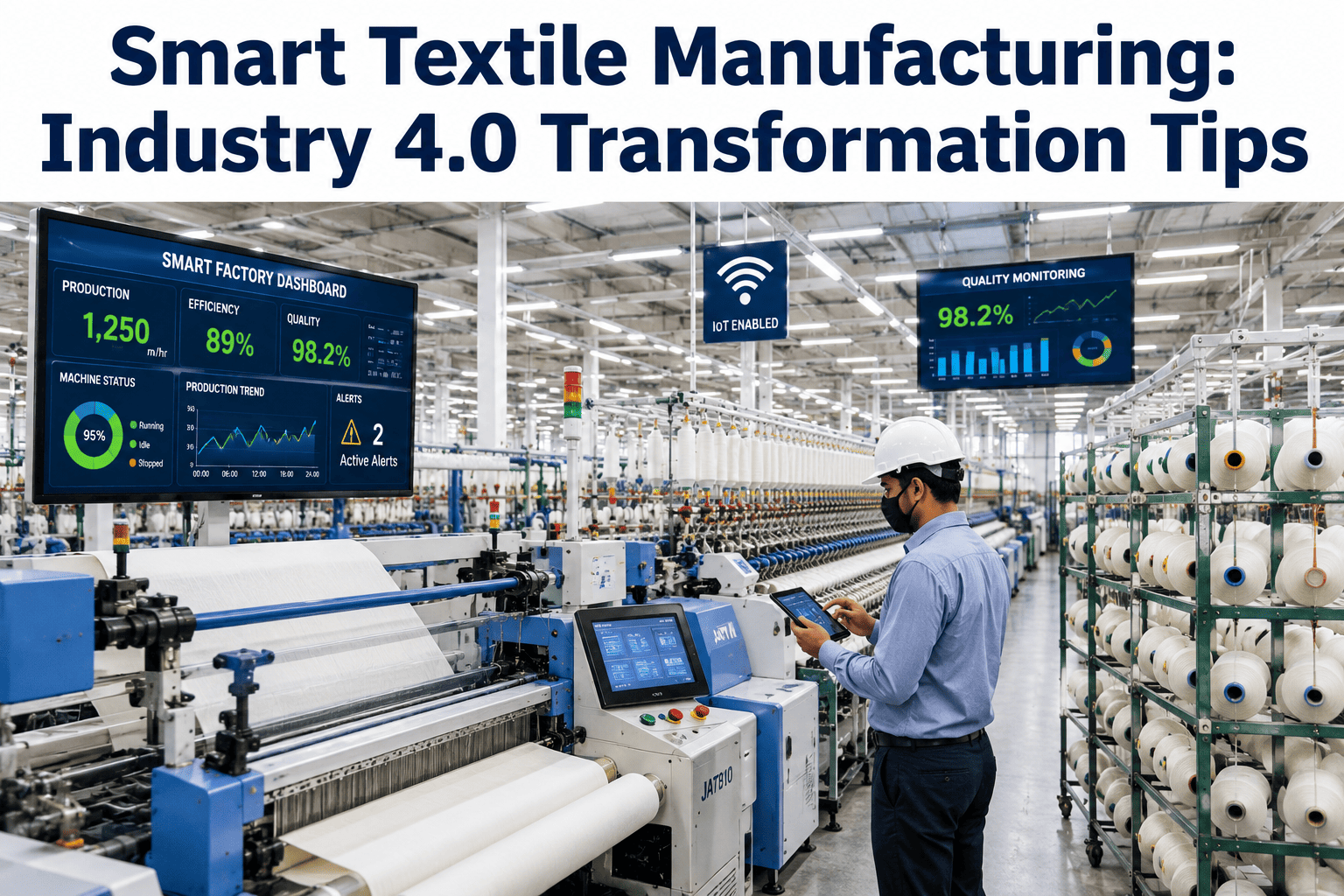
iFactory's AI manufacturing platform provides the real-time process monitoring, cross-department traceability, and automated compliance documentation that smart textile manufacturers need — from conductive yarn spinning through functional finishing and dispatch.
See iFactory in ActionFrequently Asked Questions
The Future of Textiles Demands Smarter Production
Smart fabric manufacturing is more complex, more precise, and more traceable than conventional textile production. iFactory gives you the AI-powered process intelligence to produce intelligent garments consistently, compliantly, and at scale.


.jpg)

