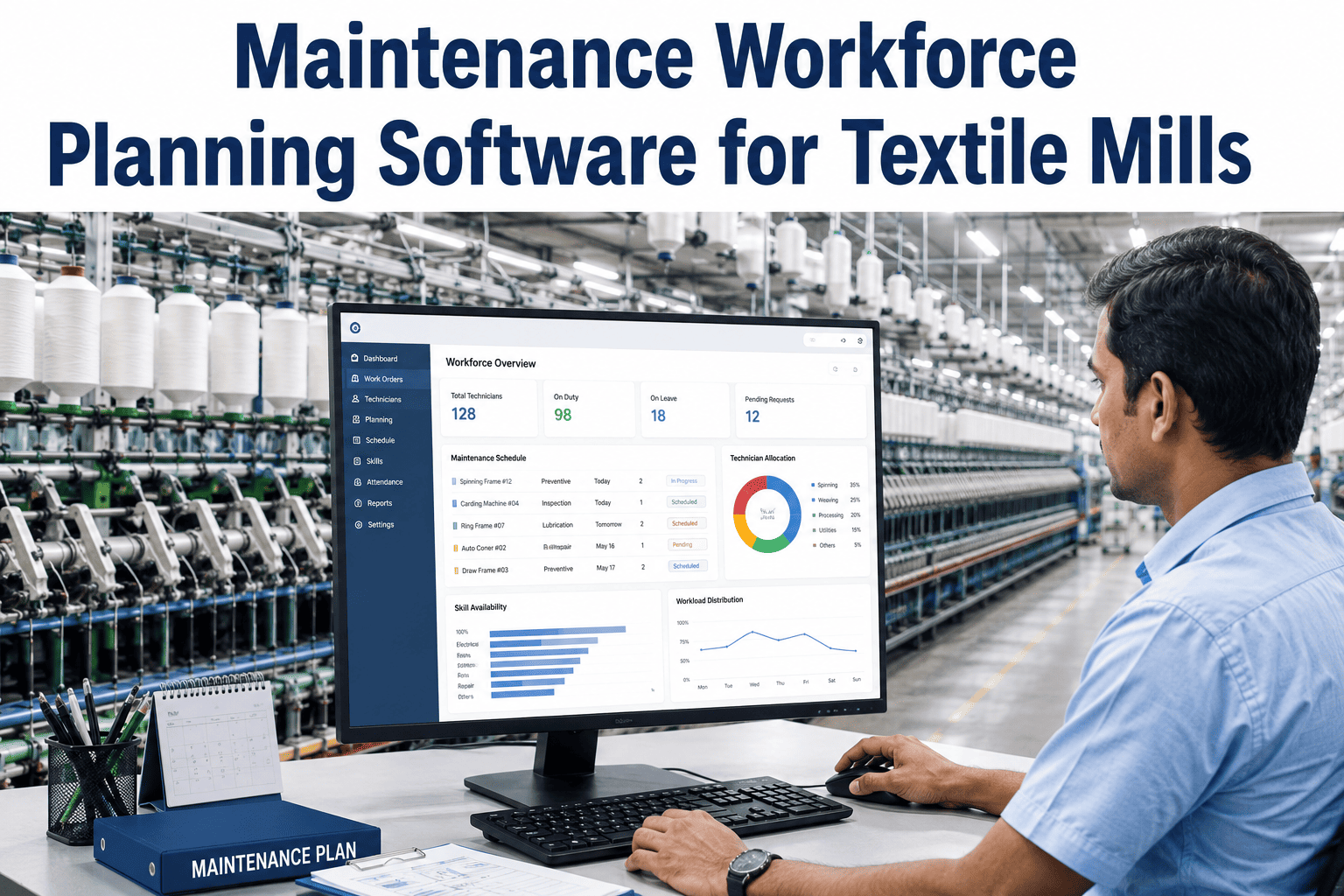
Ask any maintenance manager in a textile mill how they decide who fixes what on a given shift, and the honest answer is usually a whiteboard, a WhatsApp group and whichever technician happens to be free when the phone rings. That works until it doesn't — until a specialised loom mechanic is buried in routine preventive tasks while a breakdown on a critical dyeing machine waits, or a contractor is called in at premium rates for work an in-house technician could have handled if anyone had known their schedule. Maintenance workforce planning software replaces that improvisation with a live view of technician skills, shift coverage, preventive workload and breakdown response capacity across every department in the mill. If your team's calendar still lives in someone's head, Book a Demo to see how iFactory turns maintenance staffing into a planned, visible operation.
Match the Right Technician to the Right Work, Every Shift
iFactory's CMMS & Work Orders module plans skills, shifts, preventive tasks, breakdown response and contractor workload in one live schedule — built specifically for multi-department textile maintenance teams.
The Hidden Cost of Unplanned Maintenance Staffing
Textile mills run maintenance across wildly different disciplines — mechanical, electrical, instrumentation, HVAC, and increasingly automation and controls — often with a single supervisor trying to track who is qualified for what, who worked yesterday's night shift, and who is already overloaded with backlog. Without a system tying these together, the same handful of experienced technicians get pulled into every breakdown regardless of the actual skill required, while less experienced staff sit underutilized on routine work they could be trained to handle.
The pattern repeats at the shift-change boundary too. A breakdown reported at the end of one shift often loses momentum entirely when the incoming shift has no visibility into what was already diagnosed, what parts were requested, or who was mid-repair. Work restarts from zero, doubling the time to resolution and frustrating both the maintenance team and the production department waiting on the machine.
Five Layers of Workforce Planning That Actually Prevent Downtime
Skill Matrix Mapping
Every technician is mapped against certified skills — electrical, mechanical, instrumentation, specific machine brands — so work orders route to someone actually qualified, not just available.
Shift Coverage Planning
Shift rosters are checked against required coverage per department before they are finalized, catching gaps in critical departments before they become a 3 a.m. surprise.
Preventive Workload Balancing
Scheduled preventive tasks are distributed across the available workforce so no single shift is overloaded while another sits idle, keeping PM compliance consistent.
Breakdown Response Routing
When a breakdown is reported, the system suggests the nearest qualified technician with available capacity, cutting the time between report and first response.
Contractor Workload Management
Specialized or overflow work assigned to contractors is tracked against the same schedule and cost visibility as in-house labor, avoiding duplicate or unnecessary outside calls.
Shift Handover Without the Information Loss
One of the most underrated causes of extended downtime in textile mills is the handover gap between shifts. A digital work order carries the full diagnostic history, parts requested and technician notes forward automatically, so the incoming shift picks up exactly where the last one stopped instead of re-diagnosing from scratch. Supervisors reviewing shift performance get a complete, timestamped record of what happened, by whom, and how long each step actually took — visibility that a paper logbook or verbal handover can never reliably provide. Mills that want to see this handover flow in action can Book a Demo using their own shift structure as the example.
See Your Skill Matrix Mapped Against Real Coverage Gaps
Most mills discover at least one department is critically under-covered on a specific shift once the skill matrix is actually visualized.
Planned Maintenance Versus Reactive Firefighting
The difference between a maintenance team that plans its workforce and one that reacts to whatever breaks next shows up clearly in the numbers over a single quarter. Planned teams spend the majority of their hours on preventive work, catching failures before they cause downtime. Reactive teams spend the majority of their hours firefighting, which means preventive tasks slip, which in turn causes more breakdowns — a cycle that compounds without a system to break it.
Built for Every Department in the Mill
Spinning, weaving, knitting, dyeing and utilities each carry different maintenance rhythms — spinning halls run continuous preventive cycles on hundreds of spindles, while dye house maintenance often centers on fewer, higher-consequence machines. Workforce planning software needs to respect those differences rather than forcing every department into the same scheduling template, and iFactory's department-aware skill matrix does exactly that, keeping the right specialists mapped to the right equipment across the entire plant.
Frequently Asked Questions
How is technician skill data captured and kept current?
Skills are entered during onboarding based on certifications, training records and supervisor sign-off, and can be updated any time a technician completes new training or works a supervised repair on unfamiliar equipment. The skill matrix stays a living record rather than a one-time form, so routing decisions reflect actual current capability. Details on setup can be reviewed through Support.
Can this handle multiple shifts and rotating rosters?
Yes — the platform is built around shift-based coverage planning by default, supporting rotating rosters, fixed shifts and mixed patterns across different departments in the same mill. Coverage gaps are flagged before a roster is finalized, not discovered after a shift is already short-staffed.
Does workforce planning replace our existing CMMS work orders?
Workforce planning runs directly inside the same CMMS and Work Orders system, so assignment, skill matching and scheduling use the same work order data your team already generates for preventive and breakdown maintenance. There is no separate system to maintain or reconcile.
How does contractor tracking actually reduce spend?
Contractor requests are checked against current in-house capacity and skill availability before approval, which surfaces cases where a qualified in-house technician was available but a contractor was called anyway out of habit. Over time, this visibility alone drives meaningful reduction in unnecessary outside labor cost.
How long does implementation take for a multi-department mill?
Most mills complete skill matrix setup and shift configuration within two to four weeks, with the system running alongside existing processes during that period so nothing is disrupted mid-transition. Full rollout across all departments typically completes within a quarter. Book a Demo to get a timeline specific to your plant's structure.
Give Your Maintenance Team a Schedule Built on Reality
Maintenance workforce planning is not about adding bureaucracy to a team that already knows its job — it is about giving that team the visibility to do their job without guessing. iFactory maps skills, shifts, preventive workload, breakdown response and contractor use into one schedule that reflects what is actually happening on your floor, so downtime gets resolved faster and planned work stops getting sacrificed to firefighting.
Ready to Replace the Whiteboard?
Walk through your current shift structure and skill gaps with our team — see the schedule iFactory would generate for your mill.