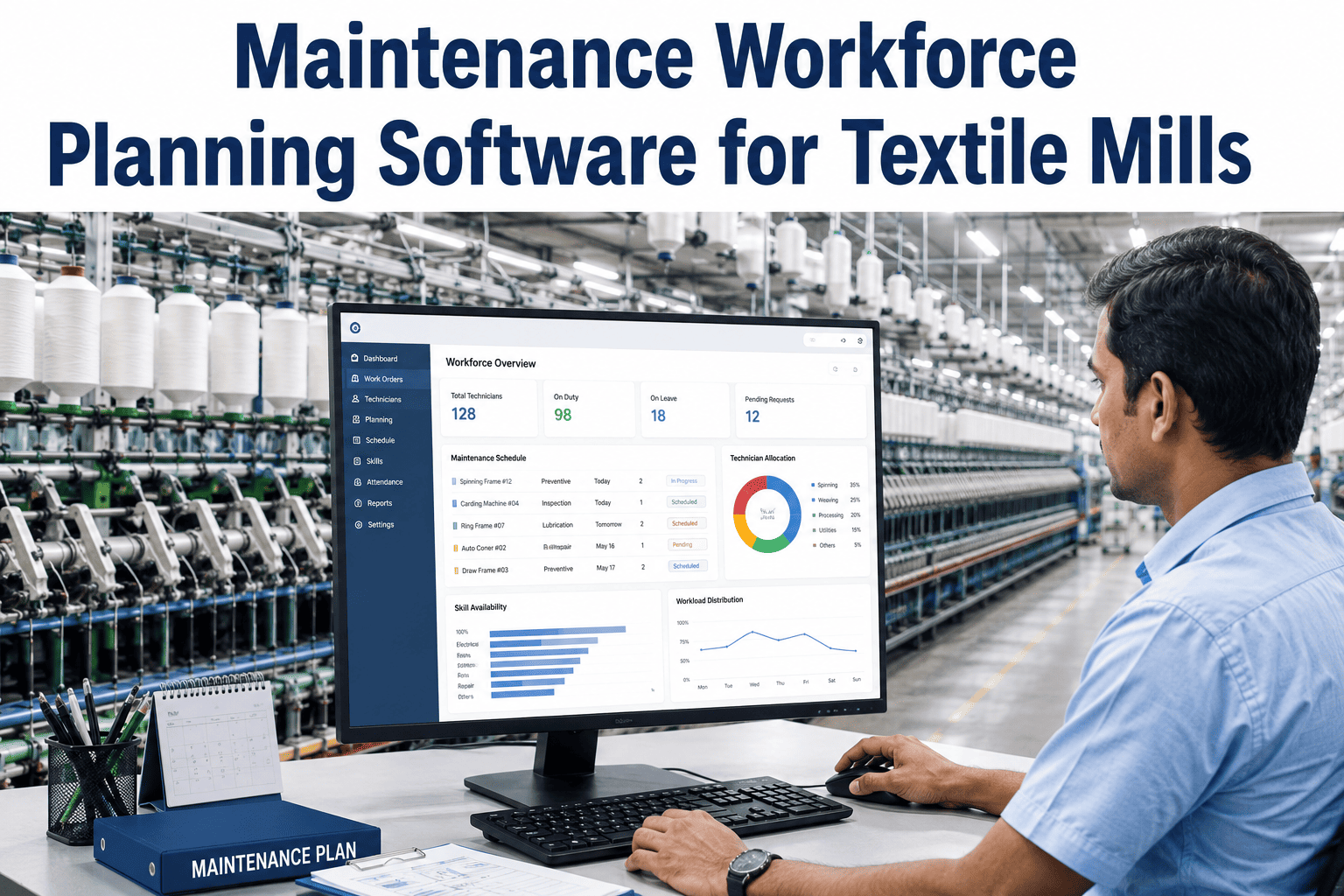
Textile mills operate in one of the most maintenance-intensive environments in manufacturing. High-humidity conditions accelerate bearing failure, lint accumulation creates fire hazards in every motor enclosure, and continuous 24/7 production schedules leave minimal windows for equipment servicing. A single ring frame breakdown can halt 1,000+ spindles, costing $5,000–$15,000 per hour in lost production. Traditional paper-based maintenance systems — clipboards, logbooks, and whiteboards — create information gaps that result in reactive repairs, redundant work orders, and incomplete audit trails. AI-powered Computerized Maintenance Management System (CMMS) software transforms textile mill maintenance by predicting equipment failures before they occur, automating work order generation from machine sensor data, and providing real-time visibility into maintenance KPIs across the entire plant floor. This guide provides textile mill managers, plant engineers, and operations directors with a comprehensive framework for evaluating, selecting, and implementing AI CMMS software in 2026.
AI CMMS Software for Textile Mills: 2026 Complete Buyer Guide
Transform textile mill maintenance with AI-powered predictive analytics. iFactory's CMMS platform predicts equipment failures, automates work orders, and digitizes compliance documentation across your entire plant floor.
Key Equipment in Textile Mills & Failure Modes
Textile mill equipment operates under conditions that accelerate wear: high humidity, airborne lint, continuous operation, and vibration stress. Understanding the failure profile of each equipment type is essential for targeting predictive maintenance investments and selecting the right AI CMMS capabilities.
Ring Frames & Spinning
Ring frames are the highest-criticality assets in a textile mill, with 1,000+ spindles per machine. Failure modes include spindle bearing wear (accelerated by lint infiltration), ring traveller fatigue, vacuum system blockage, and drafting roller eccentricity. AI vibration analysis detects bearing degradation 4–6 weeks before failure.
Critical: $5–15K/hr DowntimeCarding Machines
Carding machines process raw fibre into sliver. Critical components include cylinder and doffer wires that require periodic grinding, flat chains that stretch and break, and feed roll bearings that seize from lint packing. Thermal imaging detects overheating bearings and cylinder wire damage before catastrophic failure.
Wire Grind: Every 6–12 MonthsLooms & Weaving
Modern air-jet and rapier looms have thousands of moving parts operating at high speed. Yarn tension sensor drift, reed damage, heald frame wear, and main drive motor bearing failure are common. AI can predict shed mechanism wear and picker timing drift by analyzing pattern deviations in real-time production data.
Air-Jet: 600+ Picks/MinuteHVAC & Humidity Control
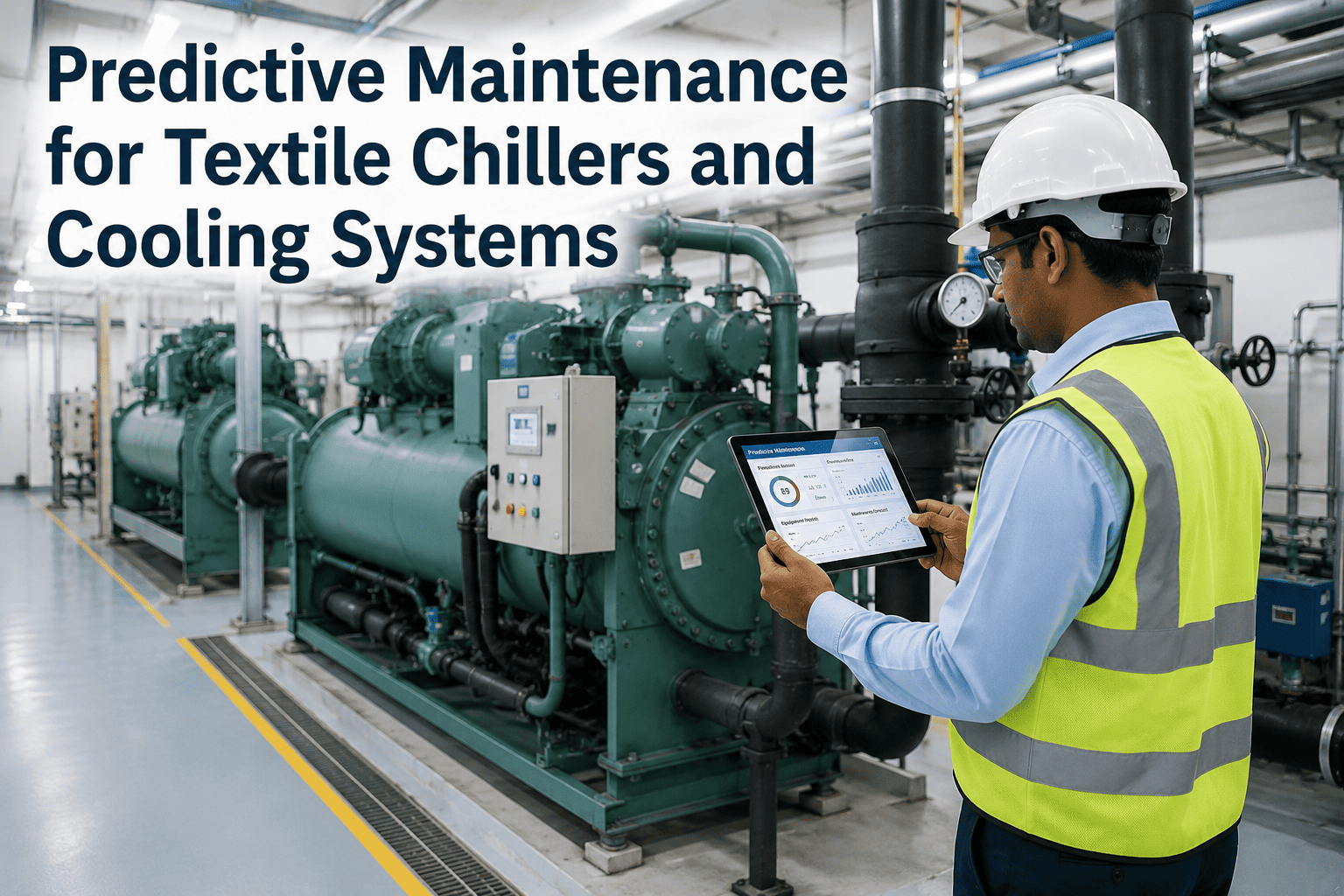
Precise humidity control (55–75% RH depending on process stage) is critical for textile quality. HVAC system failures cause yarn breakage, static electricity issues, and fibre fly problems. Chiller compressor failure, fan belt wear, filter clogging, and control sensor calibration drift are the most common failure modes.
Critical: Humidity DeviationCompressed Air System
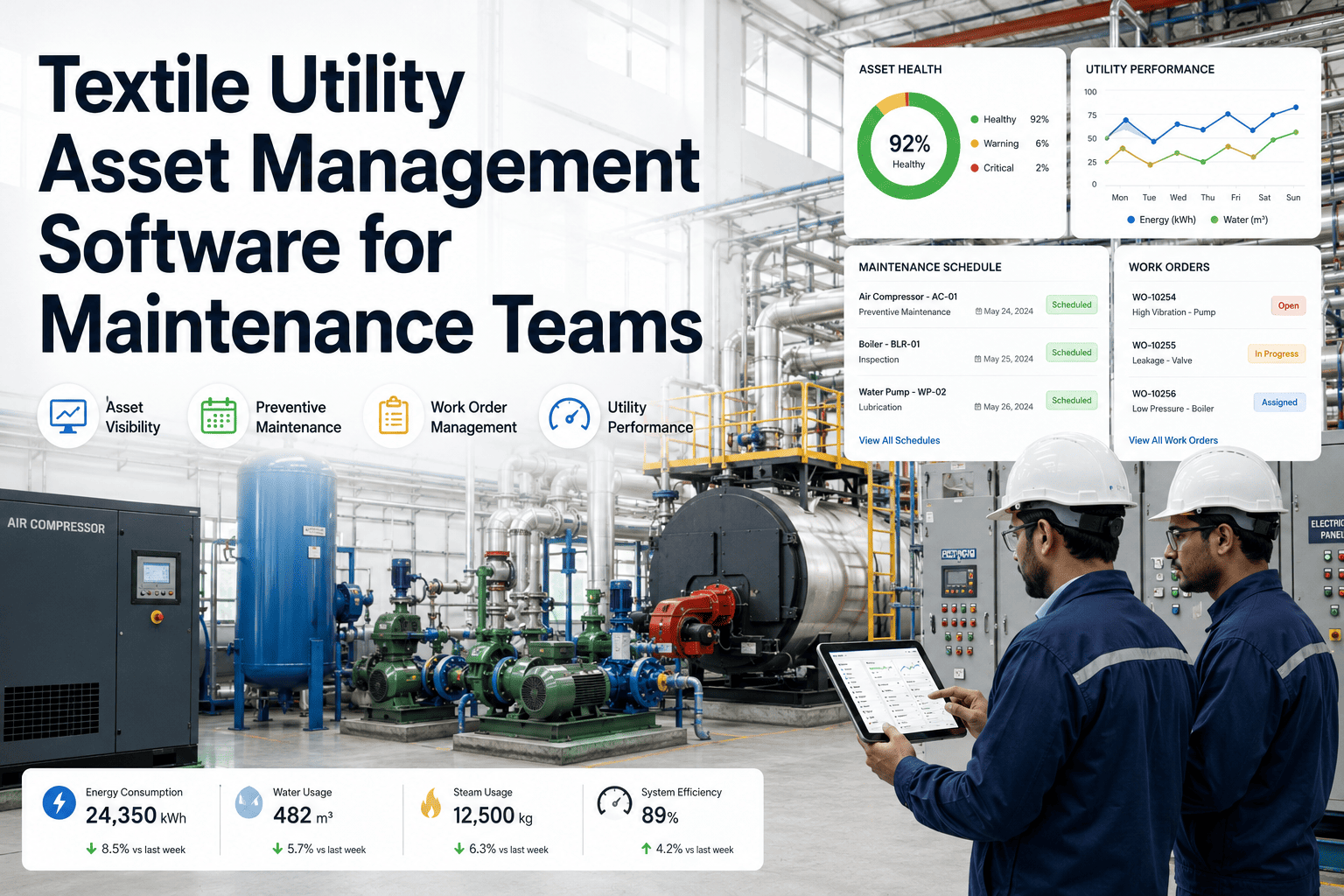
Compressed air powers air-jet looms, pneumatic controls, and cleaning systems. Air leaks, compressor valve wear, dryer desiccant depletion, and condensate drain failure are common. AI monitoring of pressure differential, kW draw, and dew point detects developing failures 2–3 weeks in advance, preventing production quality defects.
Leaks: 20–40% of Total AirMaterial Handling & Conveyors
Automated guided vehicles, conveyor systems, and bale handling equipment move material between process stages. Bearing failure, belt tracking issues, sensor misalignment, and drive coupling wear are common. Downtime in material handling creates starvation or blockage cascading across multiple production areas.
Cascading Impact RiskStop unplanned downtime before it reaches the production floor. iFactory's AI CMMS platform monitors every critical asset in your textile mill with predictive failure detection and automated work order dispatch.
AI CMMS Features Comparison for Textile Mills
Not all CMMS platforms are designed for the specific demands of textile manufacturing. The following comparison evaluates must-have AI CMMS features against traditional CMMS capabilities for textile mill applications.
| Feature | Traditional CMMS | AI CMMS (iFactory) | Textile Mill Benefit |
|---|---|---|---|
| Work Order Generation | Manual entry required | Auto-generated from sensor thresholds | Eliminates 80% of manual WO creation |
| Failure Prediction | Calendar-based only | ML models trained on machine data | 4–6 week advance warning vs. reactive |
| Vibration Analytics | Standalone system, manual upload | Integrated, real-time, with AI pattern recognition | Bearing failure detection before audible |
| Energy Monitoring | Separate dashboard | Unified with asset condition data | kW deviation = developing mechanical fault |
| Spare Parts Management | Basic inventory tracking | AI demand forecasting, auto-reorder | 90%+ critical spare availability |
| OSHA Compliance | Manual log maintenance | Auto-documented with audit trail | Pass audits with complete records |
| Mobile Access | Limited functionality | Full mobile CMMS with offline mode | Technicians document from the machine |
| Integration | Minimal API support | PLC/SCADA/IoT sensor integration | Real-time machine data drives CMMS |
| Reporting | Static PDF reports | Real-time dashboards, automated KPI alerts | OEE tracking, downtime analysis |
ROI of AI CMMS in Textile Mills
The return on investment for AI-powered CMMS in textile mills is driven by four primary value drivers: reduced unplanned downtime, extended equipment life, optimized spare parts inventory, and improved labour productivity. The following analysis models typical ROI for a mid-size textile mill.
Downtime Reduction
AI predictive maintenance reduces unplanned downtime from 12–15% to 6–8% of available production time, recovering 400–600 hours of annual production per mill. At $5,000–$15,000 per hour, this represents $2M–$9M in recovered production value annually.
Primary Value DriverMaintenance Cost Reduction
Transitioning from reactive to predictive maintenance reduces overall maintenance spend by 30–50% through eliminated emergency repairs, reduced overtime labour, optimized PM schedules, and extended spare parts life. Typical annual savings: $250K–$800K for a mid-size mill.
Direct SavingsEquipment Life Extension
AI-driven condition monitoring and optimized maintenance schedules extend critical equipment service life by 20–30%. Ring frame spindle life, carding wire life, and loom component life all improve through predictive interventions rather than run-to-failure.
Capital AvoidanceLabour Productivity Gain
Automated work order generation, optimized technician routing, and mobile-first documentation reduce non-value-added maintenance time by 15–25%. Maintenance technicians spend more time on actual repairs and less on paperwork, travel, and parts hunting.
Efficiency GainOSHA Compliance Documentation for Textile Mills
Textile mills face unique OSHA compliance requirements covering combustible dust (lint), machine guarding, lockout/tagout, and noise exposure. An AI CMMS automates compliance documentation and provides auditable records for every regulatory requirement.
| OSHA Requirement | Textile Mill Application | CMMS Documentation | Audit Frequency |
|---|---|---|---|
| Combustible Dust (29 CFR 1910.22) | Lint accumulation in HVAC, motor enclosures, overhead structures | Housekeeping inspection schedule with photo verification | Weekly |
| Machine Guarding (29 CFR 1910.212) | Ring frame, carding, calendering nip points | Guard integrity checklists with pass/fail documentation | Monthly |
| Lockout/Tagout (29 CFR 1910.147) | All equipment with energy sources during maintenance | LOTO procedure verification, periodic inspection records | Annually |
| Noise Exposure (29 CFR 1910.95) | Looms, spinning frames, compressed air | Noise monitoring schedule, hearing conservation documentation | Annually |
| Confined Space (29 CFR 1910.146) | Dye becks, storage tanks, ductwork | Permit-required confined space entry logs | Per entry |
| Electrical Safety (NFPA 70E) | Motor control centres, panel boards, variable frequency drives | Arc flash labelling verification, PPE inspection records | Annually |
From predictive ring frame maintenance to OSHA-compliant lint inspection documentation — iFactory digitizes every textile mill maintenance and compliance workflow.
Implementation Roadmap for Textile Mill CMMS
Successful AI CMMS implementation in textile mills follows a phased approach that minimizes production disruption while building toward full predictive maintenance capability. The typical implementation timeline is 12–16 weeks from kickoff to go-live.
Asset Hierarchy & Data Foundation
Build complete asset register with equipment hierarchy, criticality ratings (A/B/C), and baseline condition data. Integrate existing PLC and SCADA data sources. Establish naming conventions and metadata standards for all mill equipment. Typical duration: 3–4 weeks.
Weeks 1–4Sensor Deployment & Connectivity
Deploy IoT vibration, temperature, and current sensors on A-critical assets (ring frames, carding, looms, compressors). Configure PLC data stream integration for existing instrumentation. Set up wireless mesh network for sensor communication. Typical duration: 4–6 weeks.
Weeks 4–8AI Model Training & Calibration
Train AI failure prediction models on 4–8 weeks of baseline data. Establish normal operating parameters and deviation thresholds for each asset. Calibrate predictive models against known failure modes from mill maintenance history. Typical duration: 4–6 weeks.
Weeks 8–12Go-Live & Continuous Optimization
Deploy to maintenance team with mobile access, automated work order workflow, and real-time dashboards. Conduct 2-week hypercare period with on-site support. Measure and report baseline KPIs against pre-implementation benchmarks. Ongoing model retraining. Typical duration: 4+ weeks.
Weeks 12–16+Frequently Asked Questions
What is the difference between AI CMMS and traditional CMMS for textile mills?
Traditional CMMS is a digital record-keeping system — it logs work orders, tracks PM schedules, and stores maintenance history, but it relies entirely on human input for data entry and decision-making. AI CMMS adds a layer of machine learning that continuously analyzes equipment sensor data (vibration, temperature, current draw, pressure) to predict failures before they occur. In a textile mill context, a traditional CMMS sends a reminder that a ring frame is due for bearing lubrication every 3 months. An AI CMMS monitors that ring frame's vibration signature in real time, detects a 12% increase in high-frequency vibration indicating bearing raceway degradation, automatically generates a work order for bearing replacement, and recommends the optimal replacement window based on production schedule — typically 4–6 weeks before the bearing would fail catastrophically.
How does AI CMMS handle the high-humidity, lint-heavy environment of textile mills?
AI CMMS platforms designed for textile applications use sensor calibration profiles specific to high-humidity, lint-laden environments. Vibration sensors are specified with IP65+ enclosures to prevent lint infiltration and moisture damage. The AI models are trained to distinguish between normal lint accumulation patterns (which cause gradual, predictable signal changes) and developing mechanical faults (which cause abrupt or accelerating signal changes). Temperature monitoring accounts for ambient mill temperature and humidity variations when calculating equipment temperature rise above ambient. Current monitoring detects the increased motor load caused by lint-clogged filters or ducts, triggering cleaning work orders before overheating occurs. iFactory's CMMS platform includes textile-specific sensor profiles and AI training data from 200+ textile mill deployments.
How long does it take to implement AI CMMS in a textile mill?
A complete AI CMMS implementation for a textile mill typically takes 12–16 weeks from kickoff to full go-live. Phase 1 (weeks 1–4) focuses on asset hierarchy creation, data standardisation, and existing system integration. Phase 2 (weeks 4–8) covers sensor deployment on A-critical assets and network connectivity. Phase 3 (weeks 8–12) is AI model training and calibration — the system learns normal operating parameters and establishes failure prediction baselines. Phase 4 (weeks 12–16+) is go-live with mobile deployment, technician training, and hypercare support. Predictive maintenance alerts typically begin 2–3 weeks after Phase 3 starts, once the AI models have established baseline signatures. Full predictive coverage for all monitored assets is achieved within 8–10 weeks of sensor deployment.
Can AI CMMS integrate with existing textile mill PLC and SCADA systems?
Yes. iFactory's AI CMMS platform is designed to integrate with major PLC platforms (Siemens, Allen-Bradley, Mitsubishi, Schneider Electric) and SCADA systems (Wonderware, Ignition, WinCC, RSView) through standard industrial protocols including OPC-UA, Modbus TCP, Profinet, and MQTT. The integration reads real-time equipment data — motor current, temperature, pressure, speed, production counts — and feeds it into the AI prediction engine. The CMMS can also write control parameters (e.g., adjust PM schedule based on actual run hours, or trigger alarm setpoint changes based on condition data). For mills without existing automation, iFactory provides wireless IoT sensor kits with cellular backhaul that can be deployed on any equipment within 2 hours per machine, with no wiring or plant network changes required.
What maintenance KPIs should textile mills track with AI CMMS?
Essential textile mill maintenance KPIs include: Overall Equipment Effectiveness (OEE) by machine type (ring frame, carding, loom, winding), Mean Time Between Failure (MTBF) trending by asset class, Mean Time To Repair (MTTR) by maintenance crew shift, Planned vs. Emergency Work Order ratio (target: 80%+ planned), Schedule Compliance (percentage of PMs completed on time), Downtime by Cause Category (mechanical, electrical, operational, material), Spare Parts Stockout Rate (target: below 3%), and Maintenance Cost per Production Unit ($/lb or $/yard). AI CMMS platforms automatically calculate these KPIs in real time and provide trend visualization with automated alerting when KPIs exceed target thresholds. iFactory's CMMS includes pre-built textile mill KPI dashboards with industry benchmark comparison data.
How does AI CMMS help textile mills prepare for and pass OSHA audits?
AI CMMS platforms automate OSHA compliance documentation in several ways. Combustible dust (lint) inspection schedules are auto-generated with digital checklists that require photo verification of lint accumulation in all critical areas — completed inspections are time-stamped and stored with tamper-proof audit trails. Machine guarding inspections are scheduled by frequency (monthly for ring frames, quarterly for support equipment) with pass/fail criteria and auto-escalation of failed inspections to the maintenance supervisor. LOTO procedure verification is documented with electronic sign-off, and periodic inspections are auto-scheduled with reminder notifications. All compliance documentation is stored in a central, searchable repository that can be exported for auditor review within minutes. iFactory's platform includes pre-built OSHA compliance templates specific to textile mill operations, reducing audit preparation time by 80%.
Ready to transform your textile mill maintenance with AI-powered predictive analytics? Book an iFactory walkthrough to see how AI CMMS delivers 45% downtime reduction and full OSHA compliance documentation.